AMENIA — The first lighting of the two evergreens outside Amenia Town Hall occurred shortly after sundown on Saturday, Dec. 17.Townspeople and members of the town government gathered outside Town Hall to sing carols and eat holiday treats before the 6,600 lights were lit during a special ceremony.The two trees were originally planted in the early 1990s in honor of Krista Proper, 8, and Melissa Proper, 6, two local girls who died in a tragic car accident on Bog Hollow Road in 1990.Several members of the Proper family attended the ceremony. The girls’ parents currently live in Florida and were unable to attend.The girls’ uncle, Steven Proper, said his nieces were greatly loved by their family and their friends. “They will always be loved and remembered,” he said.He and his brother, Ron Proper, had the honor of lighting the trees for the first time.Town Supervisor Wayne Euvrard was the one who first came up with the idea to light the two trees. He said that he was originally unaware of the history and the significance of the evergreens, but that it was “heartwarming” to see the outpouring of donations from the community and the local businesses.In all, 55 area residents and businesses made donations to purchase the lights and finance the event. Local businesses also donated their time and services, which included installing the electricity at the base of the trees and putting on the strings of lights.Fundraiser Kevin Cassone said that he believes this fundraising initiative was one of the biggest ones ever done in the town, outside of those held by the local fire company.Cassone said the donations were enough to purchase several thousand LED lights, which use only 1,000 watts of electricity as opposed to the 16,000 watts of traditional holiday light strands. He said enough LED lights were purchased to continue covering the trees as they grow over the next decades.
Latest News
BD marks 65 years of manufacturing in North Canaan
Debra A. Aleksinas
The BD Canaan facility opened in 1961 with eight employees working in a 25,000-square-foot building and producing approximately 10 million syringes annually.
“For 65 years, generations of employees have continued to improve how we manufacture while delivering the quality and precision clinicians count on.”
—Eric Borin, worldwide president of Medication Delivery Solutions at BD
NORTH CANAAN — Since 1961, a familiar manufacturer in town has been quietly producing a medical device that has become indispensable to healthcare around the world.
BD (Becton, Dickinson and Company) marked the 65th anniversary of its North Canaan manufacturing facility Oct. 6, celebrating generations of local employees, the evolution of the site and its continuing role in producing the company’s widely used BD syringe.
The anniversary celebration also included a $10,000 grant to the Community Health and Wellness Center (CHWC) in North Canaan, bringing BD’s financial support for the Federally Qualified Health Center since 2024 to $90,000.
CHWC CEO Joanne Borduas said the donation will help the organization’s health centers in Torrington, Winsted and North Canaan provide care to residents regardless of insurance status.
“We are deeply grateful for BD’s generous donation of $10,000,” Borduas said. “This contribution will go a long way in helping us to support our patients and local families as we carry out our mission of keeping our community well through providing access to quality health care regardless of insurance status.”
Several state and local lawmakers participated in the celebration, including state Rep. Maria Horn (D-64) and state Sen. Stephen Harding (R-30), who presented BD officials with an official citation from the General Assembly.
“BD has been an important part of northwestern Connecticut for 65 years, providing local jobs while manufacturing a product that supports patient care around the world,” the pair said in a joint statement.
Humble beginnings on Grace Way
The BD Canaan facility, located on Grace Way, opened in 1961 with eight employees working in a 25,000-square-foot building and producing approximately 10 million syringes annually.
Today, more than 500 employees work at the 385,000-square-foot facility, which produces more than 2 billion syringes a year.
More than 50 current BD employees at the Canaan site have worked for the company for at least 25 years, including 10 who have reached 40 years or more of service.
“The BD Syringe was invented here in Canaan as a breakthrough in patient safety and has become an essential part of care around the world, touching 80 patients every second,” said Eric Borin, worldwide president of Medication Delivery Solutions at BD.
“For 65 years, generations of employees have continued to improve how we manufacture while delivering the quality and precision clinicians count on,” Borin said. “This milestone is a testament to their dedication and the difference their work makes for patients every day.”

More than $34 million invested in North Canaan site
The history of the North Canaan operation is closely tied to the development of the disposable plastic syringe.
The BD syringe was developed at the North Canaan facility as the medical industry moved away from reusable glass syringes. The change helped reduce the risk of disease transmission between patients and eventually made the disposable syringe a standard tool in medical care.
Over the decades, syringes manufactured in North Canaan have been part of major public health efforts, including smallpox eradication, H1N1 vaccination programs and the COVID-19 response.
“Connecticut has a proud history of turning innovation into products that improve people’s lives, and BD’s Canaan facility is a powerful example,” Gov. Ned Lamont said in a statement.
BD has invested more than $34 million in the North Canaan facility during the past five years, including three new syringe manufacturing lines and equipment upgrades designed to expand production capacity and modernize operations.
The investment comes as the company continues to emphasize domestic manufacturing and the importance of maintaining a reliable supply of medical products.
The North Canaan-made syringe has also earned recognition closer to home. It was the first product from the Northwest Corner selected for the Connecticut Business & Industry Association’s “Coolest Thing Made in Connecticut” competition.
CBIA representatives, including Chris DiPentima, the organization’s president and CEO, also attended the North Canaan festivities.
BD’s generosity, noted Borduas, “highlights the powerful impact that community-minded partners can make and we are very grateful for their support.”
Salisbury celebrates 69th Fall Festival
Patrick L. Sullivan
Children enjoy a hayride during Salisbury’s 69th Fall Festival Saturday, Oct. 10, as beautiful weather drew crowds downtown for activities, book sales and live entertainment.
SALISBURY — Beautiful weather drew crowds to downtown Salisbury on Saturday, Oct. 10, as the town celebrated its 69th Fall Festival, a three-day event held Friday through Sunday, Oct. 9–11.
Cars were parked on both sides of Route 44 west of the Scoville Memorial Library, well past the junction with Salmon Kill Road.
The library lawn was crowded with children decorating pumpkins and receiving temporary henna tattoos.
Inside and behind the library, book lovers browsed the Friends of the Scoville Library book sale. This year, the Friends added a tent behind the library for more display space.
Across Library Street, by the Congregational Church, magician Peter James wowed the crowd with illusions, including the “Chop-A-Lot,” which magically sliced carrots but not fingers.
Inside the church was the annual quilt show in the worship space and a massive tag sale in the community room at the rear.
A highly arbitrary sample of items for sale: a fondue pot, an air purifier, assorted fabrics, baked goods of every description and a set of wooden salad bowls.
The quilts had also provided a backdrop Friday at noon for the church’s regular monthly musical performance. Solo cellist Jakob Nordlinger played an all-Bach program, surrounded by quilts hanging over the pews and from the railings.
Moving along Main Street, the church’s hot dog tent was doing brisk business, enlivened by stalwart parishioner Barbara Wiggins in a hot dog costume.
Next door, the Lakeville Hose Company Ladies Auxiliary tent was equally busy dishing out “comfort food,” mainly variations on chili and macaroni and cheese.
Next to St. John’s Episcopal Church, Will Trowbridge of Sharon provided visitors with an ongoing blacksmithing demonstration.
Someone asked if he was using coal.
“Yes, that’s coal,” said Trowbridge. “And you see where it’s fluffy? That’s coke.”
Coke, a fuel formed as coal heats, burns hot enough to heat iron for shaping.
The visitor asked whether the coke could be used to fuel the forge.
“Oh my yes,” replied Trowbridge, lifting a red-hot piece of iron out of the fire.
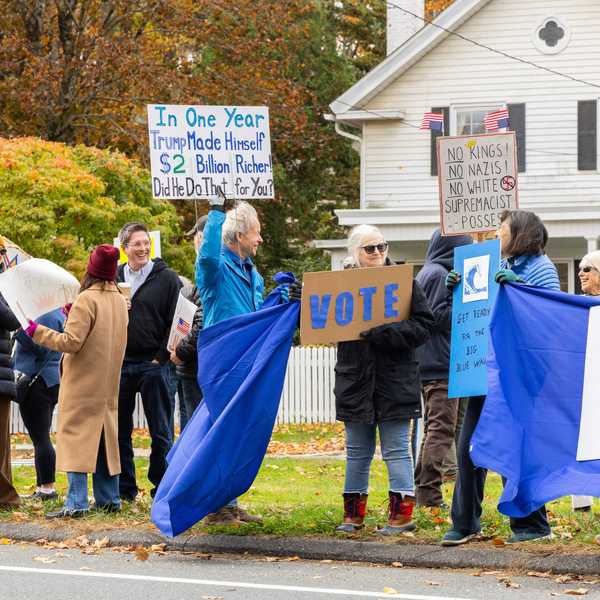
At the town green at the intersection of Undermountain Road and Main Street, protesters were holding a “No Kings” demonstration.
Nearby, the musical group The Joint Chiefs was setting up.
On the White Hart lawn, Salisbury Handmade artisans offered goods ranging from woolen shawls to ceramics and leather goods.
People sat at tables on the lawn enjoying lunch and the fine weather.
As the clock approached 2 p.m., Darcy Boynton and Amber Cameron of Blue Studio Dance politely asked diners to move their tables back a bit from the White Hart porch so a dance program could begin.
Everybody was agreeable, and most stuck around for the show.
Sunday dawned chilly and wet, forcing the cancellation of the Pet Parade in Lakeville.
But the Salisbury Winter Sports Association’s Brew Ski event at Satre Hill went ahead.
Attendees sampled beers and ales, including “Roadsmary’s Baby,” described by the brewer, Two Roads of Stratford, as a “rum barrel-aged pumpkin ale.”
Ethan Gee of Salisbury shook his head when told about the pumpkin ale.
“No. Pumpkin pie at Thanksgiving. That’s it.”
With the unpleasant weather, Main Street was largely deserted Sunday afternoon, but the Friends of the Scoville Library book sale was still going strong.
Lisa White of the Friends said sales were on track to beat the previous record set in 2024. The proceeds support library programming.
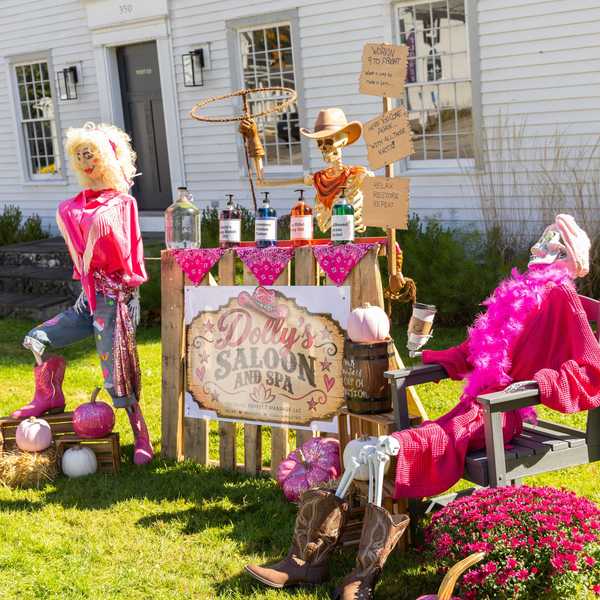
All weekend, everywhere one looked in Salisbury and Lakeville, there were scarecrows.
Some elaborate, some simple, some bearing messages, some just for fun. The winners of the scarecrow contest were announced on Monday.
Survey backs keeping local elementary schools
Ruth Epstein
FALLS VILLAGE — Respondents to Region One’s organizational study survey strongly favor keeping elementary schools in their communities but are closely divided over establishing a seventh- and eighth-grade program at Housatonic Valley Regional High School.
Among the 592 people who answered those questions, 77% preferred retaining an elementary school in their town, regardless of its grade configuration. A proposed middle school program at HVRHS drew support from 54%, while 46% opposed it.
The survey, which was open from Aug. 16 through Sept. 23, drew 860 participants, with 572 completing the questionnaire in its entirety. Participation varied by question, and respondents included people who live outside the region.
Region One Superintendent Melony Brady-Shanley said she was pleased with the participation and the thought people put into sharing their opinions.
She said the answers reflected a “good balance,” adding that these are issues that need to be talked about.
The study began last spring to evaluate the region’s K–8 structure amid declining enrollment in several smaller schools and rising operational costs. Brady-Shanley and Business Manager Sam Herrick are leading the work.
The study will examine demographic trends, enrollment patterns and operational capacity to identify ways to improve educational opportunities, ensure equity and maintain financial sustainability. It will also consider the history and traditions of local schools, providing information to help each local board of education and community make decisions about its school.
Of the 790 participants who answered the residency question, 142 were from North Canaan; 136 from Salisbury; 111 from Canaan/Falls Village; 108 from Sharon; 91 from Cornwall; and 79 from Kent. Another 123 lived outside the region.
Parents or guardians of current Region One students were the largest group participating, accounting for 342, or 43%, of the 794 people who identified their primary perspective. Region One employees were the next largest group, with 126 responses.
The questionnaire covered community and school identity, educational opportunities and services, classroom size, governance and resource sharing.
Keeping a local elementary school was a clear priority, but respondents also showed openness to considering structural changes. Asked about a future organizational design that could improve educational opportunities, sustainability and financial efficiency, 55% said they were very or extremely open to considering changes. Another 27% were moderately open.
The survey found particularly strong support for universal pre-kindergarten, with 85% favoring a program free of charge to families.
Classroom size was another area of agreement. Some 82% preferred a balanced class size that provides enough peers for social-emotional growth, diverse perspectives and group collaboration. Eighteen percent said smaller classrooms are always better, regardless of how few students are in the room. Eleven to 18 students was the most frequently selected first choice for optimal classroom size.
Respondents also supported cooperation across schools. Seventy-three percent rated sharing resources or services as very or extremely important when it improves efficiency without reducing educational quality.
Maintaining a voice for each town remained a priority: 83% said representation from each Region One community in educational decision-making was very or extremely important.
Educational quality ranked first among priorities for long-term sustainability. When asked to balance educational opportunities and local tax impact, 40% said educational opportunities should take priority even if costs increase. Another 34% said the two should receive equal consideration, while 22% prioritized financial efficiency when educational quality could be maintained. Just 4% made limiting tax increases the primary consideration.
Written comments reflected differing views about how to achieve those goals.
“I would like the Region One schools to remain the same for the next generation of students,” wrote one respondent who identified as a Region One graduate and current employee. “I like the distinction of each school and how each community possesses its own identity.”
Another respondent favored bringing older students together.
“I think that merging middle school students from different Region One towns makes a lot of sense in order to provide social and educational enrichment for middle school students to prepare them for high school.”
Others supported regional cooperation while retaining local elementary schools.
“A school is greater than the sum of its parts,” one respondent wrote. “It is a community hub, a place where kids and parents are connected to each other across the community.”
Another proposed a unified pre-K–12 learning community with shared leadership, curriculum, staffing, student services, technology, transportation, purchasing and long-range facilities planning.
One respondent argued that combining schools would benefit students in very small classes.
“Combining schools (pairs, regionally, etc.) provides better educational opportunities for the children and communities than having classrooms that are empty and grades with only 1-2 students per class.”
Others strongly opposed changing the existing structure.
“We have gone down this path several times before. Please leave our schools alone…The system works!” one respondent wrote.
The survey results describe the preferences of participants rather than all residents, and the combined report does not show how views on individual proposals differ by town.
Virtual forums scheduled for Oct. 20–22 will present regional and town-specific survey results and provide time for questions and feedback.
The Canaan/Falls Village forum will be held Tuesday, Oct. 20, from 6 to 7 p.m., followed by Cornwall from 7:15 to 8:15 p.m.
Kent’s forum will be Wednesday, Oct. 21, from 6 to 7 p.m., followed by North Canaan from 7:15 to 8:15 p.m.
Salisbury’s forum will be Thursday, Oct. 22, from 6 to 7 p.m., followed by Sharon from 7:15 to 8:15 p.m.
Google Meet and telephone access information is available in the forum notice on the Region One website.

Want more of our stories on Google? Click here to make us a Preferred Source.
Lakeville Journal celebrates 5th anniversary as nonprofit, honors community leader Dick Hermans
Patrick Stachniak
From left, Board Chair Dan Dwyer, Publisher and CEO James Clark, Estabrook Community Leadership Award recipient Dick Hermans, his daughter Suzanna Hermans and Jubilee co-chair Joan Osofsky at the annual gala Oct. 11.
The Lakeville Journal and The Millerton News, published by the nonprofit organization LJMN Media, held their annual Jubilee gala at the Sharon Playhouse Sunday, Oct. 11, to celebrate five years of nonprofit ownership and honor Dick Hermans with the Estabrook Community Leadership Award.
About 200 attendees, including contributors, board members and staff, gathered in the Bok Gallery at the Sharon Playhouse at 49 Amenia Road to enjoy food and a live performance by The Joint Chiefs and pay tribute to Hermans.
In an address to supporters, Publisher and CEO James Clark said the papers’ survival had been uncertain five years ago, before the transition to nonprofit ownership. Clark thanked attendees, board members and others in the community whose grassroots support enabled that transition.
“You demonstrated that The Lakeville Journal and The Millerton News are essential community assets worth supporting. That support has allowed us to do much more than sustain two newspapers,” Clark said. “We’ve strengthened our newsroom, expanded our reporting, and invested in the people and resources needed to cover our communities more thoroughly.”
Brian Ross, the board vice chair, also addressed the gathering.
The Estabrook award, named for the publications’ former owners, Mary Lou and Robert Estabrook, recognizes outstanding work in the community. Clark praised Hermans’ “longstanding commitment to this region,” saying he “made a lasting difference” as the owner of Oblong Books and as a community activist.
Dan Dwyer, board chairman, connected that commitment to the support of those in attendance, crediting them with helping keep the newspapers going despite widespread closures across the industry.
“Newspapers across the country, thousands of them, have closed in the last 30 years. Similarly, bookstores around the country have too,” Dwyer said.
He pointed to Hermans and the Estabrooks as examples of the community commitment that helps such institutions endure.
“It’s because the Estabrooks established the pivotal role of the newspaper in this community. And Dick Hermans, through his business and his public service, has identified community service as the role that a citizen needs to play.”
For Dwyer, Hermans’ work embodied the practice of good citizenship.
“A bookshop is not just a place where you sell books.It’s where people come… it’s a place where ideas are exchanged,” Dwyer said. “If you want to talk about good old-fashioned civics… this is the guy who’s practiced it for his whole life.”Hermans’ daughter, Suzanna Hermans, and Dwyer presented him with the award. In his remarks, he reflected on his business, his work establishing the Harlem Valley Rail Trail and his upbringing in the area.
“The store has succeeded beyond my wildest dreams and the Rail Trail is more beautiful than anybody could expect from an old railroad line,” said Hermans, who was “instrumental” in its establishment.
Hermans also reflected on his own experience in journalism, starting as a college radio host for the now NPR-affiliated WJHU in Baltimore. Hermans also co-founded the New Pine Plains Herald, a non-profit community newspaper.
“Accurate information and good news about things our neighbors are doing is a key to maintaining a cohesive community,” he said. “By being here, you’re part of The Lakeville Journal/Millerton News community. It is so important that we keep our communities sane.”

Lakeville vigil remembers domestic violence victims, calls for change
Patrick L. Sullivan
Virginia Gold of Project SAGE speaks at the Oct. 8 vigil.
LAKEVILLE — The names of 23 Connecticut residents, ages 1 to 83, killed in relationship violence in the past year were read aloud during Project SAGE’s candlelight vigil Thursday evening, Oct. 8.
After each name, the speaker said, “We speak their name,” and the crowd responded, “We remember their name.”
About 60 people gathered for the vigil, which honored those killed in the past year and called for change in the attitudes and behaviors that enable abuse.
Virginia Gold, Project SAGE’s director of client services, spoke about Carrie Stetson, who was killed in Winsted in June by her estranged husband. Stetson ran the Railroad Cafe at Geer Village in North Canaan and in Winsted.
“Carrie did everything right,” Gold said. “It wasn’t enough.”
Stetson’s husband, Leon Stetson, was arrested and charged with murder, home invasion and violation of a protective order. He remains in jail, with his next court date scheduled for Oct. 27.
“No single action is enough,” Gold told the gathering. “Change doesn’t work that way.”
While organizations such as Project SAGE provide practical help to victims of relationship violence, Gold said, their broader mission is to change conventional attitudes about power and control. Events such as the vigil contribute to that work incrementally.

The evening began at Cannon Park, at the intersection of Main Street and Sharon Road, where participants received small packets of red sand.
Artist Kristen Pratt of the Red Sand Project explained that the participatory art project raises awareness of people who fall through the cracks, including those affected by relationship violence and human trafficking.
She led participants in pouring the bright red sand into cracks in the sidewalk.
“It illuminates something we often overlook,” Pratt said.
She reinforced the message by writing “No One Should Fall Between the Cracks” in chalk on the sidewalk.
Participants then walked to Project SAGE’s headquarters at 13A Porter St. The Lakeville nonprofit supports victims and survivors and works to end interpersonal relationship violence.
Executive Director Kristen Van Ginhoven said Project SAGE holds the vigil each October alongside similar organizations nationwide. She described the emotional demands of the work as holding “joy and grief, side by side.”
Gold thanked attendees for being “a witness to the power of community and hope.”
Project SAGE board chair Tom Connell closed with a message about the importance of their participation.
“Your presence here is the sound of hope,” he said. “It’s a reminder of what it means to show up and work for change.”
Berkshire Country Store to close as new Norfolk market planned
Debra A. Aleksinas
Ryan Craig, owner of the Berkshire Country Store in Norfolk, is preparing to close the business at the end of October after nearly a decade in town. Craig said he is proud of the jobs he created and the relationships he built while serving the community.
NORFOLK — After nearly 10 years serving the community, the Berkshire Country Store will close at the end of October, ending an effort by owner Ryan Craig to sustain an independent grocery and deli in a small town where rising costs and seasonal business have made it increasingly difficult to stay afloat.
Craig, 42, announced on Facebook that the store, located at 6 Station Place, will close Oct. 31, though he said in an Oct. 9 interview with The Lakeville Journal that it may shut earlier if supplies run out. He is limiting new orders to avoid being left with perishable deli meats and other unsold inventory.
“It depends on how it goes,” Craig said. “If we run short for some reason, we may need to close sooner.”
The decision comes as another food market, Alfredo Taylor’s Food & Grocery, is planned for the historic Royal Arcanum building across Station Place. Craig said the prospect of two grocery businesses operating in a town of roughly 1,700 people adds to the uncertainty.
The proposed market is being developed by American Folk & Heritage, a partnership Craig believes has greater financial resources.
But competition is only one part of the equation. Craig described a business squeezed by rising food and transportation costs, higher minimum wage requirements, a shrinking workforce and the sharp seasonal downturn that accompanies Norfolk’s long, cold winters.
“I am not going out of business. I’m making a strategic exit,” he said.
Little room for error
Craig said the store lost $30,000 last year despite efforts to control expenses during the slow season.
Customer traffic drops during winter, even as the costs of keeping the doors open remain.
“We need to greet everyone with a smile and take care of their basic needs all the while not even making our basic expenses,” he said.
The arrival of spring brings renewed business, but the recovery is not guaranteed. The store might finally begin to make up lost ground — only to face an equipment breakdown or another unexpected expense.
“It’s like constantly kicking cans down the road.”
Working nonstop
Craig said the store began with four employees but now operates with two.
“We’re doing more with less,” he said. “It stretches people thin.”
Finding and retaining experienced workers has proved difficult. When an employee calls out sick or gives notice, Craig often has to step in himself.
“There’s never a day off for me,” he said. “That’s starting to weigh on me.”
Married and the father of two children, including a 15-month-old, Craig said he needs a more dependable source of income and a more sustainable work schedule.
He also runs a consulting business and works with National Iron Bank. He plans to begin a new job Nov. 2 but declined to discuss the position until the arrangement is finalized.
A new chapter
For Craig, the closure ends a chapter that began in his teenage years, when the Goshen native took his first job at the original Berkshire Country Store on Route 4 in Cornwall.
After the store closed under previous ownership in 2012, Craig revived it as owner in 2014. He operated the Cornwall location until it closed in 2016, then opened the Norfolk store in 2017.
In 2021, amid the pandemic, he expanded to North Canaan, opening the Berkshire Country Café on Main Street. That separate business operated for 18 months.
Across those ventures, Craig estimates he has created dozens of jobs.
“I’ve met a lot of people who have become lifelong friends,” he said. Some customers attended his wedding and celebrated his child’s first birthday with his family.
Michael Selleck, president of The Norfolk Hub, which owns the space being vacated by the store, described Craig as an “excellent business partner” and called the store a “a hub of sorts for many in the community.”
The Hub, a private operating foundation and community space located next door, was saddened by the closure and is working closely with Craig on the transition, Selleck said. The organization is speaking with prospective tenants, but no replacement has been announced.
Craig said he had tried to sell the business for six months but drew little interest. His 10-year lease expires at year’s end.
“I am leaving with the shirt on my back after 10 years of putting my blood, sweat and tears into this business,” he said. “We are going to sell out our inventory, close up and leave with our heads held high.”

Want more of our stories on Google? Click here to make us a Preferred Source.