Hotchkiss lacrosse ices Kingswood Oxford 19-0

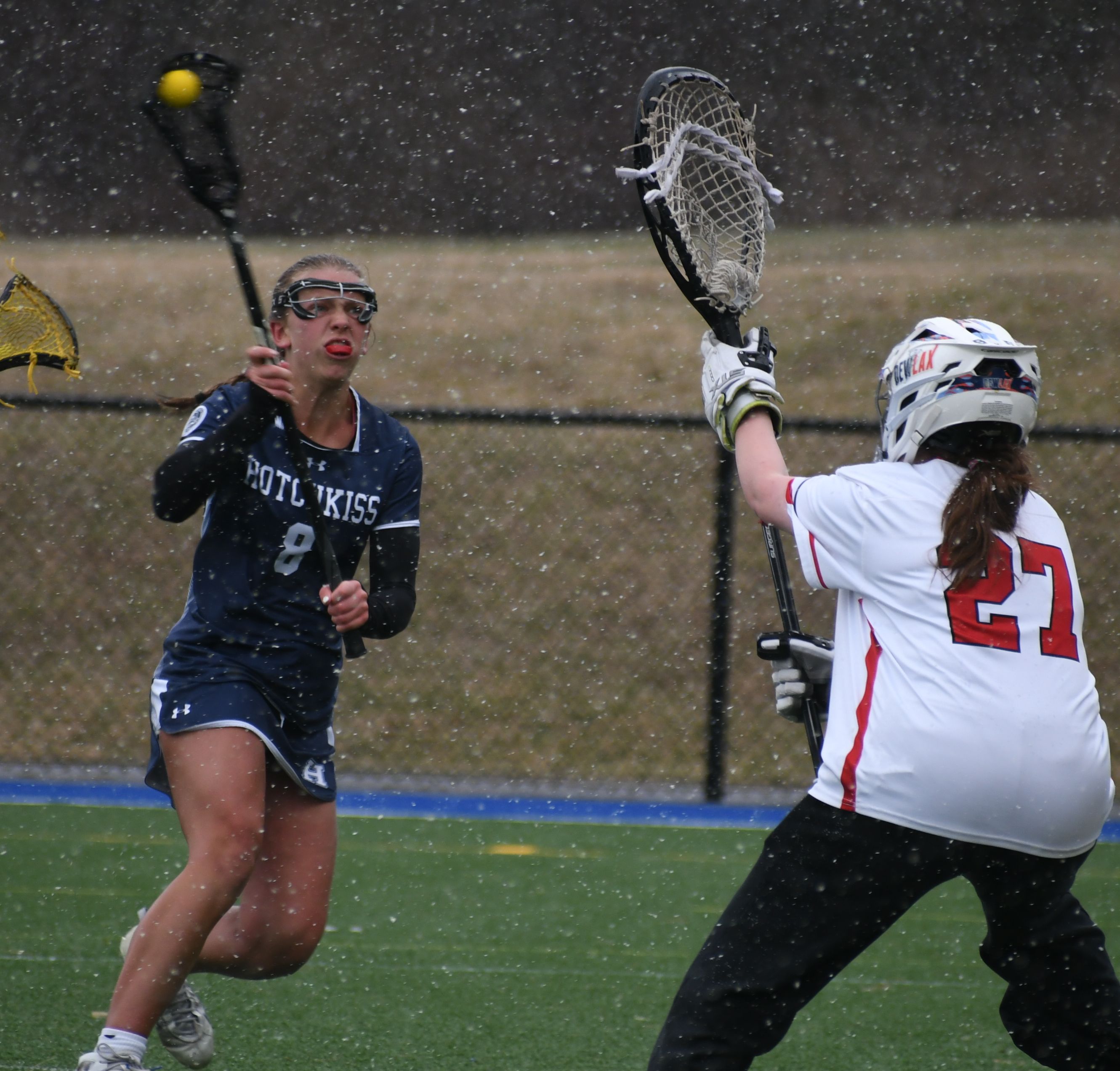
Lila Snow, No. 5 for Hotchkiss, sends a behind-the-back shot over the head of the Kingswood Oxford goalie amid a whirl of snow flurries March 26.
Photo by Riley Klein

Lila Snow, No. 5 for Hotchkiss, sends a behind-the-back shot over the head of the Kingswood Oxford goalie amid a whirl of snow flurries March 26.
LAKEVILLE — The Hotchkiss School opened the girls varsity lacrosse season with a big win in the snow against Kingswood Oxford School.
The Bearcats won 19-0 in a decisive performance March 26. Twelve different players scored for Hotchkiss, led by Coco Sheronas with four goals.

Kingswood Oxford is in the process of rebuilding its girls lacrosse program after some time without a team. The first game of the season gave the Kingswood coaches a chance to see their team play and rework position assignments.
At gametime, Downing Field became enshrouded in a veil of snow flurries. Players kept moving to stay warm with the temperature around 39 degrees.
The mercy rule kicked in during the second quarter when the lead entered double digits, causing a running clock to tick for the rest of the game.
In addition to four goals by Sheronas, MaryHelen Cooey and Charlotte Dorman scored three each and the following players scored once: Eleanor Helm, Lily Lavigne, Lilah Crispino, Kailyn Willa, Marygrace Lawry, Lila Snow, Harper Semlies, Allison Wick and Emma Ohler.
Hotchkiss will play the next two games on the road before hosting Canterbury School April 9 at 3 p.m.

Debra A. Aleksinas
Pockets of Poverty: A Northwest Corner Series
Poverty in the Northwest Corner doesn’t define an entire town. Instead, it exists in quieter pockets — apartments above storefronts, income-restricted housing and older homes where seniors and working residents struggle to keep pace with rising costs.
Pockets of Poverty is a series examining where financial hardship exists in Region One towns, what is driving it and how communities are responding.
Janet Lynn has lived her entire life in Lakeville.
At 84, the lifelong resident carefully plans her errands around trips outside the Northwest Corner — driving to Torrington, where groceries and gasoline cost less, and stretching each tank of gas long enough to refill it when she visits her daughter in Harwinton.
“People don’t understand,” Lynn said. “The prices here are geared to the rich.”
Like thousands of residents across Northwest Connecticut, Lynn falls into a category economists call ALICE — households that earn above the federal poverty line but still struggle to afford the basic cost of living.
ALICE — short for Asset Limited, Income Constrained, Employed — describes households whose incomes are too high to qualify for many public benefits but still too low to reliably cover necessities such as housing, food, transportation and health care.
Lynn was born at Sharon Hospital and has spent all her 84 years in the Lakeville section of Salisbury, on property once owned by her parents.
“But I’m struggling to stay here,” she said.
To stretch her limited budget, she regularly visits the local food pantry and carefully limits spending to essentials. Her daughter pays for her cell phone as part of a family plan.
Lynn’s experience reflects a broader reality across the region.
In the Northwest Hills Planning Region, which includes the Region One towns of Salisbury, Sharon, Kent, Cornwall, Falls Village and North Canaan, about 36% of households fell below the ALICE threshold in 2023, according to United Way data.
Statewide, about 40% of Connecticut households fell below the ALICE threshold, including 11% living in poverty and another 29% classified as ALICE.
In the Northwest Hills region, roughly one in four households — about 13,000 families — fall into the ALICE category, meaning they are above the poverty line but struggle to cover everyday expenses.
Rising housing costs have been a major factor driving the region’s affordability challenges. Median home prices in several Northwest Corner towns range from $700,000 to $1 million, fueled in part by second-home buyers and limited housing supply.
At the same time, rental options remain scarce, and rents have risen with property values, with monthly rentals reaching into the thousands of dollars.
Federal poverty statistics often fail to capture that reality.
The federal poverty line is about $15,000 for a single person, yet a single adult earning between $15,000 and $38,000 a year in northwest Connecticut falls below the ALICE budget threshold.
For a family of four, the federal poverty line is about $30,000, yet households earning between $30,000 and $116,000 in the region can still fall short of covering the region’s basic cost of living, according to ALICE measures.

A quiet lifeline in Lakeville
Across the Northwest Corner, residents facing financial strain often rely on support networks to make ends meet.
One of those lifelines is The Corner Food Pantry, located in a modest white building behind St. Mary Church in Lakeville.
The church leases the building to the pantry for a nominal $1 per year, said Holly Kempner, co-president of the nonprofit with Amanda Halle.
“We couldn’t run the pantry without their help.”
Support also comes from local businesses, volunteers and community partners. LaBonne’s Market in Salisbury helps supply fresh produce, and a massive container filled with dozens of eggs recently came from the nonprofit Tenmile Farm Foundation in Dover Plains, N.Y.
Referrals are also submitted electronically from local social service agencies, including from the town of Sharon, as well as Project SAGE, which is a nonprofit domestic violence agency serving Northwest Connecticut and nearby communities in New York and Massachusetts, Kempner explained.
Hardship is often hidden, Kempner said.
“It’s hard to know who is struggling and who isn’t. It’s not as obvious as in the city where you have a lot of hardcore stuff going on.”
On a recent Saturday morning, cars filled the church parking lot across Wells Hill Road and stretched up the driveway leading to the pantry a half hour before opening.
The vehicles reflected the income disparity in the Northwest Corner — luxury SUVs alongside aging sedans and well-worn jalopies.
Volunteers worked with practiced efficiency, unloading produce and filling grocery bags.
Among the volunteers was Jo Loi, 85, a retired educator who taught in Cornwall for three decades.
“This is really important,” Loi said as she unpacked frozen chicken and pork chops. “This is something I can really do at age 85.”
Working at the pantry has also made her reflect on how quickly circumstances can change.
“I was thinking, what would my husband and I do if we lost our home? Where would we go? We could no longer afford to live here.”
Loi worries that rising costs are gradually pushing longtime residents out.
“When people can’t afford to stay, you lose the fabric of the community,” she said. “You’re losing institutional memory.”

The social toll
Beyond financial strain, some residents say there is also a growing sense of isolation.
Lynn said the community she once knew has changed as longtime residents move away.
“I’ve lived here my whole life, and I don’t know anyone anymore,” she said. “You feel invisible.”
That sentiment was echoed by Sharon resident Linda Swenson, whose financial and social challenges became more apparent after the recent death of her husband.
Swenson was raised in Indiana before relocating to New York. She and her late husband, both graphic designers, eventually moved to Sharon to open a studio.
“One of the things I love about this area is that people accept others as you are and are very respectful of each other,” she said.
Still, she said social connections can be harder to maintain after becoming single.
“Couples have all kinds of options, but for a single woman, it can be difficult to feel connected.”
Swenson believes rural Northwest Corner towns could do more to help residents living alone build stronger social ties.
“That’s something this community can really work on,” she said.
Impacts on families and children
Lisa Ferris, executive director of the United Way of Northwest Connecticut, said the organization focuses heavily on supporting ALICE households.
“Many are working two or three jobs to cover basic living expenses and still have a hard time putting food on the table,” she said.
Ferris also worries that changes to federal SNAP regulations could make it harder for some residents to receive food assistance.
“People may have to prove they have a part-time job or show volunteer hours to qualify for benefits,” she said. “But we’re here to give them a leg up. We don’t want them to fall into poverty or homelessness.”
Health providers working with children say financial pressures on low-income families are also showing up in schools.
Rebecca Malone, a primary care provider with Community Health & Wellness Center in North Canaan, serves students through school-based health centers in the Region One School District, including Housatonic Valley Regional High School.
“Hunger is an across-the-board challenge for families in the Northwest Corner,” Malone said.
Food insecurity often remains hidden, she noted.
“People may have neighbors forced to choose between paying for health insurance, or filling their refrigerators, or paying rent,” Malone said.
Often, multiple families are living under one roof to make ends meet.
Limited budgets frequently push families toward cheaper foods with little nutritional value.
“Many kids are eating empty calories — junk food that lacks nutrition,” Malone said. “It’s not through a lack of caring. Parents are trying to feed an entire family with a very limited amount of money.”
In response, a food closet has been set up at the high school where hungry students can help themselves to healthy food and snacks.
Seasonal employment can make the situation worse.
“A lot of families work in seasonal jobs, landscaping and outdoor work,” Malone said. “Those jobs shut down for winter and people get laid off,” creating financial stress that can spill into the home.
“We can’t expect excellence from children until we fill their needs,” she said. “Without a safe and secure shelter, and food, nothing else matters.”
Ruth Epstein
Housatonic Valley Regional High School salutatorian Alexa Meach, left, and valedictorian Ibby Sadeh.
FALLS VILLAGE — The top-ranking students in the class of 2026 at Housatonic Valley Regional High School attribute a great deal of their success to the dedicated teachers they’ve had over the last four years.
Valedictorian Ibby Sadeh and salutatorian Alexa Meach emphasized during a recent interview the important role many of the educators played in helping them achieve scholastic honors.
“We had great teachers,” said Sadeh, 17. “They were very approachable.” Sadeh, of Falls Village, and the daughter of Jaimie and Shamu Sadeh, is an alum of Lee H. Kellogg School, graduating in a class of nine. “It was definitely a weird transition coming into a class of 85, but all the freshmen teachers were so nice.”
She also said surrounding yourself with like-minded students makes for a successful high school career. A self-starter, she has always strived for good grades. “I put pressure on myself. My parents didn’t push me.”
Meach, 18, daughter of Jennifer and Robert Meach of Canaan, agreed, saying, “All the people and teachers here helped a lot. You find people and settle in. You get out of it what you put into it.”
Both serve on the school’s Class Council and are members of Next Women. Sadeh is part of The Lakeville Journal high school journalism program that produces HVRHS Today, the newspaper that is created by the students with staff from The Lakeville Journal, and a member of the Housatonic Musical Theater Society, which is putting on “Guys and Dolls” this week. Meach, an animal lover, works at H.H.H. Canine Lodge & Ranch in East Canaan.
Sadeh said her favorite courses at Housatonic were history and humanities, but while she has not declared any major when she begins at Tufts University in the fall, she is leaning toward science. For Meach, language and composition, environmental science and AP literature were among her favorite classes. She plans to study political science at New York University.
“2016 sparked me,” she said. “I stay up on current events. People in my family have differing views. There are multiple opinions in our conversations.”
Teachers such as Letitia Garcia Tripp, Damon Osora and Lori Bucco stood out and the pair also noted that American history with Peter Vermilyea was memorable.
They said they look forward to moving on with both trepidation and excitement.
Patrick L. Sullivan
William Sellery, of Lakeville, tests his robot ahead of the Eastern Pennsylvania Regional competition scheduled for April.
LAKEVILLE — During his spring break, William Sellery, a senior at Mercersburg Academy in Pennsylvania, spent hours inside the Methodist Church hall in Lakeville testing and troubleshooting a competition robot.
Sellery, the captain of Mercersburg’s robotics team, was preparing for the Eastern Pennsylvania Regional competition — a key qualifying event for the international championship scheduled for April in St. Louis.
On Thursday, March 12, he put the robot through its paces on a practice course that filled most of the church hall.
He directed the robot to a structure holding brightly colored, multi-sided objects slightly smaller than a softball.
The robot first gathered the balls using a complicated system of wheels.
“And a lot of rubber bands and zip ties,” Sellery said.
The robot then moved to the structure — an elevated, narrow rail — and deposited the balls.
Using an arm extending from the side, the robot pushed the balls along the rail and back to the floor.
Satisfied with the maneuver, Sellery turned to a laptop, explaining that he was fine-tuning the code that allows the robot to function autonomously.
Sellery said each team has four members. The drills last a couple of minutes, and team members have specific tasks — such as calling out directions to the person controlling the robot about where it should go next.
The Eastern Pennsylvania Regionals Sellery had been preparing for were held last weekend. Sellery said the competition “is the last stop before the international competition.”
Sellery also detailed the inner workings of the robot. He had an array of batteries charged and ready to go, each lasting about four minutes of nonstop use.
“There are eight motors in the robot, so the batteries go pretty fast,”he said.
The robot also includes two pneumatic devices that require air pressure. Sellery used a small, handheld air compressor to charge them to 100 pounds per square inch (psi).
Sellery said judges closely monitor the pressure. Going over the 100 psi limit results in disqualification.
Sellery has been interested in robotics since participating in a Salisbury Recreation LEGO robotics event at Town Hall in 2015.
He said the competition gets hectic, and that’s fine with him.
“The most stressful moments I enjoy the most.”
Sellery reported Sunday evening, March 15, that the team’s performance at the regional competition was “not amazing.”
“We ran into some mechanical problems” and placed 40th overall.
But there was some good news.
“We also got an interview from a major YouTube channel,” FUN Robotics, and the team found out they received a judges award after they left.

Want more of our stories on Google? Click here to make us a Preferred Source.
Patrick L. Sullivan
Community Health and Wellness (CHWC), based in Torrington, operates three school-based health centers (SBHC) in Region One schools, giving students access to medical health services during the school day. However, medical staff cannot treat students unless their families enroll them in the program.
Becca Malone,a nursewith the program, urged parents during an online discussion Wednesday, March 11, to sign their children up. She emphasized that participation in the SBHC program does not replace a child’s pediatrician.
“It’s just another layer of support.”
CHWC currently operates centers at Housatonic Valley Regional High School, North Canaan Elementary School and Sharon Center School. Both medical and behavioral health services are available at the high school and North Canaan. Sharon currently offers behavioral health only.
There are 276 children enrolled in Region One.
Malone said she believes the school-based model is especially effective “because I get to see the students in their natural habitat.”
When families enroll, anything from routine health procedures to emergencies can be dealt with promptly at school.
Malone said this takes pressure off parents, who otherwise have to miss work in order to get their children to and from medical appointments that often involve a lengthy drive. A prompt response can also preclude an expensive visit to the emergency room at a hospital.
The in-school staff can also coordinate quickly with the school nurse, administrators and teachers.
Raneem El-Ayoub, a licensed clinical social worker, spoke about how the school-based team can respond to signs that a student is experiencing a behavioral problem.
“Are they withdrawn, flat and sad? Or are they acting out, being verbally or physically aggressive?”
With behavioral health, parents tend to react when “something big” happens.
The in-school team can act before the problem gets to that point.
Malone said in the last couple of years she has seen more eating disorder cases at HVRHS than in 15 years at an outpatient facility.
Catching it early is critical. “By the time the parents bring the child to the pediatrician they’re really sick. With school-based health my kids are able to be honest about it so much earlier in the disease process.”
One young woman was in trouble with an eating disorder. Malone was able to get the student to open up about it, and set up a schedule for a twice-weekly check-in.
After six months of that, the frequency changed to once a week, and then once every other week. The child completed an intensive outpatient course of treatment as well.
All of this was done in coordination with the parents, the child’s primary physician, and the high school staff.
“If we hadn’t caught it, it would have been much worse.”
Malone offered another case, that of a young woman who got hit on the head playing volleyball.
She said she saw the child an hour later for what was “an obvious concussion.”
“The whole thing happened quickly and collaboratively,” with the parents, pediatrician and school nurse all involved.
And for follow-up, the pediatrician, who was going on vacation, asked Malone and her team to provide the follow-up.
“We are able to assess a situation and create a safety plan. The child is seen and heard. And we can do it all in a couple of hours.”
L. Tomaino
Suzan Scott discusses color, words, wonder and seeing at the Hunt Library on March 12.
FALLS VILLAGE — Painter Suzan Scott’s comparison of words to colors explained the visual language she has developed over many years. “I love the thesaurus.” When she chooses a color, it is like finding a word in the thesaurus. And to her “words have color, and tone, and weight. Finding the right word, is like finding the right color.”
Attendees at her talk looked with interest through a notebook she passed around, a kind of catalog of color, two or three rectangles on each page which she painted in solid, subtle tones using gouache. This was one of her books of visual syntax, demonstrating how sets of colors come together into an image the way words do in a sentence. “My language is line and color and shape. They are my voice made visible.”
How has she built her visual language? She remembers her delight when, as a child she finally was given“ a pad, a book of blank paper!” “All of this is very personal to me.” “I paint wonder. It’s really a landscape, but I paint wonder.”
“There is so much more here than what we can see, if I can step back, maybe not try to name things but just experience them.”
She will often start a canvas in orange, her color for the earth under the grass. Her process becomes a meditation “about layers under the hill, layers of time, life lived there”, by “digging holes into hills with color.” And about clouds, trees, the seasons, weather, and the night sky. She has created a series of paintings on each. When she arranged in sequence 365 paintings she had done one year, she saw the sweep of color of the sky and earth over time.
She spoke of the artist Sol Lewitt with whom she had contact while organizing slides as Assistant to the Curator of the LeWitt Collection in Chester, Connecticut. She described him as a gentle, approachable man whose work with sequences, minimalism, and conceptual art deepened her realization of what can be represented in her work, “simplifying to get the essence of a thing.”
“Wonders are there — we just have to look. Each one of us has a specific view. Individual vision is a gift.”
Her show at Hunt Library, in Falls Village, This Beautiful Place, ended on March 13. Her website is www.suzanscott.com. Hunt Library: www.huntlibrary.org
Patrick L. Sullivan
Peter Becket reads at Salisbury Central School Friday, March 6.
SALISBURY — “Woo Hoo! You’re Doing Great!” was the theme when members of the community came to Salisbury Central School for Read Aloud Day Friday, March 6.
The phrase is also the title of Sandra Boynton’s 2024 children’s book. Boynton, a bestselling children’s book author, led a school assembly in the afternoon.
Boynton also provided swag: t-shirts, bookmarks and stickers. The “Woo Hoo! Go SCS!” logo on the shirts was also on a banner hanging outside the middle school.
Janet Neary, a Salisbury resident, started off telling her group about Boynton’s early career making greeting cards with funny slogans like “Hippo Birdie Two Ewe.”
Peter Becket kidded around with his students before settling in with the book.
The event was scheduled for March 3 but was snowed out, so not all of the readers listed were able to make it. The readers were: Neary, Becket, David Valcin, Alex Harney, Lauren Brown, Lee Sohl, Kyla DeRisi, Elyse Harney Morris, Deb Orlup, Rita Delgado, and Lou Bucceri.

Want more of our stories on Google? Click here to make us a Preferred Source.

Want more of our stories on Google? Click here to make us a Preferred Source.