It’s time once again to have a look back in time and realize just how fast it slips away from us.10 years ago — 2001: We were already into our new century and had experienced our first national election, which saw George W. Bush sworn in as our 43rd president; our fifth-grade students at the Colebrook Consolidated School were being born; Colebrook was building a new firehouse in the Forge District; and George Wilbur ceased producing milk from his once large herd of Brown Swiss cows, ending the era of small farms in what since Colonial times had been the backbone of our economy.20 years ago — 1991: Ronald Reagan became president; Gulf War breaks out as U.S.-led alliance with sanction of U.N. invades Kuwait and Iraq, expelling Iraqi forces from Kuwait; war begins in Yugoslavia, changing forever the political makeup in the Balkans.30 years ago — 1981: Egyptian President Sadat assassinated by Islamic fundamentalists; first U.S. space shuttle, Columbia, makes successful flight; Voyager II flies by Saturn; the ’80s ushered in the era of proliferation of the personal computer, where the average individual could constantly communicate and interact with any other computer in the world.40 years ago — 1971: People’s Republic of China admitted to U.N. in place of Taiwan; civil war in Pakistan between East and West Pakistan; East Pakistan becomes the independent nation of Bangladesh; U.S. astronauts continue manned exploration of the moon’s surface; U.S. satellite Mariner 9 orbits Mars.50 years ago — 1961: John F. Kennedy elected president; U.S. breaks diplomatic relations with Cuba; Bay of Pigs invasion of Cuba by anti-Castro Free Cuban forces supported by United States fails; East Germany builds the Berlin Wall; our flag had 50 stars.60 years ago — 1951: Libya becomes an independent nation; Gen. MacArthur relieved of command in Korea for advocating use of atomic weapons; peace treaty signed with Japan; first transistors developed for commercial use; Chrysler introduces power steering for automobiles; transcontinental television broadcasting begins in United States.70 years ago — 1941: In May, British forces in North Africa are driven back to the Egyptian frontier by German army commanded by Rommel: On Dec. 7, Japanese bomb Pearl Harbor, plunging United States into World War II; aerosol spray containers introduced; first Jeeps are produced on designs developed in 1940.80 years ago — 1931: Japanese troops occupy Manchuria; DuPont introduces Freon.90 years ago — 1921: Women have the right to vote for one year; Irish Free State created within the British Empire; our flag had 48 stars.100 years ago — 1911: Italo-Turkish war results in Italian victory and annexation of Tripoli from the Ottoman Empire; Amundsen reaches South Pole; our flag had 46 stars.110 years ago — 1901: Queen Victoria dies after more than 63 years on the British throne; Commonwealth of Australia formed; President McKinley assassinated; Vice President Theodore Roosevelt becomes president; Marconi transmits first wireless signals across Atlantic; oil discovered in Texas; our flag had 45 stars.130 years ago — 1881: James A. Garfield became president; the first summer camp in the United States for city children is established at Squam Lake, N.H.; our flag had 38 stars.One hundred fifty years have passed since Abraham Lincoln was elected president; also in 1861, the U.S. Civil War began; the U.S. flag contained 34 stars.170 years ago — 1841: William Henry Harrison was elected president, although he died in office after having served for only one month. He was succeeded by his vice president, John Tyler; the Sawyer Cotton Mill in Colebrook River was beginning its first full year of operation, which was to extend to 1890; the first ever picture of the moon was taken; our flag had 26 stars.210 years ago — 1801: Thomas Jefferson was elected president; four-tined dinner forks came into common use, before that they had either two or three tines; our flag had 15 stars.230 years ago — 1781: the War of Independence was winding down to its conclusion. On Sept. 5, the British fleet was forced out of Chesapeake Bay by the French; on Sept. 8, New London, Conn., was seized and burned by the British under the command of Benedict Arnold; on Oct. 19, Cornwallis surrendered his army at Yorktown, Va.; our flag had 13 stars.And so it goes: The years recede into the past, and only the highlights are remembered by the man in the street. Perhaps the most common occurrence in these 10-year windows is the prevalence of wars. As a species, it seems that we should make greater efforts to avert the causes of these destructive cycles before one overwhelms us. Bob Grigg is the town histoiran of Colebrook.
Latest News
A new chapter for Oblong Books and Stissing Center
Natalia Zukerman
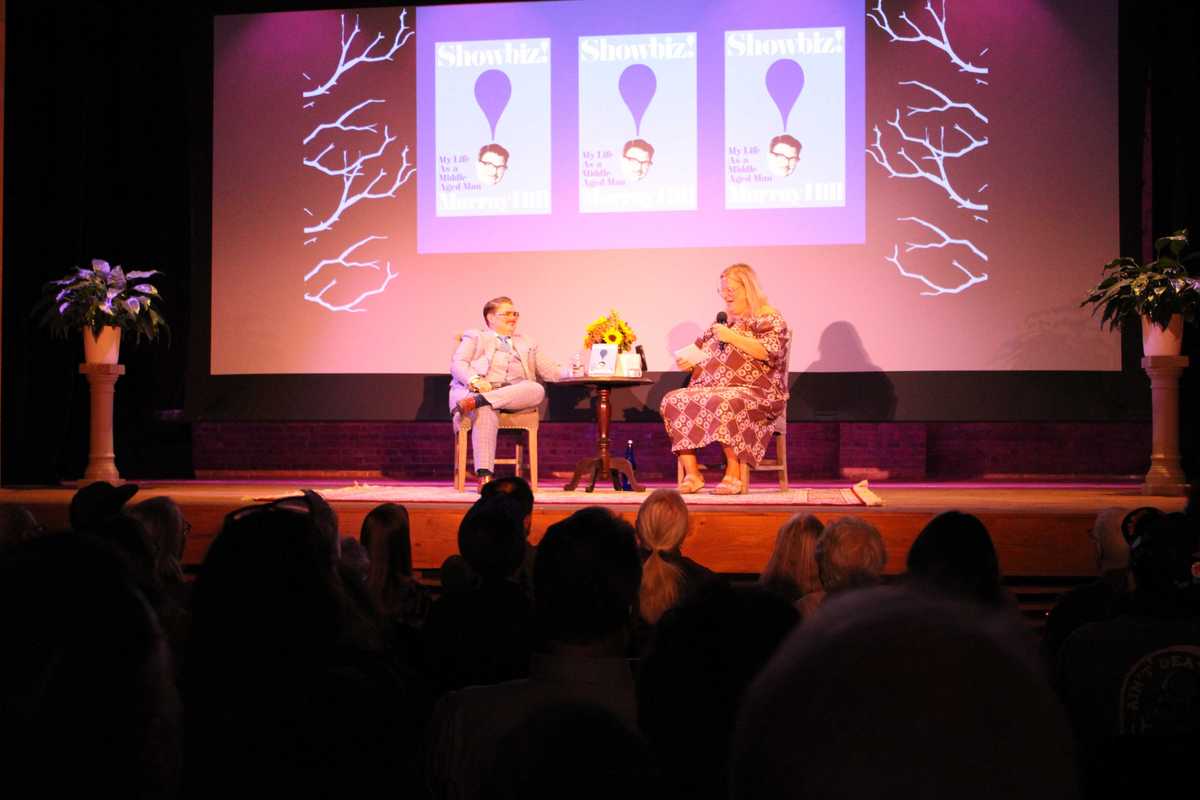
Murray Hill and Bridget Everett shared the stage at Stissing Center in Pine Plains on Thursday, Oct. 8, for an evening celebrating Hill’s new memoir and the launch of a literary partnership between Oblong Books and Stissing Center.
When Oblong Books co-owner Suzanna Hermans ran into comedian Murray Hill in New York City, she saw an opportunity.
Hill, the self-described “hardest-working middle-aged man in show business,” had a new memoir, “Showbiz! My Life as a Middle-Aged Man,” coming out, and Hermans was eager to bring him to the Hudson Valley for an author event.
She approached him and suggested a visit to “an independent bookstore in the Hudson Valley.” Hill asked where the bookstore was located.
“Millerton,” Hermans replied.
“Oh my God, Oblong?” Hill exclaimed.
As it turned out, Hill already knew of Oblong with its locations in Millerton and Rhinebeck. His friendship with actor and comedian Bridget Everett had brought him to the region, and he had visited the shop before.
“It was a marriage made in heaven,” said Helen Seslowsky, Oblong’s events director.
The chance encounter led to an evening of laughter, storytelling and an exuberant conversation between Hill and Everett on Thursday, Oct. 8, at Stissing Center in Pine Plains.
The event also marked the beginning of a promising collaboration between Oblong Books and Stissing Center, bringing together two regional cultural institutions with a shared interest in connecting artists and audiences.
For Seslowsky, the partnership has been a long time coming.
“One of the things that we really were missing was a midsize venue for author events for Oblong,” she said.
The bookstore has long hosted literary events at its Rhinebeck location, which can accommodate about 50 people, and at The White Hart Inn in Salisbury, where audiences of roughly 100 can gather. But a venue that could accommodate larger crowds while retaining an intimate atmosphere had remained elusive.
Seslowsky had been discussing the possibilities at Stissing Center with Executive Director Patrick Trettenero for some time, waiting for the right opportunity to emerge as the venue’s renovations progressed.
“It’s just taken until now for something that really was a good fit to pop up,” she said.
That something turned out to be Murray Hill.
“It came about quite by chance and was a perfect fit,” Seslowsky said. “We couldn’t have wished for better.”
The conversation between Hill and Everett, long-time friends and co-stars in the acclaimed HBO series “Somebody Somewhere,” brought a lively mix of show business stories, friendship and irreverent humor to Banning Hall, The Stissing Center’s upstairs performance space.
The evening also demonstrated how well the theater could accommodate literary programming. Although the event was initially considered for The Grace Note, the center’s intimate downstairs performance space, Banning Hall offered the seating capacity and sightlines needed for a larger audience without sacrificing a sense of closeness.
Seslowsky said the experience opened up possibilities for future events in both rooms.
“Now we know how it works,” she said. “Banning Hall is such a great, very versatile space to have. And then we’ve got the coziness of The Grace Note.”
Geography is another advantage. Pine Plains sits conveniently between Oblong’s two bookstores, making Stissing Center a natural gathering place for readers from both sides of the Hudson Valley and the Northwest Corner.
The collaboration also introduces audiences to cultural offerings they might not otherwise discover.
Seslowsky noticed familiar faces from Oblong and The Moviehouse in Millerton, along with patrons of Stissing Center and people she hadn’t encountered before.
That kind of audience sharing is central to the partnership’s appeal. A reader who arrives for an author conversation might return for a concert or theatrical performance, while regular Stissing Center patrons may discover a new favorite author or bookstore.
The financial arrangement is similarly collaborative. For the Murray Hill event, the ticket price included a copy of the book. Oblong handled the book purchases, author arrangements and promotion, while The Stissing Center supplied the venue, technical staff and volunteers. The partners shared the proceeds.
“We do all our end of it and the promotion, and Stissing Center has their volunteers and Patrick and the tech staff,” Seslowsky explained. “And then we just split whatever we make.”
While no additional jointly produced events have been announced, Seslowsky is already looking ahead to the spring publishing season. She is reviewing publishers’ catalogs, identifying authors with forthcoming books and submitting requests for potential appearances.
“We’ve got a lot of irons in the fire,” she said.
She expects the next round of programming to take shape after the holiday season, with events potentially beginning in February, March and April.
The timing of the first collaboration, she believes, was particularly fortunate. With Stissing Center’s renovations nearing completion and both organizations eager to expand their reach, the right event arrived at the right moment.
“I don’t believe in pushing things or trying to make things happen before they’re organically ready to do so,” Seslowsky said. “I just think things fell into place. The timing was perfect.”
And if the Murray Hill evening offered any indication of what’s possible, the partnership has plenty of room to grow.
“When we pool our collective resources, it always ends up being a better event,” Seslowsky said.
For more information about upcoming literary events, visit oblongbooks.com and thestissingcenter.org.
Feast at Rock Steady Farm
Lakeville Journal

Rock Steady Farm (41 Kaye Road, Millerton) hosts its second annual FEAST, a celebration of abundance, queer joy and community on Saturday, Oct. 17. The afternoon includes farm tours, Filipino-inspired food from Harana Market’s Chef Chris Mauricio, music by DJ BKP, performances and reflections from community members. Proceeds support the farm’s mission to train queer, trans and BIPOC farmers and provide fresh, culturally relevant food to underserved communities. 2 to 5:30 p.m. Sliding-scale tickets, with reduced-cost options available. For more information, visit rocksteadyfarm.com.
Iron industry relic finds new home on Main Street
Patrick L. Sullivan
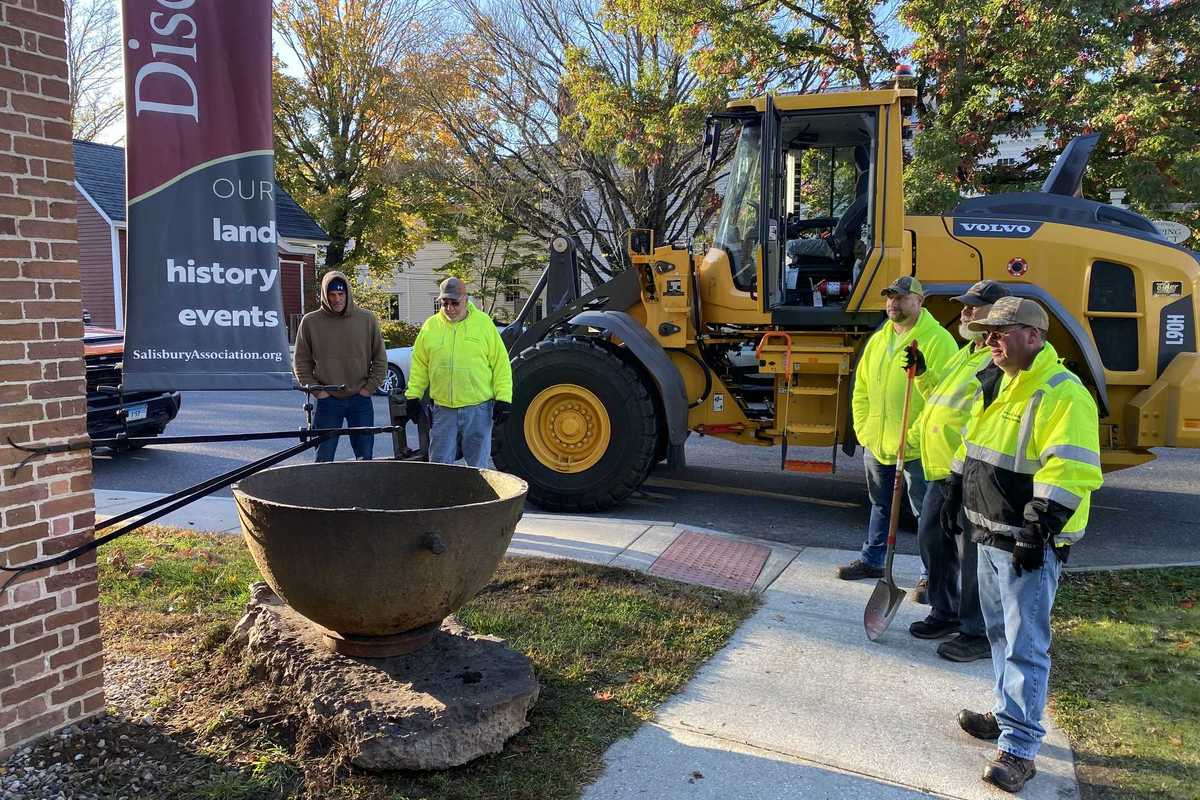
The town crew delivered a relic of Lakeville’s iron industry to the Salisbury Association on Oct. 7. Therelic was previously on display at Bicentennial Park.
SALISBURY — A relic of the local iron industry was moved from the former Bicentennial Park in Lakeville to a spot in front of the Salisbury Association’s Academy Building on Wednesday, Oct. 7.
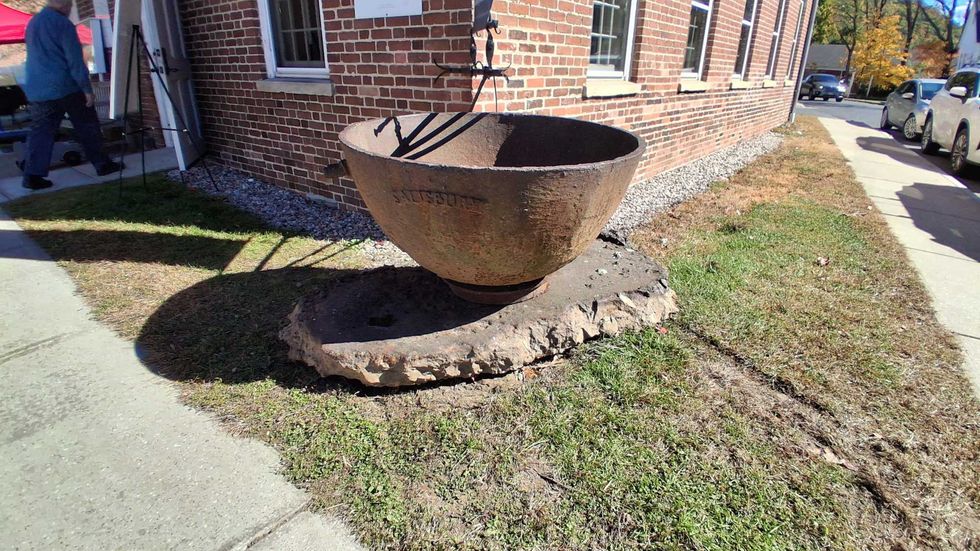
Known as a “salamander,” the solidified mass of waste material from the hearth of a blast furnace had been displayed in the park, now the site of the Holley Place affordable housing development.
The Salisbury Association’s Lou Bucceri said the town crew transported the heavy relic to outside the front door of the Academy Building on Main Street.
“And I got to teach the town crew a little history,” Bucceri said.
An iron kettle already on display at the building now sits atop the salamander.
The relic bears little resemblance to the amphibian that shares its name. Bucceri said determining how the metallurgical term originated will require further research.
He plans to add a sign explaining the salamander’s significance.
 Patrick L. Sullivan

Want more of our stories on Google? Click here to make us a Preferred Source.
Lime Rock Park dedicates tree to neighbor and friend Lisa Keller
Madi Long
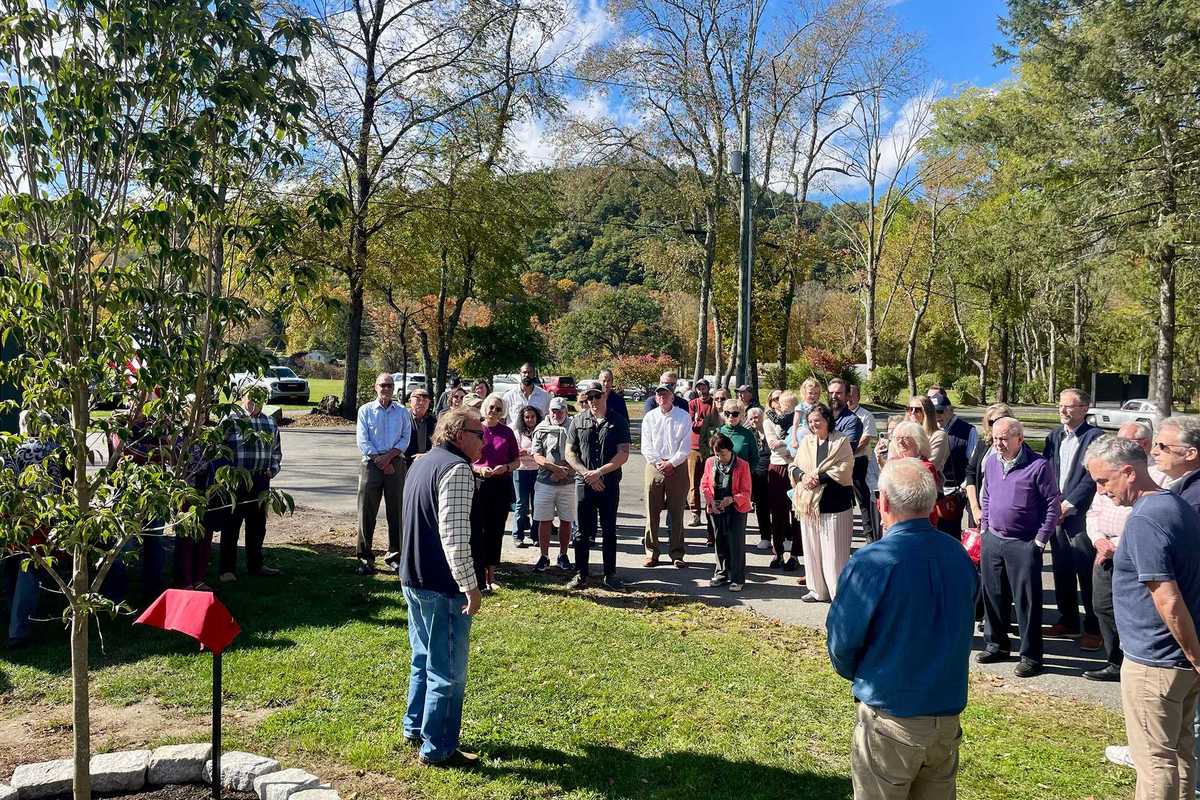
Family, friends and community members gathered to honor Lisa Keller and dedicate a flowering dogwood at the entrance to Lime Rock Park on Friday Oct. 9.
LIME ROCK — A tree dedication ceremony was held at Lime Rock Park on Friday Oct. 9, honoring the late Lisa Keller, a Lime Rock resident known for her work to foster relationships between the racetrack and its neighbors.
The flowering Dogwood named as “The Lisa Keller Welcome tree at Lime Rock Park” was planted by the entrance to the park to greet visitors, employees, and community members.
Keller served as a volunteer on the Lime Rock Citizens Council Steering Committee for over five years, helping to facilitate conversations between neighbors and Lime Rock Park as the venue continued to expand its operations. She played an instrumental role in securing approval of the stipulation agreement that allows activities to take place at Lime Rock Park.
Keller lived in the historic Lime Rock “Casino,” a home that sits directly across from Lime Rock Park, where she hosted community gatherings and worked to find common ground between the Park and its neighbors.
Beyond her work at Lime Rock Park, she was known for her baking, particularly her cookies. She regularly sent packages to her sons and their military friends while they were deployedaround the world.
During the holidays, she would bring over 80 packages of cookies to the Lakeville Post office to be mailed to lucky recipients. When she was no longer able to make cookies during her final year, she compiled a recipe book to share with those who enjoyed her treats. Keller passed away in July 2025 after a year-long battle with cancer.
Lime Rock Park CEO, Dicky Riegel, welcomed attendees to the ceremony, and reflected on the impact Keller had on the park and everyone she met. He talked about what makes the Northwest Corner special beyond just it’s natural beauty.
“Some might say that it’s the natural environment that truly defines the Northwest Corner, but I would argue that, among that landscape are the amazing people that truly define our community.”
Salisbury, Cornwall join ‘No Kings’ early voting push
Christian Murray
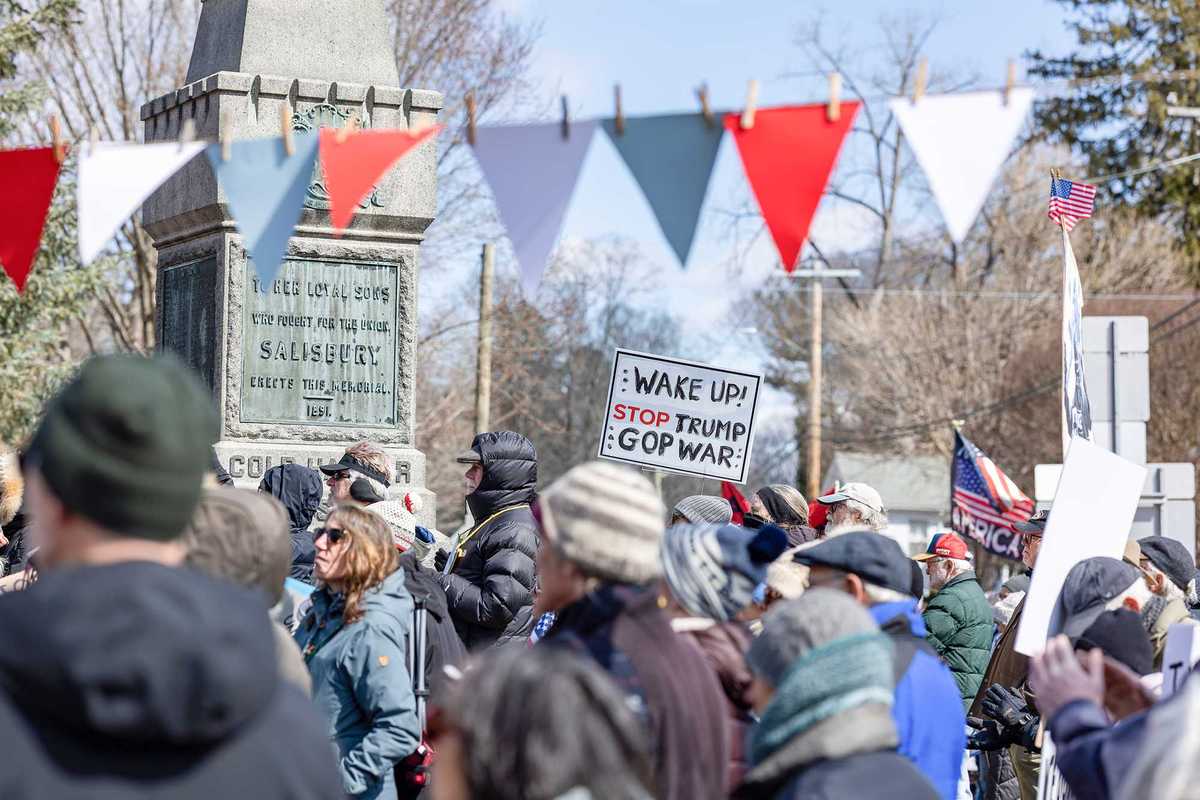
About 400 people gathered in Salisbury for a “No Kings” rally on March 28.
A gathering promoting early voting will take place Saturday, Oct. 17, on the Salisbury green as part of the national “No Kings: Vote Early” day of action.
The local event begins at 11 a.m., with participants encouraged to wear blue and bring signs promoting early voting. The main gathering will run until noon, with a voter registration table open until 4 p.m.
The national campaign focuses on helping eligible voters check their registration, understand their voting options and make plans to vote.
It follows No Kings protests against the Trump administration held in Salisbury, Cornwall and Kent in June 2025, and in those towns and North Canaan that October. A March 28, 2026, rally drew about 400 people to Salisbury and more than 300 to Cornwall Bridge.
A separate No Kings rally is planned for noon on the green at Cornwall Bridge. In an announcement published in The Lakeville Journal, organizer Jonathan Arnold said speakers are expected to include state Rep. Maria Horn. Participants are encouraged to bring signs.
The Kent Democratic Town Committee has also announced an Oct. 17 event.
Connecticut’s in-person early voting period begins Monday, Oct. 19, and runs through Sunday, Nov. 1. Election Day is Tuesday, Nov. 3. Additional event information is available at nokings.org.
Early voting begins Oct. 19 across the region
Christian Murray
Voters across the Northwest Corner and throughout the state can begin casting ballots Monday, Oct. 19, when Connecticut opens two weeks of in-person early voting ahead of the Nov. 3 election.
Early voting runs daily through Sunday, Nov. 1, including both weekends. Hours are 10 a.m. to 6 p.m., except Tuesday, Oct. 27, and Thursday, Oct. 29, when locations will be open from 8 a.m. to 8 p.m.
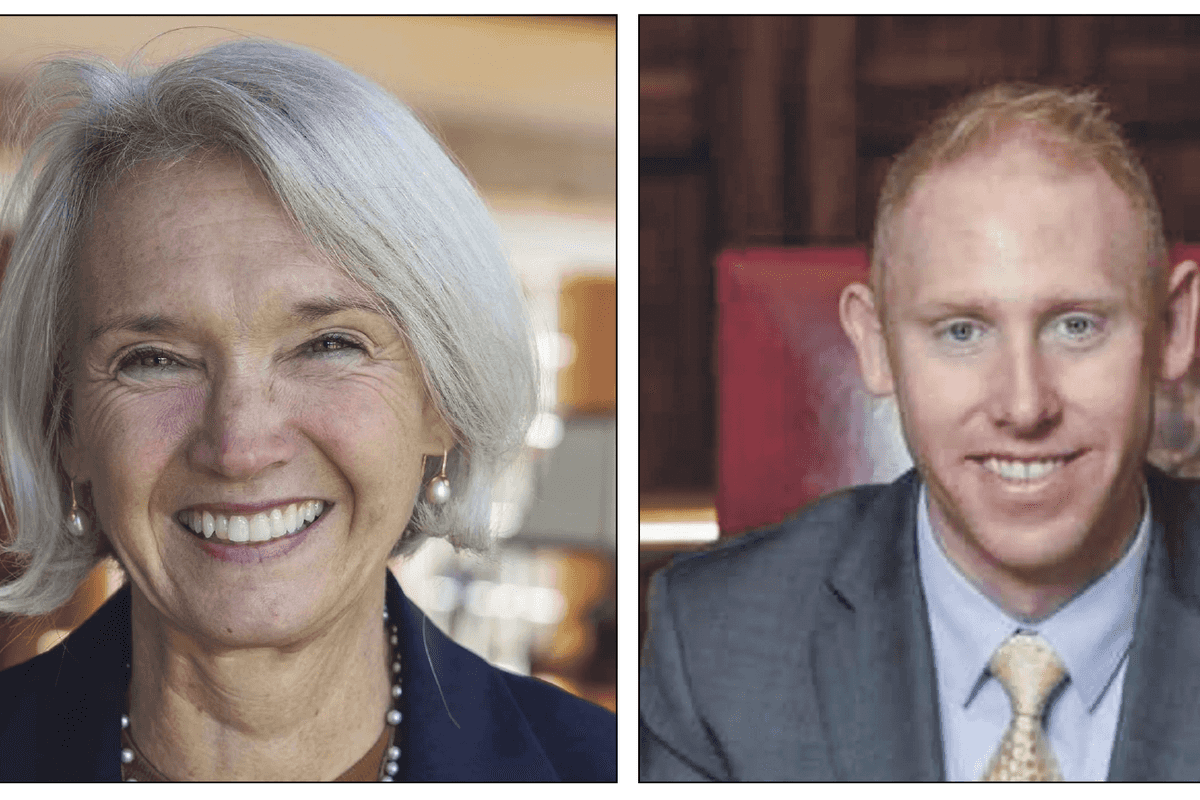
Regional contests include the 30th State Senate District race between Republican incumbent Stephen Harding and Democrat Aaron Zimmer, and the 64th State House District race between Democratic incumbent Maria Horn and Republican Katelynn Borraiz.
In the 5th Congressional District, Democratic incumbent Jahana Hayes faces Republican Chris Shea.
Voters will also choose a governor and lieutenant governor, with incumbent Democrats Ned Lamont and Susan Bysiewicz facing Republicans Ryan Fazio and Matt Corey, and fill four other statewide offices: secretary of the state, treasurer, comptroller and attorney general.
Residents must vote at their town’s designated early voting location, which may differ from their usual Election Day polling place. The Secretary of the State lists the following locations for the region:
Cornwall: Town Hall meeting room, 24 Pine St.
Falls Village: Canaan Senior Center, 107 Main St.
Kent: Registrars of Voters office at Town Hall, 41 Kent Green Blvd.
North Canaan: McCarthy Room at Town Hall, 100 Pease St.
Salisbury: Upstairs meeting room at Town Hall, 27 Main St.
Sharon: Town Hall, 63 Main St.
The advance registration deadline is Friday, Oct. 16. Eligible residents who miss it can register and vote during early voting or on Election Day.
Contact town registrars for requirements and locations.
Registered voters can request an absentee ballot without providing a reason. Ballots became available Oct. 2; applications are available online or through town clerks.
Election Day polls will be open Tuesday, Nov. 3, from 6 a.m. to 8 p.m. Voters can check their registration and find additional information at MyVote.CT.gov.
Want more of our stories on Google? Click here to make us a Preferred Source.