Latest News



Want more of our stories on Google? Click here to make us a Preferred Source.


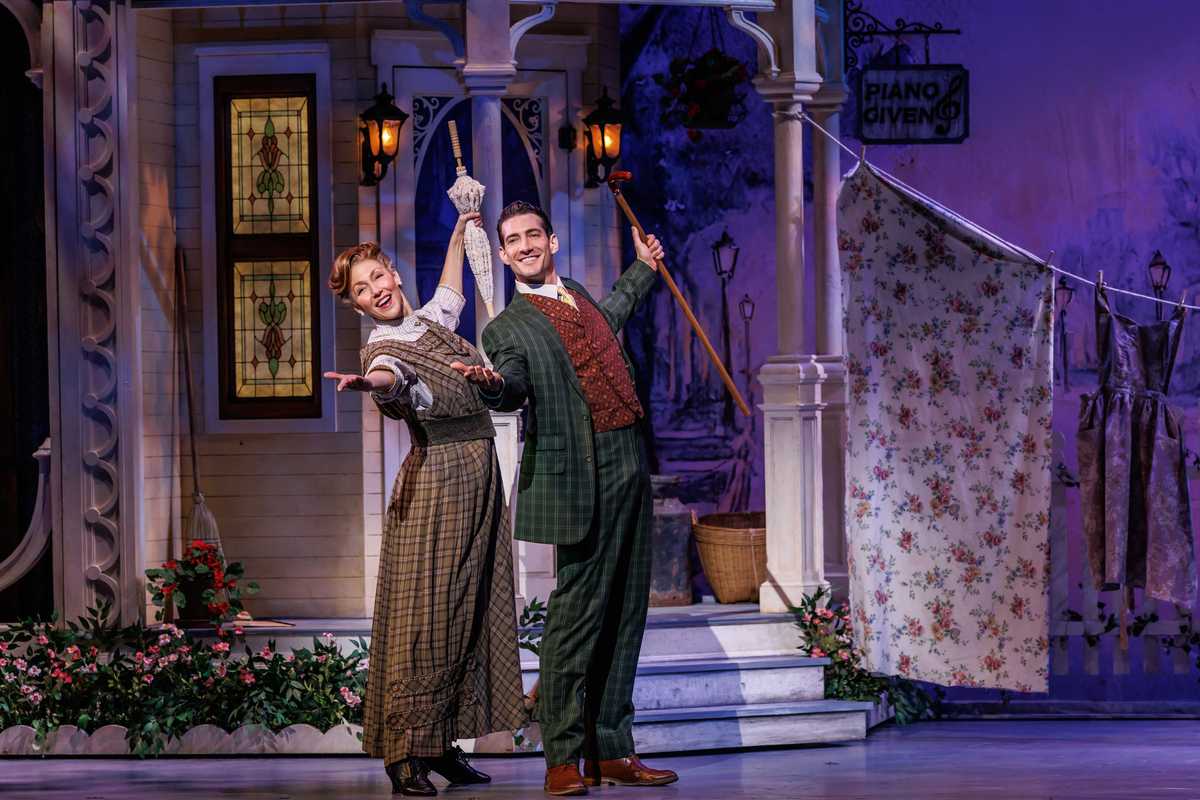
Savannah Stevenson as Mrs. Paroo and Elliott Andrews who plays Harold Hill in the nationally touring production of “The Music Man.”
Marshall Meadows
Then she became a lawyer instead.
“The leap from performing to lawyering isn’t as significant as it seems,” Stevenson said one recent morning from somewhere between tour stops on the national tour of Meredith Willson’s “The Music Man,” in which she now plays Mrs. Paroo, the Irish immigrant mother of Marian the librarian.
For 18 years, Stevenson practiced law at high-profile New York firms specializing in criminal defense before eventually becoming head of ethics, compliance and risk at Peloton during the company’s dizzying pandemic boom years.
“At some point in time, I got married and had children,” she said matter-of-factly. “And then life kind of unfolded.”
Stevenson and her husband began renting a house in Falls Village “just to get out of the city on the weekends.”
“We fell in love with it, of course,” she said. “And then when the pandemic hit, we of course fled the city up to that house and decided not to go back.”
 Sharon Playhouse Board President Savannah Stevenson, former attorney and lifelong theater loverProvided
The family — Stevenson, her husband Jon, and daughters C.C. and Sylvie — became full-time Salisbury residents in 2020.
Then came another plot twist.
While the world was buying exercise bikes and streaming spin classes from their living rooms, Stevenson was part of Peloton’s legal leadership team. But after the company’s spectacular rise came the somewhat inevitable crash.
“In 2023, the board decided to let the entire executive team go,” she said.
Suddenly, Stevenson found herself unemployed in Northwest Connecticut with time on her hands and a teenage daughter deeply immersed in the Sharon Playhouse YouthStage program.
“My older daughter said to me, ‘Well, as long as you’re bringing me to and from rehearsals every day, why don’t you audition for the show?’”
She auditioned.
“And they were like, ‘Oh, you actually can sing.’”
What followed sounds like the plot of a feel-good movie about reinvention in middle age: mother and daughter performing together at the Sharon Playhouse while Stevenson rediscovered a part of herself she had set aside decades earlier.
“It was the most joyful experience ever,” she said. “And I kind of realized that now, in my late 40s — I’ll be 50 this year — I’ve aged into this entire new crop of roles. The mothers, the older wise women, the cougar,” she said, laughing. “All of these great older women’s roles.”
So, she started auditioning.
And getting the parts.
Now she’s on a six-month national tour.
“It really does feel like a full-circle moment for me,” Stevenson said.
If that sounds glamorous, Stevenson is quick to point out that touring theater is less champagne and more buses, protein bars and Peloton app workouts in hotel rooms.
“There are certainly times where it’s a show Monday night in one city, get on the bus, show Tuesday night in another city, get on the bus,” she said. “There’s a lot of time on the bus.”
Mostly, though, she talks about the crew with something approaching reverence.
“We finish a show at 10:30 or 11 at night. They load out the entire set onto trucks. Then they sleep on the bus, get to the next city at 8 a.m., load it all back in and rebuild it,” she said. “They work so hard. It’s incredible.”
In “The Music Man,” Stevenson now plays the role she once dreamed of from the opposite side of the generational divide.
“I would have sung Marian in my 20s,” she said. “Now I get to play her Irish mother, Mrs. Paroo.”
There is a scene where Marian sings “My White Knight,” and Stevenson stands nearby as Mrs. Paroo listening silently. And while the younger actress sings about longing and possibility, Stevenson finds herself thinking about her own daughters.
“Sometimes I just find myself standing there with a tear running down my cheek,” she said.
Meanwhile back home, Stevenson has become one of the Sharon Playhouse’s most visible champions. She joined the board in 2023 and stepped into the role of president this year.
“There’s social science that provides really strong evidence about the benefits of having a theater in your community,” Stevenson said. “Lower rates of violence. Higher rates of volunteerism. Higher graduation rates.”
She speaks about theater the way some people speak about public libraries or churches — as essential civic infrastructure.
“Sharing laughter, tears, music and dancing through stories that illuminate our common humanity touches us in a way that builds connection, empathy and genuine community,” she said.
Much of that conviction comes from watching what theater has done for her own children.
When her oldest daughter interviewed at competitive boarding schools this year, Stevenson said interviewers repeatedly commented on her poise and confidence.
“They would say to me, ‘All that theater education is really paying off,’” Stevenson said. “She can establish connection with people readily.”
When asked what advice she might offer to other women contemplating a midlife pivot, Stevenson resisted the fantasy of reckless transformation.
“I don’t think it’s about jumping without a net,” she said.
Instead, she advocates something more measured.
“It’s about making a calculated risk,” she said. “And then, once you’ve run those calculations and feel planful enough about it, really diving into that risk headlong.”
Which is perhaps another way of saying that sometimes the girl who once sang show tunes in Atlanta and studied musical theater at Carnegie Mellon never actually disappears.
Sometimes she’s just waiting patiently for her cue.
For tickets to The Music Man, visit themusicmantour.com
Want more of our stories on Google? Click here to make us a Preferred Source.