If you think about it, the idea of being rich for most Americans is more and more unattainable, especially as the poverty gap widens. When 1 percent of the households (1.1 million households) in America controls 49 percent of the wealth, and the next 15 percent (16.5 households) controls 43 percent of the wealth, that leaves 92.4 million households controlling only 8 percent of the wealth of the country.
So, it is easy to calculate which students will have a silver spoon (firmly planted) and which will not. If you allow about 1.4 kids of education age per household, that is about 130 million children “have nots� who, when adults, will either have to work to make their way or rely on tax-supported programs to survive. The problem with this vast mis-distribution of wealth is that the barrier, the hurdles, to becoming wealthy and self-sufficient are gigantic and act as a disincentive to students.
In short, why learn when the difference between being on the poverty line flipping burgers is only $2 to $6 an hour worse than a hard-fought educational path leading to being a low-level manager or a technician? OK you get to buy a better car if you work really hard. Big deal. Kids are not stupid. Where’s the old American incentive?
u u u
More to the point, where is the reason for school boards to keep spouting rhetoric about better education being the pathway to financial success when most public school systems have less than a 17 percent rate of advancement beyond the minimum wage, 6 percent beyond that into lower-middle class?
School boards want to keep raising fees and taxes to improve education while struggling families — renters and homeowners alike — are screaming no more taxes and, anyway, what for? Johnny cannot find a job that pays.
Divide and conquer is at the core of any military campaign. The completely regional school finance structure in this country makes the division and conquering of education child’s play for a national organization. With no national education budget (except 5 percent from the feds for local boards — and even that is earmarked ahead of lesson planning), school boards can be suborned, cajoled or pushed (by poverty) into any direction the deep-pockets of industry or charities wish.
u u u
Who needs you to be smart anyway? Big business does, especially big American business. Faced with what they rightly see as a shortfall of stamina, drive and tax desire to improve education, big firms like Ford, IBM and Raytheon are pushing their educational programs — if only to ensure they have more workers for their industrial complex.
Don’t get your hopes up that this means your kid will either get a better general education or more money except for a job for which his or her education add-on was specially targeted. In fact, many corporations’ educational platforms are junior apprentice building programs dressed up as inspirational education.
Let us take a look at one: Raytheon’s MathMovesU. Ah, see the clever hip use of “U� meant to attract the instant-message user as well as make Mommy think it is like a university? Good marketing.
What is this program? It is an “initiative� (meaning “serious and new�) designed, as Raytheon states, to connect math, kids’ passions and “cool careers.� Since 2005 they have, again I quote, “touched the lives of more than 1,000,000 students, teachers, and parents.� It includes interactive learning, live events (at Disneyworld, no less — that playground of good education) and tutoring programs. “Raytheon believes that tomorrow’s engineers and technologists need to be excited by and interested in math today,� we’re told.
In short, they need employees, worker bees. And they dangle better education to gain a foothold in the work force of tomorrow with school boards, dressing up their recruitment program as the extra education that boards have trouble affording.
When I was a student at UCLA, we had riots opposed to the use of student learning and research as a hidden military program for the benefit of the war going on in Vietnam. Of course, this coupled with the anti-war movement. Some of us, opposed to the war, found ourselves in a tough position of not being opposed to the soldiers, but definitely opposed to the war and especially opposed to the militarization of the university and learning.
u u u
Big industry is smarter than that. Hiding in plain sight as the free purveyors of better math and sciences programs, programs designed with excellent bells, whistles, awards, grants and sometimes free calculators or computer programs, replete with visual interactivity and other trinkets dangled before the otherwise bored student, they are gaining a foothold in the education of our minors all the while school boards have increasing pressure put upon them because of budget shortfalls, loop-hole taxes for the really wealthy (industry managers), export taxes for sending U.S. jobs overseas and, never least, a disproportionate tax burden falling on the homeowner or the rent payer (who pays more and more taxes — just doesn’t understand why).
Why is simple … education has no purpose, is failing, say the big industry boys. They will show the way — and lock you into a job they can control. It is better this way for America, commercialize education, drop the notion of a rounded education, capitalize it. After all, the American dream is to be rich therefore the successful rich must be right, no?
Well, no, the American dream is built on an upbringing that allows freedom of the individual, not a predetermined industrial path. A solid general education served this country’s needs before and, I feel, will do so in the uncertain future.
Peter Riva, formerly of Amenia Union, lives in New Mexico.

 Pay Bill for Robin Starr’s service in the Continental Army.Courtesy the Alex Breanne Corporation
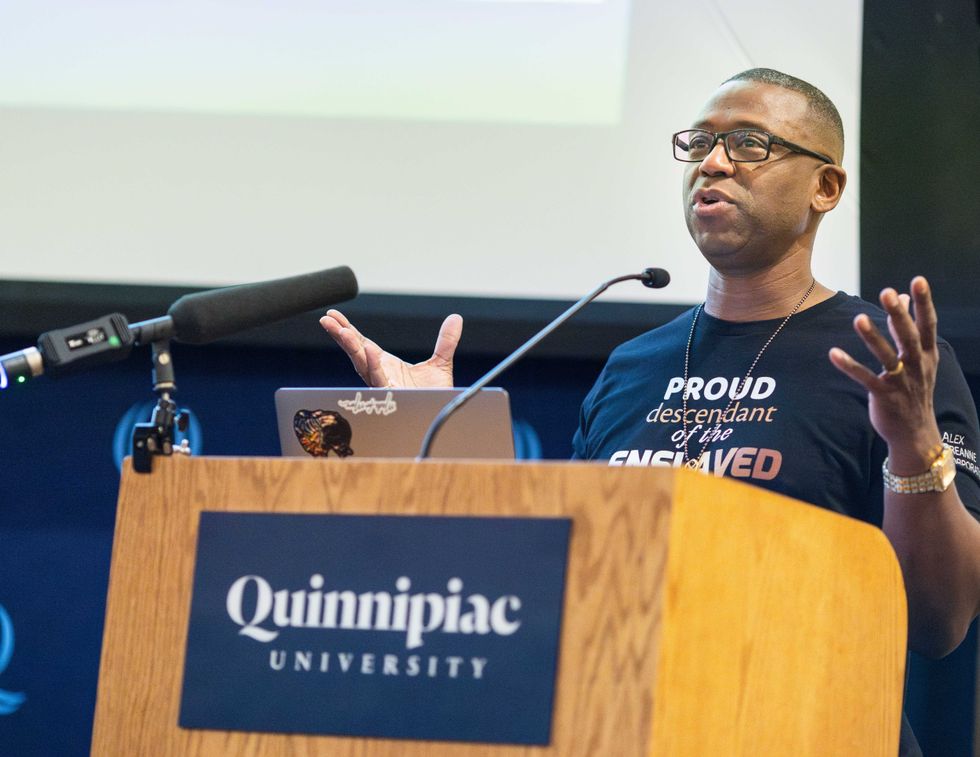 John Mills speaking at Quinnipiac University.Courtesy the Alex Breanne Corporation
 Stephanie Saetta,with her rescue dog George and Blue (left), a shepherd mix awaiting his forever home.Madi Long
 Blue, a 7 year-old Shepard mix, is waiting for his forever home. Madi Long