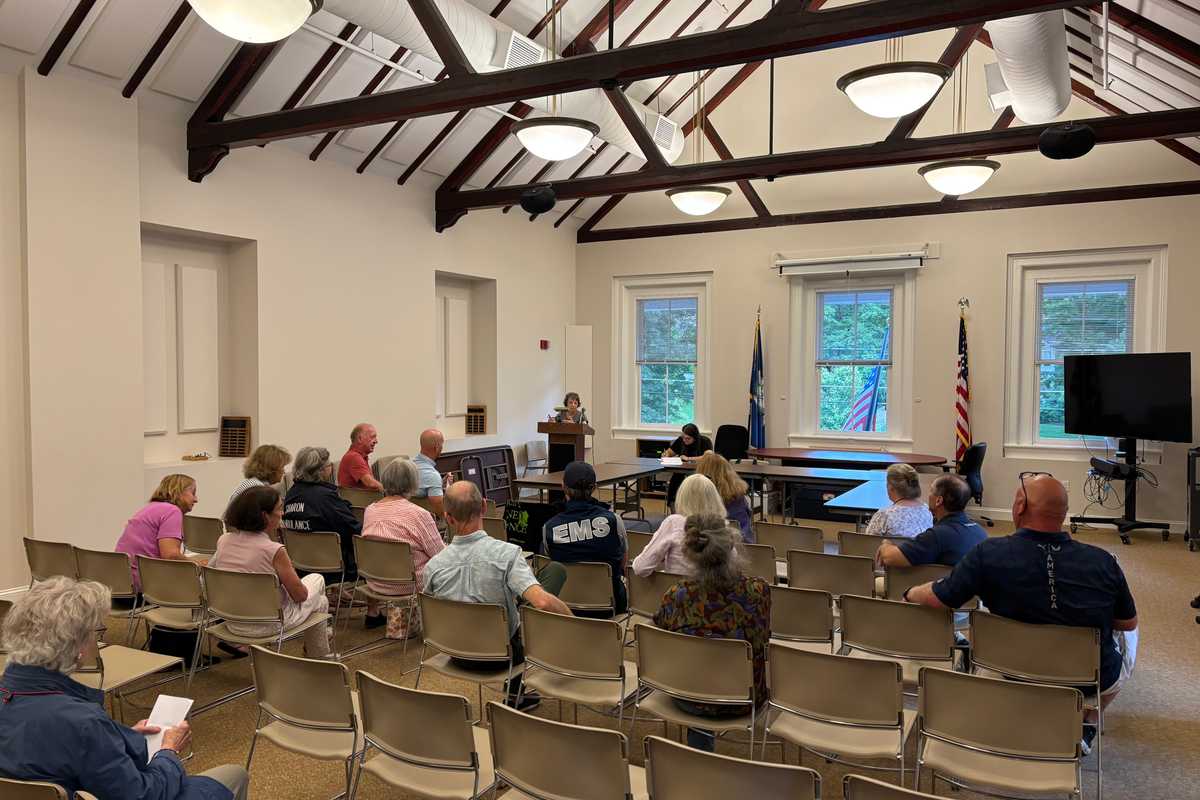
MILLERTON — The status of Millerton Overlook, the proposed affordable housing project set to be built at the head of the village, where routes 22 and 44 meet, was the focus of last Wednesday’s village Planning Board meeting. Roughly 35 residents attended the meeting, which was held at the American Legion Hall to accommodate the crowd, as it would have exceeded the Village Hall’s capacity.
At the start of the meeting, which was a regular workshop for the Planning Board and therefore meant there was other business to discuss, Chairman Gregory Lanphear informed the crowd it would be given an opportunity to speak at the end of the gathering. Lanphear made it clear that the Planning Board was not holding a public hearing that night, which meant it was not obligated to let the public speak, but said the board would allow comments — limited to two minutes per person — so that everyone would have a chance to express their concerns or commendations.
From there business swiftly got underway. Bog turtles, and their presence at the Millerton Overlook site, was discussed. According to Lanphear, a recent study stated that the entire wetland located on the site is a “non-core habitat†for bog turtles, although it stated it is possible they are there.
Eric Bernardin, an engineer with Fuss and O’Neill of Poughkeepsie, who is working with Housing Resources of Columbia County, Inc., the not-for-profit agency behind Millerton Overlook, also addressed the issue.
“Before we started investigating the bog turtle issue we went to the DEC [Department of Environmental Conservation],†he said. “[We were told to] go ahead and design the project in as an environmentally sensitive way as we could... because they didn’t feel it would create an impact, even if bog turtles exist in that way.â€
Bernardin also said the U.S. Department of Fish and Wildlife put the project on its schedule, but it “could be six months to two years before we get any response†from them regarding bog turtles. The engineer added that Housing Resources’ site is just over 3 acres, yet is has the drainage capacity of more than 150 acres.
“Less than 3 percent of the water area could be within the bog turtle area,†he said. “It is taken into consideration and we designed it to take into account the DEC’s suggestions.â€
“When we get into the SEQRA [State Environmental Quality Review Act] process, everything will go to the DEC for their approval,†Lanphear said.
The Planning Board’s attorney, Michael Hayes, pointed out that as lead agency the board will be forwarded all of the paperwork and notified of any work that is required. It will then need to make a determination of significance regarding the environmental review. A positive declaration means the project could potentially impact the environment in some way. A negative declaration means the project would likely not impact the environment in any way. The latter usually leads to a much shorter environmental review process.
As lead agency, the Planning Board is also responsible for ensuring all other involved and interested agencies get the required paperwork so they can comment and respond as appropriate. It then has to wait “a reasonable amount of time,†according to Hayes, for responses.
Hayes then addressed the board’s concerns about getting caught up in a lawsuit, or an Article 78.
“My feeling is you can’t ever be bullet-proof,†Hayes said, adding it’s best not to be arbitrary and capricious. “If your basic goal is to avoid a lawsuit, my advice is get the DEC, wait as long as is reasonable, then you move forward.â€
There was then talk about setting a public hearing, which the Planning Board is not obligated to do until the SEQRA process is complete. However, it decided to schedule a public hearing, which will likely remain open for at least a short while, for Sept. 16 at 7 p.m. at the Millerton American Legion Post 178.
In the meantime, members from the audience at the Aug. 12 meeting were allowed to speak following the general discussion. Dave Shufelt was among those to voice his concerns.
“I’m not against the housing,†he said. “I’m against where this is being put. In order to close the SEQRA process, you need to find no adverse environmental impact on the project.â€
Shufelt said that he was concerned about the bog turtles and didn’t believe the DEC was doing its job.
Next up was Jeanne Rebillard, who owns the property next to the Millerton Overlook site with her husband, Brad.
“I wanted a noise study and a visual study and was told by the applicant that it wasn’t necessary,†she said. “I ask that you give a positive declaration and do a full SEQRA. I want to know where the septic is going... All the water is traveling toward our property.â€
Bernardin said that Housing Resources is “catching all its water on site.â€
Resident Cindy Heck said she was concerned about the cemetery next door to the project’s site, and that she “wants to know where the water is going to go.â€
“At what point will the Department of Health tell us if the ground can handle all of the water, because they’re expecting most of this water to soak into the ground like a sponge,†queried Heck’s husband, John.
“Their trigger for taking real action is the SEQRA determination,†responded Morris Associates engineer Paul McCrary, a consultant for the town.
Eugene Flores, a Millerton resident, rose to ask a question.
“If 90 percent of the village is against this, will it go through?†he asked the board’s chairman.
“The project will go through or fail on its own merits,†replied Lanphear.
“According to a public survey that was done a number of years ago, the public does want housing,†Planning Board member John Gilmor said. “A public hearing was held to make the change to zoning to allow that use in that location.â€
Zoning Enforcement Officer Nancy Brusie then contributed to the discussion.
“This affordable housing project is allowed with a special use permit in the village of Millerton,†she said. “As long as the state’s criteria is met, the county’s criteria is met, the public is heard at the public hearing, they have no choice but to [approve it]. They may not like the project, but they have no choice — this will pass or fail on its merits.â€
“I disagree that 100 percent or 70 percent of the public is against this,†resident Sam Busselle said. “A great number of people [support this].â€
Resident Brad Rebillard rose to speak; he and wife, Jeanne, own property adjacent to the proposed project site.
“I support this board — it’s done its work and I support it 100 percent. But if this project is going through, it has to be right, for Housing Resources and for the cemetery,†he said. “If anything I’m for affordable housing, but if anything it’s the siting of this project. Where are they going to put their septic system?â€
Shufelt then spoke a second time, and suggested the plans Housing Resources intends to present at the public hearing should be made available to the village prior to the meeting.
“I don’t want to see this board taken advantage of,†he said. “We need to know what their plan is.â€
Lanphear agreed.
“Things do change and continue to change,†he said. “But people should see what’s going on, too.â€
Resident Casey Swift also requested a new site plan and artist’s rendering be presented at the public hearing as the present ones are no longer current.
Lanphear said the public hearing will give Housing Resources representatives a chance to update the community on everything that’s happened during the last six months, as well as answer questions and concerns raised at the Aug. 12 meeting. Following their presentation there will then be a question and answer session.
Plans are expected to be made available at Village Hall for people to review 10 days prior to the public hearing; the Planning Board is also counting on an electronic copy making it to the village’s Web site, villageofmillerton.com.

 Classic styles, bold colors, and creative concerts make up the “Imaginary Concerts” line at Peggy Mercury.Provided
 Shirts from Peggy Mercury’s first fashion line, “Imaginary Concerts,” hang on display.Provided