Recently, several readers of The Journal cornered me with more questions about competing health insurance plans further to an Insight piece on “Cost of universal health care vs. cost of doing nothing� (The Lakeville Journal, July 30, 2009). Here are their half-dozen questions, and my tentative answers.
First question: What do you think would be the comparative overhead costs of a typical private insurance plan versus a public option similar to the WHO (World Health Organization) plan?
Answer: About 10 to one.
Could you quantify that in percentages or dollars?
Yes. Under a typical private insurance scheme, overhead easily exceeds 20 percent. This means that for every $100 paid in premiums, at least $20 goes into administrative costs, advertising and profit-taking. Less than $80 is devoted to actual medical care.
By contrast, in a public option like the WHO plan, administrative costs are less than 2 percent. This means that for every $100 of cost, less than $2 goes into administration, zero goes into profit and more than $98 is devoted to medical care.
Second question: How costly would such a public option plan have to be for American families, how would it be paid, and how would that compare with a typical private insurance plan?
Answer: There are endless permutations. Here’s just one: If the public option resembled the WHO plan, then premiums might be based on a percentage of family income, matched or double-matched by the employer business or government.
Thus, a family of four earning $70,000 a year might pay a rate of 5 percent, or a monthly premium of less than $300. The all-in monthly cost of the public plan could be less than $900. This compares with a monthly cost of $1,200 to $1,500 for a typical private insurance plan. Thus the public option runs one-third to two-thirds less costly, while offering overall better coverage, transparency and reliability of reimbursement.
Third question: If the public option follows the WHO plan, what medical costs would be reimbursed at the 80 percent rate, and what at the full 100 percent rate?
Answer: The WHO plan reimburses 80 percent of the costs of prescribed medicine, physicians and specialists, radiology, laboratory examinations, emergency ambulance services and hospital expenses beyond accommodation costs.
The plan reimburses 100 percent of preventive measures (such as immunizations) and 100 percent of hospitalization in a four-bedroom public hospital or equivalent.
Unlike many private insurance plans, the WHO plan includes coverage of mental, dental (e.g., braces), optical (eyeglass lenses and frames within defined limits) and prosthetics.
For major surgical or other catastrophic care, there are special rules and limits, but a surveillance authority can define or override these and reimburse in some cases up to 100 percent — unlike private insurers who usually try to back out of things like “experimental� surgery. Insider documents show that corporate executives receive promotions and bonuses based on their success in denying expensive claims.
The WHO plan works anywhere around the world, without geographical or provider limit. Most private insurance plans do not do this without your paying astronomical supplemental premiums.
Fourth question: Will the public option cover abortion? How about fertility promotion?
Answer: As far as we know, the two draft bills currently in front of Congress do not (yet) mention either of these. Nor need they necessarily do so. If we follow the WHO general line of thinking, irrespective of a patient’s station in life or personal belief system, if an intervention is medically necessary, then the plan should cover it.
In the United States, we should recall, a woman’s “right to choose,� that is to say, right of privacy and right of person, is constitutionally protected under Roe v. Wade (1973). Thus, coverage is perfectly legal. So why are we arguing about this now? Is this for crackpot political purposes?
As to fertility enhancement, yes, the WHO plan covers medical treatment for infertility up to $30,000 for the whole period of participation.
Fifth question: Will the proposed health system reform include price regulation?
Answer: Ah, there’s the rub! Clearly, the very existence of a public option will bring prices down, thanks to honest competition and bulk purchasing and negotiating power. Whether WHO’s unique mechanisms for controlling price charges can be duplicated remains to be seen.
Outright regulation of prices (as done in Germany and other “socialist� countries) is a different question. Corporate providers, notably Big Pharma, are lobbying Congress, tooth and nail, to exclude from health system reform any regulation of pharmaceutical prices. So far, they are winning. There is to date no easing of Bush-era restrictions on re-import of U.S.-manufactured drugs from Canada, where many drugs can be obtained for as little as one-third the price of the same drug purchased directly here in the United States — all this on the dubious grounds that Canadians are unable to exercise adequate drug quality control.
Many proprietary drugs in the United States sell for multiples of their fair research, development and production costs. For example, the best drug for controlling myeloma, namely Thalomid, a derivative of Thalidomide developed in the 1950s, costs something less than $100 to manufacture for a month’s supply, but sells in the United States for $5,000 a month.
No wonder sick Americans go broke! Big Insurance and Big Pharma pretend to favor health-care reform, but they don’t want a public option, and they don’t want price controls.
Sixth question: What can we do about all this?
Answer: Contact your senators and congressmen, especially Republicans and “Blue Dog� Democrats, by e-mail, snail mail or telephone, and tell them that along with 72 percent of the American public, we want a national health insurance public option, and we want reasonable price controls. Remind them that major re-elections take place in 2012.
Sharon resident Anthony Piel is a former director and legal counsel of the World Health Organization.

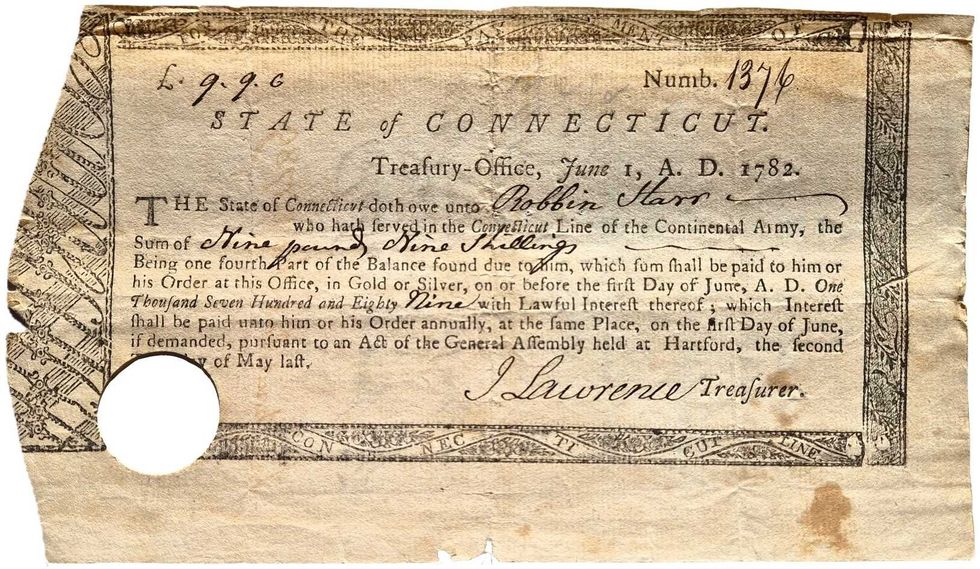 Pay Bill for Robin Starr’s service in the Continental Army.Courtesy the Alex Breanne Corporation
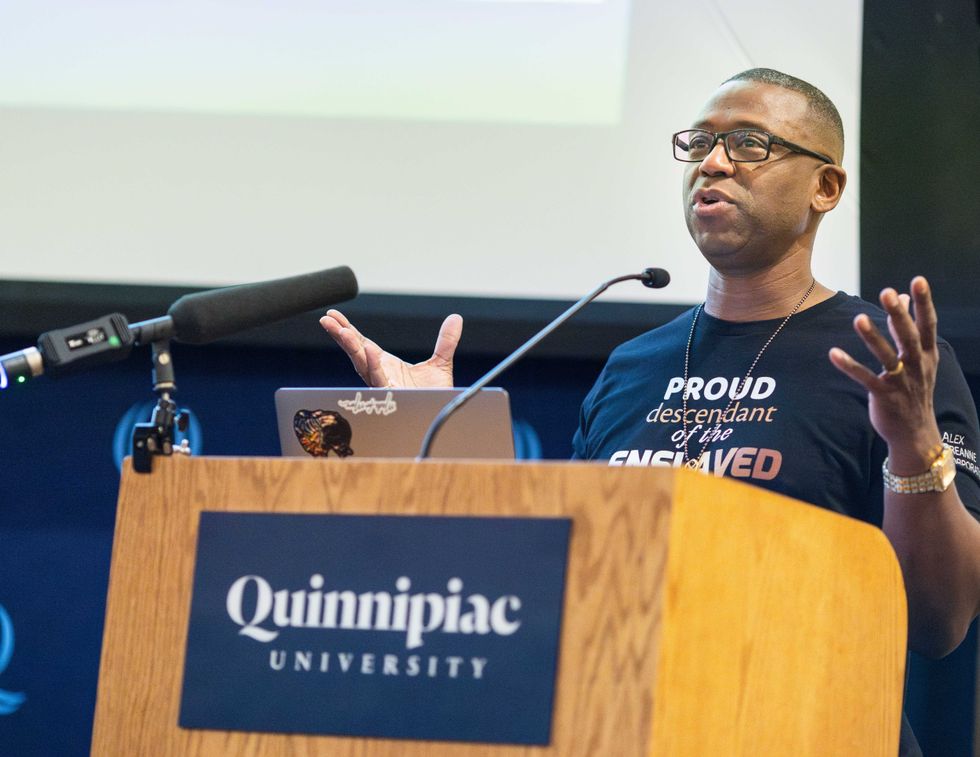 John Mills speaking at Quinnipiac University.Courtesy the Alex Breanne Corporation
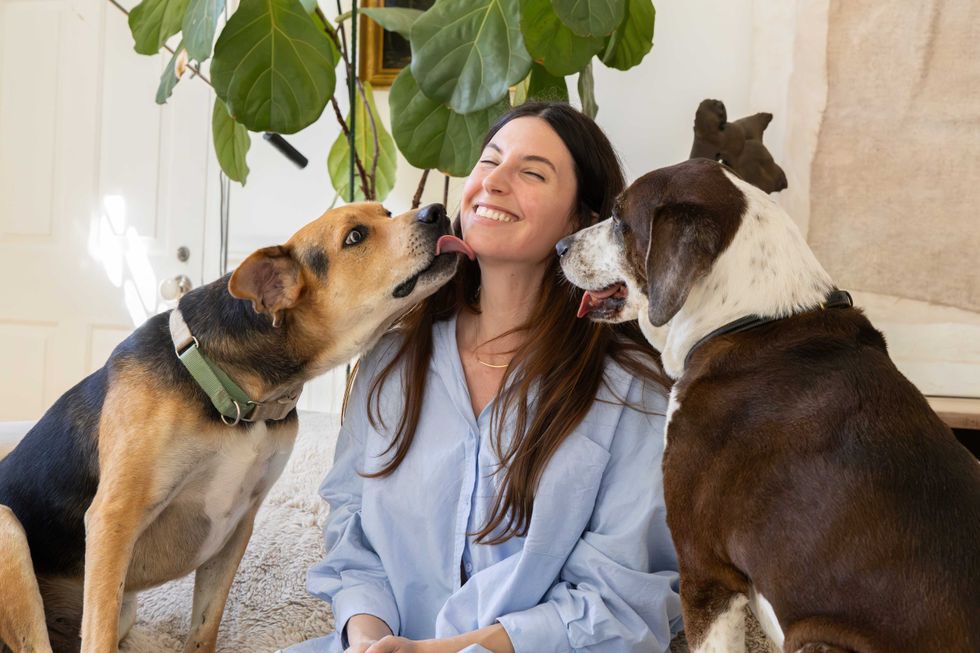 Stephanie Saetta,with her rescue dog George and Blue (left), a shepherd mix awaiting his forever home.Madi Long
 Blue, a 7 year-old Shepard mix, is waiting for his forever home. Madi Long