Cycling season: A roundup of our region’s rentals and where to ride them

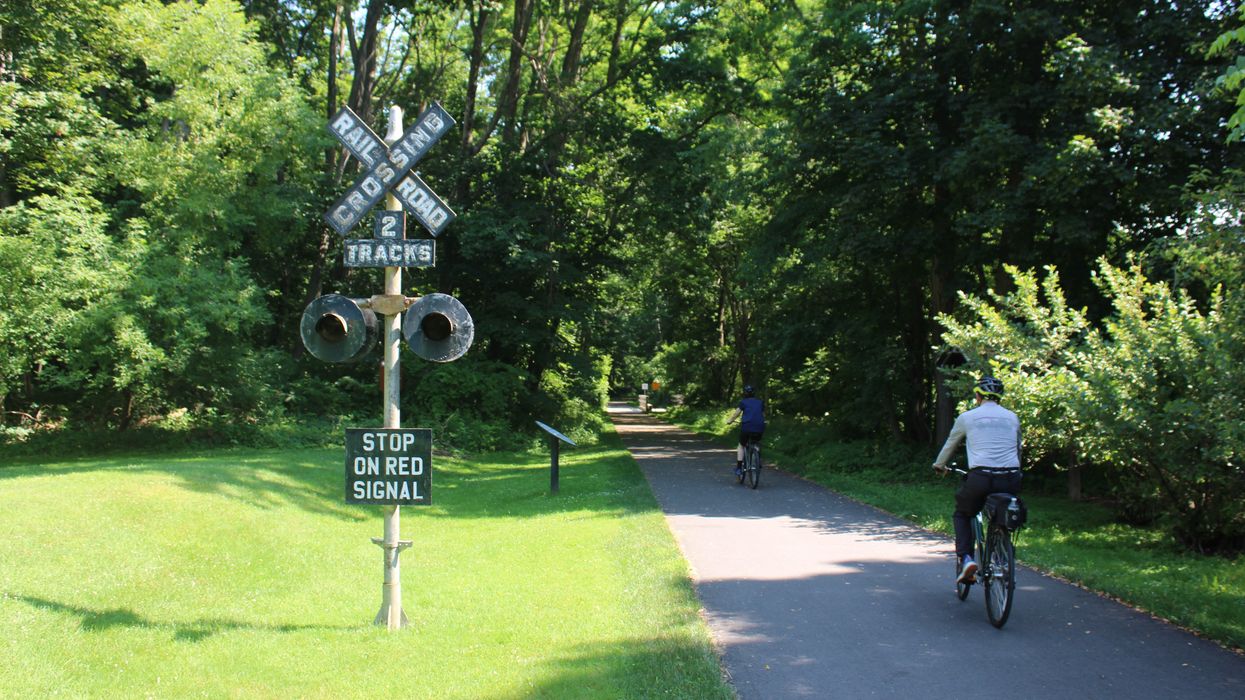
Cyclists head south on the rail trail from Copake Falls.
Alec Linden

Cyclists head south on the rail trail from Copake Falls.
After a shaky start, summer has well and truly descended upon the Litchfield, Berkshire and Taconic hills, and there is no better way to get out and enjoy long-awaited good weather than on two wheels. Below, find a brief guide for those who feel the pull of the rail trail, but have yet to purchase their own ten-speed. Temporary rides are available in the tri-corner region, and their purveyors are eager to get residents of all ages, abilities and inclinations out into the open road (or bike path).
For those lucky enough to already possess their own bike, perhaps the routes described will inspire a new way to spend a Sunday afternoon. For more, visit lakevillejournal.com/tag/bike-route to check out two ride-guides from local cyclists that will appeal to enthusiasts of many levels looking for a varied trip through the region’s stunning summer scenery.
Covered Bridge Electric Bike
Instagram @coveredbridgeebike
West Cornwall:
421 Sharon Goshen Turnpike
West Cornwall, Connecticut 06796
(860) 248-3010
Closed Tuesday, open 10 a.m. to 5 p.m. all other days
Kent:
25 N Main Street
Kent, Connecticut 06757
(860) 248-3010
Open Wednesday to Sunday,
10 a.m. to 5 p.m.
North Canaan:
1 Railroad Street
North Canaan, Connecticut 06018
(860) 248-3010
Open Wednesday to Sunday,
10 a.m. to 5 p.m.
With three locations in the Northwest Corner, this outfit offers a speedier way to zoom on two wheels through the hills with electric-powered offerings for sale or rent. Rentals are available for two hour trips, half days or full days, with several sizes and models in both throttle and pedal assist e-bikes of various styles. Route maps and e-bike trainings are on offer for renters, and guided tours are available on select weekdays. Visit the website, call or email at info@coveredbridgebike.com for pricing and more information.
Each location has its own suggested routes of varying difficulty. Ethan at the Kent location says, “The first place we send people is Macedonia Brook,” the shady and bucolic state park just northwest of downtown. For a more involved ride, Ethan also recommended the quiet country roads that wind through the picturesque hill valleys to the east of town, especially off of Kent Hollow Road and toward Lake Waramaug.
Spencer, who works at the newest location in North Canaan, said that a dual-state two hour ride that takes cyclists into Massachusetts in Ashley Falls, then down into Taconic on Barnum Street and back to North Canaan via Twin Lakes Road and Cooper Hill Road, is his favorite. At the company’s West Cornwall location next to the its namesake bridge, Spencer said a classic ride is up River Road all the way to Falls Village, where riders may visit Great Falls or find some refreshment at the soon-to-open Off the Trail Café. For a longer journey, Spencer suggested continuing up Housatonic River Road north from Falls Village, where it turns into dirt and passes through gorgeous riverside farm country.
The Music Cellar
Instagram @the_music_cellar
14 Main Street
Millerton, New York 12546
(860) 806-1442
Scheduling is available via call or text 24/7
The Music Cellar is an all-instrument music school for aspiring instrumentalists, but it also rents beach cruiser bikes during the warmer months. “They’re perfect for the rail trail,” says owner and music instructor Johnny, referring to the currently 26-mile (and expanding) bike and footpath that passes just outside the storefront. “You don’t have to worry about hitting little bumps or potholes or curbs or whatever – they’re good all-purpose bikes,” he said.
Unique among area bike rentals, the Cellar offers rates starting at $20 for those looking for a shorter ride up to $50 for the day and Johnny said that he’s happy to accommodate sliding scale pricing for locals might have trouble affording the full rate. “It does help keep the lights on, though,” he said, “so if you’re renting bikes, you’re helping kids learn music!”
Johnny said that with the Harlem Valley Rail Trail at his front doorstep, he usually sends riders for a journey on the reclaimed abandoned railbed. The path currently stretches from Wassaic to the hinterlands of Hillsdale, with another 20 miles to Chatham planned to be built in the next five years pending funding. Johnny said riders can choose to head north for sweeping valley vistas below the Taconic mountains, or, “for a more shady ride, you could go south – also equally scenic, lots of wildlife. You can go all the way to Wassaic Station and jump on a train to New York.”
Bash Bish Bicycle & Tour Co.
Instagram @bashbishbicycles
247 NY-344
Copake Falls, New York 12517
(518) 329-4962
Tuesday to Saturday, 10 a.m. to 5 p.m.; Sunday 10 a.m. to 3 p.m.
Located a dozen or so miles up the rail trail is the “ye olde bike shop of the Hudson Valley,” as described by its owner Sam. The shop is just two years from its 30th birthday, and appropriately exudes small-town charm without skimping on modern equipment and service. “It’s the best little bike store in the Hudson Valley,” said Northeast resident Dan Sternberg, who was clad in a cycling kit outside the store on a sunny Friday afternoon in June.
The shop is situated steps from the rail trail, just below the deep, clear and refreshing water of Ore Pit Pond in Taconic State Park, a short jaunt from the old Copake Iron Works site and a mere half mile from the parking lot for one of the Taconic’s region’s treasures and the store’s namesake – Bash Bish Falls. Sam offers day tours to highlight the richness of the region – not only in its natural resources but also the pastoral, cultivated splendor of the farm roads that cut through the hills to the west of Route 22.
Sam says he plans to start running multi-day tours, drawing on experience he had guiding extending bike excursions while operating a lodge in Colorado. Also upcoming is a pop-up shop in Millerton for the summer, which he anticipates opening shortly once the permitting is in order.
In addition to tours, the shop offers sales, repairs and rentals, starting at $35 for a two-hour hybrid bike session ($15 for kids) and $45 for two hours on an e-bike. Visit the website for full pricing details on four hour, full day, multi-day, and weekly rates. Bookings can be made online or via phone.
Sam says he likes to direct guests towards the scattered gems of restaurants, bars and shops that pepper the rail trail corridor and into the hills and dales beyond. The Copake General Store, dishing coffee and café fare alongside locally-produced provisions is just down the road, while market and cultural center Random Harvest and beloved seafood peddler Zinnia’s Dinette sit a close ride away in Craryville. For a summer afternoon tipple, Roe Jan Brewing Company is up the rail trail in Hillsdale, and the creek-side beer garden atmosphere of the Lantern Inn is a somewhat stouter 25 miles down the path in the other direction.
Berkshire Bike & Board
Instagram @berkshirebikeandboard
29 State Road
Great Barrington, Massachusetts 01230
(413) 528-5555
Monday to Friday, 10 a.m. to 6 p.m.; Saturday closing at 5 p.m.
and Sunday at 4 p.m.
With Berkshire locations in Great Barrington and Pittsfield, and two other satellites in Hudson, New York and Bloomfield, Connecticut, Berkshire Bike & Board offers the gamut of cycling needs – a wide variety of gear, expert sales assistance, service and repairs, and of course, rentals.
All four locations carry an e-bike, which costs $69.99 for a single-day rate or a discounted price of 49.99 for longer rentals. The Great Barrington store also offers a non-electrified gravel bike for a single day rate of $99.99 or $79.99 for multiple days. All bookings for rentals are made online on the company’s website.
Great Barrington employee Wyatt described the gravel bike as “a little more aggressive” than a standard hybrid, and “able to handle packed dirt, a little bit of loose gravel, back roads, but not be super slow like a mountain bike” on pavement.
He said both the e-bikes and gravel bikes are well suited to handle one of his favorite routes, the Alford Loop. An approximately 20 mile ride, cyclists take Alford Road northwest out of Great Barrington, and then upon reaching Alford, may choose to take East Road to West Road or vice versa for a scenic and easy circle through the Berkshire forest and fields. In Wyatt’s words: “Great loop, super quiet, not a lot of cars.”
Housatonic Valley Regional High School's boys varsity basketball team won the Berkshire League/Connecticut Technical Conference Holiday Tournament for the second straight year. The Mountaineers defeated Emmett O'Brien Technical High School in the tournament final Dec. 30. Owen Riemer was named the most valuable player.
Salisbury’s Joel Blumert, center, is flanked by Linda Huebner, of Halifax, Vermont, left, and Trish Walter, of Collinsville, atop the summit of Bear Mountain on New Year’s Day. It was Blumert’s 1,000th climb of the state’s tallest peak. The Twin Lakes can be seen in the background.
SALISBURY — The celebration was brief, just long enough for a congratulatory hug and a handful of photos before the winter wind could blow them off the mountaintop.
Instead of champagne, Joel Blumert and his hiking companions feted Jan. 1 with Entenmann’s doughnuts. And it wasn’t the new year they were toasting, but Blumert’s 1,000th ascent of the state’s tallest peak.
The 76-year-old Salisbury resident has been hiking Bear Mountain twice a week, with only sporadic lapses, for nearly a dozen years. On New Year’s Day, Blumert reached the goal he set a few years ago of 1,000 climbs.
He has hiked it in the wintry cold and the summer heat, amid the splendor of the autumn foliage and even in the middle of a daunting tornado.

“It’s just been one step at a time and one climb at a time,” said Blumert, a musician who performs mostly at area nursing homes.
Blumert and his wife, Theresa Carroll, moved to Sharon in 1985 and to Salisbury in 1987, in part for the outdoor recreation the Tri-State region offers. But after their two daughters, Shayna and Denali, were born in the 1990s, Blumert’s exercise regimen started to lag.
In 2000, his doctor reported he had “ridiculously high blood pressure.”
“I decided if I was going to die of a stroke, it was better to die in the woods than sitting around the house,” Blumert said.
He began hiking again and rebuilt his endurance. In March 2014, he summited Bear Mountain, which at 2,316 feet is the highest peak in Connecticut. (The state’s highest point at 2,380 feet lies on the south slope of Mount Frissell at the border with Massachusetts.)
It was Blumert’s first hike up Bear in several years. As he gazed at the Twin Lakes shimmering below, he said to himself, “I love this mountain. I’m going to do this once a week.”
He grew to love the hike so much that after a year he doubled it to twice a week. Since then, Blumert has stuck to his weekly ritual with only occasional pauses for out-of-state trips or illness, along with one 13-week stretch when a pulled ligament in his pelvis planted him on the couch.
He knows the 2.9-mile route intimately, from the Undermountain trailhead off Route 41 to the intersection with the Appalachian Trail and on to the summit. In his sojourns, he has seen porcupines, deer, a timber rattler, a pair of copulating copperheads (“Or maybe they were milk snakes; I didn’t interrupt them to find out”), owls and redtail hawks — yet not a single bear.
Soon after he began hiking Bear regularly, Blumert made another vow: He would be cheerful and friendly to every hiker he met on the mountain. “I’ve developed trail friendships with 20 to 30 people,” he said.
One of them is Collinsville resident Trish Walter, who became a regular hiking buddy and has now climbed the mountain with Blumert about 70 times over the past five years.
Walter and her friend, Linda Huebner, of Halifax, Vermont, joined Blumert for his milestone hike on New Year’s Day. With 4 inches of snow having fallen the night before, they set foot shortly after noon and reached the top just before 3 p.m. The trek back down took half that time.
Aside from the blustery wind approaching the summit, they enjoyed a spectacular day of bright sunshine and blue skies.
The weather hasn’t always been so cooperative. Blumert was once nearly struck by lightning on the upper ridge. And this September, he hiked down in what he described as a tornado.
“It came right down Undermountain Trail,” he noted. “Trees were swishing back and forth. Branches were flying everywhere. There was grape-sized hail. It was scary.”
Now that he has reached his goal, Blumert plans to cut back to one hike of Bear each week. That will free time for other climbs in the area, a recumbent bicycle he has bought, and yet another mountaineering goal.
“I want to complete the 4,000-footers in New Hampshire,” Blumert said. “There are 48 of them, and I’ve done 23.”
Tessa Dekker, four-year basketball player at Housatonic Valley Regional High School, was named female Athlete of the Year at the school's athletic award ceremony in May 2025.
FALLS VILLAGE — From breakthrough victories to record-shattering feats, the past year brimmed with moments that Housatonic Valley Regional High School athletes will never forget.
From the onset of 2025, school sports were off to a good start. The boys basketball team entered the year riding high after winning the Berkshire League/Connecticut Technical Conference Holiday Tournament championship on Dec. 30, 2024.
Basketball games were well attended last winter thanks in part to the return of the Mountaineer cheerleaders. The squad performed halftime shows and coordinated themes for the audience, such as Hawaiian night.
“We made the themes really pop off,” said cheer captain Taylor Terwilliger.

The birth of a new Berkshire League rivalry emerged between HVRHS and the newly created Lakeview High School. The bleachers were packed when the girls and boys teams faced off back-to-back in Falls Village Feb. 5. HVRHS won the girls game 59-43, but Lakeview won the boys game 71-60.
At the end of the basketball season, Daniela Brennan was chosen to receive the Berkshire League’s Edward B. Kolakoski Sportsmanship Award.
The Housatonic co-op hockey team played its final game last winter. After the season, the co-op disbanded and this year HVRHS players are in a new co-op hosted by New Milford High School.

Players took to the diamonds come springtime for baseball and softball. In addition to high school teams, the Region One Middle School Mountaineers fielded teams for both sports.
Varsity baseball went on to earn a state tournament bid as the 21 seed. The boys played 12 seed Haddam-Killingworth High School in the first round and remained tied until a final inning walk-off win for HK.
Varsity girls lacrosse had a stellar season on the field and made it to the Western Connecticut Lacrosse Conference championship game. They ran into top-ranked Watertown High School and after a back-and-forth battle, Watertown won 6-4.

Track and field athletes made waves last season, breaking several school records and taking home 10 gold medals at the Berkshire League finals and festival. Sixteen Mountaineers represented HVRHS at the Class S state meet in New Britain and five went on to qualify for the State Open meet: Anthony Labbadia, Mia Dodge, Kyle McCarron, Gabi Titone and Ryan Segalla.
Labbadia’s performance in the triple jump earned him a spot at the New England track and field championships. His best distance of 44 feet and one inch stood for ninth place in New England and set the new HVRHS record. The previous school record of 43 feet eight inches was set by Don Hurlbutt in 1967.

Athletics continued into the summer with the Housy Hoops teams at the Torrington Summer Basketball League and the Housy Juniors in the Babe Ruth League summer baseball program. The girls basketball team became TSBL runners up after making it to the championship game against Lewis Mills.
When school started up in late August, fall sports swung into action beginning with varsity golf. Jonas Johnson went on to win the longest drive award at the Berkshire League golf all-star tournament Tuesday, Oct. 14.

Girls and boys soccer teams had historic seasons on the field and both qualified for the postseason tournaments.
The boys soccer team defeated Shepaug Valley High School for the first time in five years. The 1-0 win came in the Berkshire League tournament semifinals.
On the girls team, Ava Segalla set the new school scoring record with a total of 134 varsity goals. She surpassed the previous record of 120, which was set by her sister Sydney Segalla in 2021.
“Having scouts for the first time was definitely a very rewarding experience,” Segalla said. “It was exciting to see my hard work paying off.” Segalla committed to play Division I soccer at Sacred Heart University.
Girls soccer made a deep run in the Class S tournament, concluding with a showdown against Morgan High School in the semifinals. Morgan went on to become Class S champions.

HVRHS had three cross country runners medal at the BL championship Oct. 16. Olivia Brooks placed 11th, Hannah Johnson placed 17th and Finn Malone placed 18th.
Gilbert/Northwestern/Housatonic’s co-op football team was led in large part by the Mountaineers with eight seniors on the team. The team faced a top-heavy schedule and started the season 1-4. But they stayed disciplined and battled back to a 5-5 finish, concluding with a 34-0 shutout win in the Turkey Bowl.

“Out of the four years I’ve been playing, undefeated on Thanksgiving. No one will ever take that away from me,” said GNH captain Wes Allyn after the win.
Winter sports returned in December beginning with basketball. The girls team has a lot of young talent in new freshmen, and the boys team features a senior-heavy roster.
“I’m feeling very optimistic,” said senior captain Victoria Brooks. “Our strength is definitely going to be our dedication this year.”

Sharon Hospital, shown here, experienced a consequential year marked by a merger agreement with Northwell Health, national recognition for patient care, and renewed concerns about emergency medical and ambulance coverage in the region.
Housing—both its scarcity and the push to diversify options—remained at the center of Sharon’s public discourse throughout the year.
The year began with the Sharon Housing Trust announcing the acquisition of a parcel in the Silver Lake Shores neighborhood to be developed as a new affordable homeownership opportunity. Later in January, in a separate initiative, the trust revealed it had secured a $1 million preliminary funding commitment from the state Department of Housing to advance plans for an affordable housing “campus” on Gay Street.
That commitment was later doubled by the state, allowing the trust to break ground in September on a project that will renovate the long-defunct Community Center—once a Masonic Temple—into four additional affordable units. Those apartments will join six already occupied units in adjacent buildings, creating a unified, 10-unit development. The project cleared its final local hurdle in November, receiving approvals from both the Zoning Commission and the Historic District Commission.
Alongside those efforts, a more contentious proposal dominated Planning and Zoning Commission agendas during the first half of the year. A condominium development proposed near Sharon Hospital drew support from residents who favor a more diverse housing mix, while neighbors raised concerns about potential impacts on property values and quality of life.
The project, proposed by Gold Dog LLC, a private development company, was approved in August following months of heated public hearings. That decision, however, has since been appealed by opponents, ensuring that housing will remain an ongoing issue.
Health
It was a consequential year for Sharon Hospital, marked by major institutional changes, national recognition, and lingering concerns about access to care.
In May, Nuvance Health, the nonprofit operator of Sharon Hospital, announced that it had formalized a merger agreement with Northwell Health, one of the largest healthcare systems in the Northeast. The announcement raised concerns among some residents who feared consolidation could lead to reduced services at a facility that serves a region often described as a healthcare desert.
Hospital President Christina McCullough sought to reassure the community, emphasizing that the merger was intended to strengthen—not diminish—local care. “It’s not about cutting resources and cutting services,” she said. “It’s about optimizing what both of those organizations have, ultimately strengthening the access to care for everyone that lives in the community.”
In July, Sharon Hospital was the only Connecticut facility included on a national list of rural hospitals considered vulnerable to potential Medicaid cuts, underscoring the financial pressures facing small hospitals nationwide.
Despite those challenges, the hospital earned national recognition the following month. In August, Sharon Hospital received a national award for excellence in stroke care. Later in the year, it was awarded its sixth consecutive “Five Star” rating from the Centers for Medicare and Medicaid Services, placing it among just 290 hospitals nationwide to receive the distinction.
The year ended on a more uncertain note, however, when the hospital announced it would discontinue its longtime emergency response provider, Northern Dutchess Paramedics, effective Jan. 1. The decision raised fresh concerns among residents about the future of ambulance coverage and emergency medical services in the region.
Nature
Sharon’s connection to its natural environment remained strong throughout 2025, with residents, conservation groups and state officials engaging in efforts to protect local ecosystems and wildlife.
In April, local conservationist and invasive species expert Tom Zetterstrom addressed a packed Town Hall, outlining strategies to protect Sharon’s woodlands from invasive oriental bittersweet. Drawing on both successes and setbacks at the Sharon Land Trust’s Hamlin Preserve, Zetterstrom highlighted the urgency of sustained management and community involvement.
That same month, concerned residents formed the Mudge Pond Association in response to a December 2024 study that warned of imminent threats to the pond from invasive species and polluted runoff. Since its formation, the group has begun piloting protective measures and planning long-term stewardship efforts for the popular lake.

Conservation efforts expanded later in the year when the Sharon Land Trust partnered with the Northeast Wilderness Trust to secure Sharon’s first “Forever Wild” protected land. Announced in late summer, the designation places roughly 700 acres surrounding Sharon Mountain under a permanent conservation easement, safeguarding critical wildlife habitat from development, logging and motorized use.
Wildlife coexistence also drew attention in December, when the state Department of Energy and Environmental Protection hosted a community roundtable on living alongside black bears. Residents emphasized a “human behavior”-focused approach, advocating for changes in food storage and waste management rather than lethal controls.
Throughout the year, the Sharon Audubon Center remained active with public programs and education initiatives, culminating in its annual December bird count. The event connected local volunteers to a nationwide community-science effort to track winter bird populations.

Holiday season
The year closed with holiday traditions that underscored Sharon’s sense of community, bringing warmth and light to the darkest days of winter. Annual tree and menorah lightings, held five days apart in mid-December, brought luminance, song and joy to the snow covered Village Green in scenes that were classically Sharon.