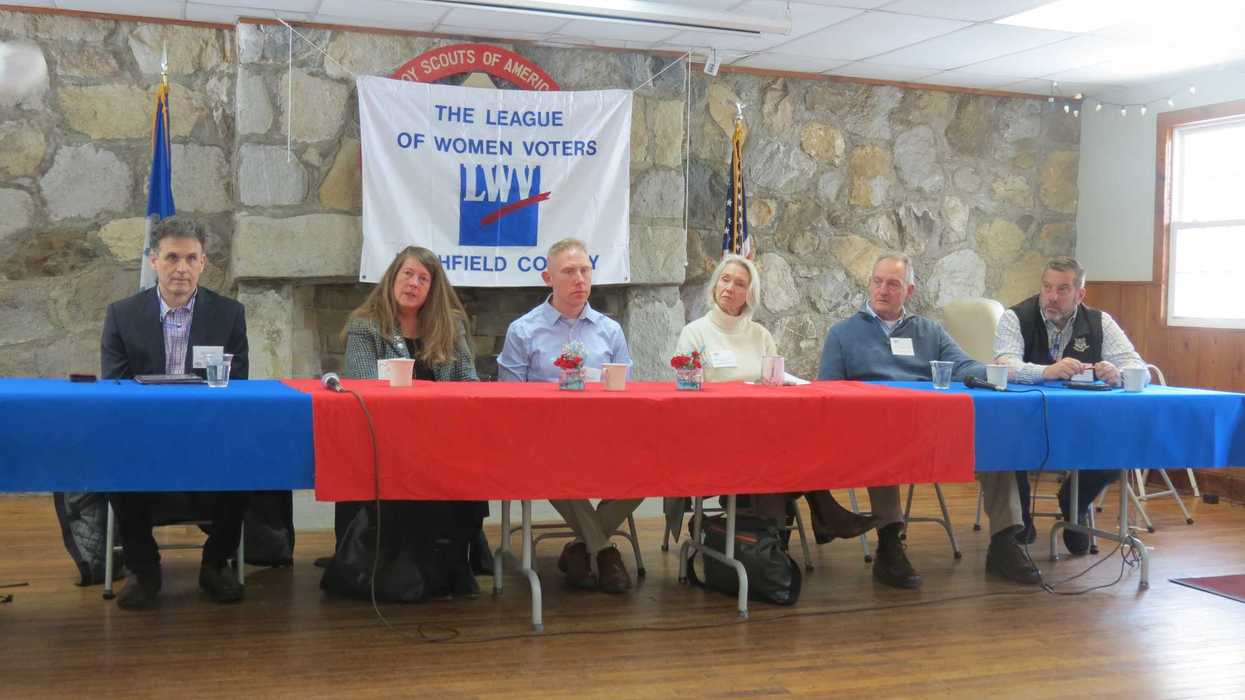
GOSHEN — Local state lawmakers delivered a unified message at Saturday’s League of Women Voters breakfast: keep the federal government out of Connecticut elections.
The six representatives in attendance were Sen. Paul Honig (D-8); Rep. Karen Redington Hughes (R-66); Sen. Stephen Harding (R-30); Rep. Maria Horn (D-64); Rep. John Piscopo (R-76); and Rep. Jay Case (R-63).
The league holds the forum annually to provide constituents with an opportunity to hear from lawmakers about current issues and to raise questions and concerns.
The discussion opened with a question from Sharon resident Jill Drew, who asked whether there was any possibility November’s election in Connecticut could be canceled and what steps were being taken to ensure it would proceed as scheduled later this year.
The question was prompted, in part, by recent concerns among state officials about possible federal interference in election administration, including efforts to safeguard voter data.
Honig said he sees no emergency and called the notion of canceling an election “insane.” While acknowledging isolated issues such as the absentee ballot incident in Bridgeport, he said Connecticut’s system works well and lawmakers are pursuing legislation to streamline it.
“President Trump saying our elections are corrupt is nonsense,” Honig said. “It’s more that he doesn’t like Connecticut because he didn’t win here.”
Meanwhile, Redington Hughes said she is confident the elections will go ahead as planned, “but we need to respect the process.”
Harding said having the federal government oversee the Connecticut voting process would make no sense. “I’m 100% against canceling the election. No elected official should support that.”
Horn said she worries about federal intimidation when it comes to voting. She favors the implementation of early voting, but realizes the 14-day early voting system can be costly and difficult to administer in a lot of ways.
“I would oppose Washington interfering with elections and any Hartford influence,” said Piscopo. “We’re good at running our own elections.”
He would like to see early voting reduced to four days, pointing out it cost Thomaston $1,600 per vote in the last election. “There’s no need for same-day registration. That should be phased out,” he added.
Case agreed with his colleagues that there should be no fear about what will be seen in the November election.
When asked whether the U.S. Department of Justice should sue states for access to voter rolls, all six lawmakers responded no.
One attendee defended early voting, arguing it should be viewed as an investment in democracy rather than an expense, particularly in light of low voter turnout.
The conversation later shifted to taxes and social services.
Harding said he fully supports eliminating state taxes on Social Security and pension income. “The state can take its hand off these taxes.”
Horn noted that individuals earning $75,000 or less and couples earning $100,000 or less already pay no state tax on those benefits. However, she said taxpayers exceeding those thresholds “fall off the cliff,” an issue lawmakers are discussing.
A man who operates several group homes said low reimbursement rates have made it difficult to retain staff, leading to chronic shortages and increasing financial strain.
Case responded that supporting the state’s most vulnerable residents — including those in nursing homes, group homes and experiencing homelessness — is a top priority for him.
Honig raised concerns about private equity firms acquiring care facilities primarily for profit. “That can cause serious problems and something needs to be done,” he said.
Concerns about Medicaid, SNAP and other federal programs also surfaced.
Case noted those programs are federally funded, but Drew responded that federal cuts inevitably shift financial pressure onto states. Case said Connecticut is examining what options it may have.
Piscopo said he supports certain federal spending cuts.
“Some cuts by the federal government I agree with,” Piscopo said. “If someone is able-bodied, they should go to work.”
Horn countered that approximately 80% of Connecticut Medicaid recipients are employed but often struggle with added bureaucratic requirements. “The cuts are hurting education, finances, housing and family planning,” she said.
Honig added, “People are struggling to make ends meet. Federal cuts on top of that make it harder.”
Education funding drew attention as well.
Flora Lazar, a member of the Region One Board of Education, said school districts are seeing health insurance costs ballooning. “Ultimately, that will result in cutting out programs for kids.”
Honig noted that Educational Cost Sharing funds have not increased in 12 years, shifting the burden to local taxpayers.
Piscopo said he supports increasing ECS funding for municipalities.
Horn also stated that Connecticut sends more money to the federal government than it receives in return. “We are net losers. We give more than we get back.”
Childcare affordability emerged as another major concern.
A young mother said she and her husband are struggling with daycare costs. Horn said a childcare trust fund is set to begin in July 2027, which would make care free for families earning $100,000 or less, or capped at 7% for those earning more.
Immigration enforcement and housing instability rounded out the discussion.
An audience member asked the legislators to be sure the Department of Homeland Security doesn’t put large detention centers in the state. Honig said there is a bill proposed to prevent such a move.
A man who runs a shelter program at Trinity Church in Torrington said funding shortfalls will force 13 women — several elderly or disabled — out of housing in April, putting them at risk of returning to homelessness. “Give me a break,” he said. “We need to help these people once they get into houses or they’ll be back out on the street.”