Persistently amplifying women’s voices

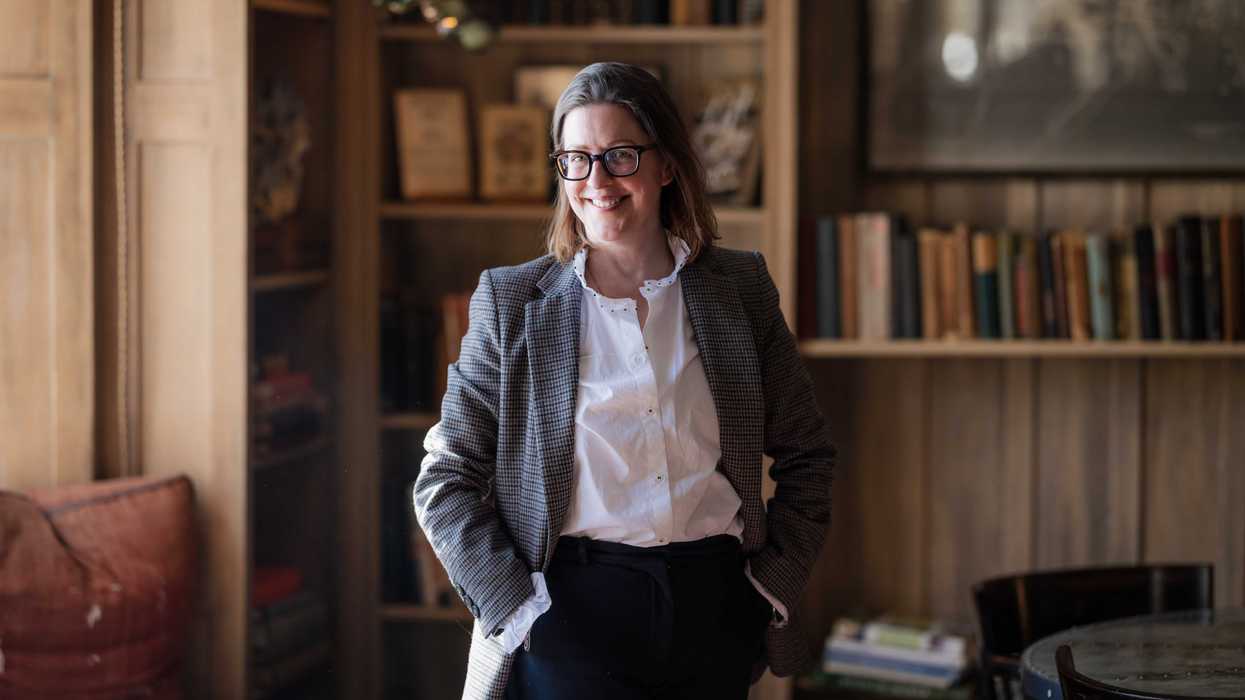
Francesca Donner, founder and editor of The Persistent. Subscribe at thepersistent.com.
Aly Morrissey

Francesca Donner, founder and editor of The Persistent. Subscribe at thepersistent.com.
Francesca Donner pours a cup of tea in the cozy library of Troutbeck’s Manor House in Amenia, likely a habit she picked up during her formative years in the United Kingdom. Flanked by old books and a roaring fire, Donner feels at home in the quiet room, where she spends much of her time working as founder, editor and CEO of The Persistent, a journalism platform created to amplify women’s voices.
Although her parents are American and she spent her earliest years in New York City and Litchfield County — even attending Washington Montessori School as a preschooler — Donner moved to England at around five years old and completed most of her education there. Her accent still bears the imprint of what she describes as a traditional English schooling.
Today, she and her family call Sharon, Connecticut, home. While she still travels frequently to Manhattan, she embraces the contrast between city and countryside.
“For me, it’s all about the contrast,” she said, adding that she is friendly and curious about people here in a way that doesn’t feel natural in the city. “I want to know who you are, what you do, and why you’re here. You end up meeting these really interesting people.”
As a longtime editor in newsrooms like The Wall Street Journal, The New York Times and Forbes, Donner said she began to notice something unsettling about how stories were framed, and whose voices were missing.
“It’s just the way news is done,” she said. “It’s the DNA of what we deem newsworthy and important in mainstream media.”
The problem, she explained, isn’t that women aren’t covered at all. It’s that when women are covered, it’s often in a stereotyped way. Women are frequently framed through familiar narratives – the gender pay gap, unpaid labor, caregiving – important issues that persist, she said, but are often treated as repetitive or secondary. Meanwhile, the stories deemed front-page worthy tend to revolve around power, economics, war and politics — and men.
“If we don’t make a deliberate effort to cover women, women won’t be covered,” Donner said.
The issue isn’t unique to any outlet, she stressed. “It’s just the way news is done.”
But that DNA — who gets quoted and whose experiences are centered — has consequences.
And for Donner, that realization demanded a response.
Enter The Persistent.
Founded in 2024, The Persistent was built around what Donner calls a simple but deliberate premise.
“Women don’t get covered in the same way men get covered,” she said.
The goal isn’t to exclude men or create a siloed “women’s section.” Instead, Donner said, it’s about correcting an imbalance by putting women at the center of the story.
Describing the approach as a reframe, this means expanding who is quoted as an expert. It means spotlighting women in business, politics, culture and global affairs. It also means examining major news stories through a lens that mainstream outlets often overlook.
“What we can add,” she said of The Persistent, “is perspective.”
Now approaching its second year — a milestone that will be celebrated next month — the publication operates with an all-women team of writers, editors and illustrators based across the world. The team meets regularly over Google Meet.
“They’re awesome,” Donner said of the editorial meetings. Some of her staff are mothers, some are not. All bring lived experiences to the table. Donner has intentionally created a newsroom culture that balances rigor with support.
“If your writing doesn’t measure up, I’m going to tell you,” she said plainly. “But it’s not a battle. It’s a partnership.”
Beyond publishing stories that matter, Donner wants contributors to be seen.
“I don’t just want people to read the story and forget who wrote it,” she said. “We can do a lot better if we amplify each other.”
As a woman, Donner rejects the idea that success is finite. She wants everyone to have a slice of the pie.
“Just make the pie bigger,” she said. “Bring more seats to the table. Make it richer.”
Donner credits her “mum” for articulating what would become her professional identity.
“You are what you can’t help doing,” her mother used to say.
Today, without hesitation, Donner said she can’t help being an editor.“My identity as an editor is very strong,” she said. Editing, she explained, is less about correcting typos and more about building and shaping ideas.
“Sometimes I imagine this physical movement of cracking something open,” she gestured.
That instinct traces back to childhood. She recalls sitting in a classroom around age 10, listening to a classmate read a short story aloud. For Donner, that moment crystallized something fundamental.
“Someone else’s words made me just sit up straight in my chair and think, wow, that is so good.”
Today, whether she’s in a historic manor house in Amenia or on a Google Meet with her team across the globe, that instinct remains the same: crack the story open, elevate the unheard voice and reframe the narrative.
Natalia Zukerman
For Elizabeth Frabizzio and Zoe Czerenda, the studios at FineLine Theatre Arts in New Milford, Connecticut hold a lifetime of memories. Both women grew up there, first as students, then as young teachers. Last September, they became the studio’s new owners.
The studio was founded in 2006 by Broadway veterans Elizabeth Parkinson and Scott Wise. Parkinson, a former principal with the Joffrey Ballet, and Wise, a Tony Award winner for “Jerome Robbins’ Broadway,” built the school on professional-level training paired with a strong sense of community. As they prepared to step back from running the school, they didn’t look far for successors. In September 2025, they handed the studio keys to two dancers who had come up through its ranks.
“It felt like the natural progression of my career,” Frabizzio said.
Frabizzio joined FineLine as one of its earliest students during her senior year of high school. Not long after graduating, the founders offered her a small class to teach.
“They gave me my first class as I was dabbling in the professional world and auditioning and performing,” she said.
Her career soon took her well beyond New Milford. She performed as an ensemble dancer in the Radio City Christmas Spectacular at Radio City Music Hall, with the modern dance company Momix, and appeared in Darren Aronofsky’s “Black Swan.”
Over time, teaching pulled her back toward the studio. About 10 years ago, after getting married, Frabizzio began gradually taking on administrative responsibilities and helping run the school behind the scenes.
Also a New Milford native, Czerenda began dancing at FineLine as a child and later joined the studio’s pre-professional repertory company, Artists in Motion. By age 15 she was assisting with classes.

Today, Czerenda and Frabizzio share the day-to-day work of running the studio. Their first school year as owners has come with a few surprises.
“It’s been kind of a wild ride,” Frabizzio said, laughing. She welcomed her second child last summer, just as the transition to ownership began.
“I’m so lucky that I have Zoe,” she said. “She’s an amazing partner. She kind of steered the ship and ran the show the first trimester of the year.”
While the leadership is new, the philosophy of the studio remains firmly rooted in what Parkinson and Wise built.
“I’m definitely preserving the technique and the passion that Elizabeth and Scott brought to FineLine,” Frabizzio said.
The founders’ Broadway backgrounds shaped the studio’s approach to training, emphasizing strong technical foundations for dancers of all levels.
“A solid technique is something that anybody would want, regardless of aspirations,” said Frabizzio. “If you want to be a professional or if you want to be a recreational dancer, it’s important to learn the right way.”
FineLine now serves more than 100 students ranging from age 3 through adults. Classes include ballet, tap, jazz, contemporary, lyrical, acrobatics and musical theatre, along with vocal performance and drama. The theatre program is led by Robin Frome, who also runs the Sherman Playhouse.

The studio recently received another sign of its local support, earning first place in Litchfield Magazine’s 2026 Readers’ Choice awards.
“We were really excited to come in first place,” Frabizzio said. “It’s so great for the area.”
At the same time, the new owners are mindful of how demanding dance culture can sometimes become.
“What I pulled from the professional world was how toxic it could be,” Frabizzio said. “I just want these kids to feel loved. I want them to feel empowered and to know that they are enough at any ability.”
For the past 15 years, Frabizzio has primarily taught children between the ages of 3 and 10 — often their first introduction to dance.
“I don’t take that role lightly, especially now that I’m a mom,” she said. “I know what those first impressions are and what they mean.”
Her goal is simple: “I want them to walk away with love and joy,” she said. “I want them to be excited to come to class.”
Accessibility is also part of the studio’s mission. This school year, FineLine awarded $23,000 in scholarships to students through an application process supported in part by community performances at the studio.
Looking ahead, FineLine will present its annual spring performance at the end of May, followed by its summer programs in July and August.
For Frabizzio and Czerenda, the studio’s next chapter is less about reinvention than stewardship.
“We’re really trying to preserve what they gave us,” Frabizzio said. “And that’s the love and the joy of dance.”
“Being an educator has been the greatest blessing of my life,” said Czerenda. “To be a safe space, a light of positivity or an outlet for these kids is what makes this experience so special. They teach me how to be a better educator and I like to think I help them become better humans as well as dancers and performers.”
Find out more and sign up for a class at finelinetheatrearts.com
Graham Corrigan
Wolfgang Amadeus Mozart
For centuries, Wolfgang Amadeus Mozart has overshadowed nearly everyone in classical music, including the talented musicians in his own family: his father Leopold, his sister Maria Anna Mozart and his son Franz Xaver Wolfgang Mozart who were all prolific composers and musicians in their own right.
On March 15, Great Barrington’s Mahaiwe Theater will explore the legacy of Mozart with its “Meet the Mozarts” concert. It’s mostly Amadeus — a quartet will perform the maestro’s “Piano Trio in B-flat, KV 502” and “Quartet in G minor, KV 478” — but the evening will feature works from both the elder and younger Mozarts.
“The story of Mozart is forever an enigma,” said Close Encounters with Music’s artistic director Yehuda Hanani. “It’s really a mystery. How did a man who, as a child, dazzled the royals of Europe end up in an unmarked grave?”
Leopold Mozart is best known for writing a foundational textbook on playing the violin. His catalog included church music, opera dances and symphonies, though much of it has been lost over time. Amadeus was his seventh child, and he served as the boy’s primary music teacher after the toddler began imitating the piano lessons taken by his older sister.
“Mozart’s father really made him what he was,” Hanani said. “He was a devoted pedagogue. He drilled him, and he corrected his early pieces. And then, of course, he was a great promoter. He created the legend.”
Mozart’s son, Franz Xaver Wolfgang, was born just four months before his famous father’s death. His musical education included lessons connected to such figures as Joseph Haydn and Antonio Salieri, and he socialized with contemporaries such as Franz Schubert and Robert Schumann. He was a renowned composer in his own right, “and he probably would have been much more acknowledged and known if not for his misfortune of being the son of a great genius,” Hanani added. Wolfgang would often perform his father’s work alongside his own. As his tombstone notes, “May the name of his father be his epitaph, as his veneration for him was the essence of his life.”
The Mahaiwe’s concert will feature a fourth Mozart: AI Mozart. “We are living in a very revolutionary technological, artistic, cultural time with AI, and it’s creating some kind of cultural crisis,” Hanani said. “So, we’re doing something a little whimsical, a little naughty and a little serious at the same time.” The three-minute piece uses Mozart’s existing oeuvre to create a composite work.
Hanani has mixed feelings. “If you compare [AI Mozart] to Leopold and Wolfgang Mozart, it’s not so bad. But next to the real Mozart, it’s full of clichés and platitudes, and it’s really drawing on something that was already there… There’s no spark in it.”
For more information and tickets, visit Mahaiwe.org
Brian Gersten
With awards season upon us, it’s that familiar time of year when one might realize they have seen little to no buzzworthy films this past year. Perhaps you were too busy shoveling your driveway this February to catch “K-Pop Demon Hunter.” Or maybe, after realizing there are 469 known feature films featuring Frankenstein’s monster, you thought it untoward to see the latest iteration of “Frankenstein” by Guillermo del Toro before viewing the previous 468 installments.
Whatever the case may be, if you need some last-minute conversational guidance for your upcoming Oscar party, I am here to get you up to speed on some of the 2026 Academy Award nominees that are worth seeing — and worth skipping.
“One Battle After Another” — SEE IT
Arguably the best movie of the year and a film that reflects our contemporary American moment better than anything else. Watching “One Battle After Another” is like looking in a mirror — witnessing an oppressive white nationalist government (represented by a grotesque Sean Penn) attempting to thwart a coalition of resolute freedom fighters (led by Leonardo DiCaprio, Teyana Taylor, Chase Infiniti, Regina Hall and Benicio del Toro). It’s a 3½-hour revolutionary roller coaster with unexpected laugh-out-loud humor, capped off with one of the greatest chase scenes ever put on film. A must-see.
“F1”— SKIP IT
A 2½-hour formulaic car commercial with next to no redeeming qualities. I’d skip it faster than Brad Pitt driving a McLaren at 200 mph.
“Bugonia” — SEE IT (BUT EXPECT NIGHTMARES)
Emma Stone and Jesse Plemons are hauntingly terrific in this twisted kidnapping escapade. Plemons plays a gaunt conspiracy theorist who thinks our capitalist overlord (Stone) is an alien intent on destroying mankind and taking over the world. A brilliant take on the complexity of conspiracies, the film keeps you guessing until the very end about what’s true and what’s not.
“Hamnet” — SEE IT (BRING TISSUES)
A Shakespearean tale of love and loss. To call it a tearjerker would be an understatement. A powerful and instant classic.
“Sinners”— SEE IT (IF YOU LIKE HORROR FILMS)
The one film of the year where the buzz surrounding the project might outweigh its artistic ambitions. Racist white vampires terrorizing Black juke joint patrons in the Jim Crow South is as scary a horror premise as there is, and there’s loads of powerful symbolism at play. But at the end of the day, it felt like just another gory, gruesome horror movie. Loved the Buddy Guy cameo, though.
“Marty Supreme” — SEE IT
Whether you like Timothée Chalamet or not, his performance as the Trump-esque Marty Mauser — a professional pingpong player and hustler who will stop at nothing to achieve his goals — is an astute take on the affliction of American exceptionalism. With an anxiety-inducing pace and cadence we’ve come to expect from director Josh Safdie, the film is full of truly bizarre and memorable moments and characters.
“The Alabama Solution”— SEE IT
Pine Plains resident Andrew Jarecki takes viewers inside the Alabama state prison system in a documentary constructed almost entirely from cellphone footage covertly shot by prisoners. The conditions inside are utterly deplorable and completely shocking — resembling modern slavery more than rehabilitation. One struggles to make sense of the inhumanity and to come to terms with the fact that this is happening in America in 2026.
The 98th Oscars will take place Sunday, March 15, 2026, at 7 p.m. The ceremony will be hosted by Conan O’Brien and broadcast on ABC, with streaming available on Hulu.

Want more of our stories on Google? Click here to make us a Preferred Source.
Mike Cobb
Students at Berkshire Waldorf High School rehearse for the performances of “Little Women” March 13-15 at The Unicorn Theater in Stockbridge.
The Berkshire Waldorf High School presents “Little Women” by Kate Hamill, adapted from the novel by Louisa May Alcott, at The Unicorn Theater in Stockbridge, Massachusetts.
Director Kendell Shaffer has taught screenwriting for the Writers Guild Foundation High School Screenwriting Workshops. About the choice of play, Shaffer said,
“The idea of ‘Little Women’ came from our senior girls who wanted a play with a heavy female cast after doing ‘The Outsiders’ last year. Kate Hamill’s adaptation is spunky, funny, with a contemporary feminist slant that transcends Louisa May Alcott’s ideas to today’s audience.”

Actor Noelle Bodenstab said, “My role is Hannah. She’s very sassy and a very big contrast from the role I played in ‘The Outsiders’ last year. I feel as though it’s exercising my acting abilities, and I’m really excited to see how it turns out in the play.”
Actor Leo Martinez said, “I am playing Laurie, who is a friend of the Marches and this lonely, rich, sentimental guy who doesn’t really like the traditional idea of a man. His character revolves around his love for Jo, who doesn’t fit into the role of a girl very well, and them growing up together.”
The production features contemporary and original songs performed by the Berkshire Waldorf High School rock band.

“Having been a TV producer in L.A. before relocating to the Berkshires, I like to add live music to plays I direct, similar to underscoring a film or TV episode,” said Shaffer. “The music helps guide the emotion and elevates the experience for both the audience and actors. Using contemporary music performed by our school’s rock band updates this classic play.”
“We are fortunate to have so many talented students at the Berkshire Waldorf High School and professional mentors working with the students as costume designer, choreographer, musical director, and vocal coach. The Berkshires are alive with artists, and it’s a gift to work with its seasoned and emerging talent,” Shaffer added.
Performances start at 7 p.m. Friday, March 13; 7 p.m. Saturday, March 14; and 2 p.m. Sunday, March 15.
For more information, visit berkshiretheatregroup.org.
Lakeville Journal
On Friday, March 13, The Cary Institute of Ecosystem Studies in Millbrook will host a reception and lecture with Robin Wall Kimmerer, bestselling author of “Braiding Sweetgrass.” A plant ecologist and member of the Citizen Potawatomi Nation, Kimmerer blends Indigenous knowledge and Western science to explore how plants and ecosystems can teach us about reciprocity, resilience and our relationship to the natural world. The in-person event is sold out. To register for the online event, visit caryinstitute.org
Lakeville Journal
Deborah Simon’s “Ecological Streams of Consciousness: Sika Deer (2025).”
This Must Be the Place, the winter exhibition at Wassaic Project, will have its closing reception on Saturday, March 14. The exhibition showcased the work of 11 artists throughout the seven floors of Maxon Mills, exploring personal and cultural history, material transformation, the sacred and speculative and immersive encounters. There will beartist talks beginning at 2 p.m. followed by open studios of the March artists-in-residence program.

Want more of our stories on Google? Click here to make us a Preferred Source.

Want more of our stories on Google? Click here to make us a Preferred Source.