It has it all, “The Real Inspector Hound�: Playwright Tom Stoppard, Shakespeare & Company actors, and director Jonathan Croy, the fellow who turned this season’s “Richard III� into a rip-roaring exhibition of star power and theatrics.
And, yes, jokes. “Hound� has lots and lots of them.
The setting is a British country manor routinely separated from the rest of the empire by fog and high water. And all the action takes place in the drawing room, of course, a handsome place strewn with potted palms, shiny trinkets, Chinese pots (every item, it seems, harboring a handy measure of gin) and a body. A dead one. On the floor.
Think Agatha Christie, with gags: musical, verbal and sight.
It’s clear from the start, “Hound� operates on the notion, elevated to new heights by Croy, that if a joke works once, it ought to be employed again. And again.
Croy’s first move is to make Mrs. Drudge, the cleaning lady, blind. Stoppard had her simply ignore the body as she does her daily dusting. But the opportunities for schtick with a character (played by Meg O’Connor) who passes out tea by dropping cups into thin air, repeatedly, and dusts furnishings she cannot see are too numerous and beguiling for Croy to pass up.
Now Drudge’s real job is to answer the telephone and tune the radio to police reports of a madman on the loose. Nearby. Meanwhile, a pair of theater critics sit in the front row and chat.
“It’s a whodunnit, man!� Birdboot (Josh Aaron McCabe) tells Moon (Enrico Spada), loud enough for us all to hear. The two take notes, drink water and eat chocolates: gooseberry fondue, pistachio fudge, Chateauneuf du Pape ’55 cracknell. (A few years after Stoppard wrote “Hound� Thomas Pynchon’s Slothrop in “Gravity’s Rainbow� observed “The English are kind of weird when it comes to the way things taste� after eating camphor-flavored sweets, a gin marshmallow and a cough drop that made him feel as though he had been “belted in the head with a Swiss Alp.�)
Enter mysterious stranger Simon Gascoyne (David Joseph) through the French windows. Enter Felicity (Alexandra Lincoln), a house guest, through the French windows. Enter Lady Cynthia Muldoon (Dana Harrison), the lady of Muldoon Manor, the same route, playing tennis in a plum satin evening gown. Now, along with wheel-chair bound Major Magnus Muldoon (Scott Renzoni) — a Canadian with a Scottish accent — there are four for a card game that moves about the room, merges rules from bridge, canasta, roulette, maybe bingo, and requires hectic displays of temperament of everyone at the table.
Still, no one notices the corpse. Not until the end of Act I.
By then we have seen all kinds of shenanigans: Birdboot crossing the stage to answer the manor phone (and speaking to Myrtle, his “homely but good-natured wife�), and forcing audience members to change seats with him. So much for the critic’s icey remove.
And we have seen acrobatic romancing, several homicides, obscured identities, many more sight gags and, finally, the real Inspector Hound.
By the end, of course, all is clear: It’s Stoppard’s play, but it’s Croy’s world.
“The Real Inspector Hound� runs at Shakespeare & Company’s Elayne P. Bernstein Theatre in Lenox, MA, through Nov. 7. For tickets: 413-637-3353.
Now, for another take on English country weekends, The Ghent Playhouse is staging Noel Coward’s “Hay Fever.�
Critics complained back in 1925 that this farce was short on plot and witty lines. But it certainly gives actors ample opportunities to let loose as members of a self-absorbed family who invite acquaintances to their house and then berate or ignore them. Meg Dooley has a grand old time playing Judith Bliss, famed actress now retired, and Cathy Lee-Visscher is her fine histrionic self as the seductive Myra Arundel.
Clara, the maid, Judith’s former dresser (Ellen Lieberman), has the shortest and best role, slamming tea trays about and unwelcoming visitors at the door. The rest of the cast is fine in this straight-forward production of a play about useless, flimsy, irritating people.
“Hay Fever� plays at the Ghent Playhouse through Oct. 31. Tickets: 518-392-6264.
When young girls pretend they are princesses, the game is meant to be fun. When grown men pretend they are women who are pretending to be maids, who are pretending to be each other and also their mistress, it’s meant to unsettle. This is Jean Genet’s play “The Maids.�
Two sisters, Claire (David Anderson) and Solange (Daniel Osman), play games, pretending to be each other and “Madame� (Ken De Loreto). The game always ends in the killing of Madame, which (in their minds) gives them power and control.
Director Thomas Gruenewald’s production at the New Stage Performing Arts Center in Pittsfield uses male actors who enter and don their women’s clothes on stage. Throughout the play, the fact that they are men is distinctly in mind, while one still partially believes they are actually women. This is a confusing artistic decision, but its purpose is to add another layer of pretense to the scenario.
This production is intense, edgy and exciting.
“The Maids� runs at the New Stage Performing Arts Center, 55 North St., in Pittsfield, MA, above the Beacon Cinema. It runs Friday, Saturday and Sunday through Oct. 31. For tickets, call 413-418-0999.
— Kara Wilbeck


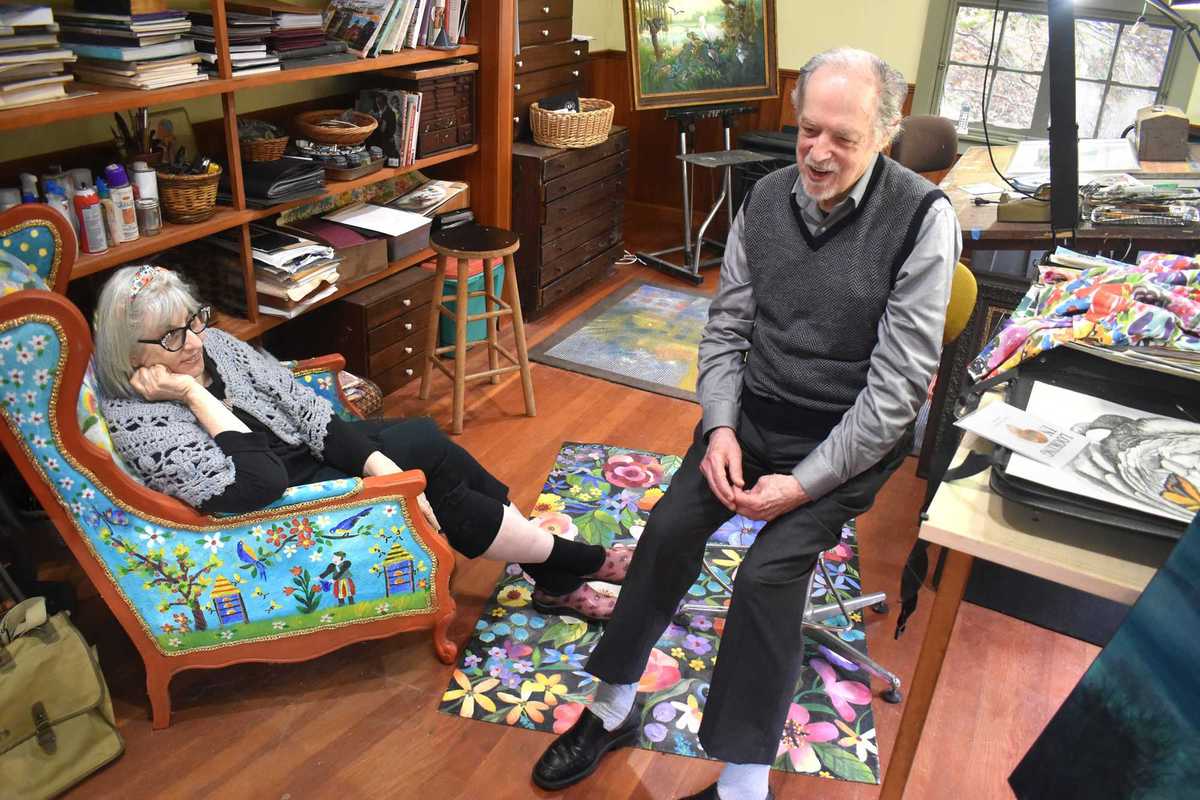
 Justine and Victor Valla in their studio with a painting of Victor’s,”Jonah and the Whale.” Robin Roraback


 A ceramic vase by Kathleen Heidemann.Provided
  Joy Brown’s delightful ceramic sculptures.Provided