The retiring of veteran Democratic senators Christopher Dodd, age 65, of Connecticut and Byron Dorgan, age 67, of North Dakota have some short- and long-term consequences for the Democratic Party and its members.
Sen. Dodd’s announcement that he was finished did not surprise me. He was going through difficult times with his health, the loss of his closest sibling and his closest friend in the Senate, Ted Kennedy, and was not inclined to battle through an uphill fight for re-election. 2010 is, arguably, the most important legislative year of his career for financial and health-insurance reforms.
Mr. Dodd should be comforted because it is very likely he will be succeeded by Connecticut Attorney General Richard Blumenthal, who leads the polls and is expected to win handily. Mr. Blumenthal will find a great opportunity to use his enforcement experience as a leading consumer advocate in the Senate against corporate wrongdoing.
u u u
Sen. Joseph Lieberman, the political hermaphrodite of national politics, is probably elated. Blumenthal detests Lieberman’s politics and unctuous self-righteousness and was ready to unseat him in 2012. Once again, Lieberman finds four-leaf clovers — first when he was the 50th Democratic vote in the Senate, then the 60th vote in the Senate — in order to push the Democratic Party to the right, and now having lost a formidable contender in 2012.
For Sen. Dodd, the question is whether, now freed from his Wall Street fundraising, he can blossom as a tough legislative advocate for consumers and investors in the major bill to regulate Wall Street that is now in the Senate Banking Committee, where he is the chairman and the most powerful force.
As a lame duck, all his expertise and determination will have to be used to avoid his colleagues taking advantage of his announced retirement.
u u u
The prairie populist from North Dakota, Sen. Byron Dorgan, leaves after 30 years in the House and Senate. He will leave a big hole that will be all the larger with his replacement expected to be the incumbent Republican Gov. John Hoeven. Dorgan was an authentic American populist. As a child, his parents would take him to the rallies of the tough anti-corporate farmers who remembered the Non-Partisan League tradition of fundamental landed populism.
As North Dakota’s tax commissioner, he blazed the way to challenge multinational corporations that were using evasive tactics to escape state taxation.
In the Senate, 11 years ago, he led a handful of prophetic Senators in a losing battle to preserve the successful Glass-Steagall Act, which kept commercial banking separate from investment banking. Clinton, the big bankers and Treasury Secretary Robert Rubin got their way and the economy proceeded to lose its way in an orgy of disastrous speculation fueled with other peoples’ money.
With his feet always on the ground, with the working people, Dorgan never bought into the empirically starved theory of “free trade� used to export jobs and industries to countries run by fascist and Communist dictators who know how to keep their workers in their place. His criticism of the Federal Reserve was informed and relentless, as were his warnings of the growing media monopoly in fewer and fewer hands.
u u u
So needed, why did he decide to quit? In his words, he wanted to write a couple of books, teach a little and do some work in the energy field “in the private sector.� The latter raises some worries among his closest friends.
As one who has known Sen. Dorgan for years, I suspect there was another reason in the mix. He wants to get changes made, which he believes are supported by most Americans. He has waited a long time for the Democrats to take control of the Congress and the White House. That has happened and little has changed.
Late last year, during the Senate debate on health insurance, Dorgan proposed and eloquently explained an amendment to reduce drug prices — the highest in the world — by allowing so-called drug reimportation from countries such as Canada under regulatory safeguards.
He expected Obama’s active support since Mr. Obama promised to press for this needed competition in his presidential campaign. He figured wrong. The White House used none of its capital to get the few extra votes needed. For Mr. Obama had already cut a deal privately with the drug company chieftains.
That may have been the last straw for Sen. Dorgan. He is not the only progressive Democrat in the Congress who is saying, “What does President Obama really stand for?�
I would like to see a petition signed by dozens of national civic, labor and farm groups urging Sen. Dorgan to reconsider his decision and go for one more six-year term.
Otherwise another lifeline for the people in Congress is snapped. That inside voice of justice has got to be worth saving, even if two books and a little teaching are deferred.
Consumer advocate and former presidential candidate Ralph Nader grew up in Winsted and attended The Gilbert School.


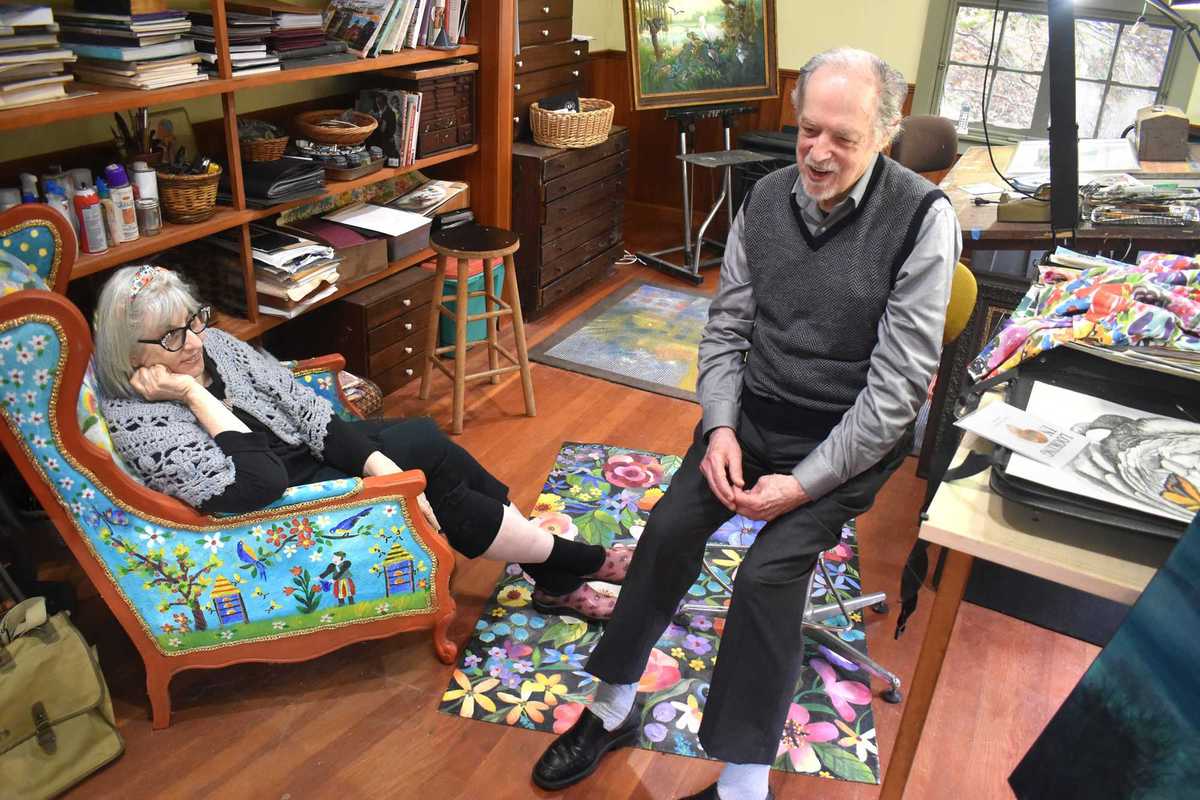
 Justine and Victor Valla in their studio with a painting of Victor’s,”Jonah and the Whale.” Robin Roraback


 A ceramic vase by Kathleen Heidemann.Provided
  Joy Brown’s delightful ceramic sculptures.Provided