NORTH CANAAN — Another layer of primary education has been proposed for North Canaan Elementary School (NCES).
The school’s three kindergarten teachers and a Title 1 teacher made a pitch to the Board of Education Jan. 13 for an early kindergarten program. It would provide a curriculum and pace geared toward 4-year-olds whose birth date may qualify them for school, but who score low on school readiness screening.
North Canaan has an unusually high number of children in that category. One third of this year’s kindergarten class started as 4-year-olds. The projection for next year is that the number will rise to more than half of about 40 incoming students.
Too much for young students?
These children are not quite up to what teachers described as a “rigorous� kindergarten curriculum. At the same time, they may not qualify for the pre-kindergarten program.
Kindergarten teachers LeighAnn Merrill, Ashley DeMazza and Melissa Bachetti, and Title 1 teacher JoEllen Belter told the board Connecticut is the only state to maintain a Dec. 31 cut-off for 4-year-olds to enroll. Most states use Oct. 1, and there is good reason for that.
A “huge range� is how Merrill described the developmental differences in current kindergarten classes.
“Dec. 31 is a very, very late cutoff,� DeMazza said. “The current kindergarten curriculum is very demanding, and assumes students have already received some formal education.�
Kindergarten is a full-day program at NCES, which may place its own demands on younger children.
“The only option right now is to have students repeat kindergarten,� Belter said. “That’s not really appropriate.�
The other side of the coin is that a tough economy is forcing more and more parents to opt to enroll their children in school, instead of paying for day care.
“We are seeing much less of students being held back from starting school by parents, even if they know their child is not ready,� Belter said. “They will agree to a second year of kindergarten, if needed, as long as they can get out from under day care costs.�
Needs to be
developmentally correct
In some cases, parents are removing their struggling children midway through the kindergarten year.
Yet, the first-grade curriculum DeMazza said she taught when she started at NCES in 1986 is what she is now teaching in kindergarten.
“We want to create a place for 4-year-olds that is completely developmentally correct for them,� she said.
Pre-k at NCES is provided for 3- and 4-year-olds who are identified by screenings as in need of structured learning to prepare them for school. Developmental needs may include motor and social skills and basic knowledge of things like letters and shapes.
Teachers would shift around
Canaan Child Care Center offers a pre-k program, which fills up quickly. The school’s pre-k program also has a limited number of slots. Those not filled by children with identified needs are open to any resident child. But there are always more children than spaces. A lottery is held. Tuition is $1,000 for the school year.
If the early kindergarten program is instated, children would qualify for either the pre-k program, or early kindergarten, but would not compete for slots in either, board members were assured.
The proposal would call for one of the kindergarten teachers to move to the early kindergarten class. Board members pointed out that the numbers may not always divide up in a workable way. The teachers agreed, but said the plan included being flexible and reassessing each year.
There was a discussion about “reverse mainstreaming,� in the sense that “slower� learners can be helped by their peers. The teachers explained that the issues are usually motor skills and other developmental issues that one child cannot learn from another.
Board members employed in the education system, as well as Region One School District Assistant Superintendent Diane Goncalves, agreed with the teachers’ assessment that most students who struggle through the early grades will always find education a challenge.
NCES Principal Rosemary Keilty noted that there is a “ripple effect� of costs when students start off on shaky footing and end up in special education.
The cost would be minimal — mostly supplies and curriculum. Teachers have already begun reviewing options for the latter.
It was further explained that the program does not provide an extra year of school for some children, as these are the children who would otherwise repeat kindergarten.
Board members asked for more information, particularly about established early kindergarten programs elsewhere, and results that may have been tracked. The matter will presumably be on the agenda, for discussion and a possible vote, of the Feb. 10 board meeting.

 Sharon, CTBill Wakeley
  Mill Pond, Sheffield MADeb Segalla-Watson
 New Marlborough, MAWendy Miller
  Peter Austin
 Falls Village, CTPete Sanders
  Tom Carley
  Factory Pond, Lakeville CTBarbara Peck
 Lime Rock Road, Lakeville CTKeary Hanan
 Lime Rock Road, Lakeville CTJake Marcum
 Housatonic River, Sharon, CTBill Wakeley
 Norfolk, CTTom Carley
  Reed Brook, Deans Ravine, Canaan CTBill Wakeley


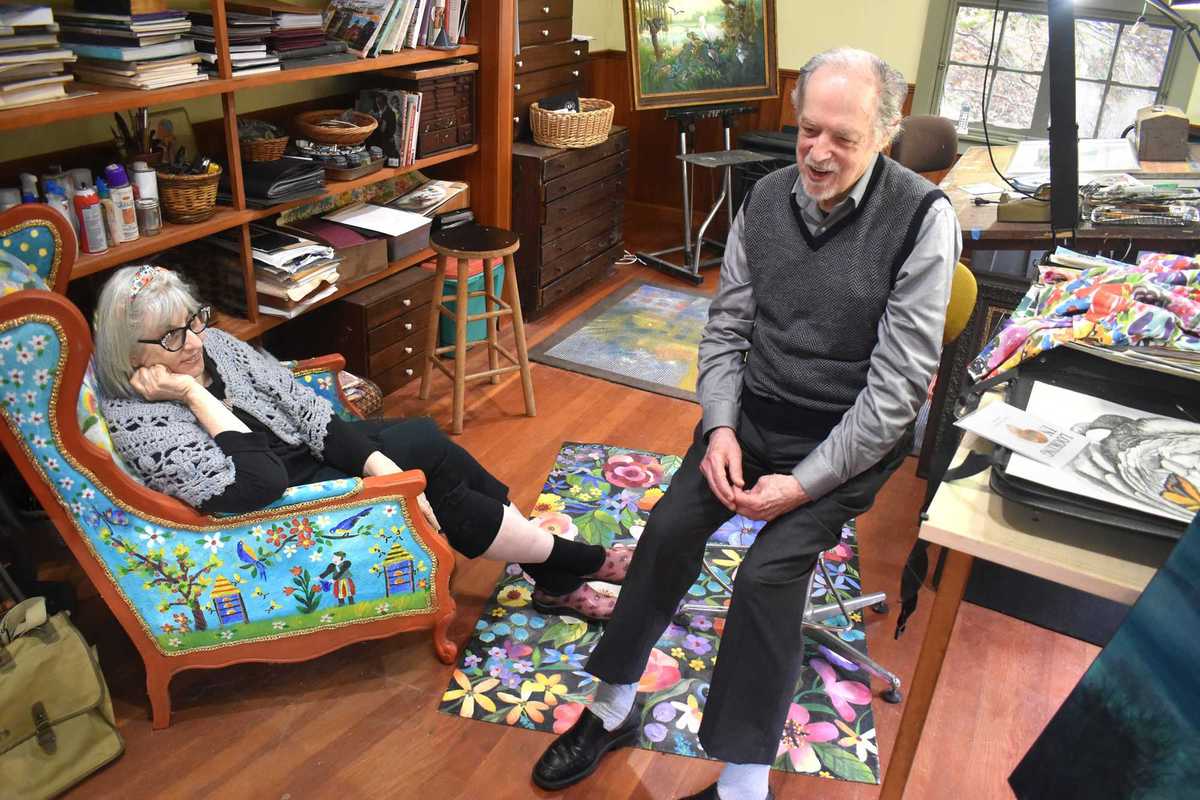
 Justine and Victor Valla in their studio with a painting of Victor’s,”Jonah and the Whale.” Robin Roraback

 A ceramic vase by Kathleen Heidemann.Provided
  Joy Brown’s delightful ceramic sculptures.Provided