Probably only a part-time movie reviewer would go to “The Girl Who Played with Fire� without having seen or read anything about the popular series by Stieg Larrson. Based on my unscientific sampling, everyone else in the audience had read the books, seen the first film, or both. My advice: read this handy backgrounder before going. Then you might enjoy it much more than I did. Lisbeth Salander is a sullen, possibly disturbed computer genius with a history of terrible abuse by people in authority. Mikael Blomqvist is the editor of the muckraking Millenium magazine, who loves and believes in her. In the first installment they solved a murder and became lovers, though only after she hacked into his computer to spy on him.
In this film they are not only not lovers, they don’t even come face to face until the very end. She’s got a sort-of girlfriend, and he occasionally sleeps with his co-editor, Erika. If it seems like I’m placing a lot of emphasis on their sex lives, it’s because the film does, too — it shows sex in many flavors, consensual and forced, and like many European films, much more graphically and without the soft-focus and warm glow in so many American films. (The violence, too, is uglier and less glamorous.)
It’s the forced sex that gets the plot moving: Mikael’s magazine is preparing a story on a trafficking ring that will expose many powerful men, including cops, as johns. It’s not long before bodies start to drop — first the young journalist and his Ph.D. girlfriend and research partner who uncovered the ring are gunned down, and then a lawyer with murky connections to the case, who also happens to be Lisbeth’s legal guardian (and rapist.) Lisbeth’s prints are on the gun, and the police name her as suspect number 1.
The movie is not really about sex trafficking, and it’s certainly not about whether or not Lisbeth is the murderer. Nor does it generate much suspense about whether she’ll clear her name. Lisbeth, who has been in hiding, living off the millions she took from the villain in the first installment, undertakes her own investigation, tracking down the mountainous blond thug, Niedermann, who is brutalizing all her friends and relations, and the mysterious elderly “Zala,� who seems to be the mastermind of the whole affair. At the same time she is probing into her own past, uncovering the records of the terrible things that were done to her. Mikael is reduced to just following the breadcrumbs she leaves (online) for him to find her.
More than most thrillers, this one seems to rely extra-heavily on convenient coincidences to move things forward. Look too closely and it all falls apart. There were way too many characters to keep track of — most of them unsavory middle-aged men.
What makes it worth watching is Noomi Rapace, the actress playing Lisbeth. With her dark eyes ringed in kohl, her powerful body hunched up over the computer or unleashed to fight off a predator, she is unfailingly intense and compelling. Lisbeth is described as tiny, but Rapace fills the screen with her forceful performance. The film also has appeal for its settings — Stockholm seems like an attractive blend of Paris and New York.
The film has some problems, including a slow pace and a tendency to be repetitive — there is an awful lot of emphasis on Niedermann, who for much of the film seems to be just a generic heavy. However, information revealed late in the film suggests there is a reason for that, and that we may be seeing more of him in the third installment. This time, I’ll be sure to read the book before I go.
“The Girl Who Played With Fire� is Rated R for brutal violence including a rape, some strong sexual content, nudity and language.

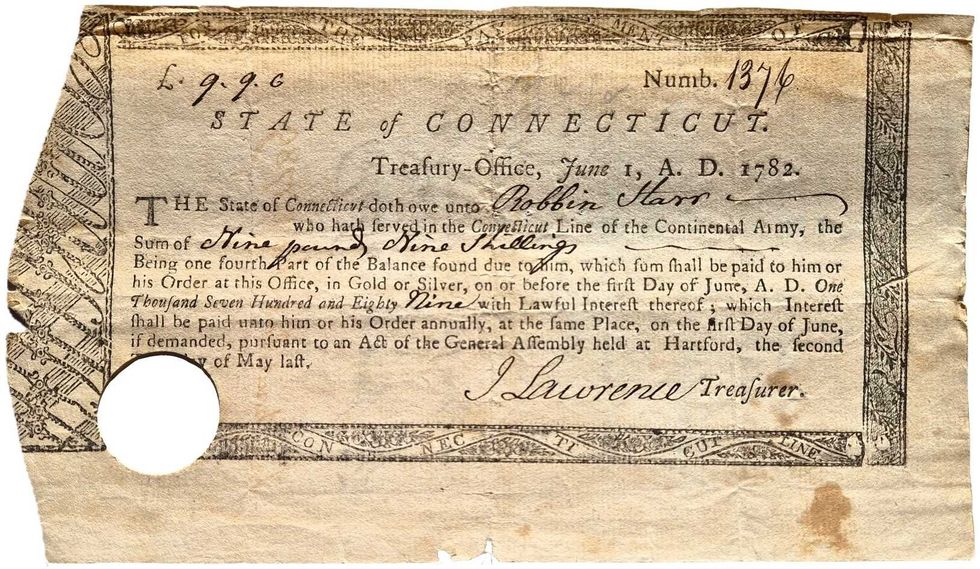 Pay Bill for Robin Starr’s service in the Continental Army.Courtesy the Alex Breanne Corporation
 John Mills speaking at Quinnipiac University.Courtesy the Alex Breanne Corporation
 Stephanie Saetta,with her rescue dog George and Blue (left), a shepherd mix awaiting his forever home.Madi Long
 Blue, a 7 year-old Shepard mix, is waiting for his forever home. Madi Long