The terrain for the day’s hike was level, with lots of turns and switchbacks. Temperatures were in the 80s, so I knew I needed a lot of water. Otherwise, I slimmed the daypack to bare essentials. Tape measure, pad and paper. I could find nourishment as I went, so no energy bars or nuts. The ground surface was even, so I wore my gym shoes, rather than my regular hikers. I daubed sunscreen on my arms and the back of my neck and set out.
It was my first assault in several years on the mighty New England challenge: the Brimfield outdoor antiques markets.
One encounters all levels of professionalism at this thrice-yearly extravaganza that includes probably 1,000 or more vendors. The savviest are the ones who make a living from discovering a moderately priced gem, turning it over, if not immediately at their own booth at the market, then at home at their regular store. Some make a 100-percent profit in an hour’s time. You can often identify them by the walkie-talkies. They don’t carry Kovel’s price guides; they know the prices by heart.
Others of us, experienced in visiting the market, moderately knowledgeable, perhaps, in one or two fields of collectibles, are there for the sport, the thrill of the search. One quickly learns to focus, to glance at a booth and immediately determine if it has any Bakelite, for example, or Hopalong Cassidy.
I had no major objective this day at Brimfield. I would look for farm tools and old photographs.
Photos and paper ephemera, as it turned out, were in strong supply at this year’s show, though tools were dismally lacking. I did come home with a first edition hardcover book, slight batter marks on the corners, torn spine. But it was signed! It was a Whitman 1959 edition of Doris Schroeder’s young adult novel "Lassie Forbidden Valley." The cover bore a felt-marked autograph of Jon Provost, "Timmy."
The vendor told me the $10 I paid was about what he had handed the actor for the autograph at a show. (Vendors will never let on they’re making a profit.) The seller had a lot of TV Guides and movie star photos. He shared a canopy with a familiar face if you watch PBS’s "Antiques Road Show" regularly: Gary Sohmers. Sohmers is the middle-aged gent with the ponytail who evaluates antique toys and board games and the like. At this show, he had cartons of vintage LPs for sale. He has a store in Framingham, MA.
I visited Sohmers’ Wex Rex Collectibles booth early on in my excursion; it was another hour-and-a-half before I found something else to purchase, a handful of 1940s-era orphan snapshots, in a "50 cents each" box. In between, I saw an Adirondack-brand Gil Hodges baseball bat from the 1950s for $65; an Aunt Jemima cookie jar for the same price; a glass butter churn for $125; a Blackmark rose- pattern dinner plate for $20; a 17-inch 1957 Shirley Temple Minton doll in a box for $525; and an 1859-patent Mason canning jar for $28.
There were a lot of shoppers at Brimfield. But with the huge number of dealers, no tent was crowded. (I shied away from dealers with paper goods who were not in tents; they didn’t show much respect for sun-fading and wind.)
The biggest surprise of the day was to turn around one corner and find myself between Jake and Elwood, the character from The Blues Brothers. These were bigger-than-life-size plastic renderings, microphones in hand. A bargain at $1,350 for the pair!
The Brimfield markets are held three times a year. The next ones are July 10 to 15 and Sept. 4 to 9. There are a couple dozen fields. Not all are open every day. A few charge an admission. Parking is least expensive and easiest to find at the edges of the market ($5). To park in the center (generally for $10), one needs to arrive very early. Food (of the hamburger, grinder, occasionally salad variety) and lemonade and water vendors are scattered throughout the market. Porto-Potties are in abundance.
To reach the markets from the Massachusetts Turnpike, take Exit 8 at Palmer and travel east on Route 20, or Exit 9 at Sturbridge and travel west on Route 20. From Route 84, take Exit 1 in Massachusetts and find Sturbridge.
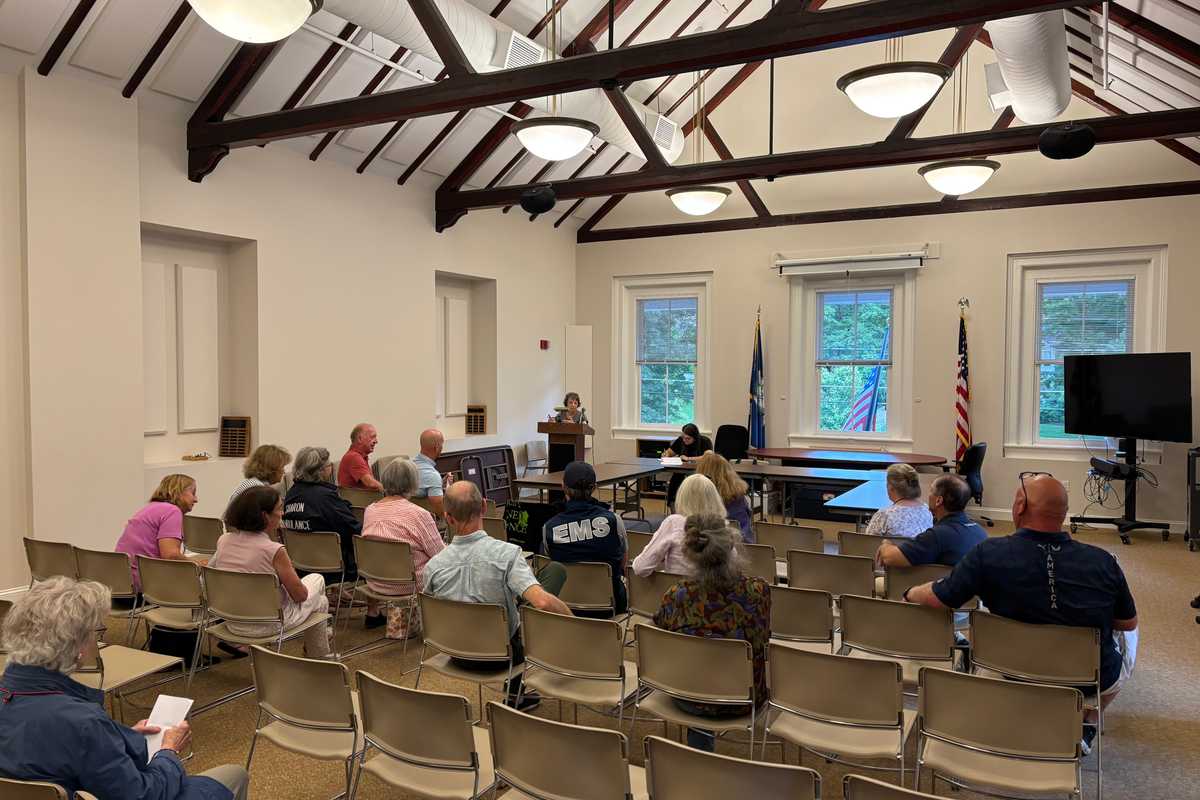
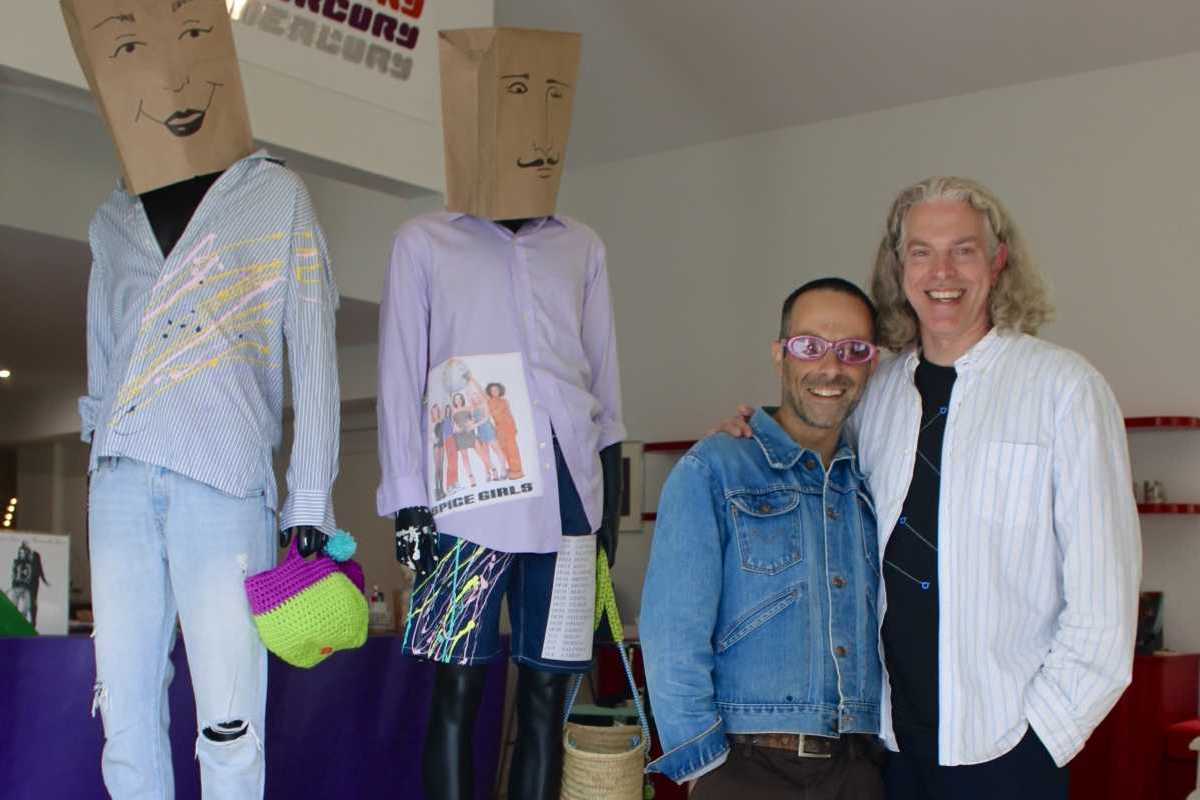
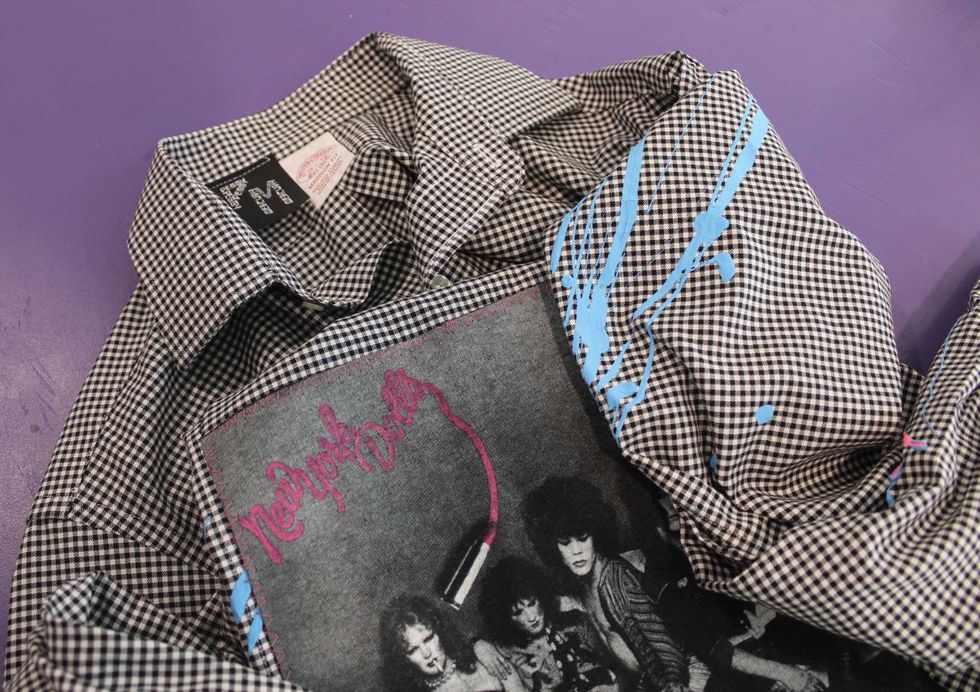 Classic styles, bold colors, and creative concerts make up the “Imaginary Concerts” line at Peggy Mercury.Provided
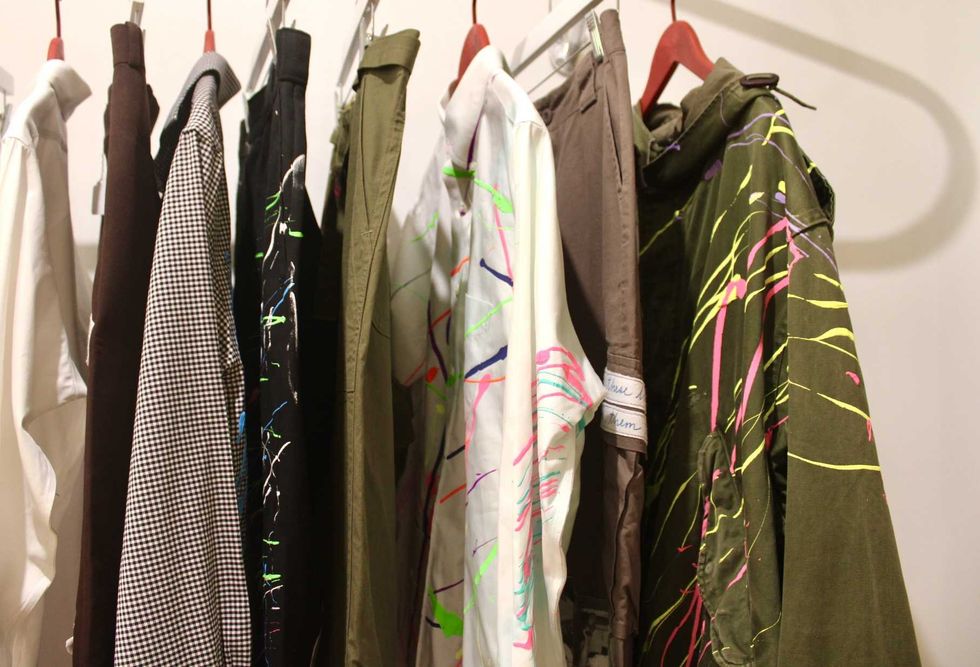 Shirts from Peggy Mercury’s first fashion line, “Imaginary Concerts,” hang on display.Provided