President Obama, the Afghan war escalator, received the Nobel Peace Prize in Oslo, Norway, and proceeded to deliver his acceptance speech outlining the three criteria for a “just war,� which he himself is violating.
The criteria are in his words: “If it is waged as a last resort or in self-defense; if the force used is proportional; and if, whenever possible, civilians are spared from violence.�
After 9/11, warmonger George W. Bush could have used the international law doctrine of hot pursuit with a multilateral force of commandoes, linguists and bribers to pursue the backers of the attackers. Instead, he blew the country of Afghanistan apart and started occupying it, joined forces with a rump regime and launched a divide-and-rule tribal strategy that set the stage for a low-tiered civil war.
Eight years later, Obama is expanding the war within a graft-ridden government in Kabul, fraudulent elections, an Afghan army of northern tribesmen loathed by the southern and south-eastern tribes of 40 million Pashtuns, an impoverished economy whose largest crop by far is a narcotic, and a devastated population embittered by foreign occupiers and non-existent government services.
President Obama’s national security adviser, former Marine General James Jones, said two months ago: “The al-Qaida presence is very diminished. The maximum estimate is less than 100 operating in the country, no bases, no ability to launch attacks on either us or our allies.�
Since Mr. Obama repeats George W. Bush’s reason for going into Afghanistan — to destroy al-Qaida — why is he sending 30,000 more soldiers plus an even greater number of corporate contractors there in the near future at a cost stated by the White House of $1 million per solider per year? Is this “proportional force�?
u u u
Always small in number, al-Qaida has moved over the border into Pakistan and anywhere its supporters can in the world — east Africa, north Africa, Indonesia. The gang is a migrant traveler.
Is Obama pouring soldiers into Afghanistan so that they and our inaccurate, civilian-destroying drones can expand the fighting across the border in Pakistan, as indicated by The New York Times? Beyond the violations of international law and absence of constitutional authorization involved, this could so roil Pakistanis as to make the U.S. experience next door look like a modest struggle.
Obama has emphasized weakening the Taliban as the other objective of our military buildup with its horrible consequence in casualties and other costs. Who are the Taliban? They include people with different causes, such as protecting their valleys, drug trafficking to live on, fighters against foreign occupiers or, being mostly Pashtuns, protecting their tribal turf against the northern Tajiks and Uzbeks.
How many Taliban fighters are there? The Pentagon estimates around 25,000. Their methods make them unpopular with the villagers. They have no air force, navy, artillery, tanks, missiles, no bases, no central command. They have rifles, grenade launchers, bombs and suiciders. Unlike al-Qaida, they have only domestic ambitions counteracted by their adversarial tribesmen who make up most of the Afghan army.
Robert Baer, former CIA officer with experience in that part of Asia, asserted: “The people that want their country liberated from the West have nothing to do with al-Qaida. They simply want us gone because we’re foreigners, and they’re rallying behind the Taliban because the Taliban are experienced, effective fighters.�
u u u
To say as Obama inferred in his Oslo speech that the greater plunge into Afghanistan is self-defense, with proportional force and sparing civilians from violence is a scale of self-delusion or political cowardliness that is dejecting his liberal base.
For as President Eisenhower stated so eloquently in his 1953 “cross of iron� speech, every dollar spent on munitions and saber-rattling takes away from building schools, clinics, roads and other necessities of the American people.
The Afghan War and the Iraq war-occupation — already directly costing a trillion dollars — are costing the American people every time Washington says there is not enough money for neonatal care, occupational disease prevention, cleaner drinking water systems, safer hospitals, prosecution of corporate criminals, cleaner air or upgrading and repairing key public facilities.
Even the hardiest and earliest supporters of his presidential campaign in 2008 are speaking out. Senior members of the Congressional Black Caucus, such as John Conyers (D-MI) and Maxine Waters (D-CA) have recently criticized the President for not doing enough to help African-Americans weather the hard times.
In a stinging ironic rebuke to the first African-American president, Rep. Waters declared, “We can no longer afford for our public policy to be defined by the worldview of Wall Street.�
According to Congressman Conyers, an upset Barack Obama called to ask why the Michigan lawmaker was “demeaning� him. Conyers has been increasingly turned off by the President’s policies — among them health care reform, the war in Afghanistan, slippage on Guantanamo and the extension of the Patriot Act’s invasive provisions.
The 80-year-old Congressman spent most weekends in 2007 and 2008 tirelessly on the campaign trail trying to get Obama elected.
White House aides are not troubled by the rumblings from the moderate left. They said they have all of 2010 to bring them back into the fold by the November Congressional elections. Besides, where else are they going to go?
Well, they could stay home. Remember 1994 and the Gingrich takeover.
Former presidential candidate Ralph Nader grew up in Winsted and attended The Gilbert School.

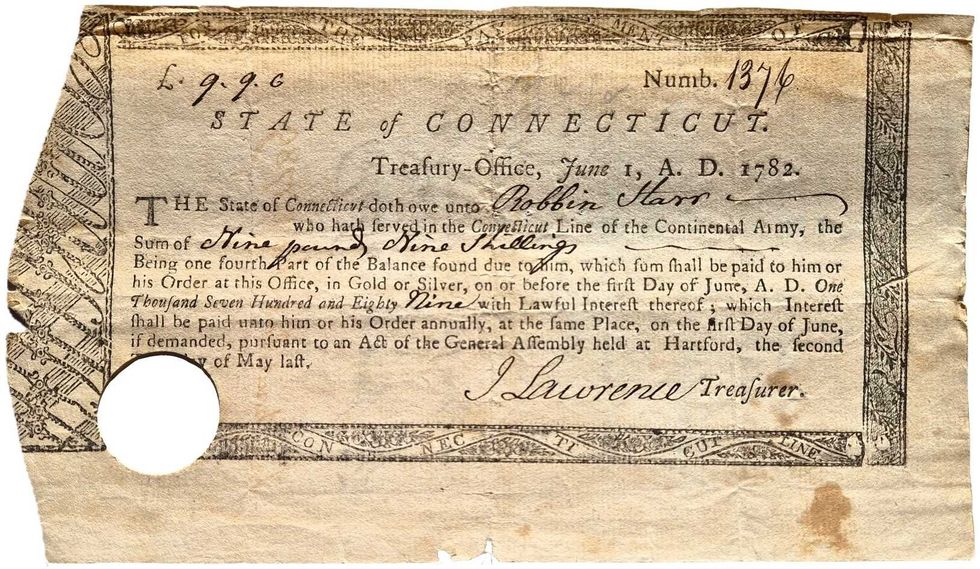 Pay Bill for Robin Starr’s service in the Continental Army.Courtesy the Alex Breanne Corporation
 John Mills speaking at Quinnipiac University.Courtesy the Alex Breanne Corporation
 Stephanie Saetta,with her rescue dog George and Blue (left), a shepherd mix awaiting his forever home.Madi Long
 Blue, a 7 year-old Shepard mix, is waiting for his forever home. Madi Long