Knotweed control put in a regional perspective
Thank you for covering the Japanese Knotweed Workshop at the Sharon Town Garage last month. The larger regional context of knotweed control deserves mention as it seeks to preserve the ecological integrity and scenic value of the recently designated Wild and Scenic Housatonic River.
That effort began with a 2018 canoe survey of both banks of a 41-mile stretch of the river by the Knotweed Network, comprised largely of Housatonic River Commissioners and facilitated by the Housatonic Valley Association, which revealed knotweed distributions still within a manageable range. River Commissioners Robert Gambino and Christian Allyn, both trained invasive managers, volunteered to control the largest patches of knotweed just above the West Cornwall Covered Bridge, in order to prevent further reduction of riparian eco-system services at the head of the river’s most notable trout fishery. (Knotweed along riverbanks reduces drift insect food-web contributions for trout to near zero.) That knotweed demonstration project on the Sharon side of the river also enhanced the scenic value of the river’s most photographed tourist site.
Most Wild and Scenic surrounding towns have subsequently mapped town-wide knotweed distributions to determine patterns of invasion along their town and state roads, where knotweed has been inadvertently planted during road projects by way of biologically contaminated fill from gravel pits and soil storage areas. Because roads intersect and frequently parallel the Housatonic and its tributary streams, knotweed along roadsides often ends up impacting the integrity of the river itself.
North Canaan and Falls Village have largely defeated knotweed along their town road networks, and Cornwall has also joined the effort. They have treated knotweed at their infested gravel pit and have begun to control knotweed previously distributed in loads of fill used in the course of routine road maintenance. The Connecticut Department of Transportation has also recently enhanced knotweed management at its various ConnDOT soil storage areas and has undertaken more extensive treatment of roadside knotweed patches.
As for knotweed control methods, foliar treatment utilizes the smallest quantities of herbicide and is most effectively undertaken in late September after the knotweed’s blossom period. Treatments are typically 90% effective in year one, and depending on patch size may require spot treatment in years two and three. Towns then shift to a prevention strategy, monitoring their fill and gravel sources as they strive for knotweed-free status. (Injection of knotweed stems is feasible only for very small patches.)
The National Wild and Scenic Rivers Act was enacted in 1968 and has thus far protected 228 rivers throughout the United States. Our recently-designated Wild and Scenic Housatonic has the potential to become notable in the Northeast for not having succumbed to the scourge of knotweed.
Tom Zetterstrom
Knotweed Network for the Housatonic River Commission and with the support of the Housatonic Valley Association
North Canaan
Kudos to your newspaper
Since your new editor took over, the paper has been transformed again into a well-written local review of the NW Corner. We have purchased your paper for more than 40 years for its value to learn about the local neighborhood and what’s going on here.
Keep up the good work. PBS had a story tonight about the deleterious effect of the diminishing number of local newspapers. Think about writing a story that tells your audience about this — no voice about our area and thus no eyes to read it — the community suffers.
We need you to keep us informed. Thank you.
Carol Seaman
Sharon
Praise for knotweed fight
I read with great interest about the effort to get rid of Japanese knotweed (Patrick Sullivan, Lakeville Journal Aug 31/2023) and kudos to the Sharon town highway crew for getting involved. Perhaps the same spray method can be used on porcelainberry — aka “kudzu of the north — wherever it has achieved 100% surface coverage, as it has along a stretch on both sides of Route 4. Porcelainberry may not have pretty flowers, offers just a generic green and is therefore easily overlooked. However, it is extremely invasive, has swallowed whole trees and shrubs, and it is spreading around Sharon.
Fritz Mueller
Sharon
Endorsing Riva for P&Z
With our local election just two months away, I wanted to get my endorsement of Bob Riva out there early. He is seeking re-election as a member of the P&Z Commission.
It is certainly gratifying to have Bob want to continue to serve the community, which he has done over the years—for example, Board of Education (8 years), Zoning Board of Appeals (2 terms), and Town Selectman (1 term).
His membership on the Affordable Housing and HVRHS Building Committees and his being a local business owner have provided him additional insights when dealing with P&Z issues. Bob’s ample civic experience, common sense, and fair-mindedness will continue to be needed to resolve the important, sometimes contentious, proposals presented to the P&Z Commission.
Peter Becket
Lakeville

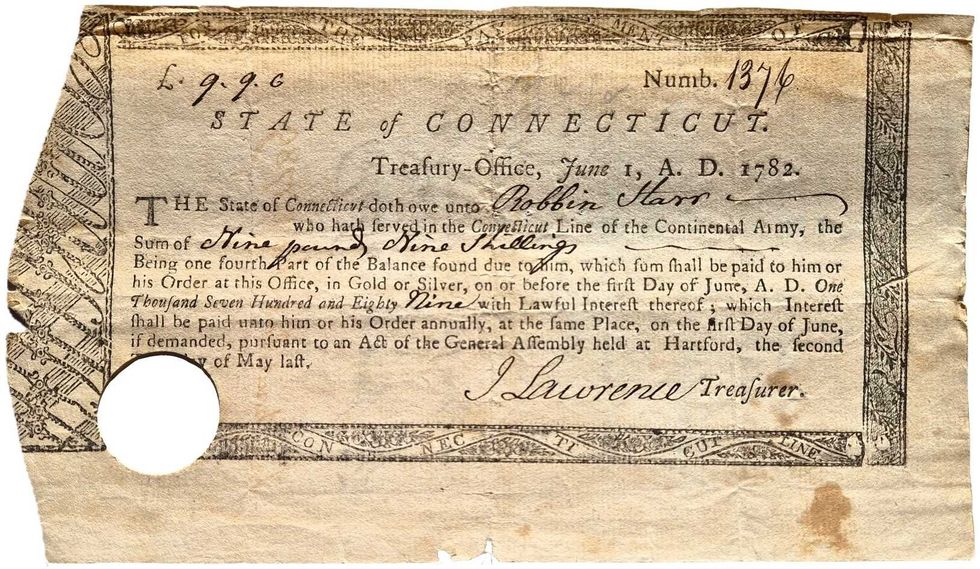 Pay Bill for Robin Starr’s service in the Continental Army.Courtesy the Alex Breanne Corporation
 John Mills speaking at Quinnipiac University.Courtesy the Alex Breanne Corporation
 Stephanie Saetta,with her rescue dog George and Blue (left), a shepherd mix awaiting his forever home.Madi Long
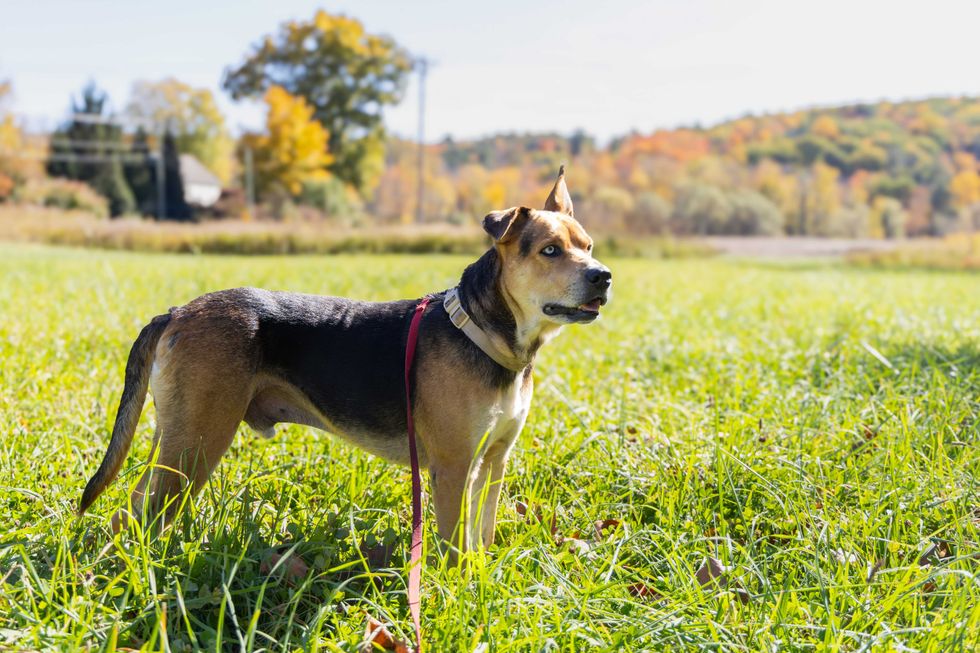 Blue, a 7 year-old Shepard mix, is waiting for his forever home. Madi Long