Fatigue toward social distancing, increased indoor congregation, school and business reopenings and close interactions among small groups of people may be at the root of a rise in COVID-19 infections in the region, according to health and infectious disease experts.
In the last two weeks, a surge of the novel coronavirus surfaced in the Northwest Corner, including at the Geer Village Senior Community in North Canaan, the hardest hit, where 30 residents and 11 staff (a total of 41 Geer community members) had contracted the virus as of Monday, Oct. 26.
In addition, one resident passed away who had already been receiving palliative care for an unrelated illness and subsequently tested positive for the virus, according to Geer’s administrator, Kevin O’Connell.
Sharon Hospital President Mark Hirko reported last week that three staff members had tested positive for the virus, and one patient who was admitted to the hospital recently for surgery received a positive COVID-19 test result. Responding to the rise in community infections, the hospital has limited entry to patients and employees, restricted visitors and is offering community testing. One additional case was reported Monday, Oct. 26.
The novel coronavirus has also found its way into four of the seven Region One School District schools in recent weeks.
Cornwall Consolidated School had a positive test result just before the start of the school year. Interim Region One Superintendent Lisa Carter reported last week that the Lee H. Kellogg School in Falls Village had one new coronavirus case involving a member of the school community (not a staff member or a student). Until that positive result, Falls Village had not reported a single positive test result during the entire pandemic.
On Monday, Oct 19, Sharon Center School sent out an announcement saying that a middle school teacher had tested positive for COVID-19, prompting closure of the school the next day and a two-week quarantine involving all students in grades five to eight, as well as Principal Karen Manning.
North Canaan Elementary School reported two positive cases on Thursday, Oct. 22, and the following day announced two additional infections. In a statement issued by the school, contact tracing revealed that the first two identified cases involved a student in the middle school who was symptom free, and an individual who has never entered the school and who had no contact with the general population of students or staff.
Meanwhile, the private Hotchkiss School in Lakeville, where four boarding students tested positive for COVID-19, reported on Oct. 20 that all test results of students and staff have come back negative, and that COVID-19 testing will continue weekly.
However, those students who had tested positive “cannot return to campus and classes because a repeat SARS-CoV-2 test does not override the original test,” said Chief Communications Officer Hope Cobera. “The students will therefore stay in isolation in order to protect the community, regardless of repeat test results. This follows Centers for Disease Control and Connecticut Department of Public Health guidelines.”
‘Painful fall and winter’
While northwest Connecticut fared better than many other areas during the pandemic’s first surge, earlier this year, health officials are bracing for what they fear could lie ahead. What is important to note, said health experts, is that the coronavirus did not go away, and then suddenly reappear. It has been quietly here all along.
“The surges across the U.S. are more pronounced because the level of community transmission was never suppressed over the summer and there is so much virus around,” said Dr. James Shepherd of Sharon, an infectious disease consultant at Yale-New Haven Hospital.
What has diminished, noted Shepherd, is the public’s resolve to social distance, wear masks and avoid close gatherings. Unless there is a reversal in behavior, he said, “This will be a painful fall and winter.”
The “big picture,” said Shepherd, “is both a national and a global surge in COVID across the northern hemisphere as fall progresses, driven by increased indoor congregation and school and business reopenings.
“A fatigue toward social distancing has played a part, and in Connecticut we are seeing increased transmission in people’s homes as they relax mask wearing and return to more close interactions with small groups of people they trust.”
Shepherd said there is data and discussion around just how much transmission is fueled by school reopening, although it is unclear. However, “A general picture is emerging of reduced risk of community transmission fueled by younger kids in kindergarten and elementary school; but rising risks to the community from older kids and undergraduates.”
As for the potency of the novel coronavirus, Shepherd noted that there is no evidence or suspicion that the virus is becoming more virulent. “In fact, most new viruses tend toward lower virulence as time goes on … as the disease they cause becomes milder, the spread becomes more efficient.” However, said the epidemiologist, “this process occurs over years and in the first 11 months of this pandemic, the virus has remained markedly stable.”
Some good news, said Shepherd, is that the mortality rate of severe COVID-19 “seems to have come down in the U.S. as we get better at treating it and the age range of patients became younger over the summer.”
Protecting the most vulnerable
In response to the surge in infection among residents at nursing homes and assisted living facilities, the state Department of Public health on Friday, Oct. 23, required operators to test all residents and staff weekly until further notice, said William Pond, administrator at Noble Horizons. The Salisbury retirement community has been COVID-free since the pandemic started.
“We had been testing staff typically on a monthly basis, but now we will be doing it at least one time per week for every staff member,” said Pond. Also now part of an enhanced staff screening process at Noble, he said, is a new list of questions about social activities outside of work.
“Safety has become so ingrained in everybody’s mind,” said Pond, that staff is not put off by the new protocol. He said he has been heartened to find that many employees “take it upon themselves,” to bring upcoming plans to administrators’ attention.
Pond said he is concerned about the recent surge in COVID-19 cases in the schools, hospital and at Geer Village.
“The spooky part about the whole thing is that we are seeing cases at facilities that did not record any cases early on when this thing started.” The Noble Horizons administrator said he is thankful for every day that the coronavirus remains at bay. “I knock on wood that we still have been able to keep it off campus.”
At Geer Village, strict infection control protocols are reportedly in place. All residents are isolated in their rooms, and additional staff are being added to ensure that all resident needs are being met, according to an update provided by Geer on Friday, Oct. 23. The facility’s Nursing Center staff, residents, pharmacy, outpatient therapy and transportation departments continue to test negative.
Staff are in full personal protective equipment when providing resident care and are following best practices regarding infection control. As a result of the increase in positive cases across the state, Geer reported that “weekly staff and resident testing is being performed, under the guidance of the State of Connecticut Department of Public Health/Epidemiology. This will continue until we can produce 100 percent negative test results for a minimum period of 14 days at the Geer Lodge assisted living facility.”
Staff movement between buildings continues to be strictly prohibited, and there is no public access to the facility at this time, although virtual resident visitations can continue via Skype and Zoom.
Origins are mysterious
On Monday, Oct. 26, Sharon Hospital confirmed that four of its employees tested positive for the coronavirus. “Just like we’re seeing throughout the rest of the communities, we started seeing our employees be positive for COVID,” Hirko had said Friday, when there were three positive reports. “A few were not feeling well, and we sent them home,” and other staff who were contact traced ended up testing positive for COVID-19, he noted.
“We still can’t figure out where it came from. That’s what’s different this time around. During the first wave there was very little penetration of the virus in the area,” with most of it being introduced by people from out of town. But this time, he said, “It’s the other way around.”
Even the tiniest breach in following the recommended protocols of wearing masks, social distancing and washing hands, said Hirko, can ignite the coronavirus. The new cases, he said, were “definitely community spread, and that is a concern at this time. We are a small hospital in a tight-knit community, and if we have a lot of infection, there is a risk of shutting down units and sending patients to other facilities. That’s why I am hesitant about being open to visitors.”
As a public service, Sharon Hospital opened a testing site last week, and as of Thursday, Oct. 22, “Twenty-two people have come through, although the results will be unknown for 24 to 48 hours,” noted the hospital president. “You can’t hide from this. Just make sure you follow [the advice] that’s out there.”
Upper respiratory virus season
Shepherd said all signs point to a rough road ahead. “This is a new viral upper respiratory tract illness of humans and we are entering upper respiratory virus season.
“There are things that everybody can and should do,” said the epidemiologist. “Get your flu shot. Although the flu season has been very mild this year in the Southern Hemisphere it would be foolish to miss such a simple protection.”
Second, wear your mask. “No one likes wearing them but they are as good as a vaccine in reducing your risk of infection and reducing your infectivity to someone you love,” said Shepherd.
Third, “Be sensible about mixing in groups. In a community with widespread transmission, what you think is your safe ‘bubble’ may not be so.”
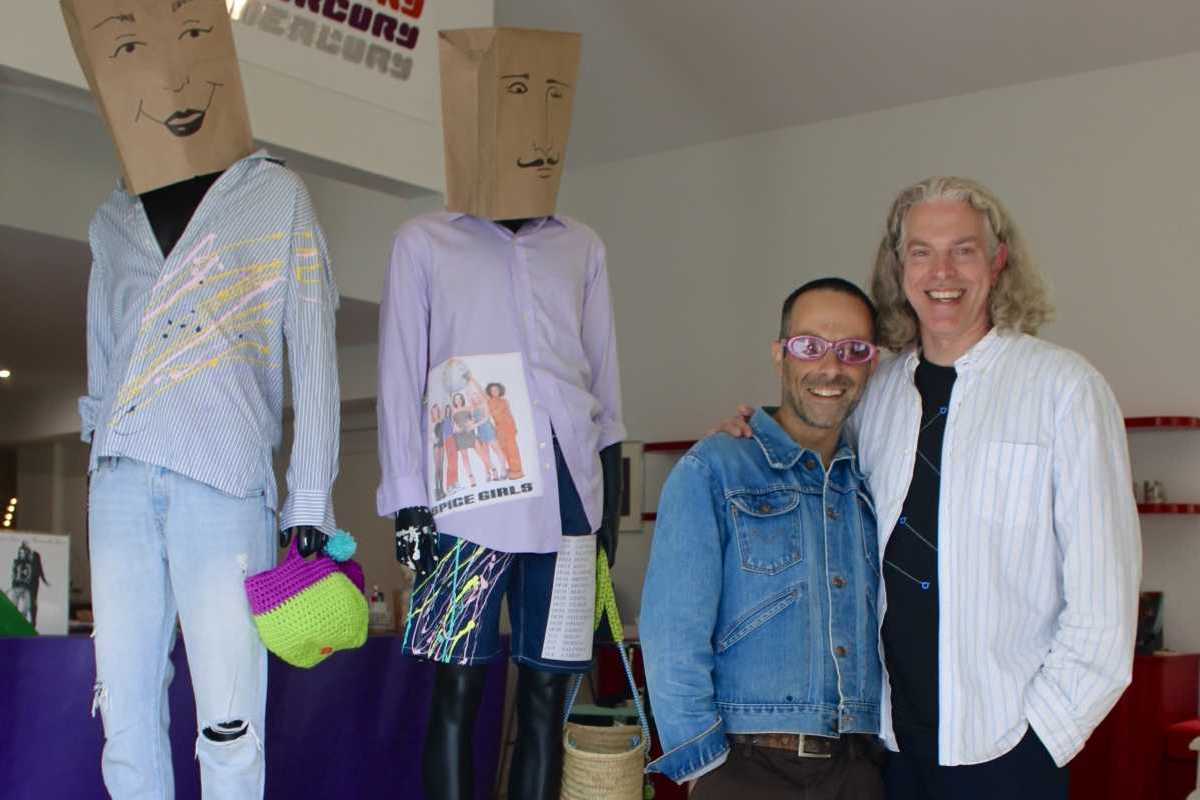
 Classic styles, bold colors, and creative concerts make up the “Imaginary Concerts” line at Peggy Mercury.Provided
 Shirts from Peggy Mercury’s first fashion line, “Imaginary Concerts,” hang on display.Provided