Thank you!
Your support is sustaining the future of local news in our communities.

Gone with a whoosh

Gone with a whoosh
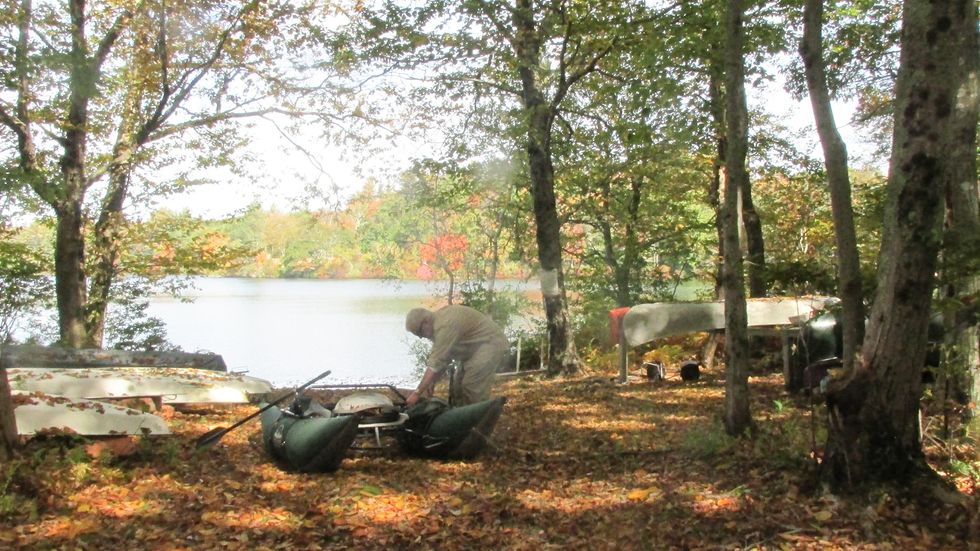
Deflating the pontoon boat is a sure sign that summer is over. That and the leaves. 
Photo by Patrick L. Sullivan

By the time you read this I will have returned from a week’s vacation in the Catskills.

Meanwhile I wrapped up the Mt. Riga side of things over the Columbus Day weekend, with the help of my cousin, who understands the plumbing better than I do.

This meant putting the pontoon boat away, always a melancholy duty. The air whooshing out of the pontoons drives it home. No more aimless floating around, catching a largemouth here, annoying a pumpkinseed there, and occasionally irritating the single most ornery finned creature in freshwater, the pickerel. (Usually when a fish is caught and released, it beats it. Not the pickerel. They hang around a few yards away for hours, glaring.)

A large part of the camp closing was already done, so the annual Inspection of the Mustard Bottles was unnecessary.

My cousin Julie, the famous TV chef, thinks we should work up the Inspection into some sort of contest. Possible parameters include: Number of mustard containers with less than one ounce remaining; number of mustard containers with more than one ounce remaining, and thus candidates for taking home, where they will sit untouched in the fridge for at least one year; types of mustard, with bonus points for more exotic varieties.

Camp closing means deploying anti-mouse materials. Because we have dogs in the equation, my inclination to go with highly toxic poisons cannot be indulged, as dogs will eat anything.

After considerable trial and error, we have settled on the fabric softener sheet.

The key here is to buy the cheapest brand. The things absolutely reek, and once they’ve been strewn liberally about the furniture and bedding, it’s hard for me to breathe.  I outweigh the average mouse by 2720 ounces (170 pounds) to something close to the average amount of mustard left in a bottle (i.e. one ounce or less). So if I’m choking, imagine what it’s like for the mice.

What these things do to your clothes is best left undiscovered.

On the Catskill agenda: A presentation Sunday, Oct. 15 at the Phoenicia Library that is billed as an oral history of fly-fishing on the Esopus. This is also known as guys sitting around lying about fishing, with cake.

The resumption of the world-famous Cinema, Angling and Culinary Appreciation film festival. The idea behind CACA is to spend the day busting a gut on the water while back at the camp a rich stew-like concoction cooks bubbles away in a slow cooker.

With dinner, we settle in for a critical examination of the world’s most appalling films.

This year we will take on at least two of the “Deathstalker” sword ‘n’ sorcery movies made by Roger Corman in Argentina in the 1980s for about $11.87. The consensus is that the second and third installments are the best, number two starring Denison University’s own John Terlesky, and number three featuring a stunning star turn by Thom Christopher as the evil warlock Troxartes. The scene where Thom, wearing a turban, channels Gloria Swanson in “Sunset Boulevard” is particularly virulent.

I also have the three original “Evil Dead” flicks teed up, in stunning Blu-Ray. And if we stick with the gore, can “Basket Case and “Slumber Party Massacre” be far behind?

I suspect the little blue lines are going to get more of a workout than usual. There’s been a lot of rain over there, and the smaller streams drain first. 

That’s fine. 

The main thing is to be somewhere else.

Latest News

‘So Little to Do,’ so much to discover at James Barron Art

Curator Deborah Goodman Davis reads the Emily Dickinson poem “The Grass So Little Has to Do.” Spencer Finch’s “Following Three Bees (Zinnias)” buzzes in the background.

Photo by Natalia Zukerman

“The Grass Has So Little to Do,” on view at James Barron Art in Kent, takes its title from Emily Dickinson’s poem “The Grass So Little Has to Do,” written in 1862:

“The Grass so little has to do—
A Sphere of simple Green—
With only Butterflies to brood
And Bees to entertain—”

Keep ReadingShow less
Marina Kotchoubey is taking care of business

Marina Kotchoubey at the Ian Ingersoll Cabinetmakers showroom in West Cornwall.

Photo by D.H. Callahan

After 40-something years navigating the world of custom fine furniture, Ian Ingersoll was getting ready to retire. Starting off with a little dovetail stool that he sold at a shop in West Cornwall in the 1970s, he’d grown his skill and his business into something he — and the whole town — could be proud of. Shutting down that business was not an option.

Ingersoll built Ian Ingersoll Cabinetmakers, which produced mainly classical Shaker furniture, on passion: the passion he had to make a living through creative challenges and the passion of his employees, who all seem deeply in love with their craft.

Keep ReadingShow less
A legacy of giving at Norfolk Chamber Music Festival

One hundred and twenty years ago, Carl and Ellen Stoeckel commissioned New York architect E.K. Rossiter to design The Music Shed in Norfolk, Connecticut. After nearly a decade of entertaining their friends and neighbors with the finest music of the day, they built a permanent home for their beloved Litchfield County Choral Union.

The commission and full funding of the construction was not unheard of in an era when great fortunes led to public enrichment. Railroad tycoon John D. Rockefeller was instrumental in funding institutes of higher education. Steel baron Andrew Carnegie was building libraries all over the country, and famously said that a man who dies rich is a disgrace, challenging his peers to give their fortunes back to the people.

Keep ReadingShow less
google preferred source

Want more of our stories on Google? Click here to make us a Preferred Source.

Two unique exhibitions at Geary Gallery

Henry Klimowicz with his sculpture, “Partial Pillar 1”

Photo by D.H. Callahan

On Saturday, Aug. 1, Geary Gallery opened its doors in Salisbury for two unique shows in its first- and second-floor gallery spaces. Art lovers flooded both floors over the course of the afternoon, giving the events a vibrant feeling that enhanced the importance of the art.

On the first floor is a show by Chicago-born, Colorado-based photographer Summers Moore, titled “Lobitos: Pueblo Fantasma,” or “Lobitos: Ghost Town.” The work centers around her daughter’s current hometown in Peru. Moore herself found a home away from home in Colorado in the mid-1980s and encouraged her children to seek out new places outside of their comfort zones.

Keep ReadingShow less

Writer’s retreat in the woods

Writer’s retreat in the woods

Participants in a 2024 Great Mountain Forest Woodland Academy workshop at Yale Camp.

Photo by Mike Zarfos

Great Mountain Forest (GMF) will host its first Nature Writing Retreat at the historic Yale Camp in Falls Village from Aug. 7-9, 2026. Writers of all levels are invited to draw inspiration from one of New England’s most notable forest landscapes. GMF envisions the retreat becoming an annual event celebrating writing, conservation and the relationship between people and forests.

This immersive three-day retreat reflects on the legacy of Hal Borland, the American writer and New York Times nature columnist whose work was deeply connected to this landscape. The retreat explores how wilderness shapes language, strengthens close observation and fosters environmental consciousness.

Keep ReadingShow less
From Cornwall to Rome, Adam Van Doren at Berkshire Botanical Garden

Artist Adam Van Doren and curator Donna Hassler talk to a group of visitors at the Berkshire Botanical Garden. A Stephen Proctor vessel sits to their left.

Photo by Natalia Zukerman

This summer, the Berkshire Botanical Garden in Stockbridge has hosted “Grounded in Nature: Paintings by Adam Van Doren,” an exhibition exploring the intimate relationship between architecture and the natural world.

On view for only a few more weeks in the Leonhardt Galleries, the exhibition features more than 35 watercolor and oil paintings by the New York-based artist, architect, author and Yale professor, curated by art historian Donna Hassler, director emerita of Chesterwood. The works span three distinct places that have shaped Van Doren’s artistic practice: New York City, Cornwall, Connecticut, and his travels throughout Europe.

Keep ReadingShow less
google preferred source

Want more of our stories on Google? Click here to make us a Preferred Source.

google preferred source

Want more of our stories on Google? Click here to make us a Preferred Source.