Thank you!
Your support is sustaining the future of local news in our communities.

Looking back: Specks of good news in challenging year

Looking back: Specks of good news in challenging year
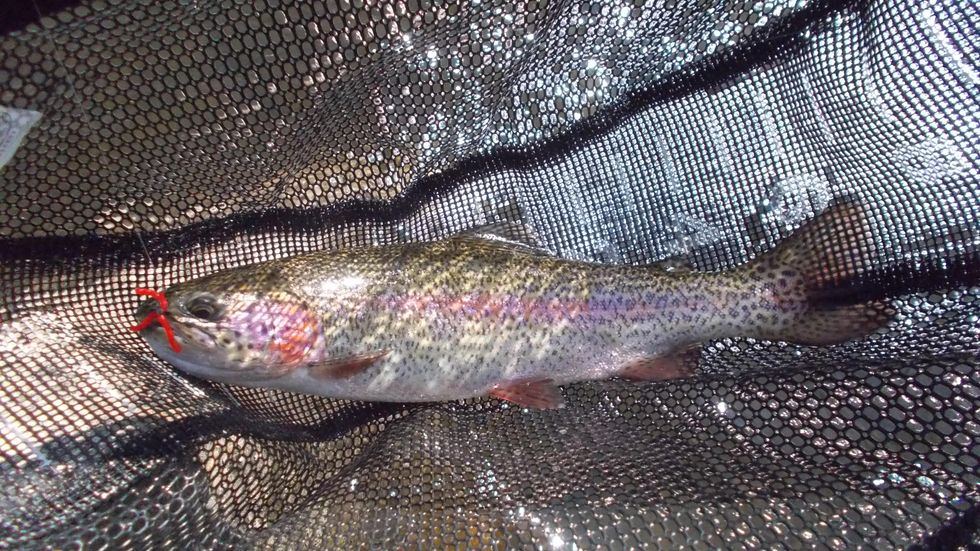
This Blackberry River rainbow was caught at Beckley Furnace in North Canaan in early April with a heavy squirmy red worm fly tied by Harold McMillan at Housatonic River Outfitters. The fish was returned to the water unharmed. 
Photo by Patrick L. Sullivan

There was one very good thing that happened in 2020: It was the year I finally got the hang of fishing with specks.

I define “specks” as flies size 20 and smaller.

Itty bitty bugs are present on all trout waters, usually year-round. Trout eat them, and anglers using the right imitations catch the trout.

Except me.

That all changed this year, when I discovered a brand of fluorocarbon tippet that worked for me. Without getting into the aquatic weeds, suddenly the practical difficulties of using specks were significantly diminished.

Meanwhile:

As the pandemic lockdowns began, Gov. Ned Lamont had a brain wave, or somebody had it for him. Trout season opened about two and a half weeks ahead of schedule, with the result that in late March, when everybody else was huddled inside waiting for the end of the world, I was hauling a fat 22-inch rainbow trout out of the Blackberry River in North Canaan.

Also in March, in the no man’s land between the Great Falls and the Falls Village power station, I caught a nice fat small-mouth that was probably looking for a good place to spawn, and a sinister-looking pike that would not fit in my 24-inch net. I have great respect for pike, especially for their large, sharp teeth. Also the slowly working jaw muscles.  I clipped off the fly without getting my fingers anywhere near its mouth.

April: Started clambering around the little blue lines, those streams holding wild brook trout that provide great sport for those inclined to expend great physical and mental effort in pursuit of little fish.

May: More of the same, weather permitting. The rod of choice was a Cabela’s CGR fiberglass 6.5 foot 4 weight, supplemented by the Dragontail Mizuchi zoom tenkara or fixed-line rod. 

June: By Memorial Day, water temperatures in the Housatonic River were at the point where wet wading was not only possible but preferable. The trout were heading into their summertime Witness Protection mode, so I targeted small-mouth bass. 

July: It was not a terrific small-mouth year on the Hous. I didn’t catch many, and when I did, they were larger than my usual clients. Almost completely absent were the dinkers, the green-colored juvenile fish that are usually so ubiquitous as to qualify as a nuisance.

August: The little blue lines were out of contention, as we experienced drought conditions. So I floated around a lake and caught large-mouth bass, gave a couple of lessons, and generally loafed.

September: Got a fair bit of time in on the Esopus in Ulster County, N.Y. Caught more and bigger rainbows than usual. 

October: Still giving the blue lines a pass, I took advantage of the fall trout stocking on the Blackberry to practice my speck technique. This was supplemented by a couple of all-too-brief trips to the Esopus, where the specks produced on pickier trout.

November: Pretty much wound things up where the season started, on the humble and hard-fished Blackberry.

December: With the blue lines back in play, made a couple of forays to the Stream That Shall Not Be Named, to see if the speck treatment would work in that setting. It did, but the wild brookies seemed more interested in big bushy flies that are bigger than their mouths.

Then it snowed, and I reluctantly put most of the fishing gear away.
Latest News

‘So Little to Do,’ so much to discover at James Barron Art

Curator Deborah Goodman Davis reads the Emily Dickinson poem “The Grass So Little Has to Do.” Spencer Finch’s “Following Three Bees (Zinnias)” buzzes in the background.

Photo by Natalia Zukerman

“The Grass Has So Little to Do,” on view at James Barron Art in Kent, takes its title from Emily Dickinson’s poem “The Grass So Little Has to Do,” written in 1862:

“The Grass so little has to do—
A Sphere of simple Green—
With only Butterflies to brood
And Bees to entertain—”

Keep ReadingShow less

Marina Kotchoubey is not a woodworker

Marina Kotchoubey is not a woodworker

Marina Kotchoubey at the Ian Ingersoll Cabinetmakers showroom in West Cornwall.

Photo by D.H. Callahan

After 40-something years navigating the world of custom fine furniture, Ian Ingersoll was getting ready to retire. Starting off with a little dovetail stool that he sold at a shop in West Cornwall in the 1970s, he’d grown his skill and his business into something he — and the whole town — could be proud of. Shutting down that business was not an option.

Ingersoll built Ian Ingersoll Cabinetmakers, which produced mainly classical Shaker furniture, on passion: the passion he had to make a living through creative challenges and the passion of his employees, who all seem deeply in love with their craft.

Keep ReadingShow less
A legacy of giving at Norfolk Chamber Music Festival

One hundred and twenty years ago, Carl and Ellen Stoeckel commissioned New York architect E.K. Rossiter to design The Music Shed in Norfolk, Connecticut. After nearly a decade of entertaining their friends and neighbors with the finest music of the day, they built a permanent home for their beloved Litchfield County Choral Union.

The commission and full funding of the construction was not unheard of in an era when great fortunes led to public enrichment. Railroad tycoon John D. Rockefeller was instrumental in funding institutes of higher education. Steel baron Andrew Carnegie was building libraries all over the country, and famously said that a man who dies rich is a disgrace, challenging his peers to give their fortunes back to the people.

Keep ReadingShow less
google preferred source

Want more of our stories on Google? Click here to make us a Preferred Source.

Two unique exhibitions at Geary Gallery

Henry Klimowicz with his sculpture, “Partial Pillar 1”

Photo by D.H. Callahan

On Saturday, Aug. 1, Geary Gallery opened its doors in Salisbury for two unique shows in its first- and second-floor gallery spaces. Art lovers flooded both floors over the course of the afternoon, giving the events a vibrant feeling that enhanced the importance of the art.

On the first floor is a show by Chicago-born, Colorado-based photographer Summers Moore, titled “Lobitos: Pueblo Fantasma,” or “Lobitos: Ghost Town.” The work centers around her daughter’s current hometown in Peru. Moore herself found a home away from home in Colorado in the mid-1980s and encouraged her children to seek out new places outside of their comfort zones.

Keep ReadingShow less

Writer’s retreat in the woods

Writer’s retreat in the woods

Participants in a 2024 Great Mountain Forest Woodland Academy workshop at Yale Camp.

Photo by Mike Zarfos

Great Mountain Forest (GMF) will host its first Nature Writing Retreat at the historic Yale Camp in Falls Village from Aug. 7-9, 2026. Writers of all levels are invited to draw inspiration from one of New England’s most notable forest landscapes. GMF envisions the retreat becoming an annual event celebrating writing, conservation and the relationship between people and forests.

This immersive three-day retreat reflects on the legacy of Hal Borland, the American writer and New York Times nature columnist whose work was deeply connected to this landscape. The retreat explores how wilderness shapes language, strengthens close observation and fosters environmental consciousness.

Keep ReadingShow less
From Cornwall to Rome, Adam Van Doren at Berkshire Botanical Garden

Artist Adam Van Doren and curator Donna Hassler talk to a group of visitors at the Berkshire Botanical Garden. A Stephen Proctor vessel sits to their left.

Photo by Natalia Zukerman

This summer, the Berkshire Botanical Garden in Stockbridge has hosted “Grounded in Nature: Paintings by Adam Van Doren,” an exhibition exploring the intimate relationship between architecture and the natural world.

On view for only a few more weeks in the Leonhardt Galleries, the exhibition features more than 35 watercolor and oil paintings by the New York-based artist, architect, author and Yale professor, curated by art historian Donna Hassler, director emerita of Chesterwood. The works span three distinct places that have shaped Van Doren’s artistic practice: New York City, Cornwall, Connecticut, and his travels throughout Europe.

Keep ReadingShow less
google preferred source

Want more of our stories on Google? Click here to make us a Preferred Source.

google preferred source

Want more of our stories on Google? Click here to make us a Preferred Source.