Latest News
The COVID-19 pandemic was supposed to spell the end of the cruise line industry. These massive ships, crammed with sick passengers, were labeled “petri dishes” by the media, infectious disease experts, and politicians. Six years later, the sector is alive and growing.
AAA projects that a record-breaking 21.7 million Americans are planning to hop aboard an ocean cruise in the coming year. If so, that would mark the fourth year in a row the cruise industry has experienced record passenger volume. This year, more than 20 million passengers flooded the gates to new King Kong-sized vessels, offering fixed-price packages and promising a wide variety of cruise options for every age and pocketbook.
If you break down the demand demographically, Baby Boomers still make up the majority of cruise-goers, followed by Millennials. Most adults travel with a companion. Nearly 50% of U.S. cruise passengers are cruising as a couple.
About 65% of adult passengers are 55 or older. However, 27% are from younger generations (35 to 54 years old), and 7% are aged 18 to 34. The trend also includes multi-generational groupings who choose to take cruise vacations together. One quarter of Baby Boomers who like cruises do so with their adult children, and roughly 29% of Gen Z members cruise with their parents.
A survey identifying trends shaping the modern cruise experience found that Millennials and Gen Z are increasingly enthusiastic about opting for a cruise vacation. Key among the changes in attitude was the affordability of shorter itineraries, which allow younger generations to vacation more frequently. They much prefer a two-to-four-day sailing to the more traditional five-to-seven-day voyage.
The Caribbean remains the most popular destination, attracting 72% of American cruise passengers. As a result, Florida ports are the busiest in the world due to this vacation demand. The new mega-vessels ply the Caribbean, Mediterranean and Northern European waterways. Smaller vessels are more common in Northern Europe for expedition cruises and in the Mediterranean for luxury trips.
More than half of the 4,500 people surveyed had already cruised, and nearly 30% planned to do so again over the next two years. Of those planning another cruise, 36% were born between 1981 and 1996. The average age of a cruise guest is now 46 years old, and 36% of all cruisers are now under 40.
Cruise lines have quickly adjusted to these preferences and begun marketing three-to-five-night cruises. Another popular consumer preference is the chance to visit a private island. Cruise lines are investing big bucks to create this type of destination or upgrade existing ones. Cruise operators know that the main draw for vacationers is convenience and value, especially today.
As such, cruise companies bundle lodging, meals, and entertainment. The price often equates to a lower per-night cost than on a land-based vacation. Celebrity-level chefs and Broadway-level shows have replaced the rubber chickens and crew member chorus offerings of yesteryears.
Modern-day ships are increasingly resembling ocean-going resorts, complete with floating buffets and satisfied customers — couples like the built-in date-night dining and entertainment options. Families appreciate the kid clubs, water parks, and multi-room lodgings. An expanding list of destinations, such as a cruise to Antarctica or the Arctic, excites and attracts younger adventure seekers.
More than 90% of U.S. cruise passengers rate their experience as good or very good, according to AAA, and 91% have taken multiple cruises. With those kinds of repeat rates, cruise lines expect growth to continue well beyond the next few years.
Wall Street likes what it sees and has rewarded these companies with higher stock prices. Rather than rest on their laurels, cruise companies worldwide are expanding their fleets, building destination islands and upgrading their offerings hand over fist.
Bill Schmick is a founding partner of Onota Partners, Inc., in the Berkshires.Bill’s forecasts and opinions are purely his own and do not necessarily represent the views of Onota Partners, Inc. (OPI).None of his commentary is or should be considered investment advice.
Keep ReadingShow less
Misconduct by its recently disgraced and departed chairwoman, Marissa Gillett, has Connecticut’s Public Utilities Regulatory Authority on the defensive. Past utility rate decisions have been put in legal jeopardy, utility companies are getting angry and aggressive, Gillett’s Democratic allies in the General Assembly have been discredited for their complicity with her power grabbing and lies, longstanding criticism by Republican legislators has been vindicated, and state government’s infamous “public benefits charges” on electricity bills are becoming a political issue again.
Some of those charges were recently removed by legislation with their financed transferred to state government borrowing, but most of the charges remain, comprising about 20% of customer electric bills, an estimated $1 billion annually. So at a Hartford Business Journal conference last month, a senior vice president of Connecticut’s largest electric utility, Eversource, Digaunto Chatterjee, called for removing the charges from electric bills entirely and financing their programs through the state budget.
For some time this has been the position of Republican legislators, who note that the charges function not only as a hidden tax but also as a tax on a necessity of life. But the electric companies, being heavily regulated and long having been scapegoated for Connecticut’s high electricity prices, had not been taking sides on the issue, lest they aggravate their adversaries.
Governor Lamont and most Democratic legislators are still resisting serious reform with the charges. The House chairman of the General Assembly’s Energy and Technology Committee, Rep. Jonathan Steinberg, D-Westport, says it makes little no difference how the programs financed by the charges are paid for -- by footnotes on electricity bills or by regular state government appropriations and formal taxes.
Steinberg is wrong. For if the “public benefits charges” were eliminated, the programs they finance would have to start competing for appropriations along with everything else state government spends money on. They would become part of the budget process, where the items financed by the charges would get far more scrutiny from the governor, legislators, news organizations, and the public than they get now when they are buried in electric bills.
The HBJ reported last week that the “public benefits charges” consist of 63 fees that are summarized on electric bills in two line items, a format that virtually prohibits intelligent review. Of course that’s the way the governor and most Democratic legislators like it. They don’t think they would gain much politically from a billion-dollar reduction in electricity costs if it came with a billion-dollar increase in the state budget and taxes. Then they might face another billion dollars’ worth of controversy as they converted from a system where the charges and the programs they finance are hidden to a system where they would jostle against everything else government money is wanted for. Maybe in such a public process the governor and legislators would have trouble justifying some of the charges. Maybe they would feel compelled to reduce or eliminate some of the programs.
Moving the charges to the state budget would be best but it’s not the only way to increase transparency and accountability. A modest improvement might be for state government to keep the charges and their programs but to recover their costs with a formal sales tax on electricity — itemized in bold lettering at the top of all electricity bills.
That would get people’s attention even if it failed to explain the programs being financed by the charges.
Some of those programs may be necessary for the stability of the electrical system, but some are environmental niceties and nuttiness and some are simply welfare subsidies that are fairly resented by people who pay their own electric bills.
If the main objective of the “public benefits charges” is to pay for necessary things, they can be financed by the state budget and formal taxes.
If the main objective of the charges is just to conceal government expenses and deceive people, nothing is worth that much and programs financed that way should be scrapped.
Chris Powell has written about Connecticut government and politics for many years.
Keep ReadingShow less
125 years ago — December 1900
Miss Emma Ayres came nearly being burned to death on Tuesday. She was putting some wood in the stove and her apron caught fire and an instant later her dress was ablaze. She had presence of mind to remove her clothing, but it was a narrow escape.
Mr. and Mrs. William Conklinwere presented with a beautiful silver set this week, it being their 25th anniversary. The members of the K. of P. Lodge and other friends were the donors of the gift which was an evidence of the high esteem in which this worthy couple is held.
Chester Barnes, about whom reports have been brought to the authorities to the effect that he was discharging firearms at passersby from his house on Canaan mountain was Thursday taken into custody and was examined by Dr. Hamant of Norfolk and Dr. Cobb of Falls Village as to his sanity. The decision reached was that Barnes was not actually insane, but was the victim of constant hallucination which caused him to think that some one was going to kill him and rob him of his pension of $12 a month. Barnes, it appears, is a veteran of the civil war, belonging to the Nineteenth Connecticut regiment, and has lived a solitary life on Canaan mountain ever since the death of his wife twelve years ago.
100 years ago — December 1925
The Lakeville Fire District Committee have just ordered from the Connecticut Power Company the installation of six new street lights on the Hotchkiss School road. This will make a well lighted street the entire distance from the village to the cement road near Hotchkiss. The expense of installing and caring for the lights will be paid by the Hotchkiss School.
Donald M. Thrall, while motoring to Lakeville last Thursday night, ran into a good sized doe near Norfolk and quite badly injured the animal. The doe sustained a broken shoulder and other injuries. Don did not want to leave the doe to suffer and for a time was puzzled as to what course of action to follow. He decided to get the doe off the highway, and he had quite an exciting time in so doing, owing to the struggles of the animal. He finally accomplished the task, but was still averse to leaving the animal by the roadside. He finally got out a heavy Stilson wrench from his car, and using that as a club, he struck the doe on the forehead, killing it instantly. With the help of a couple of passing autoists he loaded the animal into his car and brought it to Norfolk, where he hunted up the game warden and made a report of the affair. Don’s worst grievance is the fact that the game warden confiscated the doe and wouldn’t even give him any portion of it, and Don is wondering just what the warden did with the venison.
The remains of Bryant S. Keefer, who died at Shelby, Ohio, were brought to Millerton and the funeral took place on Monday, according to Masonic rites. Mr. Keefer for many years was connected with the Millerton National Bank, and later was one of the firm of the Morse-Keefer Co., which a number of years ago was engaged in the manufacture of bicycle spokes at Salisbury.
50 years ago — December 1975
A petition filed last week in Litchfield Superior Court by Peter Reilly’s defense attorneys claims that a person with “possibly two motives” for harming Reilly’s slain mother has no alibi for the night of the murder.
Canaan’s newest store, a small independent grocery, opened this week on Railroad Street on the site of the former Helbling’s Delicatessen. The new little store, known as Casey’s Market, will be operated by Mr. and Mrs. Lawrence Casey of Church Street.
A memorial park will be dedicated to the memory of Michael Dunn on Sunday at 3 p.m. at the North Canaan Elementary School. Michael, the five-year-old son of Mr. and Mrs. Bernard Dunn of Housatonic Avenue in Canaan, drowned early last summer. The park, located on a knoll overlooking the school’s kindergarten wing, has been made possible through funds donated by friends and neighbors of the family.
A CBS television crew will be on hand this Sunday afternoon to film a dance at North Canaan Elementary School for the Peter Reilly Legal Defense Fund. The dance, from 2 to 6 p.m., will feature “The Departure,” the band in which Peter Reilly plays. Admission price is $1.50.
25 years ago — December 2000
Members of the Salisbury Band serenaded Jimmy DuBois at his home before playing holiday tunes at the town’s tree lighting festivities Saturday on the Green near the White Hart Inn.
CORNWALL — Norman Dorsen of Cornwall and New York City is one of five people who recently received the Eleanor Roosevelt Human Rights Award from President Bill Clinton in celebration of Human Rights Day.
These items were taken from The Lakeville Journal archives at Salisbury’s Scoville Memorial Library, keeping the original wording intact as possible.
Keep ReadingShow less
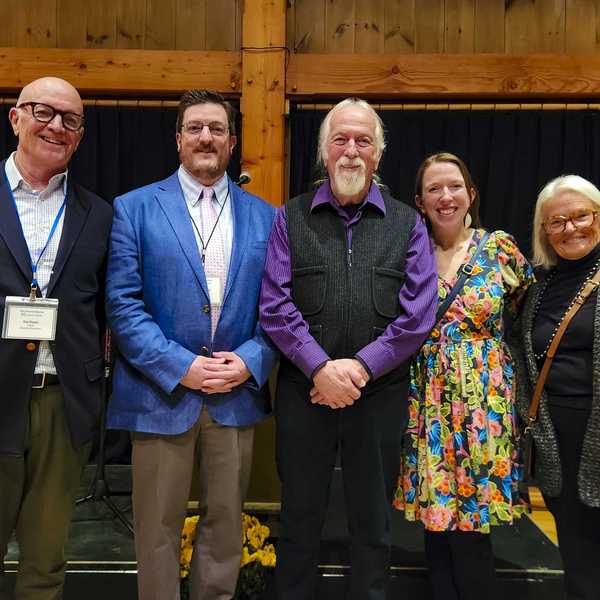
Jane Kellner and Martha McAndrews talk at a Senior Dinner put on by Sharon Hospital on Dec. 3 at the White Hart Inn in Salisbury. They were two of an estimated 100 guests.
L. Tomaino
SALISBURY — An estimated 100 people gathered at the White Hart Inn in Salisbury for a celebratory capstone dinner for Sharon Hospital’s Senior Meal Program on Dec. 3.
Sharon Hospital’s president, Christina McCulloch, addressed attendees. “Tonight, we celebrate connections, gratitude and looking ahead.”
She added that Sharon Hospital is “investing in a comprehensive approach to aging,” and said the meals are part of that, offering “not only a healthy meal, but socialization.”
Dr. Jonathan Joseph added, “activity, exercise, and socializing are key to health when aging.”
The Senior Meal Program offered residents 65 and older a full lunch that included a salad or small soup, a main course with a vegetable and starch, dessert, and coffee or tea — all for $5. Meals were served in the Sharon Hospital café from 11:30 a.m. to 1:30 p.m., Monday through Friday.
Interspersed throughout the year were suppers with themes such as “The Sweetheart Supper” in February, which included a lecture on heart health and an opportunity to meet Sharon’s new cardiologist, Sheri Harrison.
Rosemary Farnsworth, from Salisbury, remembered the Sweetheart Supper, “A lovely event, very nice.”
The discounted meals were made possible through a grant from the Northwest CT Community Foundation, the Northwest Corner Gives Fund. Donations from the community were matched by this grant.
The Dec. 3 dinner was the final senior dinner given the existing grant guidelines. Senior meals will be paused at the hospital café until the Sharon Hospital Foundation is able to secure ongoing support for the program.
Donations can be made by contacting Laura Eldridge at the Foundation, 203-739-7056 or laura.eldridge@nuvancehealth.org
Keep ReadingShow less
loading