Calling your senator
Whatever your thoughts and ideas about our country’s political system, I strongly encourage everyone to leave a voicemail at your senator’s office to express what you think. It’s quick but effective in sharing what matters to you.
The phone number for all the Senate is 202-224-3121. You’ll be forwarded to your senator’s direct line once you say his or her name, and you simply leave a message stating your thoughts.
Lynn Curtis
Falls Village
Short-sighted firing at NLRB
In the onslaught of statements and actions coming at rapid speed from the Trump administration, it is often difficult toreact to any particular matter. As a former administrator at the National Labor Relations Board, I feel compelled to speak out about an action taken at my former agency.
A few days ago, Board Member Gwynne Wilcox was informed by email late at night that she was fired. No notice. No hearing. No reason except that her decisions were not in line with the Trump administration policies. Just go.
Member Wilcox, the first African-American woman to serve on the Board, was confirmed by the Senate for term that expires in 2028. This was the first time a Board Member has ever been fired since the passage of the statute in 1935. The National Labor Relations Act was specifically designed to attempt to limit political influence in the decision-making of the Board by including in the law a provision that states that Board Members may not be removed except for “neglect of duty or malfeasance in office but for no other reason.”
This short-sighted action, if allowed to stand, will establish a precedent that will undermine any credibility and neutrality that the Board currently possesses. The statute that the Board administers bars employers from firing employees for supporting a union, requires both union and employers to bargain in good faith, and outlaws many types of union picketing or certain threats against an employer’s suppliers or customers for merely doing business with an employer in a dispute with the union. Also, significantly, the NLRB conducts secret ballot elections to determine whether employees wish to be represented by a particular union. The discharge of Member Wilcox reduces the number of Board Members to two, less than a quorum, thereby making it impossible for the Board to make a decision in any case. A union seeking to represent employees must now turn to economic or other means of persuasion to gain recognition. One of key purposes of the Act was to provide a neutral, non-economically disruptive method of deciding if a union should be certified as the bargaining representative.
The destruction of the impartiality and effectiveness of the NLRB will have widespread consequences, including the total politicization of the Agency appointments leading to changes with every administration; certainly not within the objectives of the current administration.
Dan Silverman
Former NLRB, Regional Director and Acting General Counsel
Falls Village
Need to stop provoking each other
This is regarding two letters that appeared in The Lakeville Journal, one from Mr. Lloyd Baroody concerning Israel’s conduct in the West Bank and with respect to its war on Hamas, and a second, reply letter.
I feel well positioned to write this letter for four reasons. Mr. Baroody and an author of the reply letter are friends of mine, I am Jewish, I support Israel’s right to exist within secure borders, and I am considered by many as significantly left of center politically.
I am critical of both letters. Mr. Baroody’s because of his use of trigger words, which provoke rather than persuade people. And the reply letter because it took the bait, focused on things Mr. Baroody did not say, reacted primarily to the trigger words and ignored the substance of Mr. Baroody’s criticisms.
For example, the reply letter states “there is no room for humor regarding the barbaric event of Oct. 7, the worldwide outbreak of antisemitism unleashed by that event or the constant call for the eradication of the of the State of Israel”. However, Mr. Baroody‘s letter made no reference, humorous or otherwise, to any of that.
The reply letter justifies the size of American aid to Israel by saying it “never leaves American hands” while ignoring Mr. Baroody’s implicit point that that aid supplies Israel with massive amounts of weapons which are used in Gaza and the West Bank (aka Palestine).
Regarding the trigger words, the letter states “The most obnoxious part . . . is [Mr. Baroody’s] use of the terms ”genocidal slaughter” and “holocaust.” Those terms, as the reply letter states, “describe the 20th Century Jewish experience in Germany and Europe” but the letter criticizes Mr. Baroody for not restricting those terms to that meaning. However, my Merriam-Webster dictionary indicates additional meanings. For example, the dictionary states “holocaust” also refers to “a mass slaughter of people,” providing as an example “a holocaust in Rwanda.” Note: This is not to deny that these words should be expected to trigger/provoke strong emotional reactions.
We don’t need to agree with each other but we do need to stop provoking each other, and to resist taking the bait and being provoked. And we need to remain open to critically reviewing and reassessing our beliefs, views and opinions. To that end we need to actively seek out, listen to and respect people holding views with which we disagree.
Few people would, and I know Mr. Baroody does not, justify the barbaric attack on Israel on Oct. 7. Further, few people would deny the justice of a war in response. What people reasonably can differ about is the morality of the manner in which Israel has conducted the war in light of the tens of thousands of non-combatant Gazan Palestinian men, women and children who have be killed (Israel and Hamas disagree only about how many tens of thousands) and about how Israel is conducting itself in the Occupied West Bank/Palestine.
Rick Robbins
Sharon
Appreciation for Auschwitz article
Thank you to the Millerton News and to Natalia Zukerman for a profoundly moving article on the importance of remembering, honoring, and bearing witness at Auschwitz. In a time when historical memory is often challenged or diminished, this piece served as a poignant and necessary reminder of our collective responsibility to preserve the truth.
Through eloquent storytelling and heartfelt reflection, Ms. Zukerman not only honored her family’s legacy, the victims and survivors of the Holocaust, she also underscored the moral duty we all share to confront history with honesty and vigilance. The emphasis on remembrance as a means of ensuring that such horrors are never repeated resonated deeply with me.
I hope that more pieces like this will continue to be published, fostering awareness, education, and, most importantly compassion. Sincere gratitude to Natalia Zukerman for her thoughtful and beautifully written piece.
Nina Peek
Amenia
The views expressed here are not necessarily those of The Lakeville Journal and the Journal does not support or oppose candidates for public office.

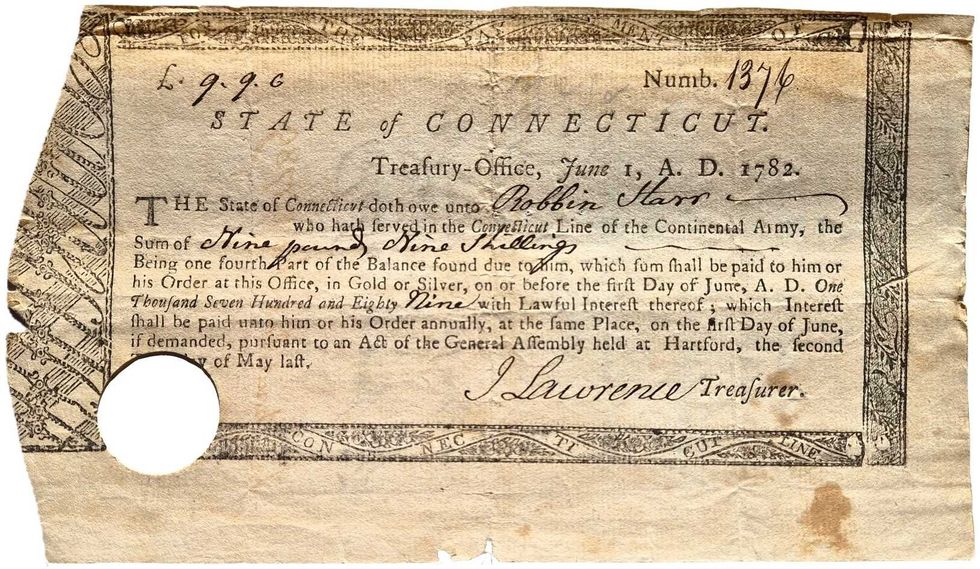 Pay Bill for Robin Starr’s service in the Continental Army.Courtesy the Alex Breanne Corporation
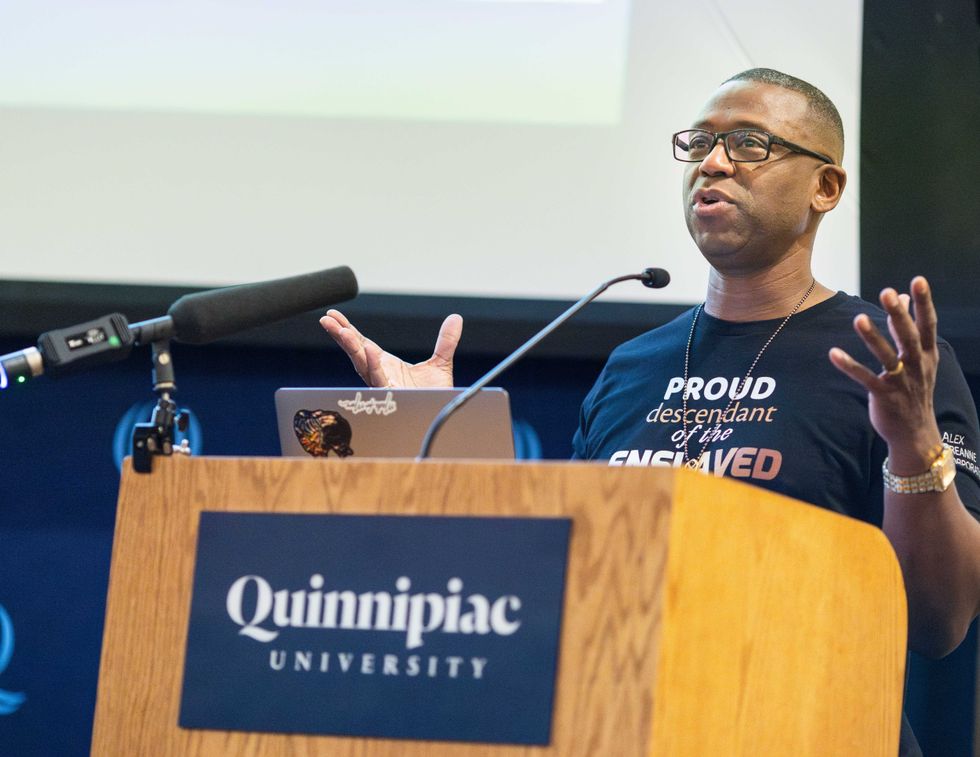 John Mills speaking at Quinnipiac University.Courtesy the Alex Breanne Corporation
 Stephanie Saetta,with her rescue dog George and Blue (left), a shepherd mix awaiting his forever home.Madi Long
 Blue, a 7 year-old Shepard mix, is waiting for his forever home. Madi Long