Coffee Roasting, Smoothie Mixing

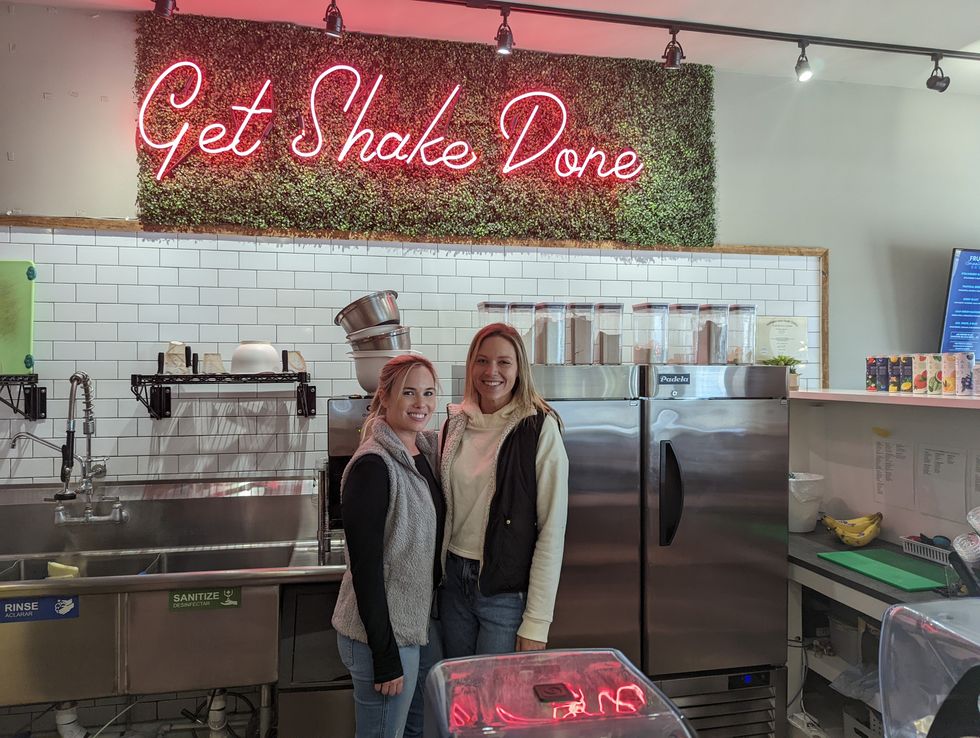
Cassidy Considine and Kelly Wolfe at Nutrition on Railroad.
Photo by Riley Klein

A short distance away from Northwest Auto, across Railroad Street, we come across the newest business in town, ILSE Coffee. ILSE is a company that has been based in Stamford, Conn. Originally, they were primarily wholesale coffee roasters that shipped beans to cafes around the world. I sat down to interview co-owners Rebecca Grossman and Lucas Smith, who couldn’t be more excited to have brought their business to North Canaan. When asked why they chose North Canaan, Grossman said, “We were coming up on our lease and thinking about where we wanted to be next in the world and North Canaan was always an option. It’s always been a special place for both of us. We had been driving by this building when we would come up and always thought that it would make for such an amazing roastery. So we reached out to the owner and he was interested in renting it to us and we decided to make the move.”
In August of 2022, Isle made its move from Stamford to North Canaan and has been bustling ever since. It was a great fit right away. While in Stamford, ILSE was located in a warehouse, which worked great, but the team was looking for that small-town feel and personality. The new location has plenty of room for the entire wholesale department while having the added bonus of a small room for a store. Leaning into the retail side of things is the direction that they intend on going as well. Opening the retail side has taken more time than they originally thought, but are ready to open this spring. Having that piece of the business be a new opportunity for growth is rather exciting for co-owners Smith and Grossman. Being able to bring to light all the deliciousness that comes with coffee and coffee-related drinks to the folks of North Canaan is something they cannot wait to do. They will also be selling their beans in the store for people who brew their coffee at home and are looking for top-notch beans. Anyone looking for a great cup of Joe and anything else related to coffee, look no further than ILSE Coffee.
Across the street, we have Nutrition On Railroad and KayCee & Co. Gift Boutique, which is a joint operation owned by Cassidy Pelletier and Kelly Wolfe. On the Nutrition side there is a medley of smoothies, acai bowls, and energy-boosting drinks, on the Gift Boutique side there are all sorts of trinkets and other assorted goods. This combo shop, if you will, is something that is completely unique to North Canaan. The birth of Nutrition started with the idea of “What is Canaan missing?” A smoothie and drink bar was the answer. Pelletier doesn’t want that to be the only way people know nutrition though, as she is always focused on “what Canaan needs and will continue to need” in the hope of always being able to adapt to the times. Adaptation is something they both see as growth and progress, that’s why about a year ago they added the Gift Boutique. Breaking down a wall between the two storefronts and becoming one, the stores flourished. Unfortunately, the traffic just hasn’t been there for the Gift Boutique so they, naturally, will have to adapt.
Nutrition is generally pretty busy, with a rush in the morning and around lunchtime with a steady stream of folks in and out in between, they stay bustling. The Gift Boutique, however, is a totally different animal. “The gift shop just doesn’t stand alone right now, whereas Nutrition has always been successful.” Due to unforeseen circumstances, the gift shop struggles to draw a crowd. Cassidy has a couple of theories of her own as to why that is. “ I don’t know if Canaan is just not ready for it, or people just don’t think about Canaan in that way. Honestly, I don’t think there are enough gift shops. No one comes to Canaan for one gift shop. I wish we had three or four gift shops and I think we’d be a lot more successful.” The gift shop is a fantastic addition to the town, and it’s great for people just passing through town that can get a memento to remember Canaan by. It’s just unfortunate that there really isn’t the foot traffic through town to support it completely. This realization has prompted Nutrition to rethink what it wants to do and how to make changes to be more successful. Seeing as one side of the business has a steady stream of customers at this point, it would only make sense for them to lean into that side.
Expanding Nutrition on Railroad will be no easy task, and as such has been planned out thoroughly, the main idea behind it is to really lean into the breakfast side of things. In order to do so they will have to undergo reconstruction, planned for sometime this summer. The area behind the bar is not very large, which is by design. There’s only so much space that one or at max two people behind the bar need, they’re only whipping up smoothies and other drinks. The storage for everything doesn’t take up very much space, they use fresh fruit for every smoothie and fruit bowl so they can’t have too much fruit in stock or else it will sit too long and spoil. So in order to accommodate breakfast they must make some critical changes, which means increasing that space, just not at the cost of the smoothie bar. The smoothie bar offers a unique way for people to come together and mingle as if it were a real bar, but there’s no alcohol and that is something that Pelletier does not want to change about the business. “I feel like it’s a fun place to come sit and what we kinda want to do is have more seating options because it is small.” Along with the expansion will come new merchandise and owner Pelletier teased that there could possibly be a name change. “I feel like Nutrition On Railroad kind of limits me a little bit… just the name Nutrition On Railroad, yes the food is nutrition, but that’s not how I want people to take it, thinking that it’s only healthy options. Right now that’s what we’re geared for and we’re always going to have that, but I wanted to offer things like pastries and sandwiches.” Time changes quickly and waits for no one, so the folks at Nutrition are adapting fast and shaking things up.

Sharon Hospital
SHARON — Northern Dutchess Paramedics will cease operating in Northwest Connecticut at the start of the new year, a move that emergency responders and first selectmen say would replace decades of advanced ambulance coverage with a more limited service arrangement.
Emergency officials say the change would shift the region from a staffed, on-call advanced life support service to a plan centered on a single paramedic covering multiple rural towns, raising concerns about delayed response times and gaps in care during simultaneous emergencies.
The decision became known on Dec. 11, when communities were informed that NDP’s service would end as of Jan. 1, according to Andrea Downs, president of the Falls Village Volunteer Fire Department and an employee of the organization.
Founded in 1994 and based in Rhinebeck, New York, NDP has provided advanced and basic life support ambulance services to communities in Dutchess and Columbia counties in New York, as well as parts of Litchfield County, for nearly three decades.
How the change came about was outlined by Al Tortorella of Sharon, also an employee of NDP.
Tortorella said every Connecticut municipality is required to have an advanced life support provider. For the past 28 years, Sharon Hospital has fulfilled that requirement by signing an annual hospital-sponsored agreement with NDP. In recent years, the agreement was signed by Dr. Ronald Santos, head of the hospital’s emergency department, under whose medical license NDP operates.
When NDP recently approached Santos to renew the agreement, he said he could not sign it, a decision that took the organization by surprise, Tortorella said.
Area towns operate volunteer ambulance squads that provide basic life support. NDP supplements those crews by delivering advanced medical care, administering medications and conducting inter-facility transports.
Sharon Hospital, which is part of Nuvance Health, merged earlier this year with Northwell Health. Downs and Tortorella said they understand that the hospital system plans to replace NDP with its own paramedic service.
Under the proposed arrangement, a single paramedic would cover the Sharon Hospital catchment area, starting each 12-hour shift in New Milford before traveling to Sharon. If needed, the paramedic would be assisted by a paid EMT provided by Nuvance.
Tortorella sharply criticized the model.
“It’s a system designed to fail,” Tortorella said. “This is a huge issue.”
Downs echoed those concerns, noting that the paramedic’s 12-hour shift would include significant travel time between locations.
“I’m very concerned about the health and well-being of residents in the Northwest Corner,” she said. “We don’t want any reduction in services for patients in the region. I can’t understand the rationale of taking services away. Northwell wants to maintain a model of corporate health care, but they can’t put a face to the people and culture we’ve established here. We’re talking life and death.”
Downs emphasized that the decision does not involve layoffs at NDP, which was recently acquired by Empress. She said there is ample demand for paramedic services in New York state and that employees’ jobs are secure. The concern, she said, is for the safety of families, friends and neighbors in Northwest Connecticut.
In an interview, Sharon Hospital President and CEO Christina McCulloch and Andrea Rynn, assistant vice president for community, government and public relations at Northwell Health, addressed the decision to discontinue the hospital-sponsored agreement with NDP.
“Recently, concerns were brought to our attention about compliance and [a lack of] communications,” they said. “This information left us unsettled and unable to be a sponsoring hospital at this time.”
They acknowledged that the timing of the transition was far from ideal. “Despite the tight timing, we are actively developing a coverage plan in concert with local first responders and area leaders. This is a process that is just beginning and we are confident it will strengthen over time.”
McCulloch and Rynn said the hospital and health system remain committed to maintaining service continuity and working with community partners to enhance emergency medical services across the region.
The pair have met with representatives of area ambulance squads and on Friday held a session with the region’s first selectmen.
Gordon Ridgway, first selectman of Cornwall, said people are feeling rushed by the move. They are concerned that services will be lessened, not enhanced.
“This is the most important thing in town; picking up people in the middle of the night and providing immediate care. It has to be done well.”
Falls Village First Selectman David Barger said the meeting was productive and answered some questions, but left others unresolved.
He said he plans to host a meeting in January at the town’s emergency services center, inviting ambulance providers, first selectmen and hospital representatives to continue the discussion.
Berlin High School’s football team rejoices after a last-minute win in the Class M championship game Saturday, Dec. 13.
In December’s deep freeze, football players showed their grit in state playoff tournaments.
Connecticut Interscholastic Athletic Conference named six state champions in football. The divisions are based on school size: Class LL included schools with enrollment greater than 786; Class L was 613 to 785; Class MM was 508 to 612; Class M was 405 to 507; Class SS was 337 to 404; and Class S was fewer than 336.
Eight teams qualified for each tournament and all championship games were played on Saturday, Dec. 13.
Class LL was won by Greenwich High School for the second straight year. Greenwich beat Southington High School 45-6 to win the tournament. Jack Kelly rushed in three touchdowns for the Cardinals and caught a fourth.
Class L was won by New Canaan High School, which completed an undefeated season. New Canaan beat Cheshire High School 34-13 for the school’s fourth-straight state title. In the regular season, New Canaan defeated Greenwich 14-7.
Class MM was won by Windsor High School, which defeated Bunnell High School 23-13. Windsor quarterback A.J. Robinson threw for 140 yards with a passing touchdown and two rushing touchdowns.
Class M was won in the final minute by Berlin High School 20-15 over Brookfield High School. The thriller came down to the wire. Brookfield went ahead with a late touchdown. Then on the kickoff that followed, Berlin’s Eli Rice ran it 80-yards to the house to take the lead with 33 seconds remaining and secure the state trophy.
Class SS was won by Daniel Hand High School, marking its 15th state title in school history. Hand defeated reigning champion Killingly High School 37-13. Killingly was previously on a 25-game win streak that stretched over two seasons.
Class S was won by Sheehan High School, defeating Northwest Catholic High School 21-7. Running back Joshua Durant ran for 215 yards and three touchdowns in the win for Sheehan, which was the first state title since 2019 for the school.
Details and photos from each championship game can be found at ciac.fpsports.org
Volunteers scan snowy treetops during the Trixie Strauss Christmas Bird Count in Sharon. Teams identified more than 11,400 birds across 66 species.
SHARON — Birdwatching and holiday cheer went hand in hand for the Trixie Strauss Christmas Bird Count on Sunday, Dec. 14, with hobbyists and professionals alike braving the chill to turn their sights skyward and join the world’s longest running citizen science effort.
The Christmas Bird Count is a national initiative from the Audubon Society, a globally renowned bird protection nonprofit, that sees tens of thousands of volunteers across the country joining up with their local Audubon chapters in December and January to count birds.
This wintry avian census, which is now in its 126th year, is very effective at amassing bird quantity and species diversity data, especially in colder climates where seasonal populations of birds are highly variable. These datasets, Audubon has upheld, provide vital snapshots of population health and trends, which then informs conservation strategy.
Sharon Audubon helped to host the Trixie Strauss count, the formal name of the regional count that covers an area centering on The Hotchkiss School, with staff members aiding 24 volunteers spread out over eight teams that each surveyed a unique 15-mile loop.
According to the total tally, the volunteers had identified over 11,400 birds spanning 66 species, just one less than last year’s total of 67 species.
While the number is similar, Bethany Sheffer, volunteer coordinator and naturalist at Sharon Audubon, said the species that are present are subject to change based on a number of factors. The early freeze of lakes and ponds in the Northwest Corner meant that there were fewer species that prefer open water tallied this December, Sheffer explained.
Belted kingfishers, for example, were entirely absent from the count.
The data also found no northern mockingbirds or gray catbirds. Several groups noticed an abundance of the dark-eyed junco, though Sheffer noted that the reasons for these changes from previous years are as of yet unclear.
However murky the causes, Sheffer noted that the amassing of this data lays the foundation for vital observations surrounding species trends. Citizen science observations enabled scientists to discover that the range of the northern cardinal was expanding, for example, and that the Cooper’s Hawk is becoming more common in the wintertime New England forest as it’s been staying behind to prey on smaller songbirds that congregate at bird feeders when the ground is snow-covered.
Sheffer noted, though, that it’s not all about the data.
“The history of the Christmas Bird Count is really moving,” she said, explaining that its origins lie in a Victorian tradition of a Christmas “hunt,” where groups would scour the hillsides and treetops to kill, not count.
Since ornithologist Frank M. Chapman declared the first count in 1900 as a direct opposition to the hunt, the tradition has stuck. Sheffer said it’s a valuable example of how humans’ relationship to the natural world can be reframed.
"It’s important for us now more than ever to be serving birds” as stewards, she said, noting that many species face threats due to climate change and habitat degradation and loss. And another plus, Sheffer said, is the spirit of community, bringing people of all experience levels with birds together for what she described as a truly joyous day: “It’s become an event that brings people together in a really moving way.”
The Trixie Strauss count is just one of 20 in Connecticut. Several, including one just over the border in Pawling, New York, have yet to occur. For a list of each upcoming count, and who to contact with inquiries, visit ctbirding.org/cbc-2025-2026/.
John and Diane Degnan plan to convert the warehouse at the back of the property into their primary residence, while leaving the four-unit building in the front available for long-term rentals.
KENT — A proposal to convert an old warehouse into a residence on Lane Street in downtown Kent has become more complicated than anticipated, as the Planning and Zoning Commission considers potential unintended consequences of the plan, including a proposed amendment to Village Residential zoning regulations.
During a special meeting Wednesday, Dec. 10, attorney Jay Klein of Carmody, Torrance, Sandak and Hennessey presented the proposal on behalf of John and Diane Degnan, who have lived at 13 Lane St. since 2022.
The Degnans are seeking to convert an industrial structure at the rear of their property, currently used for storage, into their primary residence, while keeping a four-unit building at the front of the lot available as affordable rental housing.
What appears to be a straightforward proposal has been complicated by a murky zoning history and regulatory constraints tied to the property’s designation.
Neighbors, however, say the review process has dragged on unnecessarily and are urging the commission to move forward with a project they believe would benefit the street.
“Is it normal for zoning to go this far?” asked Lane Street neighbor Lili Mason during the public comment period at the Dec. 10 meeting. “This is all ridiculous as far as I’m concerned.”
Mason’s frustrations were echoed by other testifiers, who voiced unified support for the Degnans’ project and praised the couple’s character:
“[They’ve] changed the neighborhood for the better,” said Ed Raftery. “Don’t penalize people who are trying to make improvements,” said Tamara Potter, another Lane Street resident, who recalled overpowering shellac fumes drifting through the neighborhood when the warehouse was used to store pleasure boats.
According to Land Use Office records, the structure has previously housed an auto body repair shop, an aquarium store, a mail-order book business, sign production and a skin care mail-order operation, among other uses.
“A commercial building on this street just doesn’t fit,” Potter emphasized, alluding to the fact that the conversion of the warehouse to a residence would essentially prohibit the possibility of a future industrial use on the property.
Commission members largely agreed with residents that the proposal — combining a new residence with affordable rentals — would be a positive change. Several commissioners, however, raised concerns about the applicant’s approach, particularly a proposed amendment to the section of regulations governing special permits in the Village Residential zone.
With guidance from zoning expert Glenn Chalder and town attorney Michael Ziska, the commission pushed back on aspects of the amendment, which would add a new section specifically addressing conversions of industrial or commercial buildings to residences. The proposed language included specialized rules related to density, parking and discretionary waivers of certain zoning requirements.
New commission member Donna Hayes, who was once the town’s land use director, explained that regulations designed for a particular project can have unintended effects elsewhere in town:
“One of the things that [residents] need to understand is that a regulation is written not for a specific piece of property but for a complete zone. And it’s written not for any particular person, but it’s written for the future as well.”
Ziska offered a similar warning: “Once regulations are changed, things happen. Things happen that nobody can expect.”
He expressed doubts about several aspects of the applicant’s proposal, though indicated general support for the concept and suggested there might be a simpler and safer way forward.
Klein said the Degnans’ goal is to improve the property “utilizing existing site resources” while bringing the entire parcel into zoning compliance. Ziska noted that the four-unit building at the front of the lot was never formally approved by a zoning officer — an issue that will need to be resolved if the units are to be used as affordable rentals. Chalder and several commissioners recommended that the applicant work with Kent Affordable Housing in coming up with a plan for the units, which Klein said would be priced between $950 and $1,800.
Klein, Chalder and Ziska ultimately agreed to meet later in the month to come up with a path forward agreeable to both the Degnans and the town. The hearing was left open, and will continue at P&Z’s next regular meeting on Jan. 8.