It was a stunning moment, a president using his State of the Union address to condemn a Supreme Court decision, as six — or make that five — expressionless justices looked on.
“Last week, the Supreme Court reversed a century of law to open the floodgates — including foreign corporations — to spend without limit in our elections,†said President Obama as he served notice that this was a bad decision that could take future elections out of the hands of the voters.
The president’s words inspired Justice Samuel Alito to perform a judicial, if not judicious, version of that Republican Congressman shouting “you lie†during a previous Obama speech to the Congress. Shaking his head sadly, Alito looked at the president and mouthed, but didn’t utter, “not true.†It was not a particularly wise performance by a judge supposed to be above all of that.
His colleagues, Chief Justice John Roberts and Justice William Kennedy, who had voted to open the floodgates, and Justices Ginsberg, Sotomayor and Breyer, who had dissented, sat stony-faced, unaware of their colleague’s inburst, I guess you could call it.
Justices Antonin Scalia, Clarence Thomas and John Paul Stevens, who wrote the dissent, were absent and Alito probably wishes he had been.
u u u
The week before the State of the Union, the court had decided 5-4 that corporations and labor unions were people who had the same free speech rights as living, breathing voters to contribute to political campaigns. It was the court at its judicially activist worst, producing the most politically motivated decision since Bush v. Gore, and certainly worthy of a presidential comment during a report on the State of the Union.
Granted, this sort of thing doesn’t happen every day and never in a State of the Union address with members of the court occupying the best seats in the House. (Bush the Younger was unhappy with “activist judges†on the Massachusetts Supreme Court for advancing gay marriage in his 2004 SOTU, but those judges hadn’t been invited to sit in the first two rows of the orchestra.)
The Supreme Court is at best an awkward participant in what has become essentially a pep rally, albeit a pep rally attended by supporters of both teams. One of two costumed groups, the other being the uniformed Joint Chiefs of Staff, the court sits stoically while all those around them, except the chiefs, cheer and jeer.
“I do not expect to see justices at the next State of the Union,†Lucas Powe, a Supreme Court expert, told The Washington Post. He may be right.
u u u
In the history of presidential battles with the Supreme Court, Franklin Roosevelt’s attempt to purge the court of New Deal opponents in his second term remains the most memorable. The “nine old men,†as he accurately described them in a speech, were mostly appointees of FDR’s immediate predecessors, Republicans Herbert Hoover, Calvin Coolidge and Warren G. Harding, and a reactionary bunch who had a habit of declaring Roosevelt’s legislation unconstitutional.
Roosevelt saw packing the court with friendly judges as a solution and proposed to help the aged, overworked judges with their caseloads by adding new justices up to a maximum of six for every sitting justice over 70. By an odd coincidence, six of the nine old men had surpassed 70.
Congress didn’t buy Roosevelt’s outrageous power play but the justices got the message. One conservative justice began voting for New Deal acts, including the bill establishing Social Security, and another retired.
By the end of his second term, FDR had filled five vacancies on the court the old-fashioned way as the old men began to retire. Obama has a similar opportunity as five of the present justices, including Kennedy and Scalia, are over 70.
To rebuild the court in his image, all Obama needs to do is get re-elected.
Dick Ahles is a retired journalist from Simsbury. E-mail him at dahles@hotmail.com.
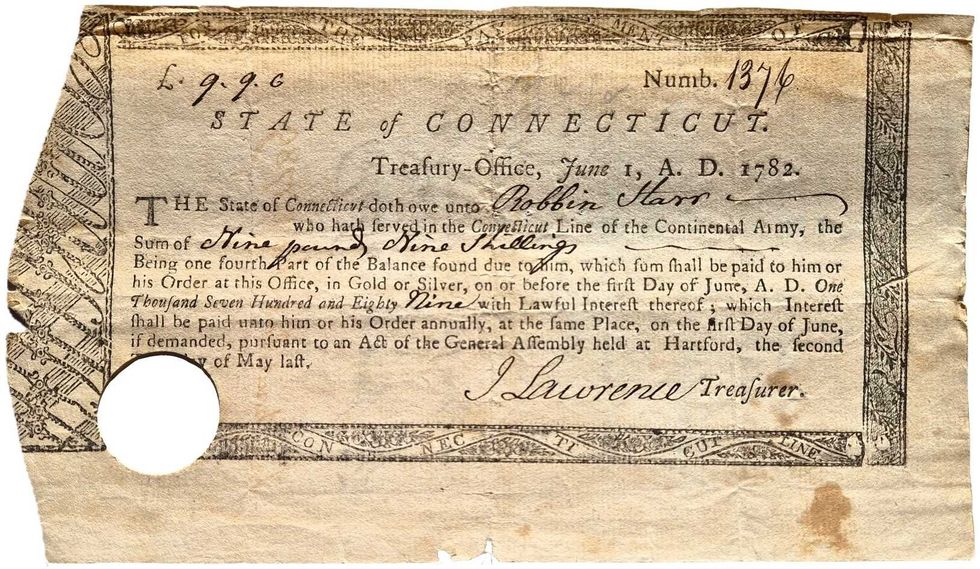 Pay Bill for Robin Starr’s service in the Continental Army.Courtesy the Alex Breanne Corporation
 John Mills speaking at Quinnipiac University.Courtesy the Alex Breanne Corporation
 Stephanie Saetta,with her rescue dog George and Blue (left), a shepherd mix awaiting his forever home.Madi Long
 Blue, a 7 year-old Shepard mix, is waiting for his forever home. Madi Long