PINE PLAINS � The "smart growth" group Pine Plains United, which formed nearly two years ago, has one issue on its collective mind at the moment�the Carvel development project.
The project, which could add 951 homes to Pine Plains, is under State Environmental Quality Review Act (SEQRA) scrutiny by the town Planning Board and its consultants.
Carvel, which is helmed by Manhattan’s The Durst Organization, is retooling its Draft Environmental Impact Statement (DEIS). If deemed complete by the board, it will partially indicate that development will not adversely impact the environment. The DEIS was deemed incomplete by the Planning Board last spring.
"We’re working with a group of consultants in regards to the completeness work on the Carvel DEIS," town Assessor and Pine Plains United Co-Chair Jim Mara said from Pine Plains Town Hall Tuesday morning.
The result of that work is a letter, written by George M. Janes, the executive director of the Environmental Simulation Center (ESC) that is addressed to Planning Board Chairman Don Bartles Jr.
The 16-page document, postmarked April 9, points out flaws in the current version of the DEIS, mostly in the area of visual simulation and impacts on Pine Plains’ viewsheds.
Janes’ letter says the DEIS does not utilize "reasonable, worst-case assumptions," something that is fundamental and critical to SEQRA review.
Pictures of the Carvel parcel in the DEIS, which were subsequently altered with superimposed models of the proposed units, were taken with a 35mm equivalent lens. A 50mm lens, Janes states, is considered the industry standard, for all SEQRA visual impact studies.
The letter, "in apples-to-apples fashion," compares the DEIS shots with 50mm pictures taken by ESC on March 7. Shots taken with the 35mm lens makes background landmarks, such as hills, look farther away. The hill looks much more prominent in the 50mm picture taken by ESC, Janes states.
"The human perspective of the relative sizes of the objects in the photograph is best represented by [the 50mm shot] ... I am unaware of any 50mm shots in this DEIS," the letter reads. "The net effect is that again, the DEIS does not present a reasonable worse-case in the photosimulations, as the lenses used systematically makes the action smaller than the human eye would perceive it."
Janes presumed that the 35mm shots could lead viewers to believe that a structure, such as one of Carvel’s units, would have less of an adverse impact because of the distant view.
"...There are serious methodological issues with the simulations that have been produced and the simulations cannot be considered reliable representations of the action," the letter continues.
"We’re focusing on that right now," Mara said, referring to DEIS completeness review, adding that in light of Janes’ comments, the DEIS should not be approved by the Planning Board in the near future. "There’s a lack of completeness."
"This is really important," said Jane Waters, a member of Pine Plains United’s steering committee.
The Durst Organization responded to the data in Janes’ letter via e-mail.
"A 35mm lens provides a wider field of vision than a 50mm lens and is better suited for the broad vistas at Carvel. The narrow view of a 50mm lens results in photos that would omit critical elements. The letter to Don Bartles is a clear indication that it is time for the DEIS to be deemed complete so that the public can comment on this comprehensive and exhaustive document," stated Alexander Durst, assistant vice-president of the Durst Organization.
In other Pine Plains United news, Mara said his group is also keeping in mind Pine Plains’ moratorium on development, which was enacted last January and was subsequently extended by another six months on March 15 of this year.
"We’re still watching that carefully," Mara said. "We wanted it to be [extended] for a year, but it’s only six months. Hopefully in July, it will be extended."
Pine Plains United wholly supports the efforts of the Zoning Commission, which recently completed, and is currently reviewing, a draft zoning law for Pine Plains, the only municipality in Dutchess County without zoning.
Once the product is finished, it will be reviewed by the Town Board and public hearings will be held.
In its most recent release, Pine Plains United said it is absolutely critical for residents to stay informed, attend all of the upcoming public hearings, as well as write letters to the Town Board and the local papers.
"We’ll get one swing of the bat and we’d better make it count. In the next few months, Pine Plains will face its biggest challenges and their outcomes will determine the fate of this area for years to come," the release states, the following words appearing in bold, capitalized type. "The finish line is within site."

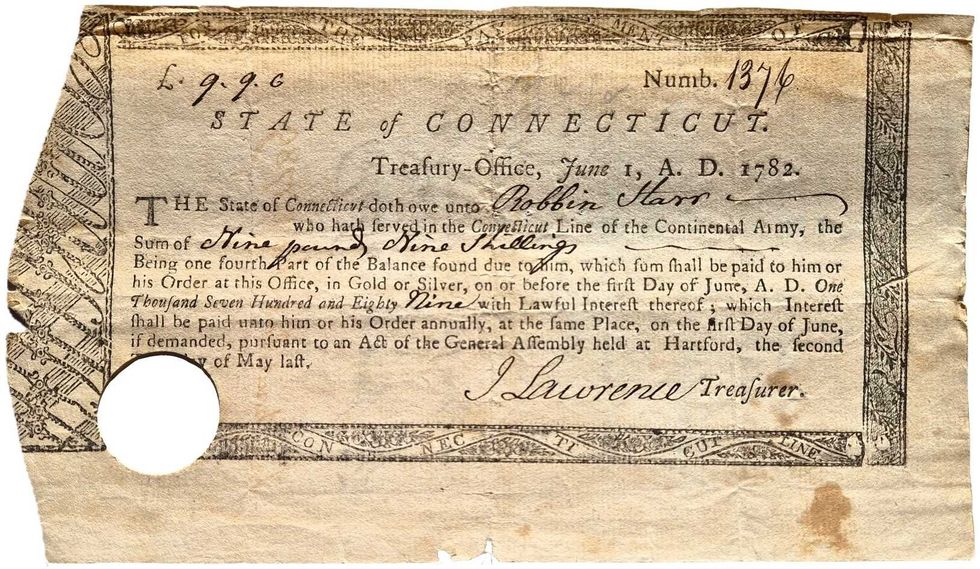 Pay Bill for Robin Starr’s service in the Continental Army.Courtesy the Alex Breanne Corporation
 John Mills speaking at Quinnipiac University.Courtesy the Alex Breanne Corporation
 Stephanie Saetta,with her rescue dog George and Blue (left), a shepherd mix awaiting his forever home.Madi Long
 Blue, a 7 year-old Shepard mix, is waiting for his forever home. Madi Long