roucho Marx famously asked: "Who do you believe - me, or your own eyes? When it comes to the Bush administration, you had better believe your own eyes, not your ears. All too often, spokespersons for the administration say one thing, designed to misinform the public, while Bush does quite the reverse, as you can see with your own eyes.
Was it Mark Twain who said: "The trouble with the world is not that people know too little; it's that too many know too much that ain't so"?
In the "ain't so" department, the U.S. administration assured us they had the "smoking gun" evidence and clear proof of weapons of mass destruction in Iraq, as well as links to al-Qaeda, and complicity in 9/11. A majority of the U.S. Congress believed all this, sufficient to grant war powers to the president (who abused them). The mainstream news media went along without critical journalistic analysis, and thus contributed to the misinforming of the American people. We all know where that got us. Enough said.
u u u
Iraq is the first war the United States has ever undertaken where most of the people have no common understanding of why we went into it. Was it for oil, for God, for freedom, for democracy, for revenge, for patricide, for anti-terrorism, or what?
Listening to the White House only adds to the confusion. Spokespersons announce "facts" and appeal to patriotic values when the observed facts and actions are quite to the contrary. For example, they say our troops are "war heros," but in fact they treat them like so much cannon fodder.
The Bush administration purports to "support the troops" in Iraq - by keeping them there. That's the slogan, anyway. In reality, as U.S. Congressman Chris Murphy recently pointed out on the floor of the House, President Bush's latest budget slashes $20 billion (that's billions, not millions) from the budget for medical care of our veterans (that's $4 billion a year for each of the next five years).
Those are astronomical figures. Bush has effectively nullified the recent budget increase for our troops and veterans that Congress had just voted for. So Congress has to start all over again.
This reduction in funding for our wounded veterans comes on top of the $1 billion a year that Rumsfeld took from the VHA hospital budget in each of the last four years - just when thousands of our troops are returning with missing arms and legs, and suffering from other serious medical problems. Does that look like supporting the troops? Many of our troops do not know the services and benefits to which they are entitled as a matter of law. They need help to find their way through the myriad of application forms to obtain the benefits and services to which they are entitled by law.
Predictably, the Pentagon and Department of Defense deny they ever suggested that VHA staff should refrain from helping our wounded veterans fill out their legitimate medical claim forms. Now a memorandum turns up in Washington, D.C., showing that is exactly what happened. The policy of the Bush administration is to minimize medical claims. They have "other priorities." Is this the thanks of a grateful nation? Does the fact that almost none of the Bush leadership has ever served in combat play a role here? So much for the declared "support" for our troops.
u u u
Moreover, the Bush administration is in denial about the human cost of its misadventure in Iraq. They say that only bona fide insurgents and enemy combatants are targeted by U.S. weaponry, with minimal "collateral damage." Really? Our bombs must be awfully "smart."
Actually, witnesses on the ground from the UN, WHO, Red Cross/Red Crescent and other organizations, who see events with their own eyes, report that Rumsfeld's opening "shock and awe" fireworks demonstration over Baghdad alone cost the lives of more than 100,000 innocent men, women and children, while the cumulative total "overkill" for Iraq under Gates now exceeds 250,000, not to mention over one million gravely injured and disabled. For what?
Already, more than 4,000 Americans have died in Bush's war, including a number of civilians whose deaths and injuries are being under-reported. The death toll does not include the tens of thousands of Americans who have lost limbs and suffered egregious injury - while President Bush slashed the national budget for their medical care, as if it were unnecessary "pork-barrel spending" (his term).
Look for Part II next week.
Sharon resident Anthony Piel is a former legal counsel of the World Health Organization and member of the U.S. Army's 2nd and 4th Armored Divisions.

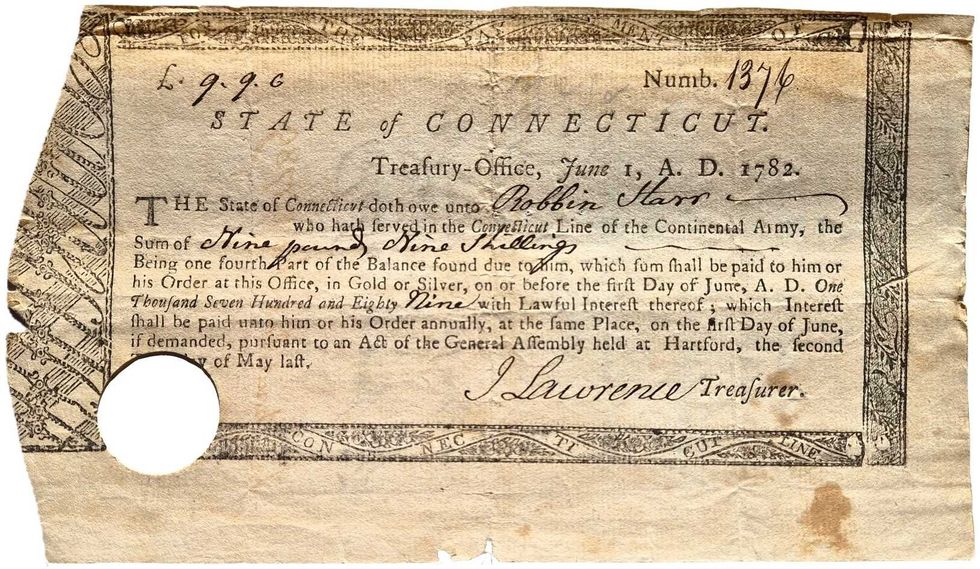 Pay Bill for Robin Starr’s service in the Continental Army.Courtesy the Alex Breanne Corporation
 John Mills speaking at Quinnipiac University.Courtesy the Alex Breanne Corporation
 Stephanie Saetta,with her rescue dog George and Blue (left), a shepherd mix awaiting his forever home.Madi Long
 Blue, a 7 year-old Shepard mix, is waiting for his forever home. Madi Long