The congressional elections of 2006 hopefully mark a tidal shift in the majority of Americans’ opinion about the war in Iraq. There appears to be an awakening of the nation to the futility and failure of current U.S. policies in Iraq, and a growing realization that we were misled into war, on false pretenses, and into a quagmire with no end in sight, in spite of the best efforts of our troops.
This is not to say Americans are not still deeply divided and conflicted about Iraq. We can sum it up this way: Some of our citizens still want to "stay the course" in Iraq. (You can fool some of the people all the time.) Others have opposed the war from the beginning. (Some people just cannot be fooled.) Most Americans who once supported going to war in Iraq no longer do so. (You can fool most people, but only some of the time.) Virtually all Americans now seek not victory, but a decent way out — an "exit strategy." (Moral: You cannot fool all of the people all of the time — can you?)
u u u
There’s one thing Americans do not waiver on: support of our troops, regardless of views on Iraq. You can see this anecdotally on bumper stickers on Connecticut vehicles. Almost overnight after the November elections, messages supporting the Bush administration and the war in Iraq have disappeared. Bumpers have been cleaned off. That takes work.
But "Support Our Troops" ribbons remain. Yet the meaning has clearly changed. No longer is "Support Our Troops" a coded way of saying "We support going to war in Iraq," as the Carl Rove spinmeisters originally intended. "Support Our Troops" now means exactly what it says: We support our troops, period.
That’s a message slow to reach Washington. The U.S. administration, which is quick to pay patriotic sounding lip service to our troops, has been slow to support them, and sometimes counterproductive. The failure to provide heavy armor protection is just one example. In the last few years, the current administration has reduced budgets for military pay and allowances for service, combat, hazardous duty, family separation, dependents, injuries, medical care and retirement benefits. The federal death benefit (which Connecticut has had to supplement) is barely 1 percent of the average compensation paid by the federal government to the family of a "9/11" victim. Why? What does this say about the politics of Washington’s support for our heroic troops?
u u u
In the face of nearly 3,000 dead, 20,000 severely wounded and disabled, and 100,000 total wounded returning from Iraq to flood our health-care system, the civilian leadership of the Pentagon, with highest level administration approval, has slashed over $1 billion from the Veterans Hospital Administration in each of the last three years, redirecting the funds to "other priorities." Consequently, many VA facilities have had to close their doors, so veterans now have to travel farther than ever before to receive medical treatment — if any.
This is the same administration which decided that, in effect, military retirees should be required to pay for their own disabilities, since every dollar in disability compensation they receive from the Veterans Administration is deducted from their military retirement pay.
Is this how we honor our sick and wounded veterans? True, we have under-compensated our veterans of WWI, WWII, Korea and Vietnam, but the current administration is bent on exceeding that dismal record of callous disregard for the well-being of our military personnel, while sending our regular military, reserves and National Guard soldiers to repeat tours of duty in Iraq.
One in four servicemen and women returning from Iraq has applied for disability compensation. Approvals can take from several months to more than a year. Refusals are frequent, and they come much quicker. The current U.S. administration is loath to recognize the reality of "Gulf War syndrome," "post traumatic stress disorder" and other combat-related injuries and disabilities. The burden of proof is shifted to the claimant.
u u u
Soldiers who volunteered and received sign-up bonuses before going to Iraq, and who then lost an arm or a leg in combat so they could not complete the term of their sign-up contract, have been sued by the administration to pay back the bonus, which for obvious reasons they cannot do. Dozens of such young people have joined the ranks of the "homeless," disproportionally filled by veterans, sleeping on heating grates and under bridges. The authors of this disgraceful situation still sleep on feather beds in Washington.
Longer-term care for our wounded and disabled soldiers is often left largely to the individual states, local municipalities, church groups, charities and "random acts of kindness," by concerned individuals. Many states (including Connecticut under Gov. Roland) have adopted a "means test" for long-term or terminal medical care. It’s analogous to Medicaid. If the veteran owns a house or some other significant asset, he must first sell it to help pay for the cost of his care. He may have worked for it all his life, but he cannot leave it to his children.
This scheme transforms the veteran into something of a pauper, a ward of the state, holding out a begging bowl to the nation he valiantly served.
There is in all of this a striking disconnect: Those that most loudly expound patriotic-sounding slogans and sound bites, such as "Mission Accomplished," "Stay the Course," "Don’t Cut and Run," "Victory in Sight," "Mission to be Completed," and, of course, "Support Our Troops," tend to be precisely those who themselves did not fulfill their mission, did not serve in combat, but rather designed their own personal, advance "exit strategies" to serve their "other priorities" when it was their time to serve their country. They are the ones who do not in fact support our troops today, other than with politically correct monuments, flags and lip service.
u u u
The time has come for patriotic Americans to rise up and demand better federal government support for our troops. Let’s legislate it.
When you see a "Support oOur Troops" ribbon on a vehicle, remember this: It has nothing to do with promoting the war in Iraq; it has everything to do with how we treat our troops here at home.
Sharon resident Anthony Piel is a former member of the 3rd & 4th Armored Divisions.

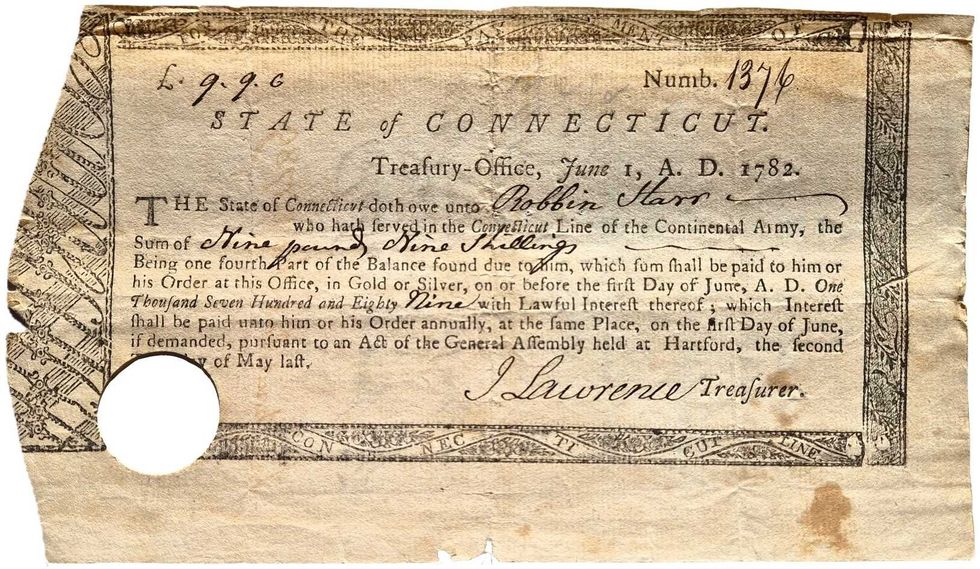 Pay Bill for Robin Starr’s service in the Continental Army.Courtesy the Alex Breanne Corporation
 John Mills speaking at Quinnipiac University.Courtesy the Alex Breanne Corporation
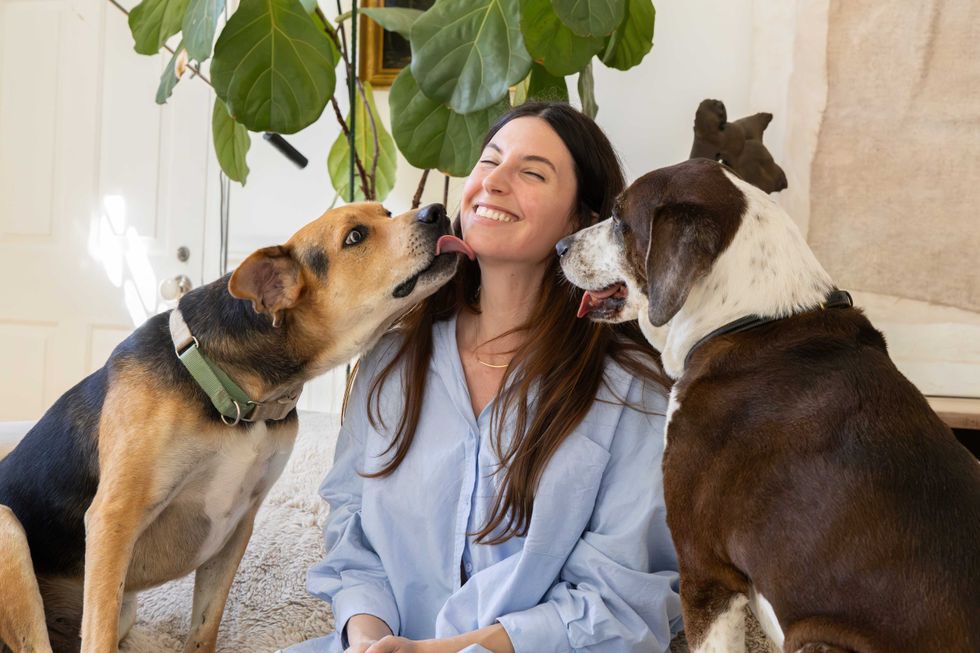 Stephanie Saetta,with her rescue dog George and Blue (left), a shepherd mix awaiting his forever home.Madi Long
 Blue, a 7 year-old Shepard mix, is waiting for his forever home. Madi Long