By the time you read this, I am confident that the nation and the world will be celebrating an overwhelming victory by Barack Obama. Such an epochal event will not in itself alleviate many of our problems, but it will open a vast arena of new possibilities for reviving our national confidence and redeeming the position of the United States in international affairs. Our friends abroad will be as overjoyed as the majority here.
So I could be wrong and have egg on my face, in which case the thing to do would be to acknowledge that I am a sloppy eater. But a substantial number of factors influenced my judgment.
u u u
The first of course is the superb organization of the Obama campaign and the astonishing way in which he has been able to inspire hope in young people and project warm humanitarian concerns while keeping his professional cool. He reflects a new opportunity to subordinate racial and ethnic divisions and unite Americans in a larger purpose. Barack Obama does not get rattled, and he has a clear vision of where and how he wants to lead the country. He has enlisted some of the country's best minds of both parties in his support.
Meanwhile John McCain seemed to me to be acting out of character. A small but telling indication was the television shot of McCain and Sarah Palin last Friday in which, as if on cue, each referred to the “Democrat� party. That verbal amputation is an old Republican technique dating from the days of Joe McCarthy. It suggests that some arcane GOP strategist was advising the candidates on how to infuriate the Democrats. If so, it was a cheap and desperate ploy out of keeping with the fundamental decency associated with McCain.
u u u
Perhaps you saw the last half of the PBS biographical portrait of Lyndon Johnson last week. Seemingly filmed about 1990, it featured a larger number of former officials reflecting on what went wrong during the Vietnam War, the tragedy that blighted hopes for the Great Society and ultimately caused President Johnson to withdraw from the 1968 election. To me the themes used to justify continuing the unwinnable war in Indochina had an uncanny familiarity to what we heard from the Bush administration about the war in Iraq — we cannot acknowledge defeat because that would encourage our adversaries. We must achieve victory, et cetera, et cetera.
This had a special poignancy because I had known quite a few of the Vietnam era principals in Washington. To judge from their latter-day comments, they knew at the time much of what was going wrong — the lies and exaggerations used to encourage public support of a war that had gone sour. But what they knew in private and what they said in public were largely at odds. Their duplicity was sickening.
u u u
I had some personal experience with this. When I was covering the United Nations, Attorney General Nicholas Katzenbach appealed to my patriotism to undertake a then secret diplomatic task involving the Hungarian ambassador, which I later thought had imposed on the role of an independent journalist. Imagine my chagrin to learn from the TV flashback that this had been a cynical ploy while all the time Katzenbach believed that the cause was lost.
Robert Mc Namara resigned as secretary of defense largely because he was weighed down morally by the defense that a note of realism crept into official assessments. His after-the-fact criticism was of the inability of President Johnson to concede that the course was wrong. Have you heard that anywhere before?
u u u
The tragedy is compounded by the fact that Lyndon Johnson accomplished more for the achievement of voting rights by black citizens — and thereby equality before the law — than any other president. He really cared. That achievement ought to be remembered, irrespective of the tragedy of Vietnam.
u u u
A sign of the times was that a friend visiting from Norwalk, who traditionally celebrates her wedding anniversary in Salisbury with her husband, reported that her work editing book manuscripts had dried up altogether. She now must commute to Manhattan to a far less congenial part-time job.
Plenty of people in this area have been feeling the economic pinch, and you can sense it in the cutbacks in spending. Organizations that depend on charitable contributions surely must find less money coming in. It is dismaying at the same time to see persons you know can't afford it — persons who work several jobs just to keep afloat — plunking down money for lottery tickets. If we're looking for moral complicity in hard times, the state of Connecticut has a lot to answer for.
u u u
Can you remember a fall when the leaves have stayed on the trees so long while the colors changed but remained vivid? These are blessings money can't buy, and they remain with us whatever the state of our personal finances.


 Justine and Victor Valla in their studio with a painting of Victor’s,”Jonah and the Whale.” Robin Roraback


 A ceramic vase by Kathleen Heidemann.Provided
  Joy Brown’s delightful ceramic sculptures.Provided

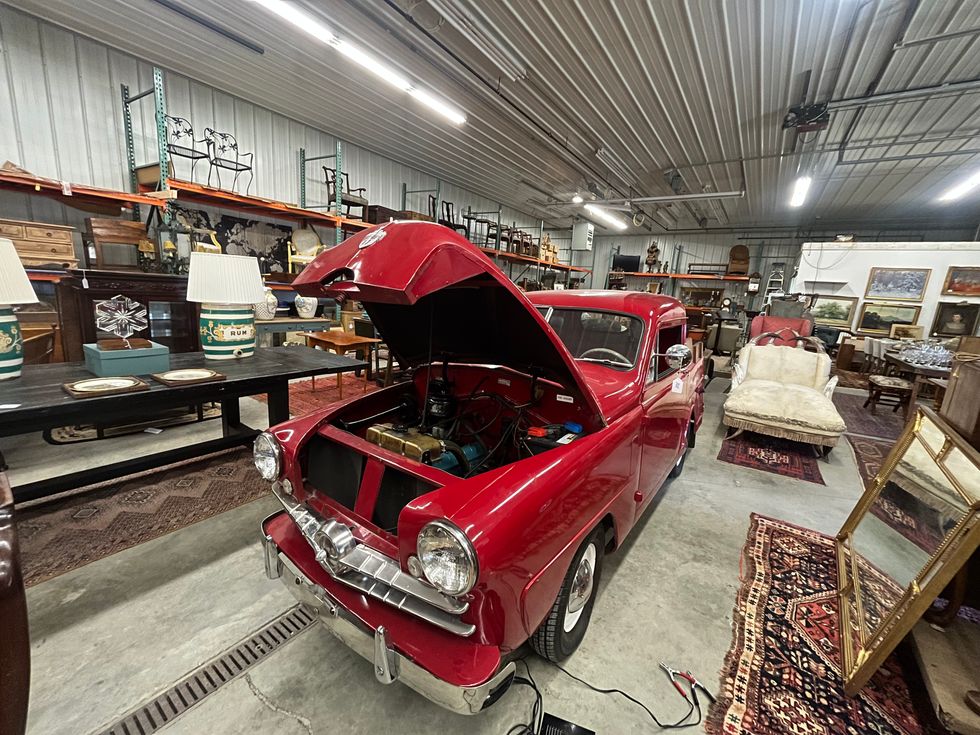 Hundreds of items at Stateline Auctions, including a candy-apple-red Crosley pickup truck.D.H. Callahan