Yes, we’re talking about the Tomato Pie War (again!). This is an interesting tale of a clash in one small area town, and it’s worth telling again because, well, it’s summer and soon the tomatoes will be ripe and ready for roasting and there will be a recipe at the end of this article.
For those who have heard this story before, I won’t go into too much detail here; if you want to know more, do a search for “tomato pie” at our newspaper’s archive online through the Salisbury, Conn., Scoville Memorial Library at https://scoville.advantage-preservation.com/.
Suffice it to say that in the winter of 2012 there were very heated discussions between the owner/chefs of two Salisbury restaurants over who/which was allowed to feature tomato pie on their menu. There was more to it than a mere menu item of course. But whatever.
Most folks who live around here will realize that tomatoes are not a winter fruit. The tomato pie, really, is not even a winter menu item. Nonetheless, angry words about fresh versus canned tomatoes were thrown about that February and at one point there was a bumper sticker handed out by one of the eateries, laying claim to the Original Tomato Pie.
Names are withheld here
In the world of art, there is something called “provenance,” which is the documentation that shows the journey of a work from artist to owner(s). In the tomato pie war, there was also provenance, of a sort.
One of the restaurants (Restaurant A) had been cited in an article in 2008 by beloved Gourmet magazine food writer (and Cornwall, Conn., resident) Laurie Colwin (it later appeared in her collection called “More Home Cooking”). The chef/owner (Chef A) told Colwin that she had found the original tomato pie recipe in a Hotchkiss School fundraising cookbook — but she had changed it enough to claim it as her own.
The other chef/restaurant owner (Chef B) still had a copy of the original fundraising cookbook — and the recipe, which was shared by Anita Westsmith, wife of a popular local dentist.
Friends of the Town Hill School
The cookbook was actually put together by students at the Town Hill School (now part of the Indian Mountain School) in Lakeville, Conn., and was called “Favorite recipes from friends *some famous* of the Town Hill School.” It was published in 1986.
In a Feb. 16, 2012, issue of The Lakeville Journal there is a letter from Alexandra Hunter of Sharon, Conn., who remembers collecting the recipes for that cookbook when she was a youngster. Hunter is the daughter of Chef B.
She says in her letter that tomato pie “is a dish my family has been making for more than 20 years. I remember testing that recipe when Anita Westsmith submitted it. I also remember writing to First Lady Reagan and asking her for a recipe, and getting one in return for that same book.”
In case you’re wondering, there is a recipe submitted by “President and Mrs. Ronald Reagan, Washington, D.C.,” for “President Reagan’s Favorite Macaroni and Cheese;” and one from “Nancy Reagan, The White House” for “Pumpkin Pecan Pie.”
Friends of the
Great James Beard
Ultimately, Hunter explains in her letter, both Salisbury tomato pies grew out of a recipe by famed chef James Beard and published in his book “American Cookery” in 1972. She generously suggests that both Chef A and Chef B adapted their recipes enough to be able to call their tomato pies their own. And after all, shouldn’t one town be big enough for two tomato pies?
Chef B also wrote a letter to the editor giving credit to Beard for the pie.
In her letter, Chef B claims that she only uses fresh tomatoes in her pie; and she accuses Chef A of using tomatoes from a can. Colwin confirms in her article about Chef A’s pie that it does use “first-quality canned tomatoes.”
Important to roast the tomatoes
I will take this matter one step further and say that the key to a delicious tomato pie is to use not canned tomatoes, not just fresh tomatoes but: roasted fresh tomatoes (preferably at their peak of ripe deliciousness, from your own garden or that of a very talented farmer).
Sprinkle a little sugar on top so they caramelize as you roast them for about 30 minutes at 375 degrees (remember that tomatoes are acidic and shouldn’t really be cooked in a metal vessel).
You’ll want to drain off the liquid from those tomatoes (set it aside and use it to make sauce) so that it doesn’t make your pie soggy.
There are several options you can choose for your own tomato pie. You can do a biscuit topping; you can use a pate brisé pie crust (denser than a regular pie crust, and better able to stand up to the liquid of the tomatoes) on top and on the bottom; or you can use a pate brisé crust on the bottom and biscuit dough on top.
The James Beard version, for the record, uses biscuit dough.
A secret to making tender biscuits: Make your own butter. It’s easy. Take a small container of heavy cream, run it through your food processor until it separates into solids and liquids; use a cheesecloth and a sieve to drain the buttermilk into a bowl; and, of course, use the buttermilk in the biscuits. You’ll probably want to chill the butter and buttermilk in the refrigerator for a couple hours.
Each of the tomato pie recipes mentioned in this article is slightly different.
The James Beard version is, of course, available in his cookbook.
The Laurie Colwin version is, of course, online — but more exciting, her cookbooks have also just been re-released in a partnership between Harper Perennial and Vintage.
If you’ve never read her fiction or food writing, you should get hold of some to read this summer, and find out why she has such a cult following. Colwin is widely adored and admired.
It’s hard to know how much Colwin adapted the recipe that she received from Chef A; and it’s hard to know how much Chef A adapted her recipe from the original cookbook.
The version that I’m going to share here is one that was further adapted in an online blog at www.thegarden.typepad.com/a_bite_to_eat/laurie_colwin.
It is the version that I use and is a bit more detailed than both the original James Beard recipe and the Town Hill cookbook recipe.
Tomato Pie
Adapted from several sources along the way to perfection
Dough
You can use whichever dough recipe you like best but this one calls for you to mix 2 cups of all-purpose flour with 4 teaspoons of baking powder. You can do this in a bowl with a whisk or save a step and drop it in your food processor, which you will need for your next step: Add 8 tablespoons of cold butter and process for just a few seconds, until the mixture is fairly uniform and doesn’t have lumps of butter.
With the food processor running, add about 2/3 cup of milk all at once (use buttermilk if you made your own butter from fresh cream; this is the secret to making exceptional biscuits). Process for a few seconds until the dough just comes together as a mass. Do not overprocess it or you’ll end up with tough dough.
Wrap your dough in plastic and let it rest in the refrigerator while you prepare the next steps.
Roasted Tomatoes
This recipe calls for 2 pounds of fresh tomatoes. I like to use fresh roasted tomatoes that have had a chance to sit and drain themselves of their liquid. I like a dry pie, not a wet one. How can you tell how many tomatoes you’ll need? This recipe calls for a 9 inch pie pan. Look at your pie pan and try to estimate how many tomatoes you can fit in it without it overflowing, keeping in mind that there is dough and there will be cheese.
To prepare my tomatoes, I roast them in a 375 degree oven until the tops kind of get dark and blistered. I usually do this well before i make the pie. It’s nice to sprinkle a little sugar on the tomatoes before you roast them.
When your tomatoes are ready, heat your oven to 400 degrees for the pie.
The Pie
Take out your dough and split it in half (a small digital scale is immensely helpful with this and other kitchen tasks).
Roll out half the dough, either on a floured surface or between two sheets of plastic wrap (the more flour you add, the tougher your dough will get).
Fit the dough sheet into your pie tin (I like to butter the pan first). Use a slotted spoon to lift a third of your tomatoes out of their roasting pan and into the pie plate, so your not taking too much liquid (the liquid will make your filling runny).
Sprinkle 3 tablespoons of chopped basil (chives and scallions are good too) on top.
Add another third of the tomatoes, and then the rest of the herbs and 3/4 of a cup of grated cheese (definitely cheddar but feel free to add others as well).
Mix 1/3 cup of good quality mayonnaise with 2 tablespoons of freshly squeezed lemon juice. Drizzle half of it over the tomatoes and herbs and cheese, then add the remaining tomatoes and top with the remaining herbs, cheese and mayo mixture.
Roll out the other half of the dough and lay it on top, and seal the edges (a little water or milk will help).
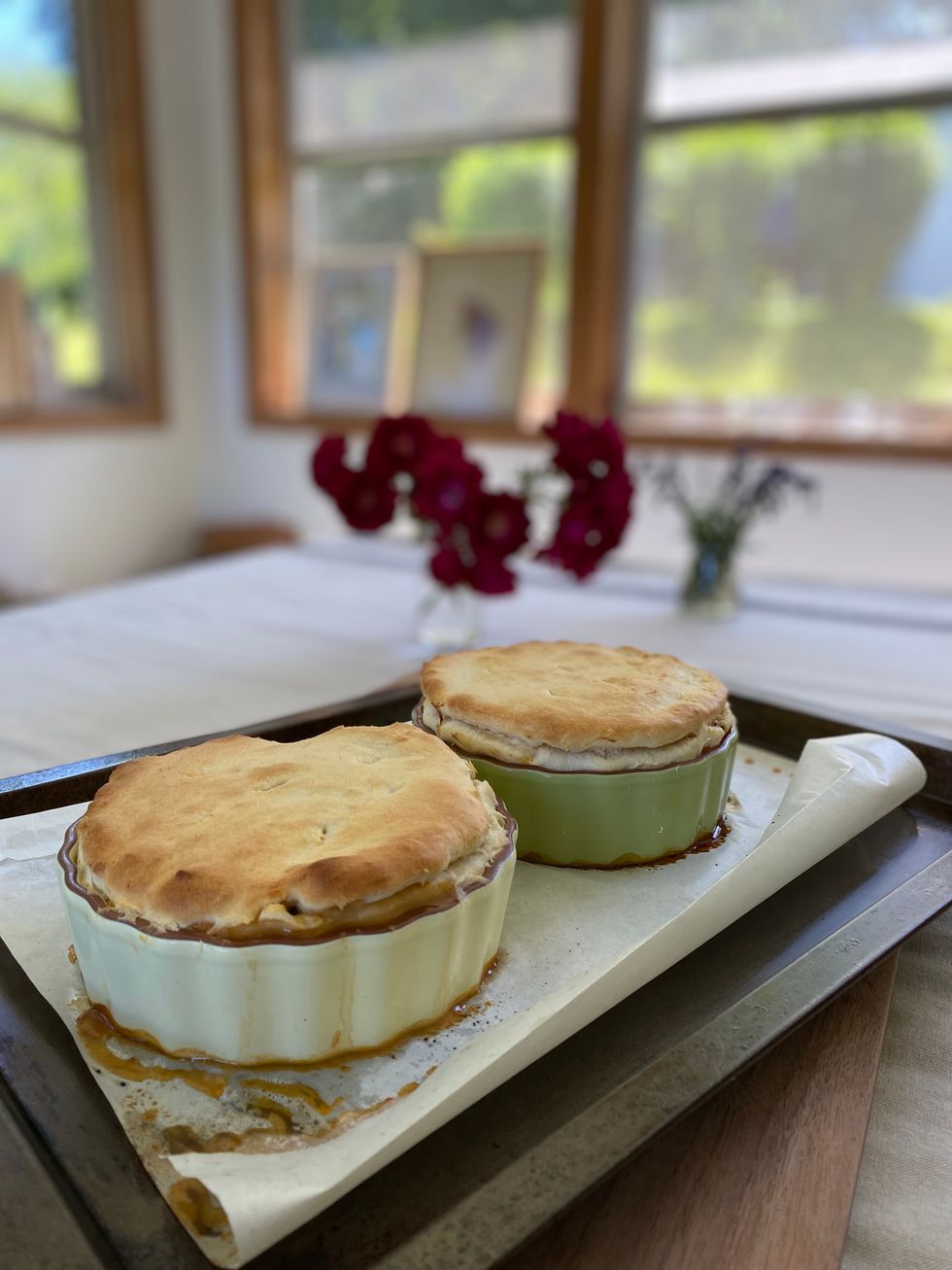
Cut several stem holes in the top. Bake at 400 degrees for about 25 minutes, until the crust is nicely brown.
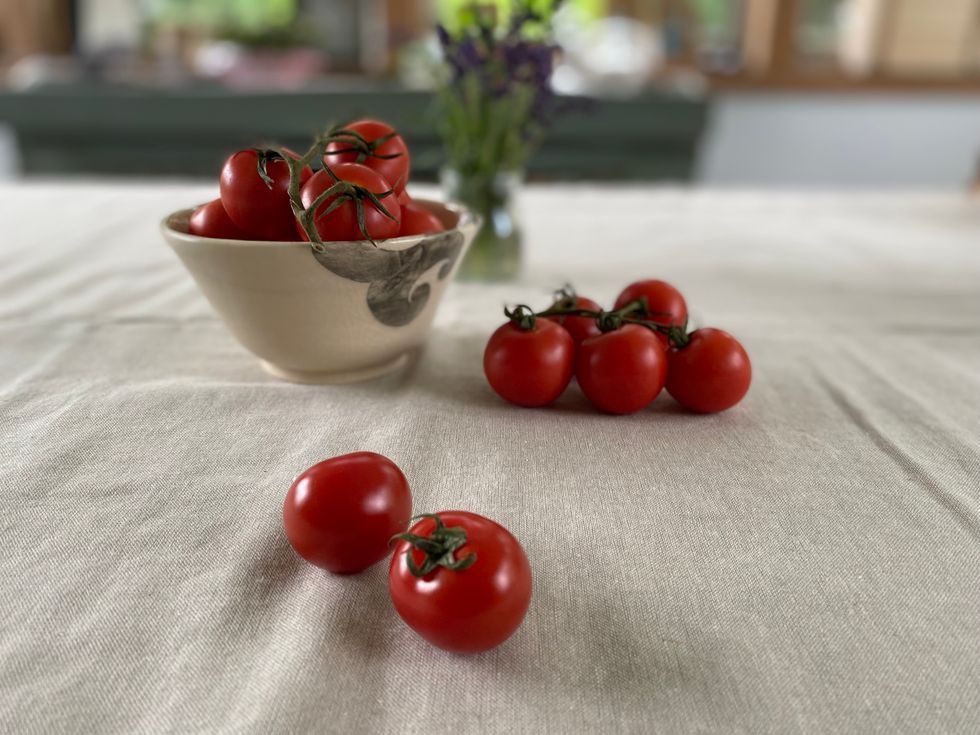
Photo by Cynthia Hochwender
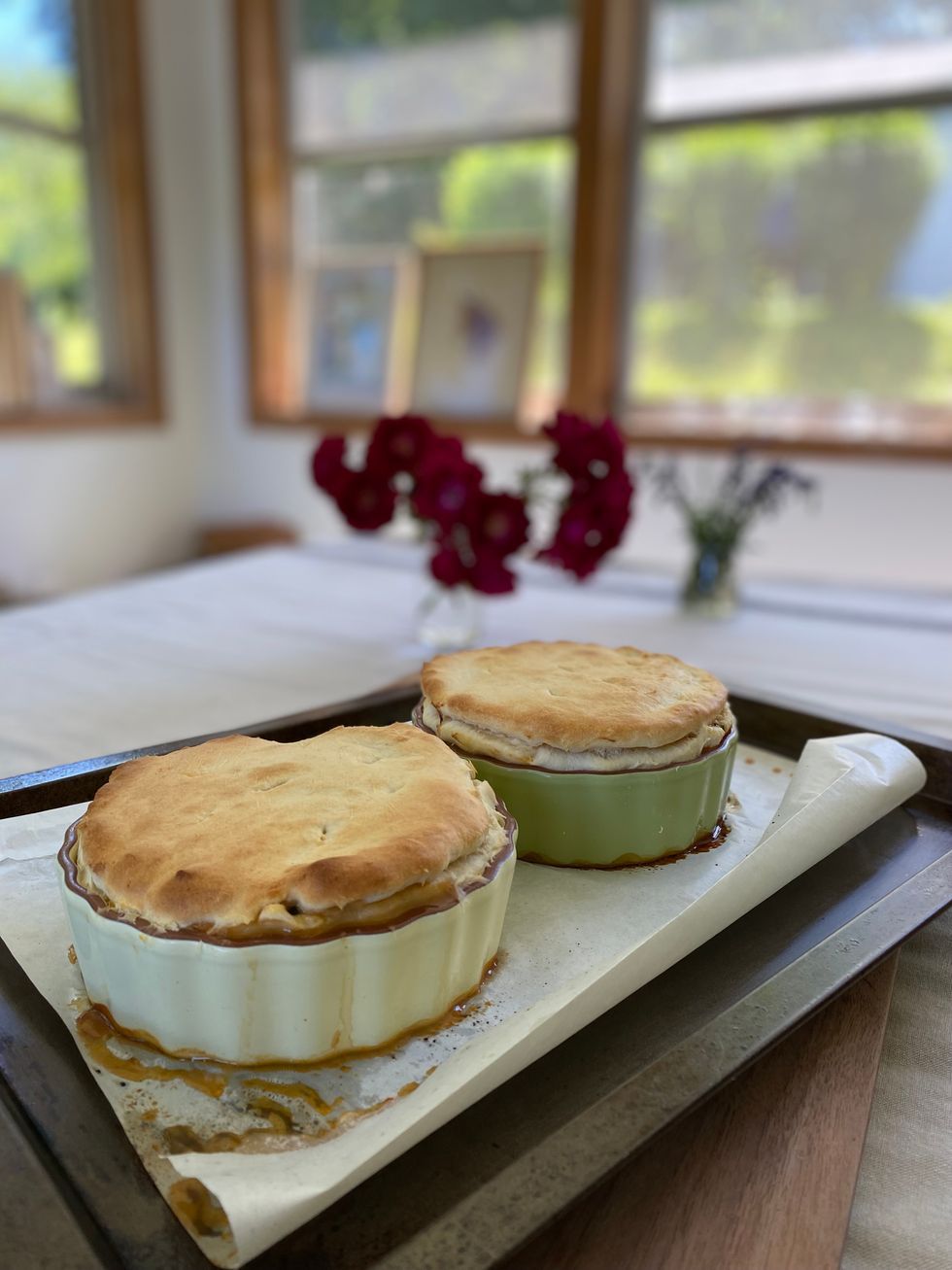
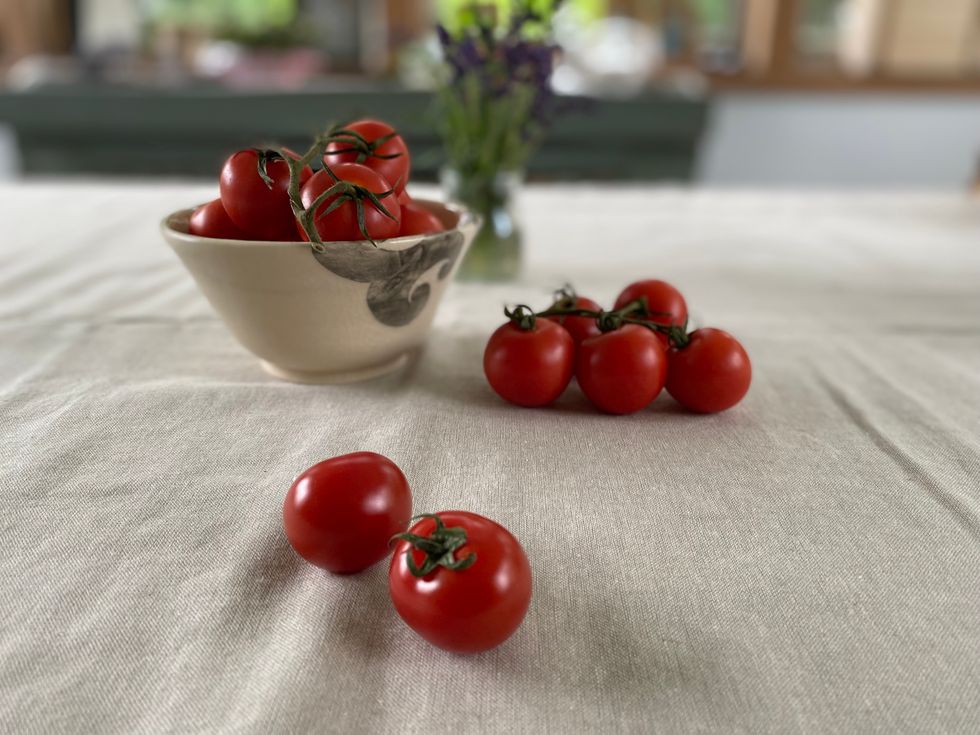
The true secret to the most delicious tomato pie is to roast and then drain the tomatoes. Photo by Cynthia Hochwender


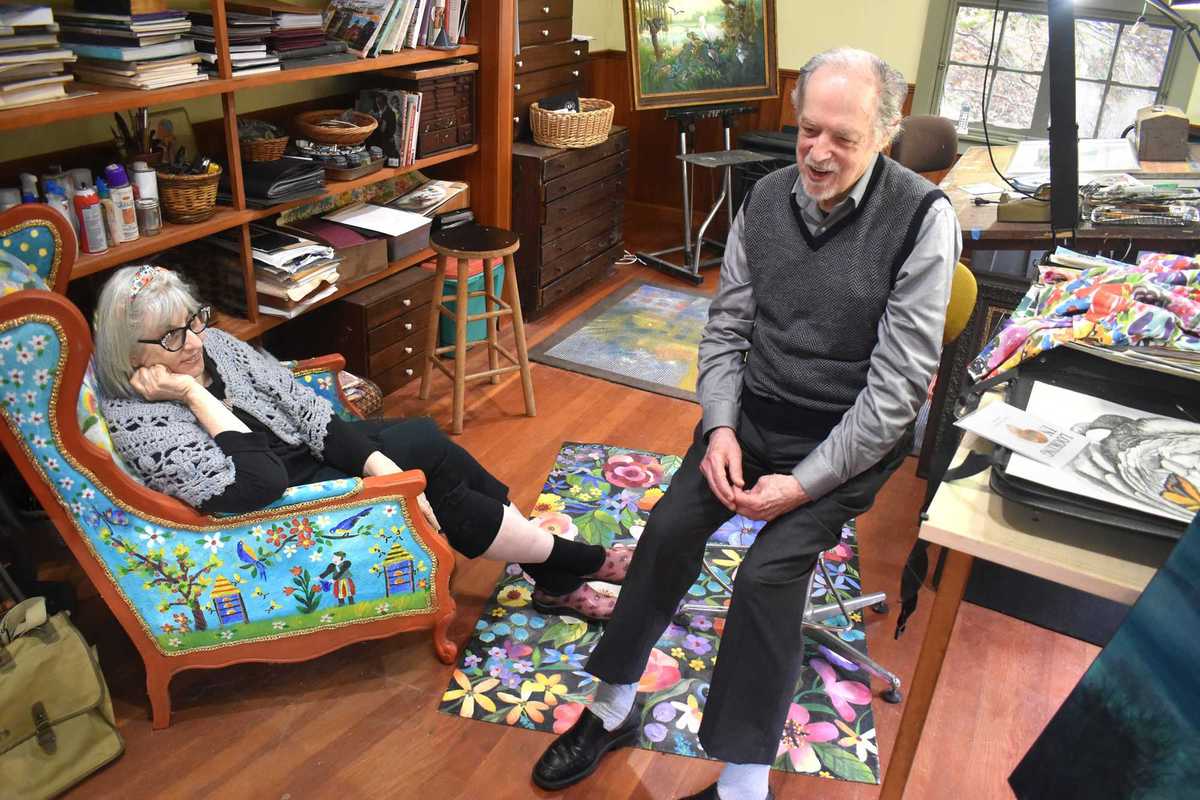
 Justine and Victor Valla in their studio with a painting of Victor’s,”Jonah and the Whale.” Robin Roraback

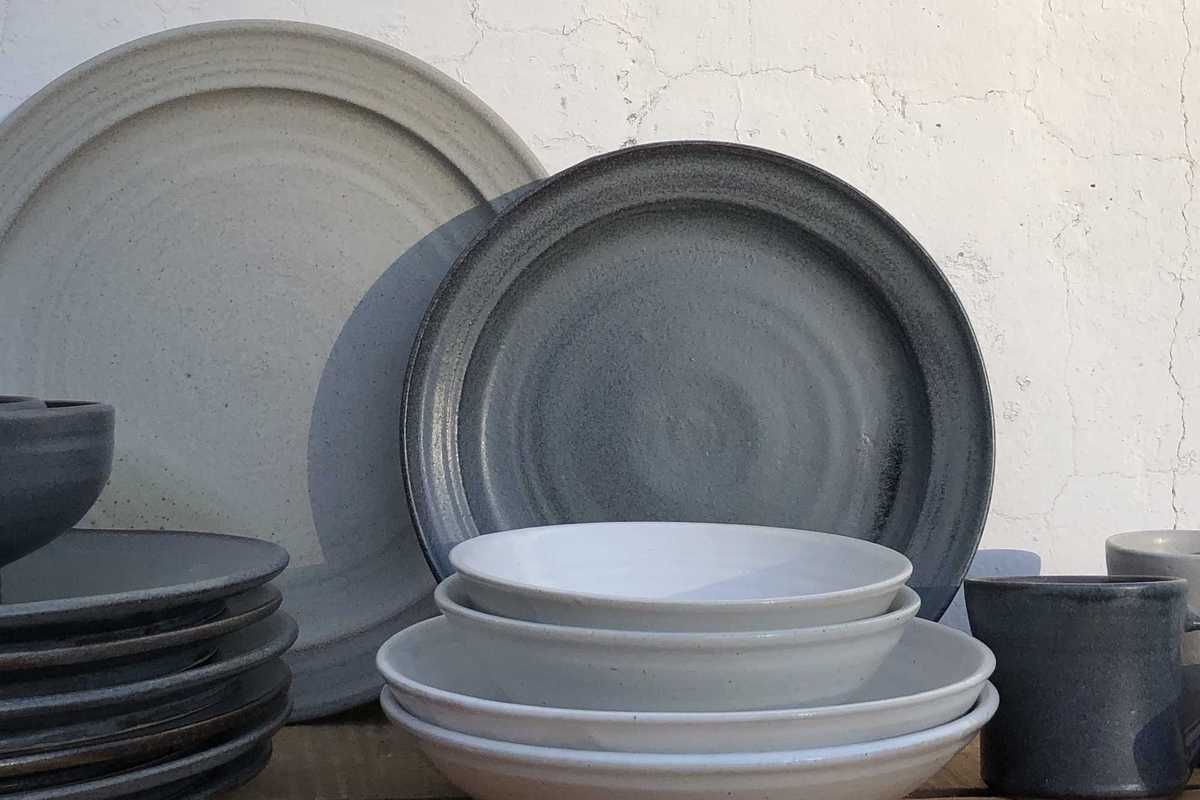
 A ceramic vase by Kathleen Heidemann.Provided
  Joy Brown’s delightful ceramic sculptures.Provided