MILLERTON — While the towns of North East, Amenia and Pine Plains have wrapped up their budgets for the 2009 year, the village of Millerton is just getting started.
With a fiscal year that starts June 1, the Village Board met last Monday, Dec. 1, to begin discussions that will culminate in a tentative budget by April 1, and an adopted final budget by May 1.
With just about every municipality in the country is adding phrases like “belt-tightening� and “trimming the fat� into their daily vocabularies, it’s no surprise that Mayor John Scutieri is looking at “ways to cut back.�
“The village doesn’t have a huge budget,� he explained. “Where towns in the surrounding areas have a list of 20 items they could look at for possible trimming, we have two or three.�
Sitting atop that list is the Recreation Department and its eight-week summer program, which is open to residents of the village and the town of North East, as well as to nonresidents at a higher cost.
“It’s becoming a burden to the taxpayer,� Scutieri said.
While concrete numbers weren’t available during the meeting, Scutieri estimated that the village was losing “maybe $15,000 in revenue� from the program.
Though exactly where the money is being lost is not clear, Scutieri said residents might be taking advantage of the financial assistance the village offers. The number of campers receiving financial aid increased this year.
Overall, Scutieri said that the percentage of village residents using the program was dwindling. Last year’s camp revenues were less than $21,000 but had been budgeted at $25,000.
Scutieri suggested the board take a hard look at the recreation budget to discover where the losses are occurring.
“I’d like everyone to be well-versed on the recreation program,� Scutieri explained after the meeting. “This isn’t something that the board is going to sit down and solve in 20 minutes.�
Noise ordinance public hearing
There will be a public hearing Dec. 15 on the village’s proposed noise ordinance policy. There was a long discussion during the meeting pertaining to the severity of punishment for offenses. Several trustees were in favor of more lenient, “stacked� fines: A first offense would be finable up to $100, the second offense up to $250, and so on. The board eventually decided that a flat fine of up to $250 would apply to all offenses.
“The severity of the fine will be left up to the sitting judge,� Scutieri said, and more than one trustee pointed out that just because the fine was punishable by up to $250 didn’t mean that every offender, including first-timers, would have to pay that amount.
Garbage cans on Main Street
The board also discussed the future role of communal trash cans in the village, after Working Foreman Larry Merwin reported that cans near the Rail Trail and the village gazebo were being filled with bags of personal trash from residents living nearby, rather than smaller pedestrian waste.
“The situation had reached the point where there was no garbage in the cans besides personal bags,� Merwin said. “And we pretty much know where it’s coming from.�
The board decided to put out the cans on Friday mornings and leave them out until Monday mornings. If the problem persists, the situation will be addressed again. Drilling holes for locks of the tops of the cans, which would prevent someone from opening the lid and depositing large bags of trash, was discussed as something to consider in the future.
Beaver removal
Finally, the ongoing beaver problem at Pulver Pond was discussed. The town has hired a nuisance beaver control officer to remove the animals from the area.
The beavers built a dam directly on the drainage culvert, which was flooding Wakeman Road and creating water levels that were creeping toward residential homes.
So far 14 beavers have been removed from the pond at a cost of $50 per animal. The animals are being exterminated, as the village has not been able to think of any other viable, affordable solution. The expense comes out of the Highway Department’s budget.
The next Village Board meeting will be on Monday, Dec. 15 at 7 p.m.

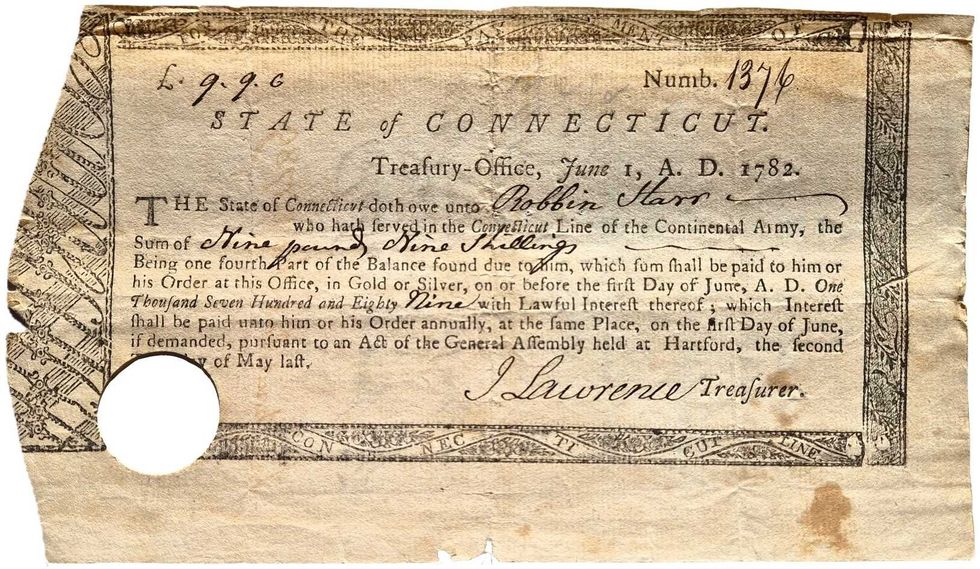 Pay Bill for Robin Starr’s service in the Continental Army.Courtesy the Alex Breanne Corporation
 John Mills speaking at Quinnipiac University.Courtesy the Alex Breanne Corporation
 Stephanie Saetta,with her rescue dog George and Blue (left), a shepherd mix awaiting his forever home.Madi Long
 Blue, a 7 year-old Shepard mix, is waiting for his forever home. Madi Long