Why so many Americans are willing to think, act and vote against their own interests continues to be a puzzle. The Tea Party activists are an extreme case in point, but by no means the only one. This deserves a closer look.
Of all Americans, the Tea Party crowd tends to be those Americans most in need of health insurance they can afford, and that will cover them in time of need. Yet, of all groups, they are most vociferous in their opposition to health-care reform.
Informal polling suggests that those in the Tea Party movement tend to suffer from higher rates of diabetes and other chronic diseases and disabilities than the national average, and they are more likely to be denied private insurance coverage because of “pre-existing conditions,� and to be dropped from coverage because of real, serious and costly illness.
At the same time, compared with the national average, these same people tend to be disproportionately reliant on government-run programs, such as Social Security, Medicare, Medicaid and VA services. Yet, it is these very protesters who demand that government “stay out of� these government programs and services. Such persons appear to be scared, angry and especially susceptible to the current “paranoid style� in American politics.
u u u
According to a recent BBC report, “If people vote against their own interests, it is not because they do not understand what is in their interest or have not yet had it properly explained to them. They do it because they resent having their interests decided by politicians and others who think they know best.� That is an interesting statement, but the conclusion is only half true.
Again, informal polling shows that Tea Party activists do not know the facts about health insurance and they do not understand their own vulnerability in the current health system. The underlying reason is that they derive their information, or rather their misinformation, from each other and from a narrow range of media sources, Fox News being an obvious one.
Check this: Recently in Florida we watched a late-night TV advertisement excoriating “Obamacare.� Virtually every statement made in the ad about health care was false. Finally, the ad concluded with a loud, authoritative voice-over proclaiming: “Health-care reform is a secret Democratic conspiracy to enrich the health insurance industry.�
Thomas Frank, author of “What’s the Matter with Kansas?� (Henry Holt and Company, 2004), comes closer to the truth when he notes that some voters’ preference for emotional engagement over rational discussion has allowed the Republican Party to take advantage of voters’ ignorance and “blind them to their own interests.� Frank adds, “The Republicans have learned how to stoke up resentment against the patronizing liberal elites and all the do-gooders who assume they know what poor people are thinking.�
u u u
It is nevertheless interesting that Europeans, especially the French, tend to admire intellectualism — almost to a fault — whereas a sizable portion of Americans despise elitism based on intellectual ability. This is why so many American candidates for high political office pretend to be “folksy,� relatively uninformed, and not overly bright — just like you or me.
President Barack Obama, whose birth certificate has been authenticated more thoroughly and reliably than that of, say, President Ronald Reagan, has another problem: He is seen by many Americans as being too bright, too intelligent, too informed and too accomplished (e.g., as editor of the Harvard Law Review) to be a “real� American — like you or me.
We seem to have a serious communication problem in America. Not only President Obama but the entire Democratic Party apparatus and their constituency have to simplify and sharpen their language, illustrate their points with real-life stories, and invent new vocabulary that goes straight to the point.
For example, we aren’t in just another “business cycle� or “recession�; we are mired in the “Republicans’ recession,� inherited from a Republican administration, and the result of a 20-year “conservative� (sic) ideology of deregulation. It isn’t the Congress that is failing to pass health, economic and campaign finance reform; it’s the Republicans who are blocking every reform proposed to benefit ordinary Americans.
u u u
There’s a reason for all this. We have to recognize and make clear that politics in America is no longer just about “right� versus “left.� It’s about top versus bottom. The less than 1 percent on top are trying to use their money to manipulate most of the other 99 percent to convince themselves that they are, or could be, on top, not the bottom. The GOP is the unwitting victim of, and party to, this deception. They still don’t know where their own true interests lie.
Ironically, the top wealthiest 1 percent of Americans, of all people, should, if anything, endorse and support President Barack Obama, because Obama, like President Franklin Roosevelt before him, is uniquely positioned to save capitalism from itself. It’s a matter of seeing what is really in one’s own interest.
Sharon resident Anthony Piel is a former director and legal counsel of the World Health Organization.
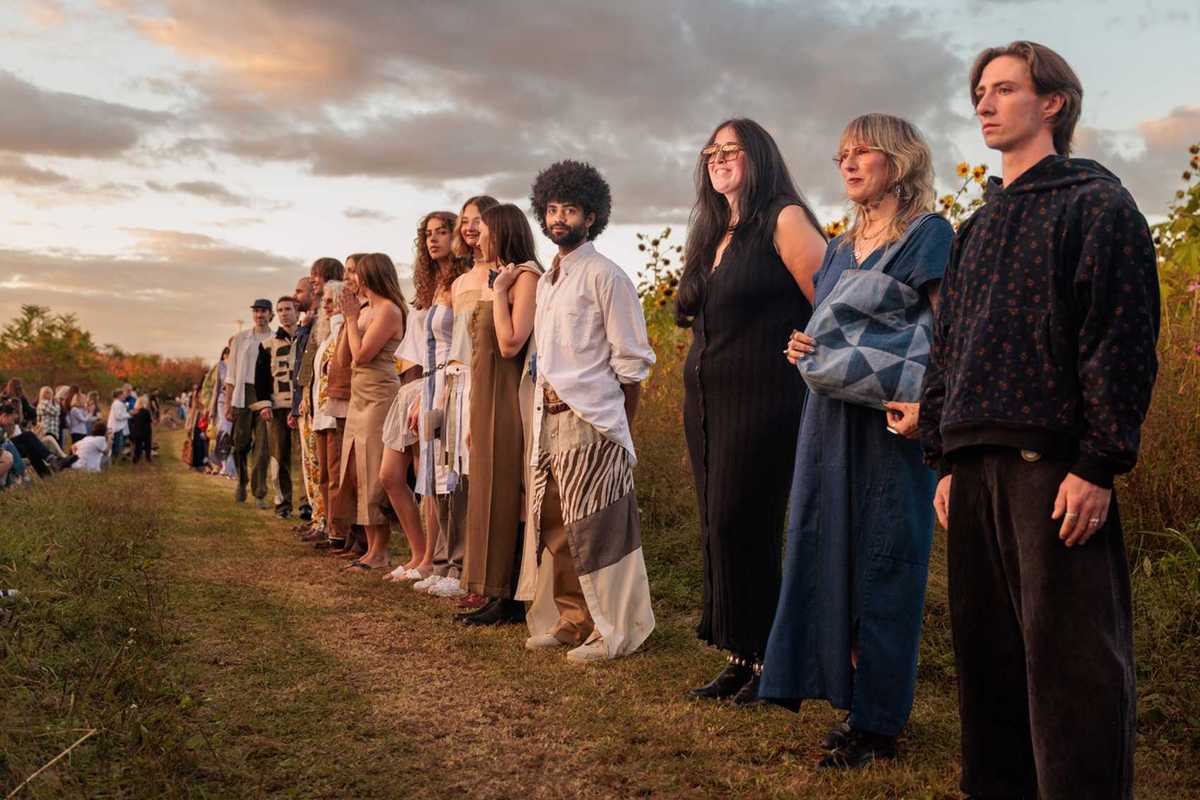
 Models walk the organic runway at HVSFW. Ilan Harel
 Susan Schneider, owner of Shandell’s, creates a variety of products with marbleized surfaces in her Ashley Falls studio.L. Tomaino


 Roger McKee naming the winners with the first place entry over his left shoulder. Patrick L. Sullivan
  Muriel Stockdale’s “Kevin” took second place in the juried art show at Trinity Episcopal Church.Patrick L. Sullivan