Earth Day series comes to Scoville

The Grumbling Gryphons’ traveling Earth Day series stopped at Scoville Memorial Library April 6.
Patrick L. Sullivan


The Grumbling Gryphons’ traveling Earth Day series stopped at Scoville Memorial Library April 6.
SALISBURY — The Grumbling Gryphons came to the Scoville Memorial Library Saturday, April 6, to mark Earth Day with poetry and music.
“Hold Fast to Dreams: Bringing Poetry to Life” featured poems in honor of Earth Day, including works by Langston Hughes, Robert Frost and Edward Lear.
Joseph Daniel Sobol provided the music, playing a 12-string cittern.
The program originally included an outdoor component, but Gryphons chief Leslie Elias reluctantly said the unpleasant weather ruled that out. But there was plenty of energy inside to keep the mostly young audience entertained.
The Grumbling Gryphons will be holding more Earth Day-related performances in Cornwall on Saturday, April 27 and Noble Horizons on Sunday, April 28. Go to https://grumblinggryphons.org/ for more information.
Jennifer Almquist
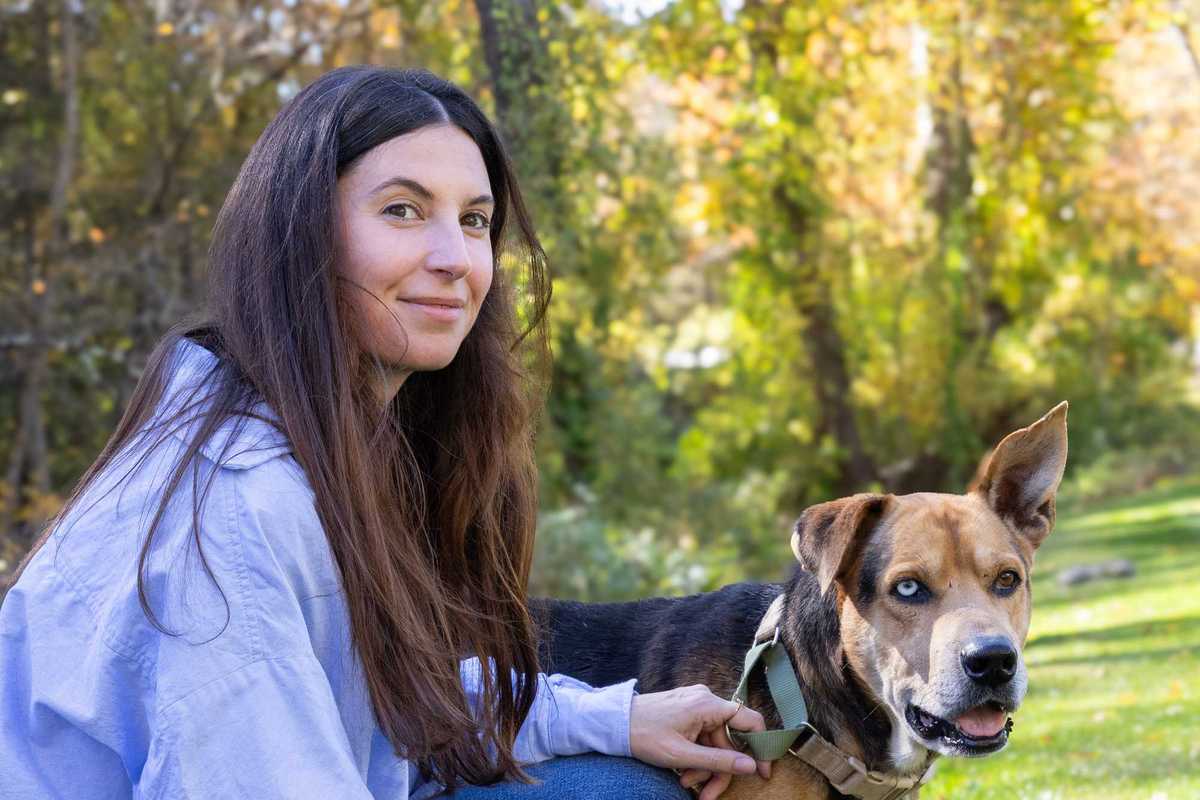
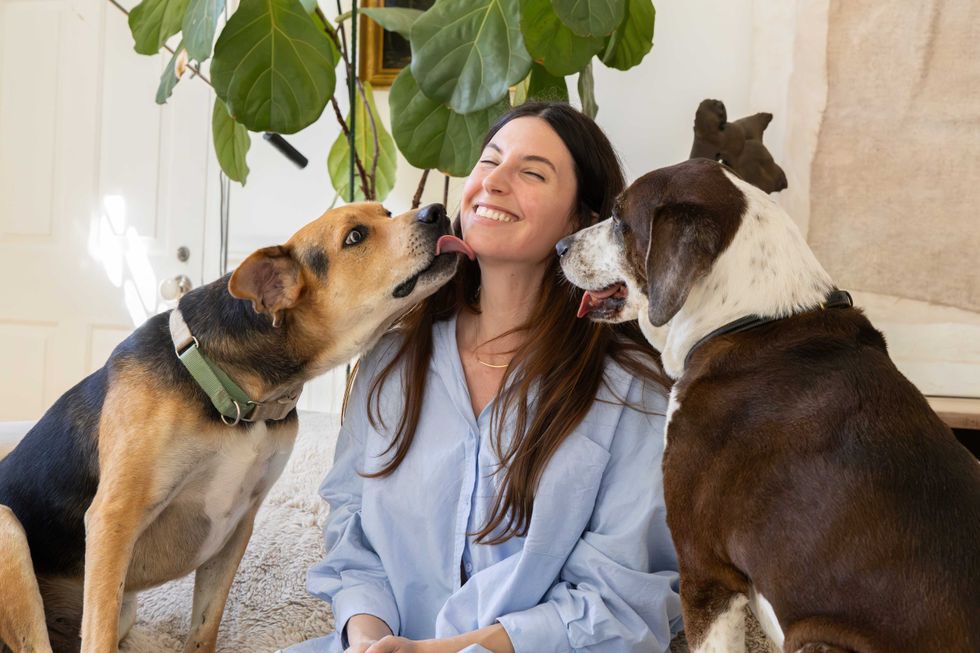
Caroline Kinsolving and Gary Capozzielo at home in Salisbury with their dogs, Petruchio and Beatrice
"He played his violin, I worked on my lines, we walked the dog, and suddenly we were circling each other perfectly."
Caroline Kinsolving
Actor Caroline Kinsolving and violinist Gary Capozziello enjoy their quiet life with their two dogs in Salisbury, yet are often pulled apart to perform on distant stages in far-flung cities. Currently, the planets have aligned, and both are working in Hartford, across Bushnell Park from one another. Bridgewater native Kinsolving is starring in “Circus Fire,” the current production of TheaterWorks Hartford, while Capozziello is a violinist and assistant concertmaster of the Hartford Symphony Orchestra. While Kinsolving hates being away from home, she feels the distance nourishes their relationship.
“We are guardians of each other’s confidence and self-esteem,” she said.
“We met during the pandemic, a bleak time,” Kinsolving said. “On our first date, we met at The Hickory Stick Bookshop and walked outside six feet apart. We fell in love.”
They lived in a tiny studio near Averill Farm in Washington, Connecticut.
“He played his violin, I worked on my lines, we walked the dog, and suddenly we were circling each other perfectly,” Capozziello said with a laugh. “When I told her I was a violinist, she mentioned ‘Appalachian Spring’ by Aaron Copland. I sent her a recording of me playing it, and it became our song.”
“For our wedding, we wanted all our friends and family out in the field listening to that music,” Kinsolving said. Capozziello’s friends from Orchestra New England performed the piece at their wedding.
“Circus Fire,” written by Connecticut’s own Jacques Lamarre and directed by Jared Mezzocchi, is a multimedia world-premiere tribute to the Hartford Circus Fire. On July 6, 1944, the big top of the Ringling Bros. and Barnum & Bailey Circus caught fire, killing 167 and injuring 700 in Connecticut’s worst fire disaster.
Capozziello, who grew up in Fairfield, began: “I came from very limited means, though my parents gave me the kind of support that mattered most. I had a hard time in school. My music teachers, noticing my knack for music, kept me in school.” As he became a teenager, he realized how demanding classical violin truly is. “I had the honor of playing in a master class for Isaac Stern when I was 18,” he said. “That was the wake-up call. He was relentless with my intonation, telling me I must ‘feel the fire in my belly.’”
At SUNY Purchase, he “met a wonderful violin teacher who taught me to play, study and practice five hours a day.” After studying at the New England Conservatory, Capozziello earned his doctorate from The Hartt School in 2018. He now teaches at The Hotchkiss School and performs with the Hartford Symphony.
He explained that his role as assistant concertmaster is the direct line between conductor and musicians, and that the orchestra is “a family dynamic, a democratic unit, truly a living, breathing organism.”

On May 2, Capozziello was soloist with Orchestra New England, performing the world premiere of Neely Bruce’s “Concerto for Violin,” along with “The River” by Jan Swafford and Aaron Copland’s “Appalachian Spring” at Battell Chapel at Yale.
“I care about bringing classical music into communities and spaces where people may not expect it,” said Capozziello.“Music is most powerful to me when it feels alive, humanand accessible, not distant or formal.”
For 20 years, Kinsolving has acted in film, television and theater in London, New York and Los Angeles. “I was first onstage at Washington Montessori School playing Peter Pan,” she said. “I improvised a line, got a laugh and liked the feeling.”
She enjoys performing Shakespeare. “I love Titania’s monologue because it speaks to our current climate crisis. Lady Macbeth surprised me. I fell in love with her while I was doing it. I could play those scenes forever; so much range and depth to explore,” she said.
Kinsolving added, “I love Shakespeare’s comedies for the fun and rhythm. I have loved Rosalind, Viola, Olivia, Helena and Kate, yet the top of my bucket list is Beatrice. Each character reflects a shade of my soul. Shakespeare had the brilliance to illuminate them. If I ever get a tattoo, it will be a list of their names.”
Kinsolving, whose parents, poet Susan Kinsolving and author William Kinsolving, live in Lakeville, studied at Milton Academy, universities in China, and Vassar College. Her theater training includes Stella Adler Studio of Acting, Royal Academy of Dramatic Art in London, Yale Drama Intensive and she is currently studying online through Juilliard.. She founded Theatre for Good, which donates its proceeds to charity.
Both artists are looking forward to June, when they will have more time to spend with their dogs.
D.H. Callahan
Esther Williams in “Million Dollar Mermaid” (1952).
For decades, Esther Williams was one of Hollywood’s brightest stars, but the swimming sensation of the silver screen has largely faded from public memory — a disappearance that intrigued Millerton filmmaker Brian Gersten and inspired him to revisit her legacy.
As a millennial, Gersten grew up largely unaware of Williams’ influential career. His teen years in Chicago were spent with friends who obsessed over movies, spending hours at their local independent video store,and watching anything that caught their eye. Somehow, though, they never ventured into the glossy world of synchronized-swimming musicals of the 1940s and ‘50s.
Gersten’s life changed when he first saw the documentary “Hoop Dreams,” which follows two young Chicago basketball players as they’re groomed and recruited by scouts with hopes of college stardom – and possibly the NBA. These boys grew up just 40 minutes from Gersten’s home, yet their world felt far away. The film’s power pushed him to take his love of movies to the next level.
After earning a bachelor’s degree in journalism from the University of Colorado, Gersten realized documentaries were his passion. He enrolled at the Salt Institute for Documentary Studies in Portland, Maine before heading to Wake Forest University in North Carolina, where he earned an MFA in documentary film.
Since then, Gersten has made a series of short, often heartwarming documentaries on subjects ranging from pigeon enthusiasts and hollerin’ competitions to the history of bowling in America and even Balloon Boy, the nickname for Falcon Heene, the child at the center of a bizarre media frenzy.
When he’s not making his own films, Gersten often edits and helps structure other projects, including the cycling documentary “Enter the Slipstream” and “Radical Wolfe,” a profile of writer Tom Wolfe.
It was while editing one of these projects that Gersten first encountered Williams.
“Who was this figure? What was going on in these films?” he wondered.
What he learned fascinated him. Williams starred in over 30 movies despite having no formal acting training. A champion swimmer, she made the 1940 U.S. Olympic team, but when the games were canceled because of World War II, Metro-Goldwyn-Mayer saw an opportunity.
Studio scouts recruited Williams, and she took to film like a fish to water. Her confidence, athleticism and, crucially for Hollywood, photogenic looks lit up the silver screen. In 1944, “Bathing Beauty” rocketed her to stardom.
For nearly two decades, Williams starred in one or two films a year, including “Million Dollar Mermaid” and “Skirts Ahoy!”. But as Hollywood turned toward grittier fare, synchronized-swimming spectacles fell out of fashion.
Williams stepped away from the camera, and her fame slowly receded — until Gersten stumbled across a clip and dove in.
Gersten’s short documentary, “Hollywood’s Mermaid” (2026) will screen alongside “Bathing Beauty” (1944) at 7 p.m. Saturday, May 16, at The Moviehouse in Millerton. It will also screen later this month at the Berkshire International Film Festival. Tickets are available at themoviehouse.net.
Natalia Zukerman
Nate King, “When I Was Younger And Now That I’m Older,” 2026, Digital projection, digital animation, photography.
The Wassaic Project, the 8,000-square-foot, seven-story former grain elevator transformed into a vibrant arts space, opens its 2026 Summer Exhibition, “Because, now is the time of monsters,” on Saturday, May 16, from 3-6 p.m. at Maxon Mills, launching a season-long presentation featuring 39 artists working across installation, performance, video and sculpture.
The opening celebration will include an afternoon of exhibitions and live programming throughout the historic mill building and its surrounding spaces. Gallery and Art Nest hours run from 12-6 p.m., with special presentations scheduled throughout the day.
Highlights include “Life’s a Game, Boy,” an end-of-year exhibition by the Wassaic Project’s JV and varsity art clubs (4-6 p.m.), showcasing work by students in grades 5-12 from across the region. At 4:30 p.m., artist Ace Lehner presents “Barbershop: The Art of Queer Failure,” a participatory performance and installation that reimagines the barbershop as a space for queer world-making through improvised haircuts and collaborative exchange. Haircuts will be given on a first-come, first-served basis.
In the evening, artist Nate King will present “When I Was Younger and Now That I’m Older” (8-10 p.m.), a projection work that transforms the facade of Maxon Mills into a shifting visual field of memory, geometry and childhood imagery, reflecting on time, age and perception.
The exhibition, organized by the Wassaic Project, will be on view through Sept. 12 and brings together a wide range of contemporary artists working in and around the Hudson Valley region. More information is available at wassaicproject.org.

Want more of our stories on Google? Click here to make us a Preferred Source.
Natalia Zukerman
The Hotchkiss School will launch a major new addition to its arts programming with the inaugural Hotchkiss International Piano Competition, a three-day event taking place May 15–17 in Katherine M. Elfers Hall.
The competition will bring together young pianists ages 10 to 18 from around the world, with participants representing the United States, Thailand, Korea, China, Canada, and Azerbaijan. Performers will compete across multiple age divisions, culminating in final rounds that will be open to the public, offering audiences the opportunity to hear a wide range of emerging international talent in performance.
The jury features an internationally recognized panel of performers and educators, including Artistic Directors Fabio Witkowski and Gisele Nacif Witkowski of The Hotchkiss School, alongside Gloria Chien, Olga Kern, Leonel Morales, and Álvaro Teixeira Lopes. Together, the panel brings broad global experience as performers, pedagogues, and competition jurors, and will evaluate contestants over the course of the event.
Organizers describe the competition as both a rigorous artistic platform and an opportunity for cultural exchange, emphasizing performance under professional conditions and the development of young artists at a formative stage in their careers. Winners will receive a total of $25,000 in prize awards, along with opportunities for broader recognition and future performance engagement.
The competition is made possible through founding support from the Yang and Hamabata families. Murong Yang (Class of 2008), whose experience at Hotchkiss shaped her early connection to music and the arts, and her husband Corey Hamabata envisioned a program that combines artistic rigor with personal growth and international exchange. Their support establishes the competition as part of a longer-term commitment to nurturing emerging musical talent.
“This competition offers a platform for extraordinary young artists to challenge themselves, share their artistry, and connect with a global community of musicians,” said Fabio Witkowski, Artistic Director.
The final rounds of the competition will be open to the public, inviting audiences to experience live performances from some of the most promising young pianists on the international stage.
More information is available at hotchkiss.org/piano-competition.
Natalia Zukerman
“Untitled” by Christine Domanic, one of the 37 artists featured in “Earthen Plot,” opening Friday, May 15.
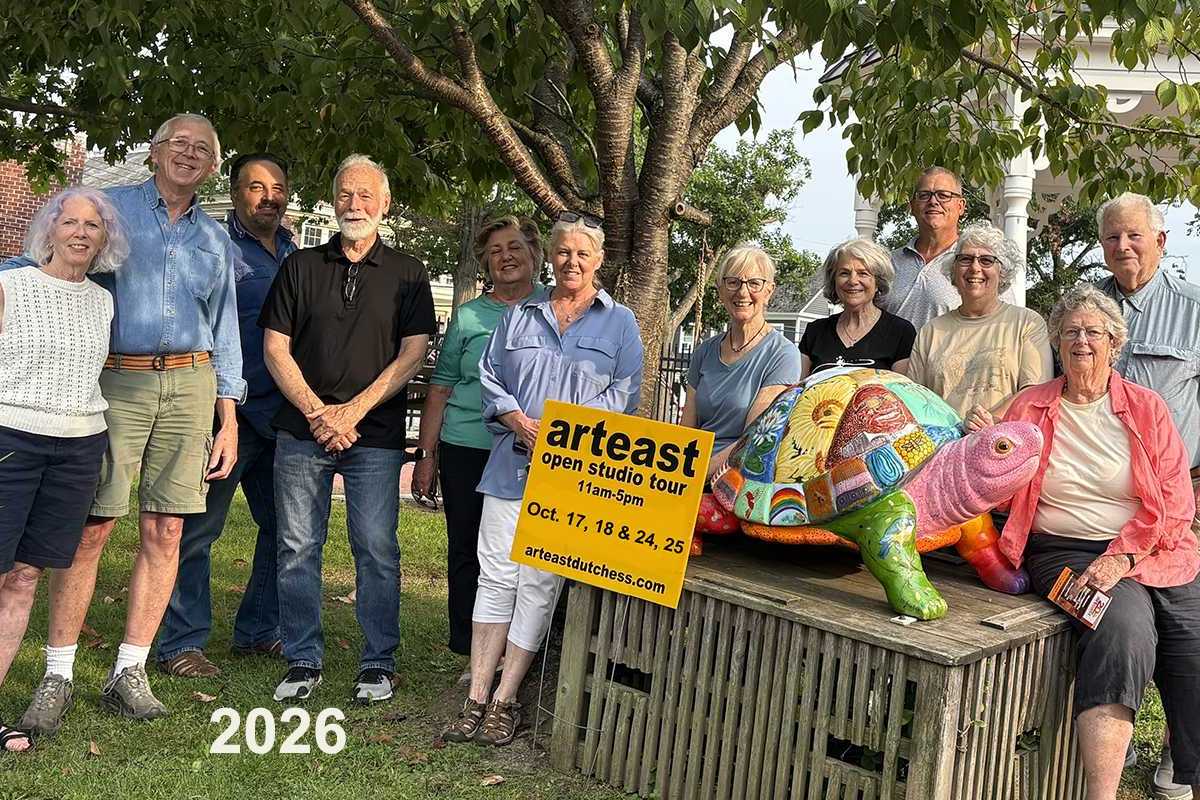
Art lovers will have an opportunity to step inside working artist’s studios across the region next weekend as Open Studios by Upstate Art Weekend returns Saturday, May 16, and Sunday, May 17, from 11 a.m. to 6 p.m.
The annual event invites the public into the creative spaces of 240 artists throughout the Hudson Valley and Catskills, offering an intimate look at artistic practices across disciplines while fostering direct connections between artists and visitors.
This year marks the first standalone edition of Open Studios. While the event previously took place alongside June’s Upstate Art Weekend festival, founder Helen Toomer said dedicating an entire weekend to studio visits allows the focus to remain fully on artists and the experience of encountering their work where it is made.
“While Open Studios previously took place alongside Upstate Art Weekend in June, dedicating an entire weekend to studios allows the focus to remain fully on the artists and the experience of visiting them in their creative spaces,” said Toomer. “We’re excited to welcome both returning and new participants this year.”
Founded in 2020, Upstate Art Weekend has grown into a major regional arts platform spotlighting artists, organizations and creative communities throughout the Hudson Valley and Catskills.
The self-guided, region-wide program transforms private studios into temporary public spaces for conversation, discovery and engagement with contemporary art.
Toomer said the shift creates a distinctly different experience from the larger June festival.
“One of the biggest differences from June is the pace and focus,” she said. “Open Studios offers a more intimate experience — giving visitors time to connect directly with artists, see where work is made, and engage more deeply with their practices.”
She added that the two events complement one another.
“Together, the two events create a meaningful balance: Open Studios in May centers the artists, while June’s Upstate Art Weekend gives participating artists the opportunity to explore the region’s museums, galleries and organizations themselves.”
This year’s Open Studios will kick off with the opening reception for “Earthen Plot,” a group exhibition curated by Toomer, from 6 to 8 p.m. Friday, May 15, at UAW headquarters in Kingston.
The exhibition features work by 37 artists selected from more than 200 Open Studios participants and explores artistic practices shaped by place — physically, spiritually and intuitively.
Through sculpture, painting, installation and ephemeral forms, “Earthen Plot” examines relationships between land, material and environment.
The exhibition will remain on view through June 29, with regular Saturday hours and extended hours during Open Studios weekend and Upstate Art Weekend, which takes place June 25-29.
Visitors can plan their Open Studios routes using UAW’s online interactive map and create customized itineraries to explore studios across the region.
“More than anything, we hope both weekends encourage people to discover the richness of the Hudson Valley’s creative community in a personal and memorable way,” Toomer said.
More information is available at upstateartweekend.org.
Dee Salomon
This brief period in the spring, before the mosquitoes and poison ivy proliferate, is irresistible to me. I want to do everything all at once: plant, remove invasives, examine what is coming into leaf and tend to plants that need protection, whether from deer or downy mildew.
Amid the nonstop gardening work, I recently made time to join a tour of two nearby gardens. Each had a fascinating history, and we looked at photos to see how much had changed and what was still there and flourishing, including a stand of large yellowroot with delicate brown-and-yellow flowers that look like a cross between an orchid and a lilac. It has been there for decades, a lesson in successful gardening with native plants.
As we toured, I overheard someone grumble about having too much wild strawberry in their garden. I secretly laughed, as I have worked for several years to encourage the spread of this sweet plant with its pert white flowers and miniature fruit. I have planted it under trees, encouraged it along woodland paths, and sat on the edges of the lawn for hours pulling out the very similar mock strawberry, Potentilla indica, to allow the native one to proliferate.
One of its characteristics is that it spreads readily, given room. As a groundcover, it also controls erosion. According to Native Plant Trust, Fragaria virginiana supports 75 different species of butterflies and moths throughout their life cycles and supports numerous other insects, as well as mammals and birds. This makes it a “keystone” plant, a designation that means without it, an ecosystem is vulnerable to collapse. That is a big responsibility for a small plant.
One person’s trash is another’s treasure. On the very same garden tour, another person was extolling the flowering lily of the valley, Convallaria majalis, situated in a stone-walled bed. I used to feel the same way until I noticed large swaths of it growing in the woods.
This romantic and fragrant flowering plant is a wolf in sheep’s clothing. Its deep rhizomatous roots crowd out native groundcover neighbors. Lily of the valley is highly toxic to mammals and, as a nonnative, supports only a few insects that use its pollen. I have tried digging and pulling it out to no avail. This year, I am using a strimmer, aka weed whacker, even though I risk damaging nearby plants. I am hoping that after doing this a few times over the next several years, I will succeed in getting rid of it. I will keep you posted.
Native groundcover may not be our first thought when we garden, but it is an easy and fundamental way to tie together a garden bed, especially when garden plants are still immature, while helping nature at the same time.
In addition to wild strawberry, another keystone groundcover in our area is violet; it is the exclusive larval host plant for dozens of fritillary butterfly species. They are flowering now in numerous shades of their namesake color. I find them to be a native treasure, too long taken for granted and eschewed for fancier plants.
In shady areas, two gorgeous native options are foamflower, Tiarella cordifolia, which has a delightful early spring flower — a 4-inch spike of tiny white foamy blooms — and wild ginger, Asarum canadense, a dignified option that creates a bed of overlapping semicircles completely covering the soil beneath.
If you are looking for something that forms a clump, the species Heuchera americana and Heuchera villosa are known as alumroot or coral bells. Finding the original species version can be difficult, as there is an abundance of colorful cultivars at nurseries. Aside from being too flashy for my taste, the versions with red and purple tones will be largely ignored by the native insects we are trying to protect. Stay away from those and stick with the green-leaved versions.
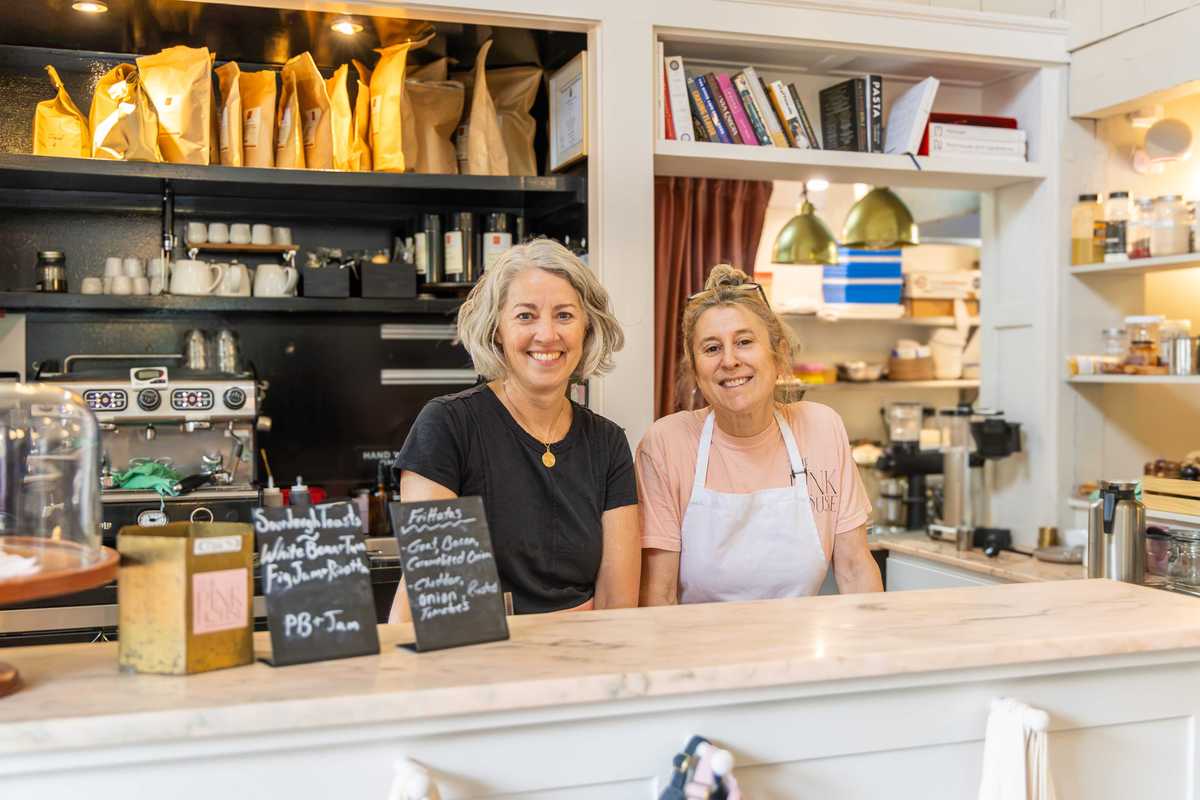
Where do you find these and other useful and beautiful plants? The Cornwall Garden Club is hosting its annual native plant sale Saturday, May 23, from 11 a.m. to 1:30 p.m. on the terrace at The Pink House Restaurant, 34 Lower River Road in West Cornwall. I will be there, as will Michelle Paladino from Lindera Nursery and Heidi Cunnick from the Cornwall Conservation Commission. Come visit and say hello.
Dee Salomon ‘ungardens’ in Litchfield County.

Want more of our stories on Google? Click here to make us a Preferred Source.

Want more of our stories on Google? Click here to make us a Preferred Source.