KENT – Visitors to the latest “People and Places in Kent” program got a behind-the-scenes look at one of the town’s most notable attractions when Eric Sloane Museum curator and site administrator Andrew Rowand spoke about the museum’s history, collections and namesake.
The presentation, sponsored by the Kent Senior Center and Kent Historical Society, explored the legacy of Eric Sloane, the artist, author and collector whose passion for preserving early American tools and traditions led to the creation of Connecticut’s first state-funded museum. Located on Route 7 north of the village, the museum has welcomed visitors since 1969 and is now designated a National Historic Landmark.
Last year, approximately 7,000 visitors toured the site, which is open from May through October.
Sloane, who was born Everard Hinrichs in Queens, New York, in 1905, reinvented himself early in life. He adopted the name Eric Sloane, taking Eric from the middle letters of “American” and Sloane from painter John Sloan.
After spending time in New Mexico, where he became captivated by the skies and weather of the Southwest, Sloane returned to the East Coast and built a reputation as an aviation artist and writer despite having no formal artistic training. During World War II, he was commissioned to create flight manuals for military pilots.
His interest in early American life grew alongside a collection of Farmers’ Almanacs and antique tools.
“He liked to reach back in time and connect to people of the past,” Rowand said.
That fascination eventually led Sloane to assemble one of the nation’s most significant collections of early American hand tools. He chronicled that passion in his 1964 book, Museum of Early American Tools, which later served as the blueprint for the museum itself.
Sloane’s collection caught the attention of Stanley Works, which owned a large tract of land along the Housatonic River in Kent. In the 1960s, the company proposed building a museum if
Sloane agreed to contribute his collection. He did, and the museum opened in 1969. Stanley Works later donated the facility to the state. Originally known as the Sloane-Stanley Museum, it was eventually renamed the Eric Sloane Museum.
Kent was viewed as an ideal location for the museum because Sloane had lived in nearby Cornwall and Warren, the town was already a destination for visitors and the project would help reclaim land that had previously been excavated.
The museum’s collection includes hundreds of tools used by early Americans, including augers, drills, shovels and other implements. Visitors are encouraged to handle many of the replicas and gain a firsthand understanding of how earlier generations worked and lived.
A replica of Sloane’s studio is also on display, including several paintings he was working on at the time of his death in 1985.
Rowand, who has led the museum for six years, acknowledged that he is one of many self-described “Eric Sloane nerds.” He noted that some admirers have tattoos inspired by Sloane’s illustrations and tool drawings, while one enthusiast even decorated a bathroom wall with the designs.
The museum hosts a variety of seasonal programs, including an artist-in-residence program and activities for children.
The grounds are also home to the Kent Furnace, which produced pig iron from 1826 until 1892, and the Noah Blake cabin, a pioneer structure built in 1974 and restored in 2020 by the Friends of Eric Sloane.
Rowand said he is honored to help preserve Sloane’s legacy and make it accessible to future generations.
“It’s a privilege to be part of preserving his life and career and making it accessible for future generations,” he said.

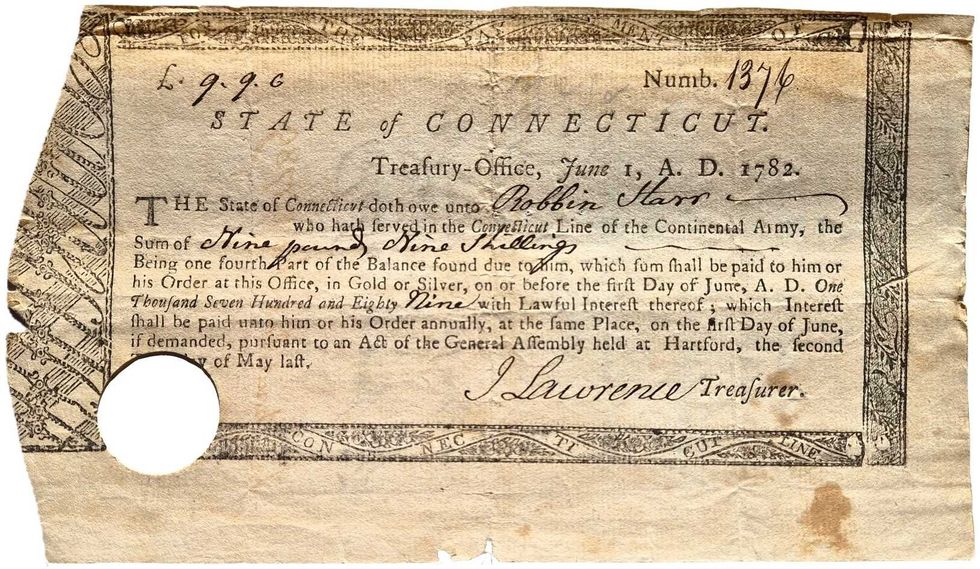 Pay Bill for Robin Starr’s service in the Continental Army.Courtesy the Alex Breanne Corporation
 John Mills speaking at Quinnipiac University.Courtesy the Alex Breanne Corporation
 Stephanie Saetta,with her rescue dog George and Blue (left), a shepherd mix awaiting his forever home.Madi Long
 Blue, a 7 year-old Shepard mix, is waiting for his forever home. Madi Long