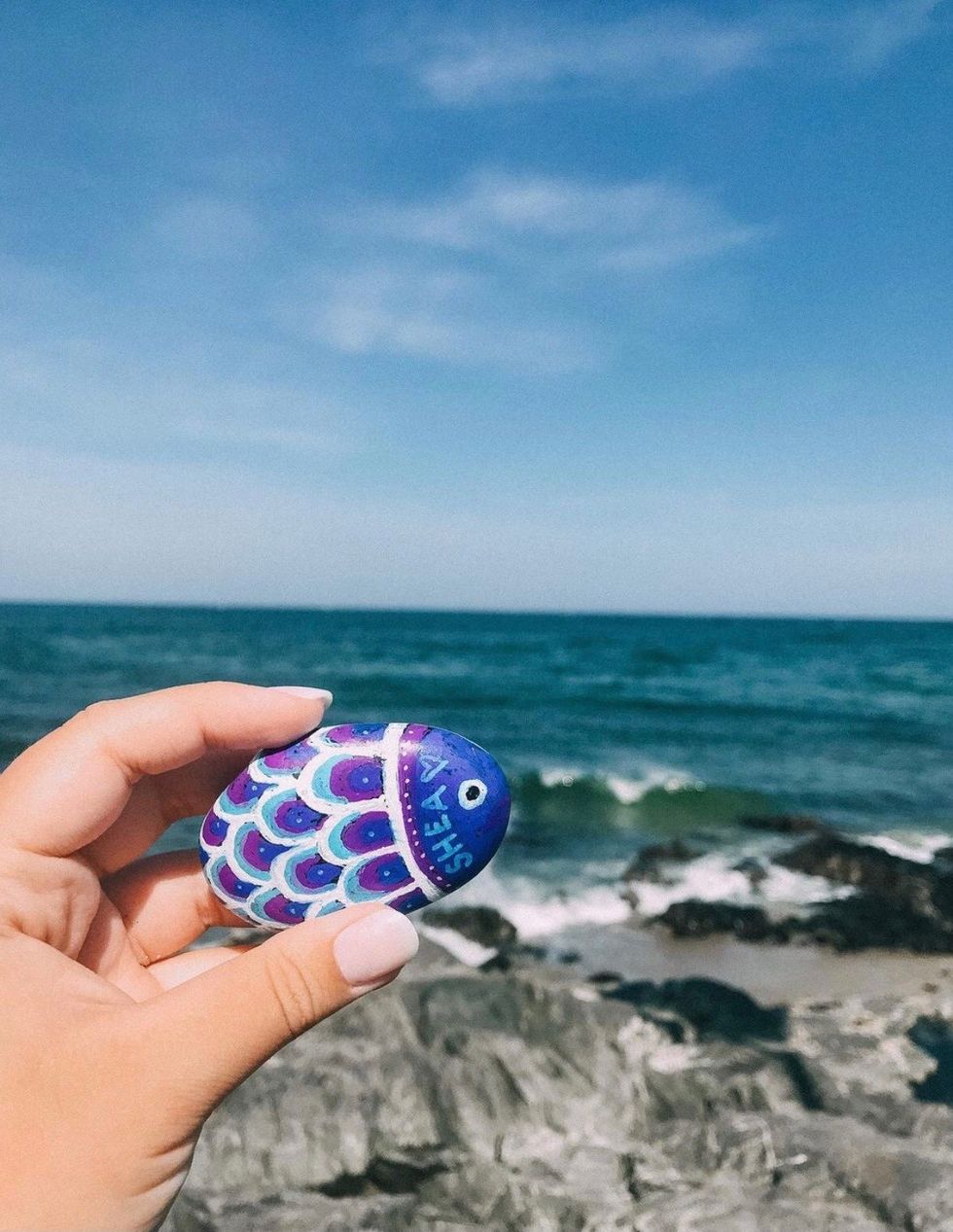
Stones embody spirit of Shea Cohn, and a hope-filled message

The Cohn family is memorializing Shea Cohn, who died in a car crash last year at the age of 16, with Shea Stones. Photo submitted

FALLS VILLAGE — Shea Stones is a noteworthy project devised by Shea Cohn’s family to memorialize his too-short life and to spread his spirit of adventure out into the world, near and far.
A tragic motor vehicle accident in March 2020 took the life of the 16-year-old Falls Village resident. Those who knew the popular young man and those who only knew of him mourn the loss.
To have known him was to know that Shea collected stones he encountered during his travels. Stones were collected. If they were smooth enough, they were used for skimming. Others were appreciated and carried home as souvenirs of a day’s adventures.
During a conversation on Friday, March 12, Shea Cohn’s family gathered on Zoom. His parents, Denise and Doug in Falls Village, and sisters Emma and Grace shared memories and stories of Shea. Emma was in Salisbury, Md., where she teaches English to students in the 10th grade. Grace, younger of the two sisters, is studying at the University of South Carolina.
“Shea was always collecting good skimmers,” his father said.
“And also shells by the seaside,” Emma added.
“It all started with my mom,” Grace recalled, prompting Denise to explain that she had known of a similar concept created for different circumstances, and remolded the idea. What emerged was the idea of stones to reflect the uniqueness of Shea, his affinity for small rocks, and his love for travel.
Fittingly, Shea Stones tend to travel.
The concept is simple. Shea Stones can be obtained from the designated website, either pre-decorated or the family will provide a kit with a stone and paints you can decorate, as you wish.
Shea Stones are traveling the world
If someone is having a family gathering anywhere, leave a Shea Stone behind, perhaps providing a photo of the stone so that it can be added to the 350 stones and photos already on display.
When someone finds the stone, instructions on the stone indicate that the stone can be taken and left somewhere else as a remembrance of Shea, with a photo taken in the new location, if the person wishes.
The locations where stones have been deposited are tracked informally on a Google map on the website. So far, map pins indicate that Shea Stones have been deposited in all 50 states, Europe and South America.
In what the Cohns term “moving the spirit along,” there are 250 destination locales where stones have been left in seven different countries around the world. The family indicates that there are many in Falls Village, of course, which counts as one destination.
One of the first stones ever found was one that Grace left at Seabrook Beach in New Hampshire, Shea’s favorite vacation spot. She had lost it into the sandy beach. As it turned out the person who found it was named “Shea.” That person in turn has placed it somewhere else.
A stone that was placed in Annapolis, Md., made its way to Washington state. Another went on to Guatemala. The stories abound.
Curious, talented and beloved
Remembering her brother, Emma noted that she was eight years Shea’s elder, so her relationship was more of a mothering overseer.
“He knew how to make things interesting,” Emma said. “His adventurousness challenged us in the best ways.”
She described him as very, very bright and an incredible musician, easily learning and surpassing anything she had to teach him about music.
Shea was so musically gifted, the family recalled his eighth-grade graduation ceremony from the Lee H. Kellogg School when music teacher Brook Martinez paid tribute to Shea’s piano talents by performing Billy Joel’s “Piano Man,” with appropriately adjusted lyrics. The audience cheered.
Closer in age to Shea, with four years between them, Grace said that he was an overall good brother, although they messed with each other as much as they could.
Shea could solve a Rubik’s Cube in 48 seconds, his dad recalled.
“We knew he would be remarkable.” Enjoying a vast circle of friends, Doug said that Shea was bright and curious, and able to converse easily with adults.
“He did his research,” his dad said.
“Shea took the time to hear and understand other points of view,” his mother added, remembering several instances of Shea’s demonstration of innate empathy.
The Cohns are now also involved with the Boston-based New England Donor Services (NEDS), having discovered that Shea had volunteered to be an organ donor, even before he had earned a driver’s license. As a result, seven recipients have benefited from Shea’s organs and tissue. All seven have received Shea Stones and have placed them somewhere. A Shea Stone now rests by the sign at the NEDS entrance.
To learn more about Shea Stones, go to www.sheacohn.com.
Students of Salisbury Central School watch ski jumpers soar during an assembly with Salisbury Winter Sports Association Wednesday, Dec. 17.
SALISBURY — Representatives of Salisbury Winter Sports Association gave a presentation at Salisbury Central School Wednesday, Dec. 17.
Former U.S. Olympic coach Larry Stone explained the fundamentals of the unique sport of ski jumping and its long history in Salisbury, where he learned to jump.
“When I was growing up here there were actually eight ski jumps just in this town in addition to the three down at Satre Hill,” he said. He noted that this winter will be the 100th year of Jumpfest at Satre Hill, named for the Satre brothers who moved from Norway in the 1920s. “They brought their sport with them and the first ski jump was actually when one of the Satres skied off of a barn roof in the center of Salisbury to show people how to do it.”
Mentioning the upcoming Winter Olympics in Cortina/Milan, Italy, Stone spoke of legendary Salisbury ski jumper Roy Sherwood who competed at Cortina in the 1956 Olympics.

Students at SCS saw videos of ski jumpers training and competing. Stone invited up students who had jumped at Satre Hill and 14 stepped forward.
One student was Aerin Sheil, who was asked what it feels like to jump: “It kind of feels like you’re flying. It’s a really good feeling.”
Gus Tripler, another student, said, “It’s like you’re suspended in the air and can see everything.”
He said his record distance of 18 meters was set in Vermont.
The student remarks gave way to closing comments that emphasized the school’s partnership with the Salisbury Winter Sports Association.
“Our partnership with SWSA is one of the most incredible things about Salisbury Central School,” Principal John Conklin said as he closed the assembly. He encouraged the students to attend Jumpfest Feb. 6 to 8.

The Community Closet at HVRHS is open for students to take clothes for any reason during the school day.
What started with one unexpected donation of clothes has grown into a quietly impactful resource for all students at HVRHS: the Community Closet. Now located in a spacious area above the cafeteria, the closet offers free clothing to any student for any reason.
The idea began a few years ago when a community member reached out to the former superintendent wondering if anyone at the school could benefit from used clothing that would otherwise go to waste. The superintendent then got in contact with Rachel Novak, the school social worker. “Once I had all those bags of clothes in my room, I was like, ‘I should put this in a space,’” Novak said. Her simple idea eventually became a full-sized closet accessible to all students.
From the beginning, Novak envisioned the closet as an inclusive space. “It’s open to anybody, it’s not just based on economic needs,” she said. Sustainability also plays a role. “Thinking about the environment, some students like to thrift and just get clothes that way,” Novak said.
After the initial donation, contributions continued to grow. “I reached out to our staff members and faculty,” Novak said. The most consistent donations come from the faculty at HVRHS and a few community members who learned about the closet. Finding teenage-appropriate clothes has been a challenge. “I get a lot of donations that are nice, but I don’t think teenagers would want to wear them,” Novak said.
Another ongoing obstacle has been awareness. Many students don’t know the closet exists at all. “That’s been the hard part,” Novak said. “Getting it out to the wider community of the school.” Novak is looking for students and staff to spread the word. “It helps because our school nurse knows and other faculty members,” she said. “When they know a student needs something, they just bring them up.”
Looking ahead, she hopes to promote the space more actively. “When we come back from this break, I do plan to … get fliers and all that up and going,” Novak said. There may even be an upcoming expansion — she has discussed the possibility of turning part of the area into a food pantry. “That would be more of a need-based system for students,” she said. “But right now, promoting it is where I’m at.”
The Community Closet is well-stocked currently. “Just because of the amount of clothes I have, I’m not accepting any more donations until I clear some stuff out,” Novak said. She is still willing to make room for more fashionable, teen-friendly items donated by students. “That way I’ll have more teenager approved clothes.”
Above all, she wants students to know that no one is limited to using the space. “Sometimes there’s a stigma around it … like, ‘I don’t need help. I don’t want to take away from anybody else that may need it,’” Novak said. Due to the amount of clothes, students should feel welcome to use the closet for any reason. Some students even grab items last minute for sports and activities. “It’s important for kids to know it’s for everyone.”
Whether a student wants to thrift clothes sustainably, forgot to pack clothes for an after-school practice, or is in need of a new outfit, the Community Closet is a resource for all.
Sophomore Eliana Lang enjoys her Housy Shack cookie.
Now in its second year, the Housy Shack is a hit among students. The special education department-run store that sells warm cookies, drinks and other snacks to students and teachers draws people to a room in the back hallway every time it’s open.
The smell of warm cookies welcomes visitors to the store with snacks, drinks and even Housy merchandise for sale. The cookies are definitely the favorite, sometimes lines go out the door to get one before they sell out.
The cookies are so popular that the store had to increase prices from 50 cents to a dollar and implement a four cookie per person maximum. The Shack sells about 40-100 cookies per day and has about 20-60 HVRHS customers visiting per day.
Julie Browning and Heather Strid, two of the HVRHS faculty members that help run the Shack, said their goal was to create real-world job experiences as well as real-world shopping experiences for students at HVRHS. “Learning the skills to work in the world can be taught in a classroom, but the lessons are more meaningful and valuable when they are applied in real work situations, which is what we create through the school store,” Browning said.
The original purpose for the store seems to be working, as several students are learning important skills. Students said the store taught them skills like counting money, checking inventory and cleanliness along with social skills and customer service that could help in the professional world after high school.

As the store quickly became a hit, organizers were faced with the challenge of finding funding. “When we started planning to start the school store two years ago we needed money to buy equipment, supplies and food to start it up but were not sure how to get it,” Browning said. “Mrs. Strid came up with the idea of applying for a grant from the 21st Century Fund to help us get started and they were so generous.” That grant has been crucial to the success and growth of the school store.
Not only does the Housy Shack benefit the special education department, students said it fosters a sense of community throughout the school. “School store cookies are my favorite thing ever. They brighten up my day,” said Eliana Lang, a sophomore at HVRHS. Dayana, one of the student staffers at the Housy Shack, said her favorite part of working in the school store is when students come in to make purchases. She enjoys talking to them and ringing up their orders on the cash register. The Housy Shack brings people together and offers the opportunity for students to connect with each other.
As the school year continues, the members of the school store look forward to expanding their inventory by creating and selling a variety of Housy merchandise — t-shirts, sweatshirts, water bottles, and more. “I have had several students put in requests for certain hats, key chains, etc. … so there will be more of that to come,” Browning said. Last school year, profits were all invested back into the school store. “This year we are hoping to make more of a profit and will look to use the money that we make for field trips, outings as well as opportunities to donate and give back to the community,” Browning said. They also would like to use the school store to fundraise for other causes. “Right now we are collecting donations for The Little Guild Animal Shelter, so if anyone has pet supplies they would like to donate please drop them off in exchange for a cookie,” Browning said.