No president has ever refused to leave office after not winning an election but a governor did it once in a most unlikely place, the Land of Steady Habits.
More than a century ago, in 1890, Connecticut had a gubernatorial election that nobody won, allowing the sitting governor, who hadn’t run for reelection, to decide to keep on sitting — and get away with it.
It happened because of the strange politics of the day but mainly because there was a very special character in the leading role — the sitting governor, Morgan Gardner Bulkeley. His biography is worth a glance.
He was born in East Haddam in 1837 and raised in Colchester by a mother who was a Mayflower descendant and a father whose ancestors founded Concord, Mass. His father was also one of the founders of the Aetna Insurance Co. and Morgan was related to the Morgan family, as in J.P., on his mother’s side.
A Civil War veteran, Morgan worked for his uncle in New York before returning to Hartford in 1872 at the age of 35 to help form the United States Bank of Hartford and bring baseball to the city with the Hartford Dark Blues, one of the original National League teams. He served as the league’s first president and was elected to the Baseball Hall of Fame after his death.
Bulkeley’s political career began as a Republican member of the Hartford City Council and as mayor from 1880 to 1888, the year he ran for governor. He lost by 1,415 votes but was elected by the Republican Legislature because neither he nor his Democratic opponent had received the then-required 50% of the popular vote. Since governor was then a part-time position, Bulkeley kept his day job as president of Aetna.
Bulkeley chose not to run again in 1890 and watched as the race to succeed him ended in a near tie with neither candidate able to win certification by both the Democratic Senate and the Republican House. The Senate was happy to accept the 26-vote victory of the Democratic candidate but the House wanted to quibble over the fact that a large number of ballots in Bridgeport, of all places, had been rejected and many others had “imperfections,” little holes reminiscent of Florida’s hanging chads 110 years later.
In the 1890s, the parties prepared the ballots to be cast for their own candidates and the practice caused a dispute over counting the ballots of a third-party candidate named Phineas Augur. The law said the gubernatorial ballot should read, “Governor, Phineas M. Augur” but Augur’s ballots read, “For Governor, Phineas M. Augur.” It seemed like no big deal but if the third-party votes were counted, the Democrat would lack a majority, so the parties split.
But when the Democrats decided to inaugurate their candidate, Luzon Morris, anyway, Republican Gov. Bulkeley informed the Legislature, “I give you notice that I regard such action as revolutionary and unauthorized” and refused to leave his office — literally.
That’s when the fun began, as the saying goes. Unable to stop Bulkeley from staying on as governor, the Democratic comptroller tried to keep him out by changing the lock on an anteroom leading to the governor’s office.
And so, facing a literal lockout, the governor-unelect came to work with a crowbar and broke the lock. But the Democrats kept trying, figuring they could stop Bulkeley by denying him funds to run the state. That didn’t work either because Aetna President Bulkeley got his company to foot the bills until the next election.
Bulkeley’s decision to stay on was eventually upheld by the State Supreme Court and he served a full term without being elected. In 1892, Democrat Morris ran again and was finally elected governor without controversy.
But Bulkeley wasn’t finished with politics and with the Republicans back in power, the Legislature elected him to the U.S. Senate from 1905 to 1911. (Legislatures elected U.S. senators until 1913 when the 17th Amendment allowed for the direct election of senators by the people.)
Bulkeley kept his job at Aetna during his Senate term — you never knew when the U.S. government might need a little insurance cash — and his 43-year career as Aetna president continued until his death at 84 in 1922. You’ll find his grave in Hartford’s storied Cedar Hill Cemetery, along with Uncle J.P. Morgan, Sam Colt, Wallace Stevens and Katharine Hepburn, to name an illustrious few.
It’s clear Bulkeley was far more successful as an insurance company president than as a governor or senator. During his presidency, Aetna increased its employees from 29 to 1,500 and its assets from $25 million to $207 million. The directors were so pleased with the Bulkeley family’s role, they decided to keep the company in the family, choosing Bulkeley’s nephew, Morgan Brainard, to succeed him. Brainard would lead Aetna for the next 35 years, until 1957.
Simsbury, Conn., resident Dick Ahles is a retired journalist. Email him at rahles1@outlook.com.
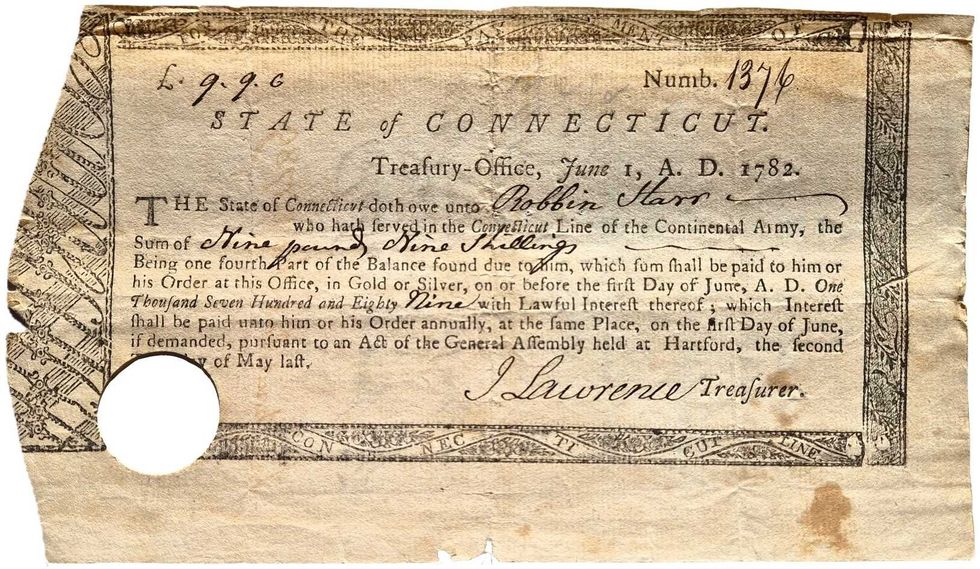 Pay Bill for Robin Starr’s service in the Continental Army.Courtesy the Alex Breanne Corporation
 John Mills speaking at Quinnipiac University.Courtesy the Alex Breanne Corporation
 Stephanie Saetta,with her rescue dog George and Blue (left), a shepherd mix awaiting his forever home.Madi Long
 Blue, a 7 year-old Shepard mix, is waiting for his forever home. Madi Long