Latest News
Land protections non-negotiable, say Northwest Corner conservationists following PURA’s rejection of Aquarion sale
Dec 03, 2025
“I applaud the advocacy from our local land trusts and conservation groups. They deserve tremendous credit for this environmental victory.”
— State Sen. Stephen Harding
The state Public Utilities Regulatory Authority’s (PURA) formal rejection on Nov. 19 ofEversource Energy’s plan to sell Aquarion Water Company ended nearly a year of uncertainty over the future of Connecticut’s largest private water utility, and delivered what conservation groups in the Northwest Corner are calling a critical win for watershed-land protection.
The Cornwall-based Housatonic Valley Association (HVA), which has long monitored Aquarion-owned lands along the Housatonic River watershed and its tributaries, said the decision will help ensure clean water and protect wildlife and forests for years to come.
HVA urged PURA to require any future buyer to commit to land-management partnerships with regional conservation organizations.
Tim Abbott, HVA’s executive director, noted that conservation groups were not trying to block the sale outright. Instead, he said, they believed that the conservation value of the former Torrington Water Company lands owned by Aquarion in Goshen, Torrington and Norfolk had not received enough attention during the PURA hearings and warranted a higher standard of protection.
“We still want that, under the present ownership and in any future sale,” said Abbott.
Likewise, the Kent-based Northwest Connecticut Land Conservancy (NCLC) — which manages thousands of acres of conserved forest and borders several Aquarion parcels — has stressed that watershed lands should remain under the control of owners with a proven record of stewardship.
The leaders of both conservation groups had called on state and municipal officials to move proactively toward permanent conservation agreements, regardless of who owns the land in the future.
The proposed sale would have transferred Aquarion’s operations to a newly created nonprofit subsidiary, the Aquarion Water Authority (AWA), in partnership with the South Central Connecticut Regional Water Authority (RWA).
PURA commissioners concluded that the deal failed to demonstrate long-term public benefit, raised serious concerns about transparency and oversight, and lacked sufficient protections for both ratepayers and land-management interests.
John Moreira, executive vice president, chief financial officer and treasurer of Eversource,responded to PURA’s decision.
“We prepared for alternative outcomes in relation to our petition for approval to sell Aquarion Water Company,” Moreira said in a Nov. 21 statement.
“In the meantime, Aquarion remains a high-quality, well-managed utility with a strong reputation for operational excellence that stands as a valued part of the Eversource organization.”
State leaders praise land protection groups
In the wake of the decision, Sen. Stephen Harding (R-30), the ranking member of the Environment Committee, and State Attorney General William Tong — both of whom had publicly urged PURA to reject the sale — praised the ruling and commended local land conservation groups for helping to block the Aquarion deal.
“This decision is a big win for our environment,” Harding said in a statement. “And it has happened thanks to groups like the Goshen Land Trust, Housatonic Valley Association, Northwest Connecticut Land Conservancy and The Nature Conservancy.”
Referring to the land conservation groups, “They all spoke out. They all raised questions about the environmental impact that this sale would have. They pointed out that watershed land could be in danger,” said Harding.
“They sent a clear message: protecting this land is essential to clean drinking water. This land is an essential part of the identity of our communities. This land is part of local Plans of Conservation and Development. Protecting our forests and our drinking water must be a priority for the state.”
Harding said he applauds the advocacy from local land trusts and conservation groups. “They deserve tremendous credit for this environmental victory.”
In July, Save the Sound submitted written testimony recommending that PURA ensure AWA follows RWA’s longstanding practice of working with conservation partners to purchase and conserve thousands of acres of privately-owned land as open space to protect watershed land and drinking water supply.
“Water companies are the second largest total owners of forested open space of the state, second only to the State of Connecticut,” said Curt Johnson, who testified on behalf of Save the Sound.
Johnson, a former president of the regional environmental organization, helped craft and pass state legislation to strengthen protections for water company land.
“Open space adjacent to rivers, particularly forestland, provides water quality benefits and helps purify and protect water supplies. In addition, these lands provide critical habitat to wildlife species who depend on larger contiguous forest blocks as habitat.”
Attorney General’s statement: consumers foremost
State Attorney General Tong praised the decision, calling the proposed deal “a costly loser for Connecticut families.” In a formal statement, he argued the sale would have sacrificed decades of regulatory oversight in exchange for short-term financial gain for the utility, risking sharp rate increases and weakened consumer protections.
“Eversource desperately wanted to offload Aquarion, and they concocted this maneuver to extract as much as possible by guaranteeing the new entity free rein to jack up rates,” Tong said. “Eversource is free to find a new buyer, but should understand that any new attempt to end public regulatory oversight over water bills for hundreds of thousands of Connecticut families is going to be a non-starter here.”
Tong and other officials had previously warned that the sale could double household water bills over the next decade, a forecast based on company-filed projections showing possible annual rate increases between 6.5% and 8.35%.
Why the sale was proposed, and why it failed
Eversource acquired Aquarion in 2017, and in early 2024 began evaluating a sale, part of a broader strategy to reduce corporate debt. In December 2024, the company and RWA unveiled the AWA proposal, which would have merged Aquarion’s operations under a quasi-public nonprofit authority.
Under the agreement, decisions about water rates would shift from PURA to a board composed of representatives from the towns served, a structure critics said would weaken independent oversight and affect the approval of rates.
Months of public hearings followed, with conservation groups, municipal leaders, consumer advocates and state officials offering testimony.
Many raised concerns not only about possible rate increases and tax-revenue losses, but also about potential future fragmentation of forested watershed lands that supply drinking water and support biodiversity.
Ultimately, PURA commissioners said the transaction failed the public-interest test.
Post-decision update: rate hikes now likely
In the days after the sale’s rejection, Eversource confirmed it will seek a $64 million rate increase for Aquarion customers in early 2026 — a move the company said is necessary to recover costs and maintain service levels now that the sale will not proceed.
While the size of the increase for individual households is not yet known, the announcement has renewed concern among municipal leaders and conservation groups in the Northwest Corner. Some worry that rising water bills could overshadow the long-term protections still needed for watershed land, now that ownership remains with Eversource.
According to the HVA, the future of high-value watershed lands is still unsettled and deserve permanent protection, regardless of what financial pressures the utility may face.
PURA made clear that any future bid will need far stronger commitments, including enforceable conservation guarantees, transparent oversight and consumer protection safeguards.
Eversource appeals
On Tuesday, Dec. 2, Eversource filed an appeal with State Superior Court in New Britain. The appeal asserts that PURA does not have jurisdiction to reject the sale and calls for the decision to be reversed.
Tong said in a statement later that day, ““They need to take no for an answer—no one wants this deal. PURA was right to reject this costly loser, and we are prepared to vigorously defend this decision on appeal.”
TIMELINE: How the Aquarion sale played out — including conservation action
2027: Eversource acquires Aquarion for $1.675 billion.
Early 2024: Eversource begins evaluating a sale of Aquarion amid its broader debt-reduction strategy.
Spring/Summer 2024: Conservation groups, land trusts and local leaders begin preparing their input. NCLC and HVA start reviewing potential impacts on watershed lands in Northwest Connecticut.
December 2024: Eversource and the Regional Water Authority announce a plan to form the Aquarion Water Authority (AWA) to take over water operations.
Spring/Summer 2025: Public hearings begin; NCLC, HVA, Save the Sound submit written conservation testimony.
Fall 2025: Environmental, consumer and municipal concerns mount.
Nov. 2025: PURA rejects the sale, citing inadequate protections and unclear public benefit.
Keep ReadingShow less
Kent issues email scam alert
Dec 03, 2025
KENT — Town officials are warning residents to be on alert after a second fraudulent email impersonating the Land Use Office was reported in less than three weeks.
The town clerk announced on Nov. 26 that another false message has been sent to residents in recent days, this time attempting to collect payment for an “Application Review and Approval Fee” tied to a supposed special permit application. No such fee or permit exists, according to Town Hall.
A similar scam email was reported on Nov. 10, prompting officials to notify the public that any messages requesting payments or personal information should be treated with caution. Residents who receive a suspicious email are urged not to respond.
Anyone who receives an email from the bogus address planning-dept.townofkentct@usa.com is urged to contact the Land Use Office at landuseadmin@townofkentct.gov or call 860-927-4625 to alert Town Hall. The clerk emphasized that recipients should not respond to the message in any way — including clicking an “unsubscribe” link — as doing so may confirm their address to scammers.
Officials note that Kent uses a federally verified “.gov” domain for all official communication. Any message claiming to be from Town Hall that does not come from a .gov address should be considered fraudulent.
Keep ReadingShow less
Tom Key’s talk at Scoville Memorial Library Nov. 9 brought forgotten tales of the Revolutionary War to light.
Patrick L. Sullivan
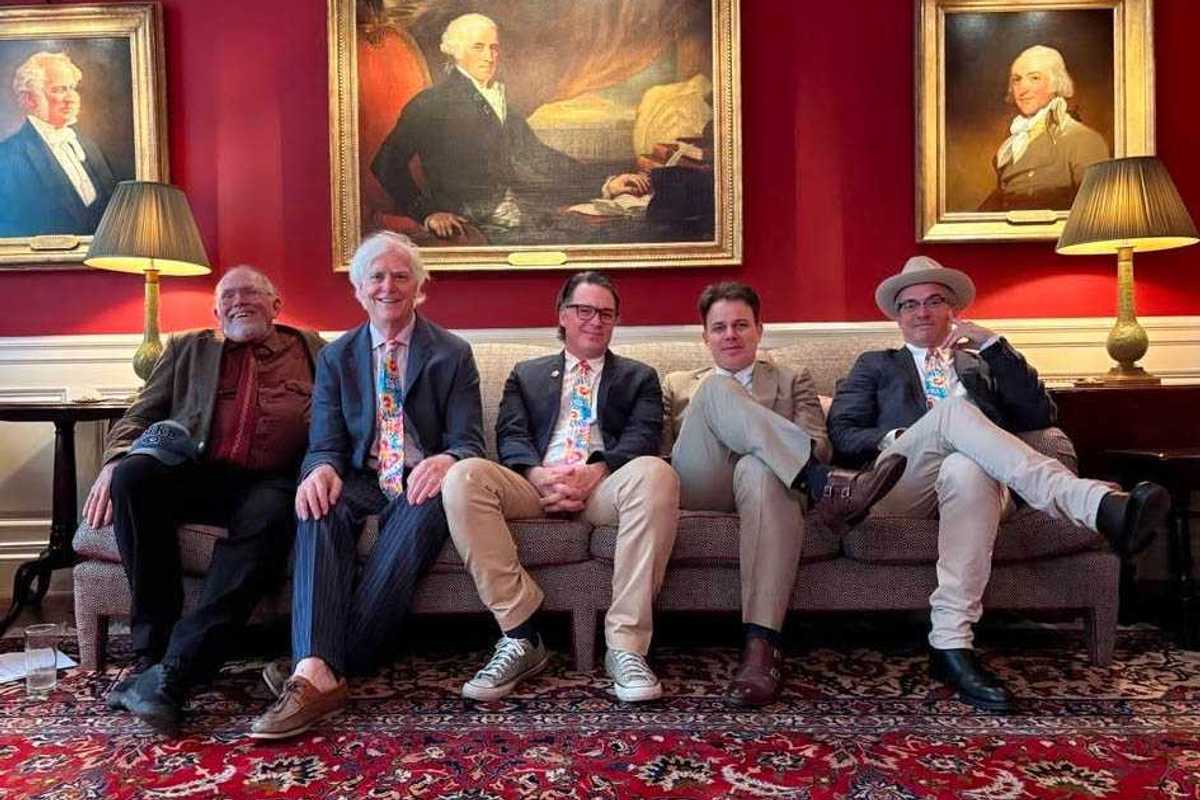
SALISBURY — In a region rich with Revolutionary War history, Tom Key, a self-described “redneck engineer,” offered residents a deeper look at some of the lesser-known events of the American Revolution during a talk at the Scoville Memorial Library on Sunday, Nov. 9.
The program was part of an ongoing series tied to author Russell Shorto’sbook “Revolution Song.” Copies are available at the library, and Shorto is scheduled to appear in person on March 27 with local teachers Peter Vermilyea and Rhonan Mokriski through the Salisbury Forum — a group well-known for its public discussions on history, politics and culture.
Key focused on the Revolution’s early stages in the northern colonies, outlining events that shaped the era in New England. He described the tense buildup to April 18, 1775 — the night of Paul Revere’s famous ride — noting that colonists around Boston were already stockpiling munitions while British General Thomas Gage watched from the city, “getting nervous.”
According to Key, the colonists expected a British march of roughly 1,000 soldiers toward Lexington. When the troops advanced, the colonists fired and retreated, setting off the skirmishes that led to the start of the war. As the British continued toward Concord, American fighters harassed them using what Key described as “guerrilla” tactics — an approach that would define New England’s early resistance.
With no reinforcements nearby, the British pulled back toward Boston. “That’s when it got vicious,” said Key. American snipers targeted the retreating troops, causing casualties and demoralizing the redcoats.
Back in Boston, Key said, the Americans “tightened the noose” by constructing a redoubt or temporary fortification on Breed’s Hill — the precursor to the more widely remembered Battle of Bunker Hill. Built overnight, the fortification heightened British frustration.
“Gage sent three waves against the colonials, into coordinated fire,” Key said. “It was a killing field.”
But the tactic was effective. By the last wave, the colonials were out of ammunition and were overrun by the British.
Key then shifted to Benedict Arnold, a figure with ties throughout New England.
Arnold participated in the siege of Boston before proposing the capture of Fort Ticonderoga on Lake Champlain. After that accomplishment, Arnold launched an ambitious attack on Quebec.
Key explained that Arnold began the expedition in September 1775 with 1,100 men, traveling up the Kennebec River in Maine before attempting a grueling march through the wilderness. The mission quickly faltered amid brutal weather and supply shortages. At one point, Key said, Arnold “saved the day” by buying a herd of cattle from a Frenchman so his troops could eat.
Reinforced by Gen. Richard Montgomery, Arnold pressed on and attacked Quebec City on Dec. 31, 1775. Montgomery was killed, Arnold was badly wounded, and the assault failed.
Arnold went on the following year to fight a series of naval actions on Lake Champlain that were ultimately unsuccessful but did delay the British advance to the south.
When asked why Arnold defected in 1780, Key said Arnold had accumulated a long list of grievances, beginning with not being paid.
His reputation had been challenged, leading him to request a court martial to clear his name. “Remember, a court martial wasn’t always a bad thing,” Key said.
Arnold also resented the personal and financial costs of leadership, was embittered by his wounds, and was grieving his wife’s death. While administering Philadelphia, Key added, “he lived it up, more like a Tory” than a committed revolutionary.
“Hurt feelings? Money? Opportunist?” Key asked. “But not a coward.”
Keep ReadingShow less
Santa attends Kent’s tree lighting
Dec 03, 2025
Lans Christensen
A crowd gathered at the Kent Town Green Friday, Nov. 28, to witness the annual lighting of the tree. Santa Claus made an appearance and attendees caroled as the tree was illuminated for the holiday season.

loading