‘A mixing bowl shouldn’t chip after using it once.” This tinny whine was met by my wife’s verbal dope slap informing me that chips are part of life, get over it. “But it’s imported from England”. Surely, this upscale tidbit would lend the appropriate gravitas to justify my indignation. She was unmoved.
Once again, the real world collided with my world and I was losing, badly. Most would say that fixating on mini-adversities is a rabbit hole to be avoided. Easier said than done. Is scuffing your new dress shoes on the revolving door of an office tower really worth even a moment of angst? What about when the proverbial shopping cart crashes into the car you just drove off the lot? Trivial, but encroachments on daily life nonetheless.
Why bring any of this up during a pandemic that has redefined adversity? You would think that this 21st century plague would force me to look at all of these banalities in their proper perspective. Yes and no. COVID-19 is like gravity. It’s everywhere, all the time, and must be respected and dealt with even though we can’t see it or, for most of us, explain it. Ignore gravity and COVID-19 at your own peril. The petty annoyances of my quotidian existence are more like solving a Rubik’s Cube. Unlike gravity (and COVID-19), you have a choice. Accept the challenge and try to solve it, or not. Some people are better at it than others. In the moment, depending on your skill or luck, it can be frustrating or rewarding. At the end of the day, it’s just another brick in the wall. Life goes on.
I realize that dress shoes, working in an office building and a Rubik’s Cube tag me as hopelessly out-of-touch. And what am I doing with a mixing bowl in the first place? Well, I thought everyone was trying to make brownies. The point is that most of life is the stringing together of daily minutiae. It is not unreasonable to expect more from this thread even if the individual details appear relatively unimportant.
Granted, taken too far it can border on the pathological. “I’m mad as hell and I’m not going to take this anymore” (“Network” – 1976). “I’m just standing up for my rights as a consumer” (“Falling Down” – 1993). Smashing the merchandise with a baseball bat is a rather extreme way to get your point across. But that bodega was charging Michael Douglas way too much for a Coke. More last century cultural references? “Hey, that’s life, get over it.”
Gee . . . that felt good.
By the way, the brownies were excellent.
M. A. Duca is a resident of Twin Lakes narrowly focused on everyday life.

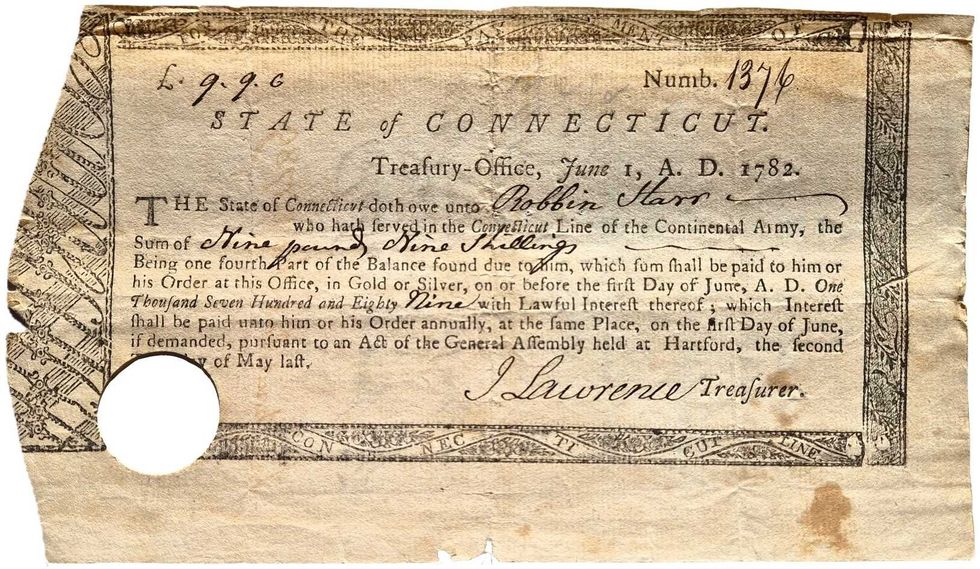 Pay Bill for Robin Starr’s service in the Continental Army.Courtesy the Alex Breanne Corporation
 John Mills speaking at Quinnipiac University.Courtesy the Alex Breanne Corporation
 Stephanie Saetta,with her rescue dog George and Blue (left), a shepherd mix awaiting his forever home.Madi Long
 Blue, a 7 year-old Shepard mix, is waiting for his forever home. Madi Long