Pieter A. Van Why



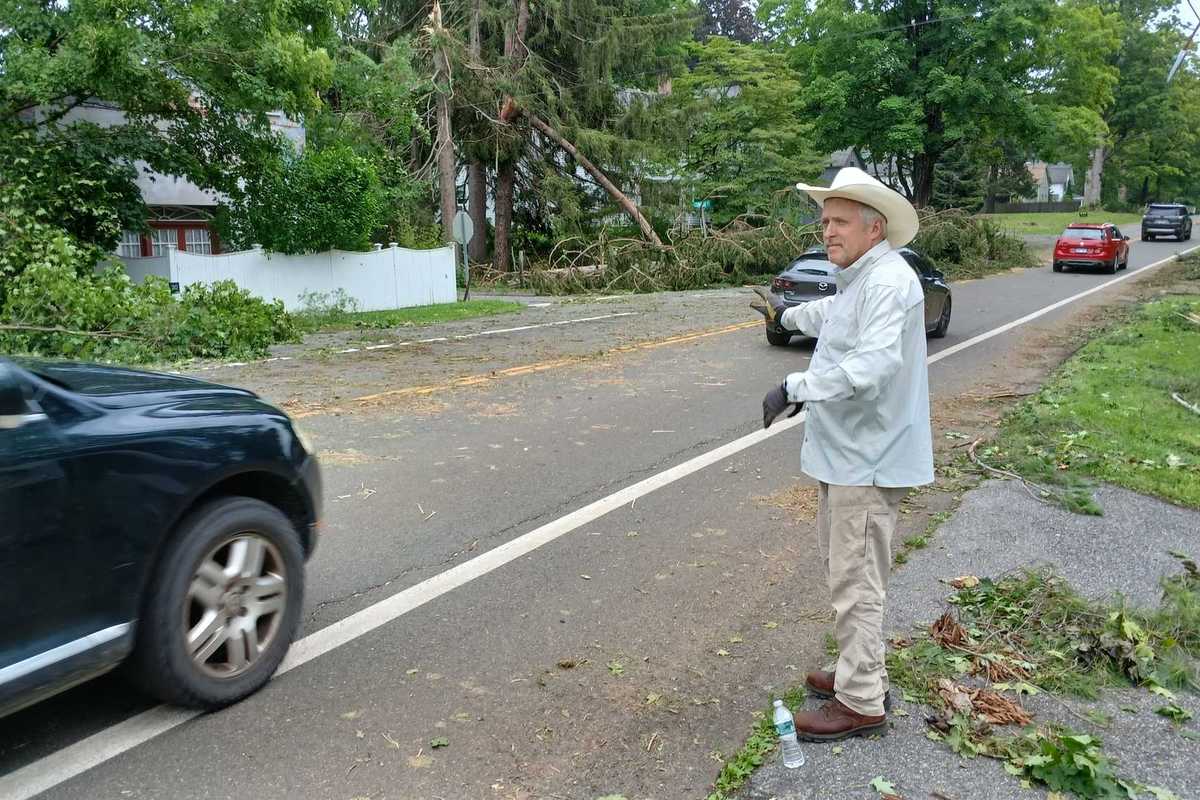
Ben Blackwell directs traffic in Salisbury as motorists navigate road closures caused by fallen trees.
Clean-up efforts may be impacted by approaching heavy rain and storms late Sunday afternoon through Tuesday. Litchfield County is under a flash flood watch from the National Weather Service, which predicted two to four inches of rainfall for the region, with local amounts possibly exceeding five inches. Excessive rainfall is expected to be the primary risk through the early week rather than wind or hail.
As of Sunday morning, July 5, many roads throughout northwest Connecticut remained closed and more than 70,000 Eversource customers in the state were left without power. Salisbury and Falls Village bore the brunt of the damage, with residents referring to the scene as “apocalyptic.”
The Town of Canaan (Falls Village) declared a local State of Emergency as a result of the storm damage. First Selectman David Barger said the move could help relieve the financial burden of the storm if state or federal funds become available.
“We want to be able to utilize all of our resources,” Barger said, adding that town crews have been called in for overtime hours to support the clean-up. He said he received calls from North Canaan and Kent town officials who offered their support.
“Whether it be with the volunteer fire departments or the department of public works, they stand ready to help us,” he said. “The towns in Region One have really been drawn together with some common problems and common initiatives, and this is one of those things where we’re all working together.”
Salisbury, Cornwall, Goshen, Harwinton and Torrington each declared a local State of Emergency as of 2 p.m. Sunday, Litchfield County Dispatch Supervisor Ryan Ptakowski said.
As of early Sunday afternoon, state police at Troop B in North Canaan had not received reports of any injuries from the storms.
Officials in the region have asked residents to refrain from unnecessary travel as crews remove trees from roads and repair utility infrastructure.
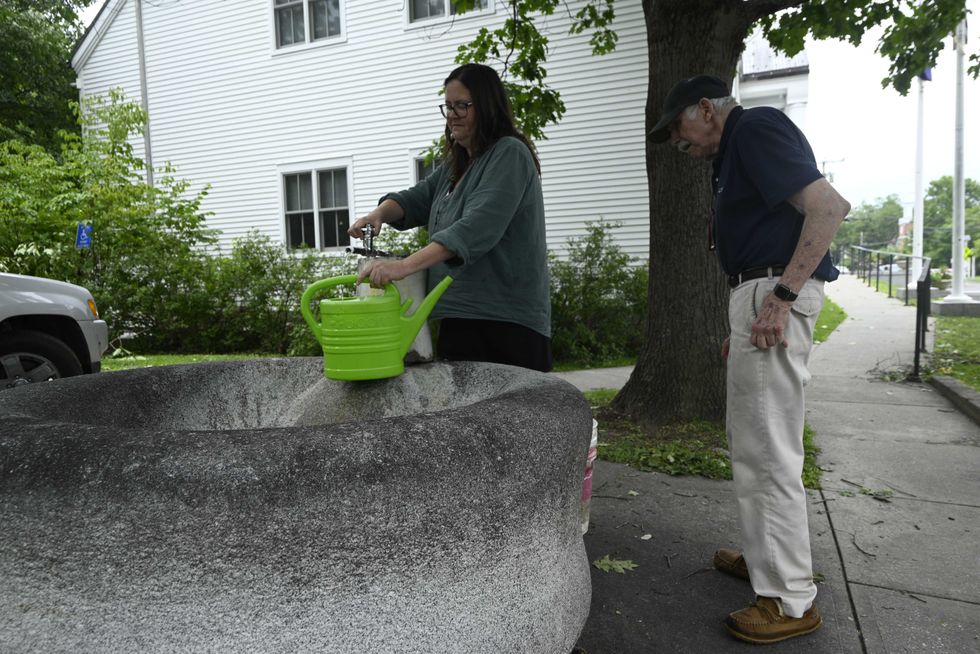 Lakeville residents Suzy Colpitt and her father, John, retrieve drinking water from a public water fountain near Salisbury Town Hall on Route 44.Nathan Miller
Power outages persist, officials say it could last ‘for days’
More than 70,000 Eversource customers were without power Sunday morning, although the number dropped to just over 66,000 by noon. Progress was slow in the Northwest Corner. In Salisbury, 93% of customers remained without power as of 1 p.m. Sunday, with 2,792 of 3,006 customers affected.
Falls Village was also heavily affected, with more than 50% of customers without power.
Just under 20% of Sharon residents were impacted, with 415 customers without power.
Gov. Ned Lamont said in a statement that repairs in certain areas could take days due to the scale of the damage.
“The utilities have called down additional crews from Canada to help restore power in Connecticut as soon as possible,” he said.
Sharon Hospital is up and running
Although Sharon Hospital lost power for a short period of time Saturday night, Supervisor Elizabeth Barrows said the emergency generators kicked on and services were not interrupted.
Griffin Cooper, who handles public and community affairs for the hospital, said the emergency room remains open Sunday and all services are operating as usual.
While Barrows could not confirm whether the storm resulted in any injuries, she said the hospital had seen a number of visits from patients who were unable to use their portable oxygen concentrators as a result of power loss. She said the Sharon Fire Department also has chairs set up for anyone who relies on oxygen and needs electricity to operate tanks.
High School to open gymnasium for families in need
Superintendent Melony Brady-Shanley announced Housatonic Valley Regional High School will open its gymnasium Monday, July 6, from 9 a.m. to 3 p.m. to offer a place for Region One families to charge phones, access drinking water or take a shower.
The high school also temporarily canceled all school activities, including camps, Extended School Year services, and other scheduled activities. Officials also asked all employees to stay home Monday and Tuesday and work remotely.
Brady-Shanley confirmed that all Region One local schools will remain closed Monday and Tuesday until further notice.
Labonne’s market in Salisbury closed until further notice
Rob LaBonne, owner of LaBonne’s market, announced the grocery store would be closed Sunday until further notice. With power lines down in the parking lot, he asked customers to avoid the area.
Although a few employees were expected to be on site Sunday to aid in the clean-up efforts, LaBonne did not provide an estimated timeline for reopening.
Electricians arrived in the middle of the night to help the market owner empty refrigerator cases and restore power through a generator.
“The town is absolutely devastated,” LaBonne wrote in a statement on Facebook. “Trees and powerlines are slashed in half. The whole town is without power.”
Sharon Farm Market and Stop and Shop in North Canaan remain open with regular business hours.
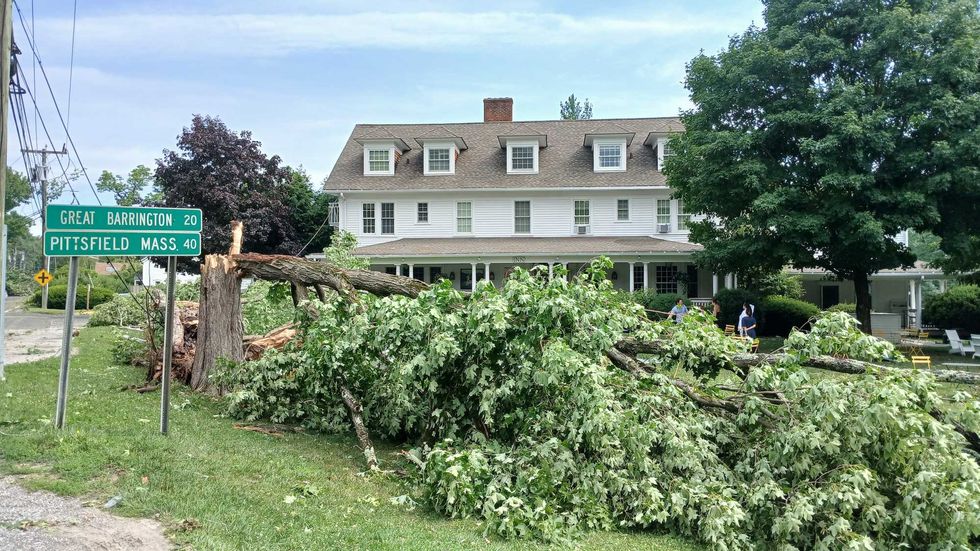 Fallen trees cover the lawn of the White Hart Inn, leaving the historic building obscured from the road. Patrick L. Sullivan
Strong winds, not tornado, likely responsible for damage, meteorologists say
Samantha Lankowicz, a meteorologist at the National Weather Service, said the most likely cause of the damage was strong winds.
“We looked over the radar and we didn’t see anything that would suggest there was a tornado – there were no strong signs of rotation,” Lankowicz said, adding that their radar did pick up strong, straight-line winds up to 60 and 70 miles per hour.
Although thunderstorms were predicted, most residents were not notified about the severity until shortly before the storm struck.
Bethel, Connecticut-based meteorologist Jack Drake, who provided real-time updates via social media throughout the storm window Saturday evening, told the Lakeville Journal on Sunday morning that forecasting difficulties in Litchfield County may have delayed warning of the storm’s destructive potential.
He said radar signatures indicated strong winds and hail as it entered Connecticut from New York, and that the storm was warned as severe about 30 minutes before impacting Salisbury, which is forecasting standard.
But the storm was upgraded to a “considerable damage tag,” an indicator the NWS uses for storms capable of producing golf ball-sized hail and 70-plus mile per hour winds, only after it had passed through Falls Village and was approaching Torrington. “It’s basically a severe thunderstorm warning-plus,” he said.
Drake said the storm traveled on a line from northwestern Salisbury southeast into Hartford County, describing it as a “classic discrete supercell” thunderstorm. He said it was one of the worst he’d seen in the region in recent years, bringing the largest hail since baseball-sized ice chunks fell during severe storms in 2018. He estimated based on damage that winds might have topped 80 miles per hour.
Drake noted that forecasting severe weather in the region, especially in summer when it is highly localized, is a challenge for meteorologists. “Litchfield County is a pretty big radar hole, in my opinion,” he said.
He said the holiday weekend may have contributed to the late warning, with a possible staffing shortage in the NWS Albany office, which had issued a “Level 2” or “Slight” risk of severe weather due to hot and humid atmospheric conditions primed for heavy thunderstorms.
Drake said that “risk-based” forecasting, which is how meteorologists predict for summer severe weather, can cause messaging issues to the public, since some storms, like yesterday's, may cause devastating impacts to one community but leave adjacent towns relatively untouched.
“The message is always just stay aware,” he said, encouraging residents to stay up to date, however possible, noting that social media has been a highly effective tool in the past two decades.
Flood risk issued for region
Further forecasted heavy rain and storms Sunday afternoon and overnight into Monday could impact recovery efforts and cause further damage, Drake said, predicting a general two to four inches of rain from the storm, with a 15%-40% risk of flash flooding for the region.
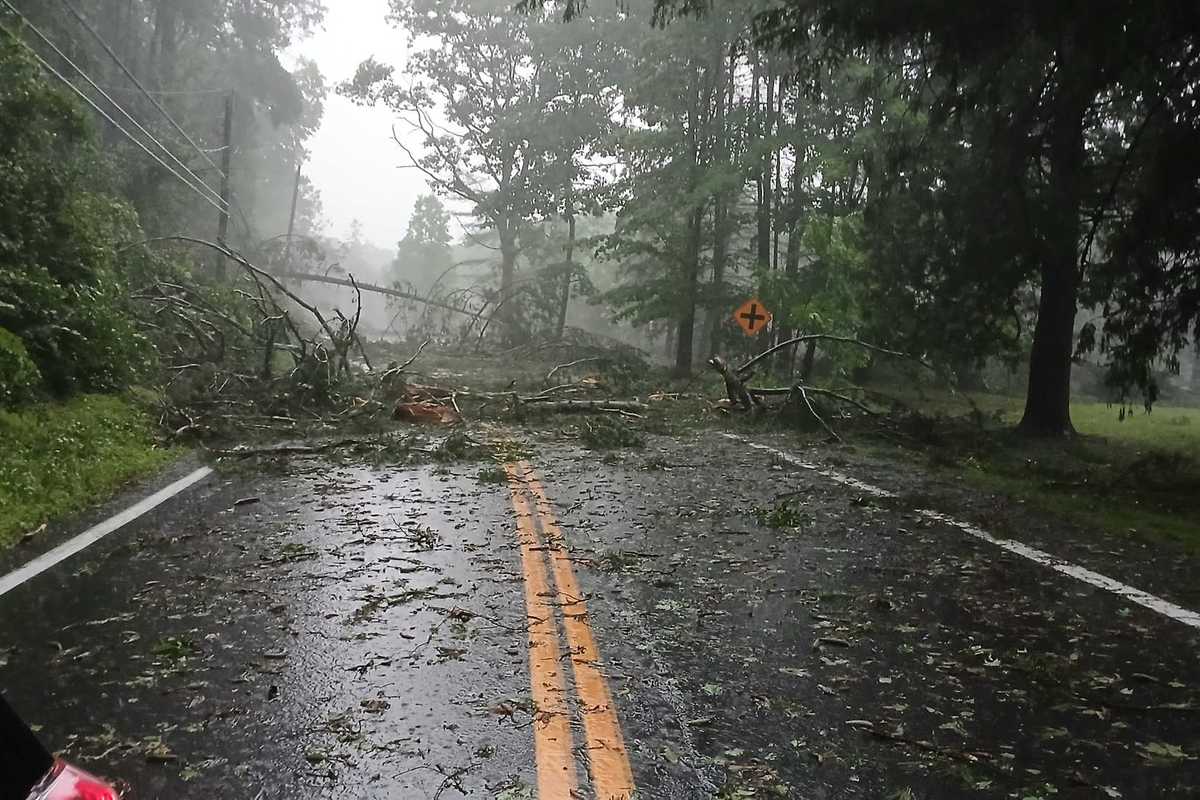
A blocked road on Route 41 in Salisbury looking north at Cobble Road.
As the sun came up on Sunday, July 5, the scale of the damage was evident. Many roads remained closed and more than 70,000 Eversource customers in Connecticut were left without power. The Northwest Corner was among the hardest hit regions, with Salisbury and Falls Village bearing the brunt of the damage.
The Town of Canaan (Falls Village) declared a State of Emergency as a result of the storm damage with additional updates from the town's emergency services director expected throughout the day.
In Salisbury, 93% of Eversource customers were still without power Sunday morning, with 2,790 of 3,006 customers affected. Route 41 from Salisbury heading north was impassable due to downed trees. Route 44 was open, but largely reduced to one lane.
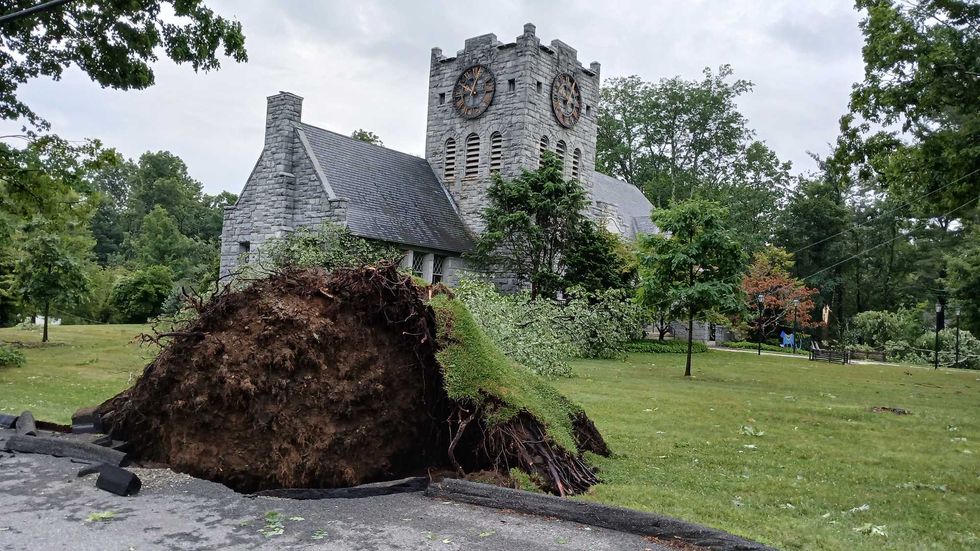 A tree is ripped from the ground next to the Scoville Library in downtown Salisbury during the July 4 storm. Patrick L. Sullivan
Canaan and Falls Village were also heavily affected, with more than 50% of customers without power. Just under 20% of Sharon residents were impacted, with 415 customers without power.
On Saturday, the storms forced last-minute cancellations of fireworks and laser light shows, and created hazardous travel conditions as hail, heavy rain and strong winds hit the area. Emergency crews responded throughout the evening to blocked roads, downed wires and fallen trees, while widespread power outages affected communities across northwest Connecticut.
In Falls Village, an area that appeared to be among the hardest hit, First Selectman Dave Barger said, “It’s a mess, at best,” adding that trees and power lines were down everywhere.
Many of the town’s major roads were blocked by fallen trees – many of them tangled in electrical wires, making cleanup difficult and limiting access for emergency vehicles.
“It seems like every tree on Route 7 has hit a wire or is entangled in wires,” Barger said. “A lot of trees along Route 126 are entangled in wires as well.”
He said Route 63 near the Canaan town line and numerous secondary roads were also blocked.
Town crews, firefighters and emergency personnel worked to clear roads where possible, setting up cones and caution tape, and reporting hazardous conditions to utility crews.
“But darkness is upon us, so we’ll be somewhat limited,” Barger said.
He also said it took the town’s emergency services director and fire chief about 30 minutes to reach the Emergency Services Center because so many roads were impassable.
“We have people staying here at our emergency center who can’t go home,” he said. “They’re waiting to go home.”
The damage far exceeded Falls Village.
Lakeville Hose Company said "Lakeville and Salisbury were in a path of a very powerful storm." A statement posted to Facebook said the town was inundated with trees and wires that came down.
"Most roads are impassable along with a massive power outage," officials said. The hose company also warned that the town might be without power "for an extended period of time."
Lakeville Journal senior reporter Patrick Sullivan, who had covered the Fourth of July festivities in Falls Village before visiting his mother in Noble Horizons in Salisbury, said he attempted to get back to his Lakeville home but there was no possible route with downed trees.
“The roads were blocked in every conceivable way,” Sullivan said.
Other residents reported taking as long as two hours to travel home as they searched for passable roads. Numerous trees were reported down along Route 112 between Lime Rock and Hotchkiss Corner, as well as on Route 7 and other state and local roads throughout the region.
Residents also reported hail and significant tree damage, with many taking to social media seeking emergency tree removal services.
Communities outside the Northwest Corner, including Harwinton and Torrington, also experienced significant storm damage.
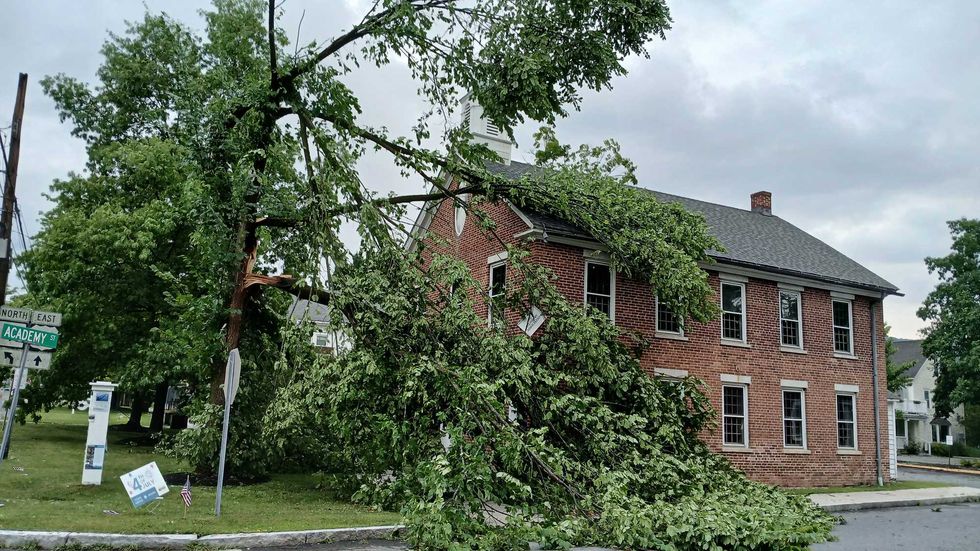 Branches fall on the historic Academy Building on the corner of Academy Street and Route 44. The Salisbury Association, which sponsored the town's Fourth of July events, now operates out of the building. Patrick L. Sullivan
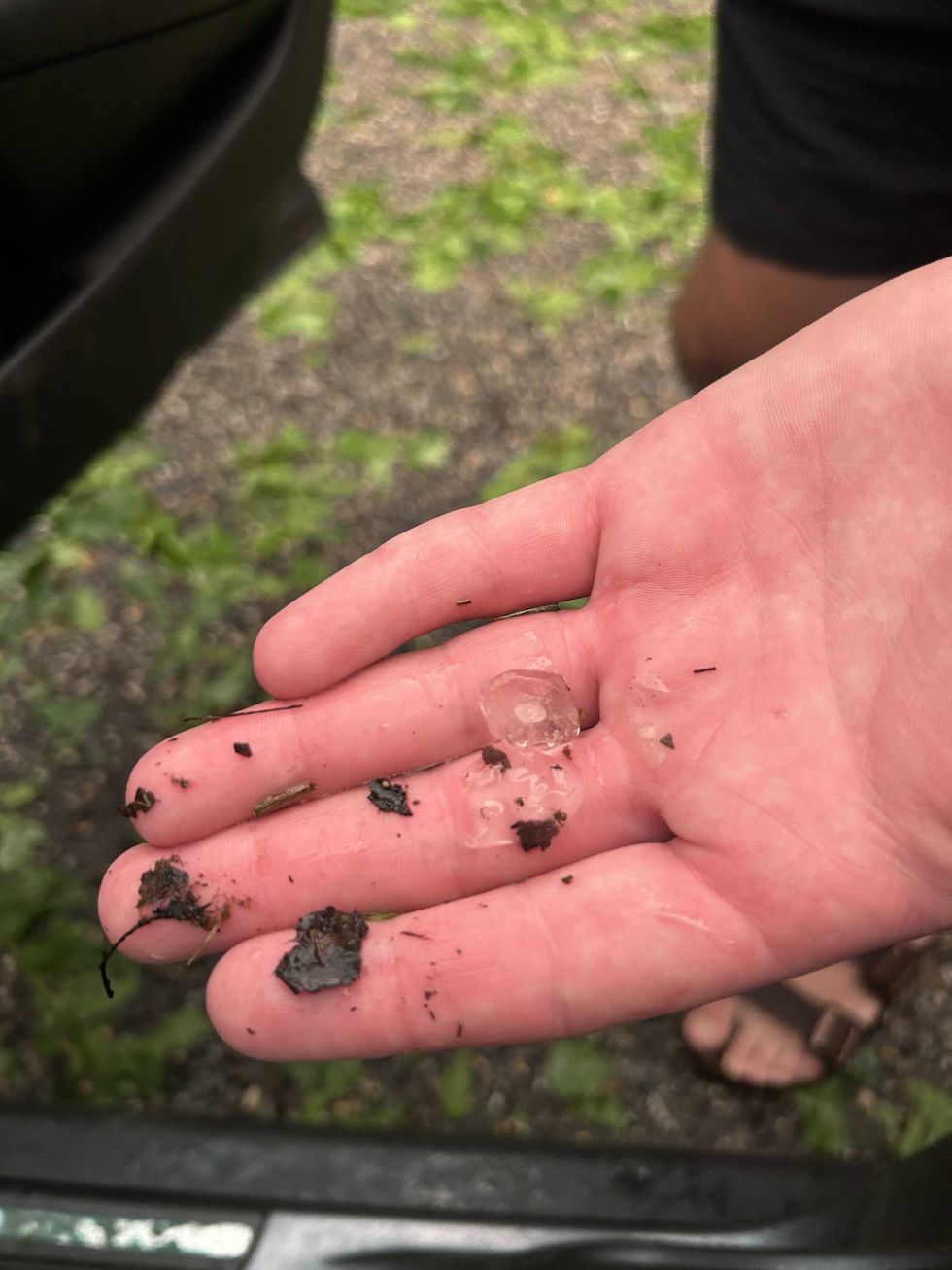 Hail was seen in Falls Village during the July 4 storm. Madi Long
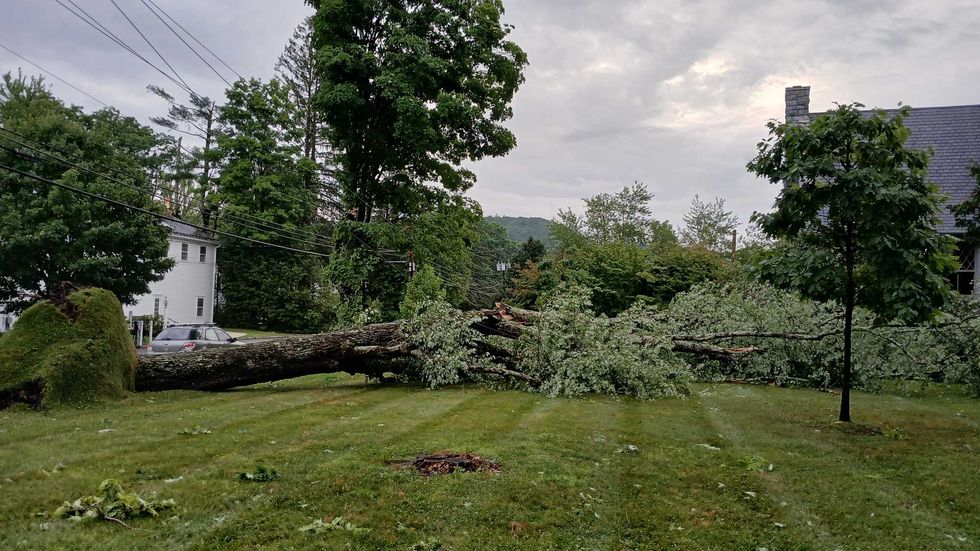 A large tree lies uprooted on the Scoville Library lawn in downtown Salisbury. Patrick L. Sullivan
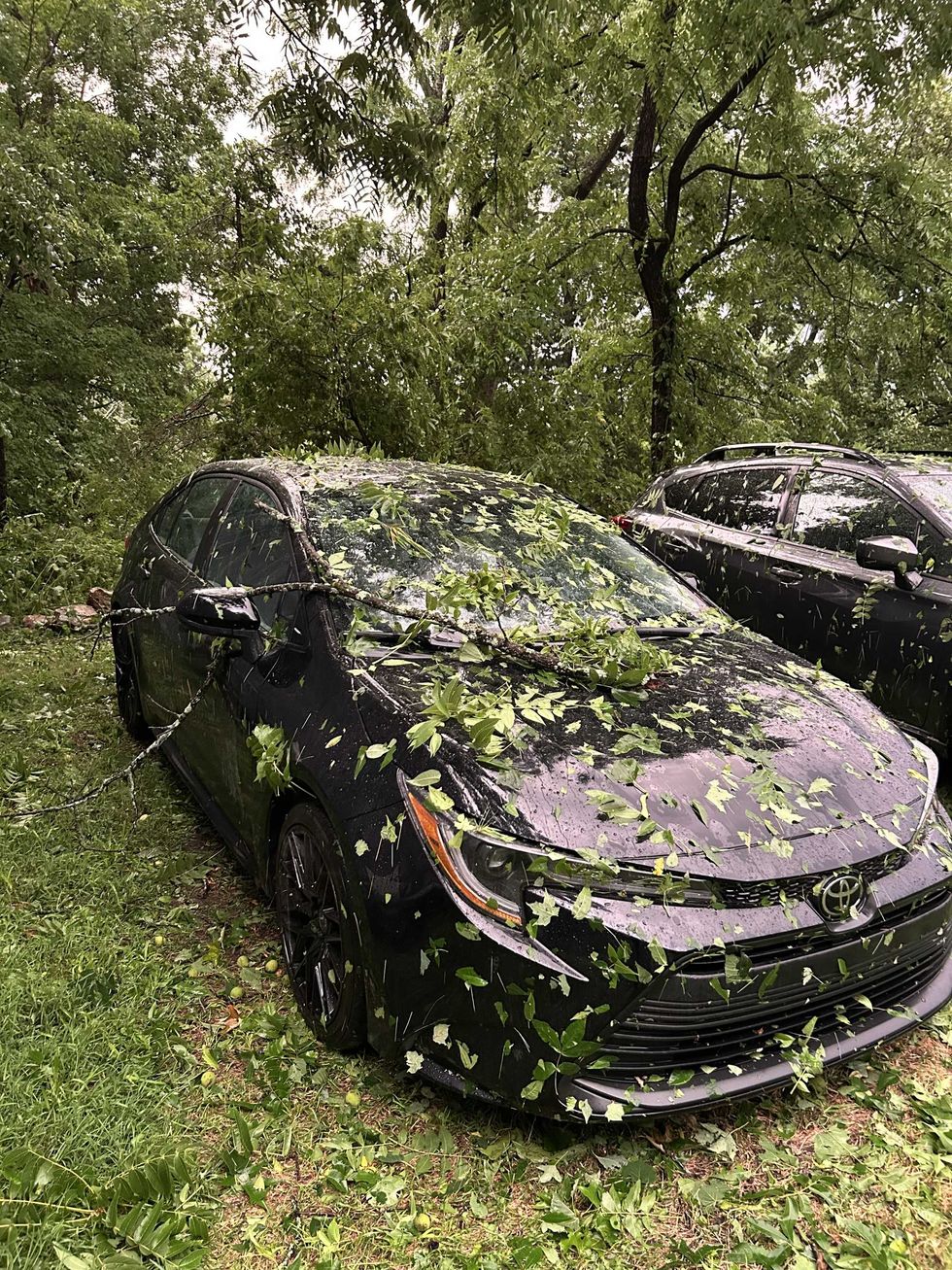 A car in Falls Village is hit by strong winds and debris during Saturday's storm. Madi Long
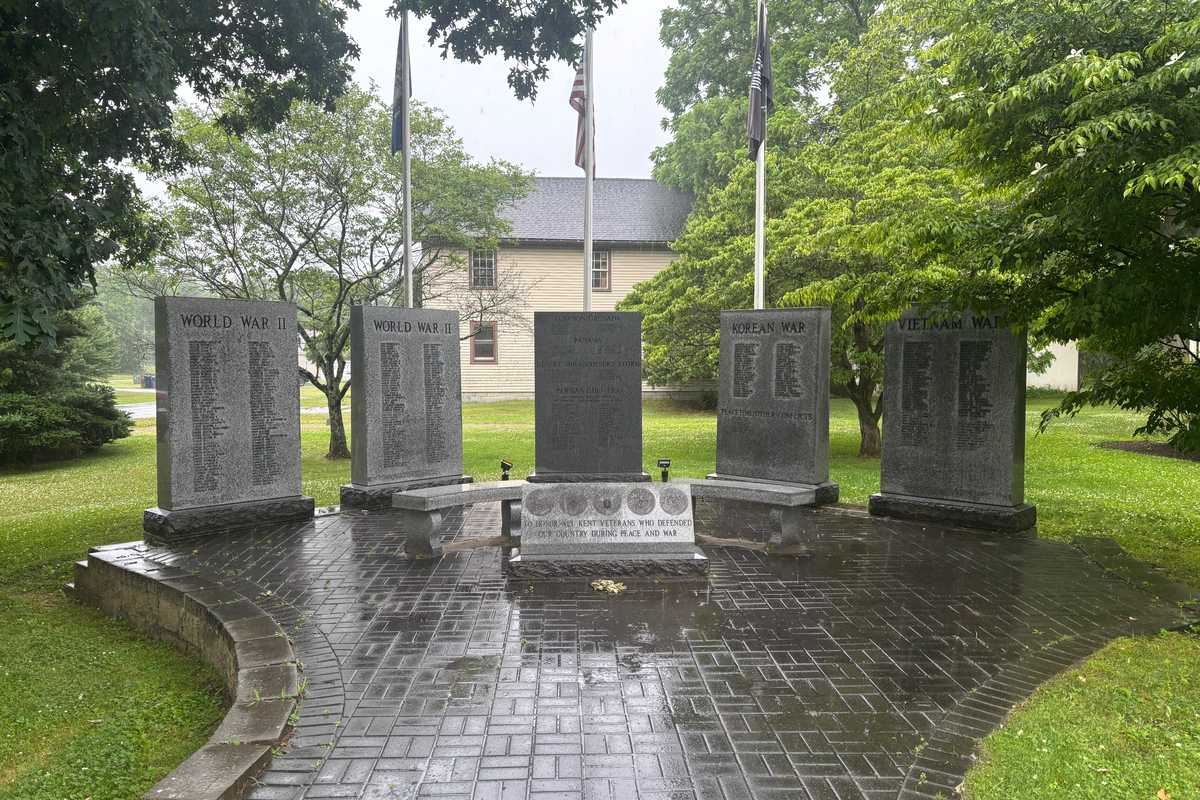
The Veteran’s Memorial is set to receive a new plaque commemorating Kent’s 44 known Revolutionary War servicemen. The stone will be displayed throughout the weekend’s USA 250 celebrations.
Friday, July 3
The parade is still set to kick off at Town Hall on Friday, July 3, at 7 p.m. It will finish with a reception at the Kent Volunteer Fire Department with a DJ, dancing and signing of the town’s ceremonial Declaration of Independence.
A planned bonfire has been replaced by the “KVFD Mega Soaker,” courtesy of a Kent Volunteer Fire Department truck, and cold refreshments in the vein of watermelon or popsicles will take the place of smores, which are being saved for a later event. First Selectman Eric Epstein, who is also a volunteer firefighter, said to get ready to get wet: “it’s more than a mister… it’s a soaker.”
Town Clerk and USA 250 Subcommittee member Darlene Brady warned parents to bring towels.
The group will also be providing vehicles and floats so parade participants can hitch a ride than walk through the heat, though they may still walk if they choose.
As of Thursday afternoon, 16 floats had registered, and anyone eager to join can still submit a last-minute request for a holiday-themed float.
Saturday, July 4
All of Saturday’s programming has been moved indoors, save for the raising of the flag which will occur just outside the Community House at noon. The reading of the Declaration, the nationwide bell ringing, and community picnic with concessions and local vendors and activities will take place inside the building until 3 p.m.
Fireworks at Lake Waramaug at dusk are still on schedule for 9:30 p.m., with parking for Kent residents at the shoreside Lake Waramaug State Park.
Widely scattered showers and thunderstorms are possible both days. Brady said that Friday’s parade may still go on in light rain, but that it may have to be halted if safety becomes a concern, as in the event of downpours or lightning.
“We’re hoping mother nature loves a parade!” she said.
Friday, July 3 (Lights & Liberty Community Kickoff):
2 p.m. – community bell ringing at 2 p.m. at the Eric Sloane Museum, 31 Kent Cornwall Road
7 p.m. – Lights and Liberty parade kicks off at Town Hall, ending at the KVFD firehouse for a reception with a DJ, dancing and refreshments
Saturday, July 4 (Celebration on the Town Hall Lawn & Fireworks Finale):
Noon – community signing of town Declaration and flag raising outside the Community House, 93 North Main Street
1 p.m. – Public reading of the Declaration of Independence inside the Community House
2 p.m. – Town-and-nationwide bell ringing
Noon to 3 p.m. – Community picnic, activity tents family programming and food and drink
9 p.m. to end – Rim-the-Lake with Flares followed by fireworks display
 A brand new Revolutionary War Memorial featuring 44 known Kent veterans of the fight for independence will be displayed during Friday night's parade and at the flag raising ceremony outside the Community House on the Fourth of July. Alec Linden

Want more of our stories on Google? Click here to make us a Preferred Source.


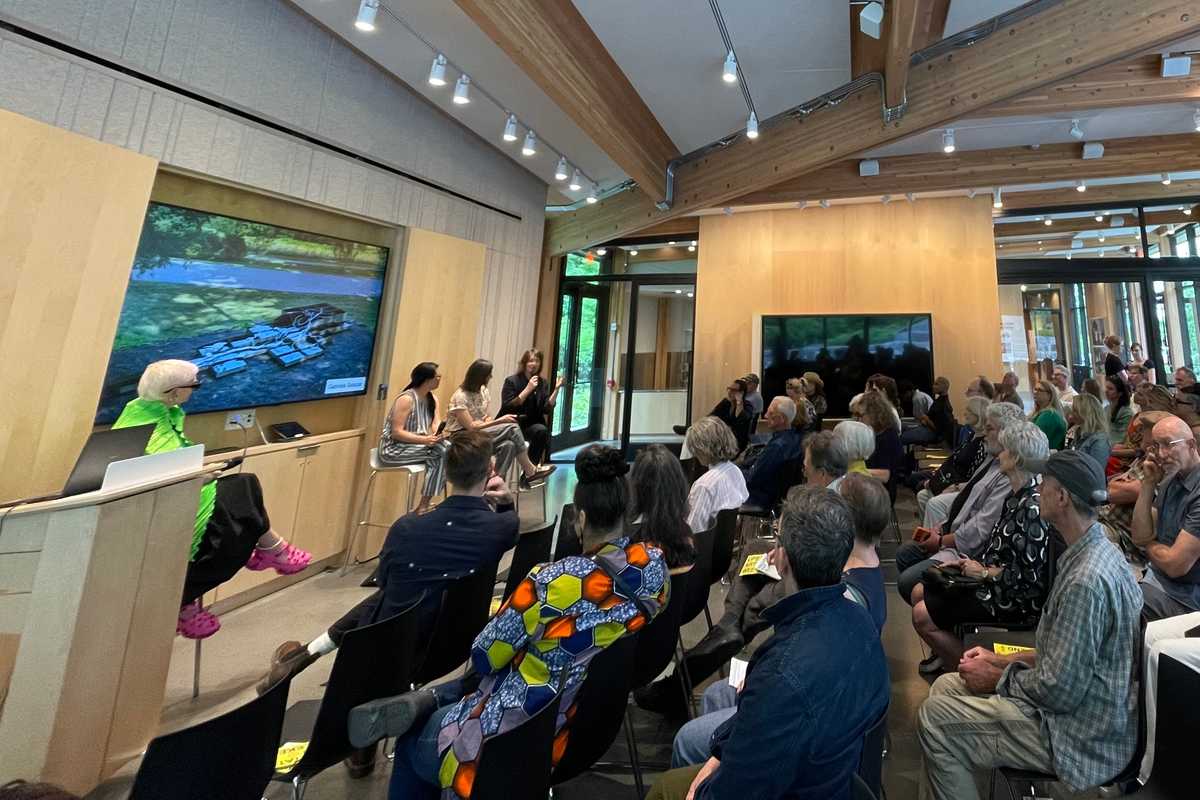
Church’s status as an early environmentalist was mentioned repeatedly during the conversation. Shin’s sculpture “Fallen,” which graced the lawn next to the estate’s main house during last year’s event, featured a fallen hemlock tree trunk planted by Church over 150 years earlier which had been wrapped in tanned leather. She described the work as a direct reference to Church’s experience witnessing the eradication of the area’s hemlocks as the leather tanning industry wreaked havoc on the natural environment of the Hudson Valley in the mid-19th century.
The relationship between art and the environment wasn’t isolated at Church’s former home. Instead, it seemed to be found all over UAW.
Now in its seventh year, UAW works to take the art world out of the city. At its best, the weekend gives artists and curators the opportunity to interact with unfamiliar environments. Just as often, however, it serves as a literal escape, allowing New York City galleries to bring works to pop-up spaces assembled for the express purpose of displaying fine art. The “Loading…” group show in Hudson did just this.
Transplanting six New York City galleries into an intimate event space, “Loading…” featured a wide variety of artists from around the globe. Sheroanawe Hakihiiwe, an Indigenous artist from Venezuela, takes ancient practices and translates his observations of the Amazon into minimalist works. Michael Assif’s “Plant a Weed” highlights the human impact on a natural landscape while feeling like a marshmallow dream. And Margaret Curtis’ “ ‘S ” uses the backdrop of a Hudson River School-style sunset to highlight the chaos of today’s state of the American dream.
The flip side of this art-world field trip is the variety of makeshift galleries in the garages and barns of the Hudson Valley. Places like Ugly Mud Studios and Ten Barn Farm, both in Ghent, along with Foxtrot Farm and Flowers in Stanfordville, housed unexpectedly refined exhibitions. These venues all integrate sustainable practices into their business: Foxtrot is a regenerative flower farm, Ugly Mud uses locally sourced clay, and Ten Barn Farm operates a farm-to-table restaurant called The Kitchen.
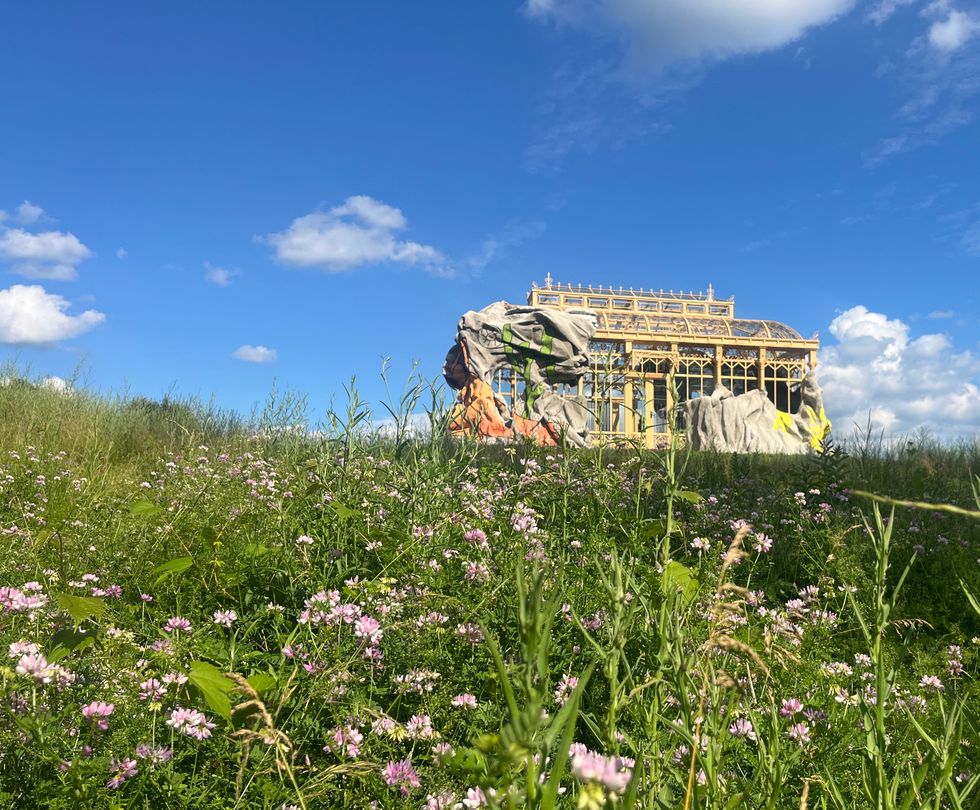
But at the end of the day, UAW is about getting the art world into the wild. So it was no surprise to see a panoply of eye-catching outfits, and out-of-this-world works at Art Omi, the sculpture and architecture park in Ghent, on Saturday evening. Complete with avant-garde ambient operatic metal, the Summer Kickoff event served as a testament to the continued growth of UAW. It seems the seeds that Toomer and her collaborators planted seven years ago are flourishing, with no signs of slowing down.
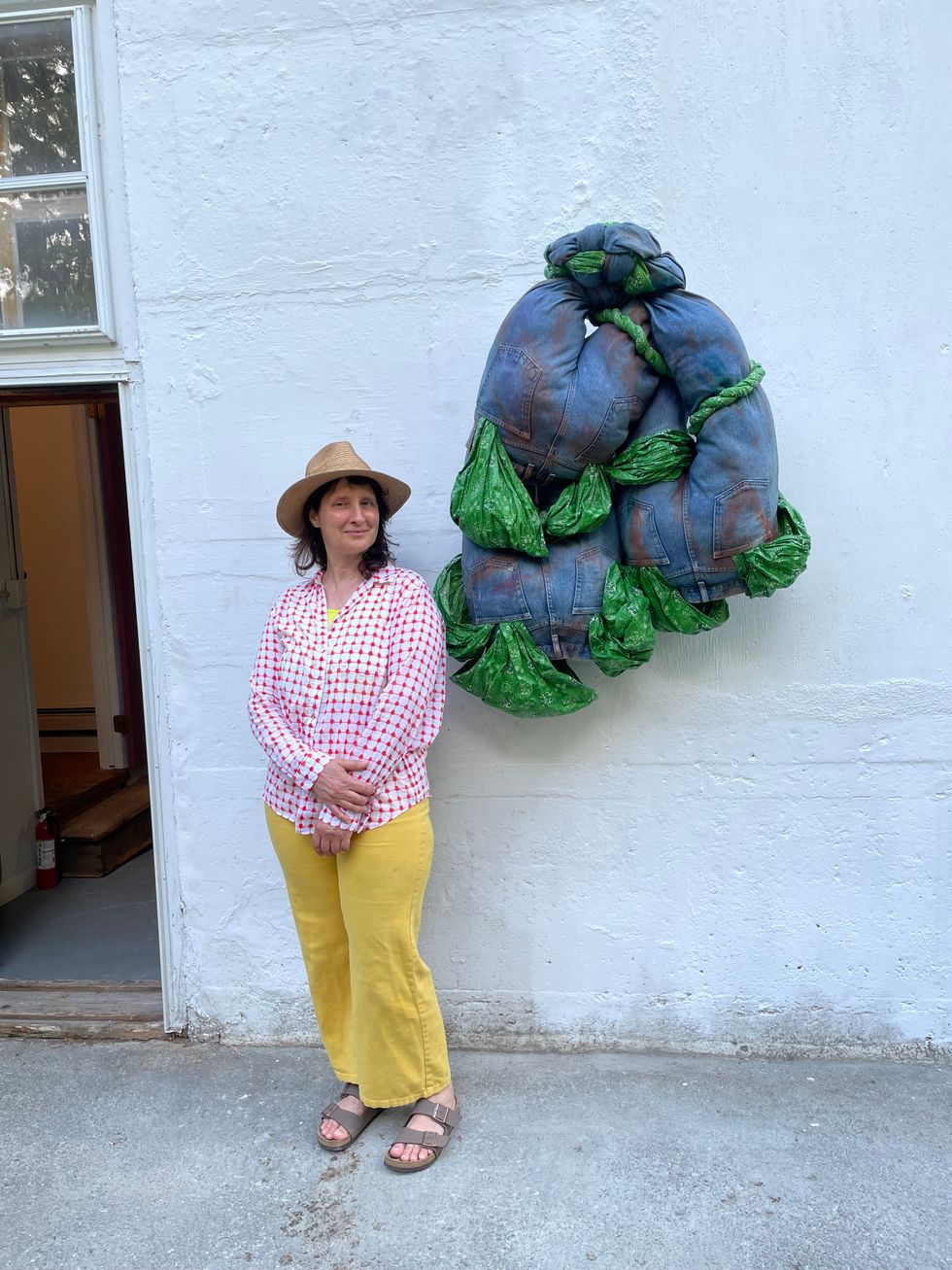
Andrew Ingall
Artist Christy Gast with her sculptures at Friday Arts in Amenia.





Want more of our stories on Google? Click here to make us a Preferred Source.