PINE PLAINS — Resident Dawn Robinson wants the town of Pine Plains to consider accepting tax payments. She approached the Town Board with the idea at its most recent meeting, held Aug. 21 at Town Hall.
"A lot of people are struggling, what with the economy being as tight as it is," she said. "That’s why I formally request, I beg of you, to please start accepting tax payments from residents."
Town Supervisor Gregg Pulver expressed some surprise at the request.
"We can’t tell the school how to collect taxes," he said. "Are there any towns doing this?"
According to Robinson, both Millerton and Hyde Park offer the service. Pulver said that while he has to do some research on the subject, if it’s a service the town can offer to its residents without being detrimental to the municipality, he would be willing to consider it.
"I don’t think it’s necessary personally, because you could make your own payments to your own checking account and then pay us," he said. "Or you could do something as simple as starting a Christmas Club account and go to the bank and give it some dollars out of your paycheck and then when taxes are due you’ll have some money and the interest to pay those taxes."
Robinson said whatever could be done by the town to help out residents would be appreciated.
"A lot of us love living here," she said. "But most of my money has gone to [other things]."
That’s why she said she is seeking help from the town in setting aside tax payments, so that when they come due, the money will be ready.
"We only have part-time people here," town Councilman Bob Couse said. "We’re not bankers here."
Assessor Jim Mara asked for clarification from Robinson.
"I’m not sure if you’re asking to prepay [your taxes] or if you want to pay them after the fact," he said. "[If you want to pay them after the fact] that means the town would have to cover your debt to the county."
Pulver said that while it’s not an idea he’s thought of previously, he does understand that everybody has a "unique financial status." Therefore, he said, he is willing to look into the matter.
"If we can do something that doesn’t cause us to revamp our entire system, or cost the rest of our taxpayers dollars, then we will look into it," he said. "One of the problems is that I don’t think there’s a mechanism for that. There’s interest and penalties [to consider]. Even though the money is coming up to us, they penalize us, so I’m not sure how that would have to work, so I’m going to have to do some research and talk to some people.
"I can understand people getting into tight financial times and not being able to pay taxes on time," Pulver added. "We are certainly sensitive to everybody’s needs and we will look into it."

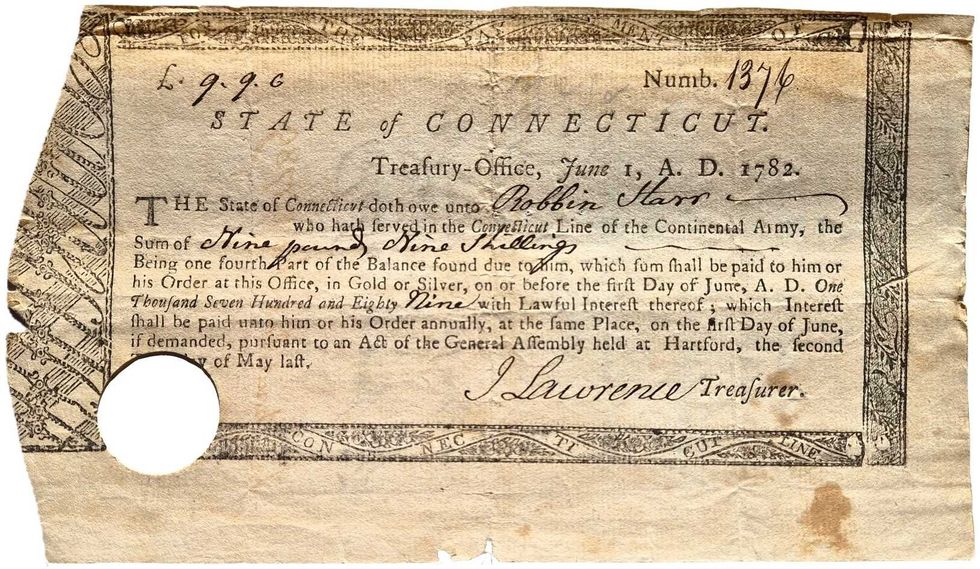 Pay Bill for Robin Starr’s service in the Continental Army.Courtesy the Alex Breanne Corporation
 John Mills speaking at Quinnipiac University.Courtesy the Alex Breanne Corporation
 Stephanie Saetta,with her rescue dog George and Blue (left), a shepherd mix awaiting his forever home.Madi Long
 Blue, a 7 year-old Shepard mix, is waiting for his forever home. Madi Long