Searching for - but not finding - the answers to health-care concerns


Across the nation and throughout the Northwest Corner, health-care concerns are becoming an ever-increasing source of anxiety and frustration.

A group of local organizations and businesses stepped in last week to try to find some answers to problems that are creating daily challenges to small business owners, entrepreneurs and part-time workers who are increasingly being kept out of the system by high costs.

About 80 people turned out on Sunday, April 29, for the forum, held at the Salisbury Congregational Church.

A panel of state Legislators and health-care experts spoke first, and then citizens stood to express their thoughts and concerns. State Sen. Andrew Roraback (R-30), state Rep. Roberta Willis (D-64) and Juan Figueroa, president of the Universal Health Care Foundation of Connecticut, made up the panel, which was moderated by Richard Collins, a retired internist (and vice president of the Salisbury Forum and president of the Taconic Learning Center) who lives in Lakeville.

The forum was sponsored by the Congregational Church of Salisbury, St. Mary’s Catholic Church, the Foundation for Community Health, United Action of Connecticut, The Lakeville Journal and other member churches of the Northwest Clergy Alliance.

Problems impacting the nation


Figueroa explained his foundation’s mission and offered some statistics on the state of health care in Connecticut.

"The mission of the foundation is to make quality, affordable health care accessible to all Connecticut residents," he said.

The lack of affordable health insurance is not just affecting lower-income, uninsured citizens, he said. It is also impacting the middle class. High deductibles and co-pays, gaps in coverage and the rising cost of prescription medications are making it increasingly difficult for those who have insurance to pay for medical care.

Figueroa also said that a lack of universal health care in this country affects America’s ability to compete in a global market.

"We can’t be competitive when every other industrialized nation has universal health care," he said. "Health-care costs add $4,000 to $5,000 per car purchased in the United States."

Figueroa defined universal health care by explaining what it is not. It is not, for example, the same thing as single-payer insurance, which is a system in which the health-care costs of an entire population are paid for through one source — the government, for example, will pay for health care from a pool of money collected from taxpayers. A single-payer system does not change the nature of health insurance; it changes the way it is paid for.

Nor is universal health care socialized medicine or "big government," in which the government takes over the administration of medical care.

Universal health care is, simply, a system in which everyone has medical insurance.

Roraback, who spoke next, said that as ranking member on the state Senate’s Public Health Committee, he has seen 10 bills addressing health care so far this session (this year’s legislative session began in January and will end in June).

"Health care is more important, quite frankly, than any other issue before the Legislature this year," he said.

The senator then told the story of a 4-year-old Torrington boy with a dental emergency who had to wait a week to see a dentist in Farmington because none of the dental providers in the area would accept the boy’s state HUSKY insurance for children.

"If they can’t see a provider, that insurance isn’t worth much," Roraback said. He went on to say that he is working to increase the payments made to providers through HUSKY to entice more providers to accept it.

Willis used her opening remarks to stress that the issue of health care affects everyone, whether insured or uninsured.

"Health care is no longer a public health issue," she said. "It really has become an economic issue." She went on to say that $600 million was paid in Connecticut last year for the uninsured and that 33 cents of every dollar spent went to paperwork.

"This is a national problem and we should have a national solution," Willis added. "It is so pathetic that we’re sitting here, state by state, trying to cover our needs."Concerns and frustrations

Mort Klaus of Sharon, a small business owner and the vice chair of a teaching hospital, opened the public comment portion of the forum. He said that employees who work at small businesses often have to pay as much as $1,600 a month for insurance.

"You can’t ask someone who makes $60,000 a year to pay $1,600 a month for health insurance," he said.

William Reed of Salisbury spoke next, calling for a federal health-care program.

"Aren’t the major health-care insurers government financed?" he asked, pointing to the fact that the government already pays hefty fees to insurance providers through various programs. "We just need to manage them better." He also pointed out that interest is paid on the government’s reimbursement pool.

Figueroa confirmed that the government does spend $300 million to $400 million a year for Medicaid reimbursement.

A nurse from Winsted, Lisa Valenti, spoke about the difficulty nursing homes and their residents encounter under the current system.

"Nursing homes are going out of business due to medical costs," she said. "We have residents on Medicaid who are denied service because providers don’t want to deal with the low reimbursement rate."

Roraback agreed that this is a problem, and added, "People end up in nursing homes who could be at home because the federal government won’t cover at-home costs. There was zero percent increase for nursing homes in the state budget this year."

Claude Rolo, who recently moved from Millerton to Lakeville, taking his small business with him, said that his insurance did not follow him across state lines and that he could not get new insurance in Connecticut. He voiced his support for a single-payer system.

Roraback responded by saying that the government already pays about 60 percent of health-care costs in the United States and the trend nationally was a move toward single-payer.

John Charde of Salisbury, who said that he has spent most of his career in managed care, said, "One good thing about managed care is that they buy it wholesale." Managed care allows a company representing a large group of consumers to purchase health care at much lower costs.

He went on to say that there are many stakeholders in the current health-care system who would oppose changes. Hospitals, he pointed out, get a lot of money from the government.

Figueroa responded by saying that many doctors have become fed up with the red tape and paperwork involved with managed care and other health-care systems.

"They’re not in the driver’s seat when it comes to making decisions about your medical care," he said. "There’s something wrong with that picture."Searching for a solution

Though many problems were brought up over the course of the discussion, no one had any answers. Willis said that many options were floating around the General Assembly, including moving to a single-payer system; creating a state pool; expanding coverage to the uninsured; mandating municipalities to join a health-care pool. But she was skeptical that a comprehensive reform could be achieved in this session. She felt that anything done this year would be "piecemeal" and would have to be built upon in following years.

Roraback called for integrating technology into the practice of medicine, advocating telemedicine, where a doctor can converse with a patient through video conferencing, and electronic medical records.

Figueroa said that since the various stateholders in the health-care system will probably never agree, the government needs to step in and legislate a solution.

There were many ideas floating around the room that afternoon, but nothing approaching a solution came from the discussion. Each of the panelists admitted that he or she did not have an answer. Panelists and commenters alike agreed that a federal solution would be better than a state solution, but also recognized that in the absence of federal health-care reform, the states have a responsibility to their citizens to attempt to find an answer to this problem.

The discussion will continue on Saturday, May 5, at 11 a.m. when the Universal Health Care Foundation of Connecticut will organize a march, "Stand Up for Health Care," in Bushnell Park in Hartford.

Latest News

A winter visit to Olana

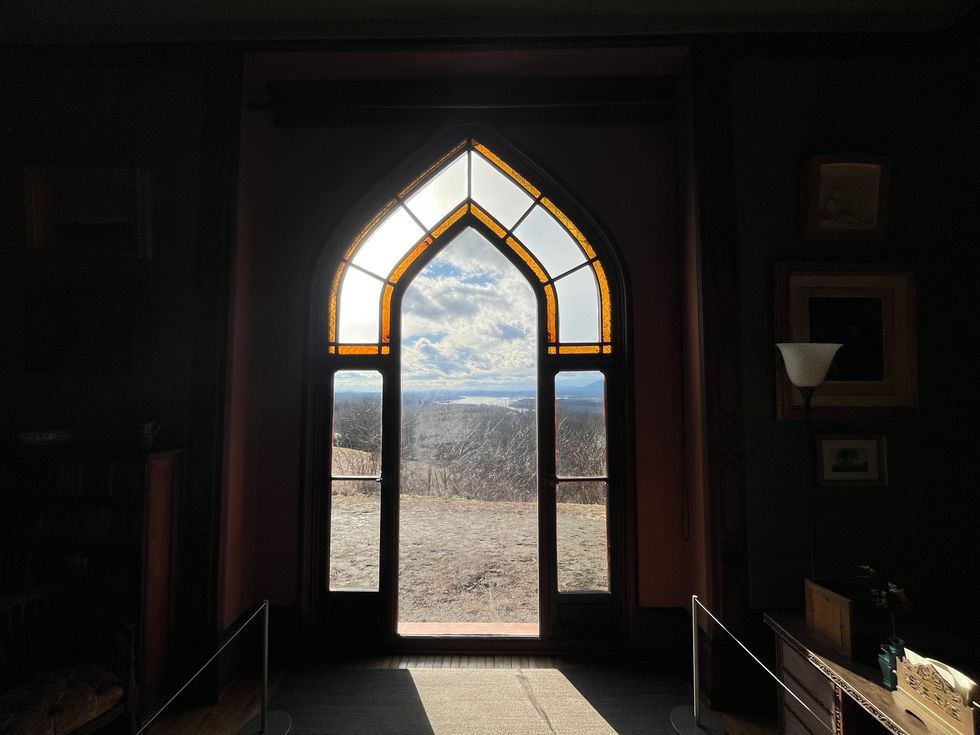
Olana State Historic Site, the hilltop home created by 19th-century Hudson River School painter Frederic Edwin Church, rises above the Hudson River on a clear winter afternoon.

By Brian Gersten

On a recent mid-January afternoon, with the clouds parted and the snow momentarily cleared, I pointed my car northwest toward Hudson with a simple goal: to get out of the house and see something beautiful.

My destination was the Olana State Historic Site, the hilltop home of 19th-century landscape painter Frederic Edwin Church. What I found there was not just a welcome winter outing, but a reminder that beauty — expansive, restorative beauty — does not hibernate.

Keep ReadingShow less
Housy ski team wins at Mohawk

Berkshire Hills Ski League includes Washington Montessori School, Indian Mountain School, Rumsey Hall and Marvelwood School.

Photo by Tom Brown

CORNWALL — Mohawk Mountain hosted a meet of the Berkshire Hills Ski League Wednesday, Jan. 28.

Housatonic Valley Regional High School earned its first team victory of the season. Individually for the Mountaineers, Meadow Moerschell placed 2nd, Winter Cheney placed 3rd, Elden Grace placed 6th and Ian Thomen placed 12th.

Keep ReadingShow less
Harding launches 2026 campaign

State Sen. Stephen Harding

Photo provided

NEW MILFORD — State Sen. and Minority Leader Stephen Harding announced Jan. 20 the launch of his re-election campaign for the state’s 30th Senate District.

Harding was first elected to the State Senate in November 2022. He previously served in the House beginning in 2015. He is an attorney from New Milford.

Keep ReadingShow less
Specialist Directory Test

Keep ReadingShow less