NORTH CANAAN — Concerns mounted last week across the state and Northwest Corner that proposed farmland tax increases could threaten the future of working farms. In response, owners of large agricultural tracts warned that higher property tax assessments would make it impossible to continue operating under the same rules as residential development.
Those concerns — echoed by farmers who traveled to Hartford to testify and amplified by local lawmakers — prompted Gov. Ned Lamont to order an immediate halt to steep increases in farmland property tax assessments that critics said could push land out of agriculture and into more intensive use.
The 2025 revised land-use values were compiled by the state Office of Policy and Management, in coordination with the Connecticut Department of Agriculture, using landowner survey data collected as part of the five-year update process — a methodology farmers and assessors later said produced distorted results because of low participation and uneven data.
Lamont’s action followed a Jan. 15 press conference at the State Capitol organized by Connecticut Senate Republicans, where lawmakers stood alongside farmers to call attention to sharp valuation increases proposed under the state’s farmland tax program.
Senate Minority Leader Stephen Harding, R-30, whose district includes much of the Northwest Corner, played a leading role in bringing the issue to the forefront, warning that the reassessment threatened the economic viability of family farms across rural Connecticut.
Following pressure from Harding, local farmers, and a petition with more than 20,000 signatures, the governor agreed to pause the new, higher valuations and revert to 2020 levels.
At the press conference, Harding said farmers in his district and across the state were facing projected assessment increases of hundreds — and in some cases thousands — of percent under new land-use values developed by the state.
“This isn’t about tax avoidance,” Harding said at the time. “This is about whether family farms can survive when the rules change overnight.”
Farmers attending the event echoed those concerns, saying sudden jumps in assessed values could translate into tax bills they could not absorb while continuing to operate.
 State Sen. Stephen Harding, R-30, visited South Farms in Morris to speak with fourth-generation farmer Ben Paletsky, who is concerned about Connecticut farmland tax hikes and the state’s methodology for assessing farmland.Photo by Debra A. Aleksinas
The most controversial proposal would have increased the value of swamp land from $40 an acre to $970 an acre. That increase was later eliminated following public outcry, although other land categories in the new revaluation remained subject to significant tax hikes.
“Unforeseen lack of data” to blame
Lamont said in a statement, “Due to an unforeseen lack of data in establishing assessment values for these lands as required, significant increases in valuations occurred for the tax years beginning with the 2025 grand list.”
Only about 4% of the state’s farmers contributed survey data for the revaluation, according to state officials.
To address the problem, the governor directed OPM, in consultation with the Connecticut Department of Agriculture, to revoke the 2025 Recommended Land Use Values and Best Practices for farmland, forestland, open space and maritime heritage land, and reinstate the 2020 recommended land use values for these categories.
The governor also ordered immediate notification to all municipal tax assessors of the revocation and reinstatement, and mandated that a working group be convened in collaboration with the state department of agriculture, including representation from agricultural organizations, farmers, municipal leaders and assessors.
What triggered the concern?
The dispute centers on Public Act 490, the state law that allows farmland, forestland, and open space to be assessed for property tax purposes based on its current use rather than its fair-market value.
The law is intended to reduce pressure on landowners to sell to developers and to keep working landscapes intact.
Every five years, the state develops recommended land-use values that municipalities may use when setting assessments. In late 2025, updated values released by the Department of Agriculture and OPM would have significantly increased assessments in several farmland categories, prompting alarm from farmers and assessors alike.
Although the state revised the figures earlier this month after hearing concerns, many landowners said the updated numbers still represented dramatic increases.
In the Northwest Corner — where farms are often land-rich but cash-poor — farmers warned that higher assessments could limit reinvestment, complicate succession planning or push land toward subdivision or other non-agricultural uses.
Benjamin Freund of East Canaan said the proposed changes would have had a direct and immediate impact on his family’s farming operation, which comprises 455 acres enrolled under Connecticut’s farmland tax program.
“It would have impacted us, as we have all of our acres — minus the houses — under PA 490,” Freund said. “We have every land classification, from tillable acres to swamp and woodlands. PA 490 is a critical tax relief program that allows us to farm large tracts and be taxed according to the use. We could not afford to plant corn and have the same property tax as a house lot.”
Freund said his family has operated for decades under PA 490 and described the program as essential to keeping farmland in production in Connecticut.
“We could not farm in Connecticut without it.”
He said landowners are periodically surveyed to provide the raw data used to determine updated land values, but said low participation contributed to distorted results in the most recent valuation cycle.
“The Connecticut Farm Bureau recognized the issue and worked with the Department of Agriculture to address the concern.”
The third-generation Freund Farm, operated by Ben and Matt Freund, rents land and barns to Canaan View Dairy, operated by Ethan Arsenault, who owns the cows and grows the crops.
Jennifer Dubray, assessor for North Canaan, Kent and Sharon, said the governor’s action will not require changes to the current grand lists in those towns.
“The PA 490 values in those towns were all established using the latest values provided by the Office of Policy and Management at the time of their respective revaluations,” Dubray said. “In North Canaan, the revaluation took place in 2022 and utilized the 2020 values. For Kent and Sharon, the revaluations occurred in 2023, so the 2020 values were also used.”
“Consequently,” she said, “it will not be necessary to make any changes to the 2025 Grand List for these towns.”
Farmers’ input sought
In addition to directing OPM to immediately notify municipal assessors that the 2020 land-use values are back in effect, Lamont also ordered the creation of a working group that will include farmers, municipal officials, assessors, and state agencies to review the valuation process and recommend improvements before the next five-year reassessment cycle.
Harding said the governor’s action was an important first step but emphasized that longer-term reforms may be needed to ensure transparency and predictability.
“This pause gives farmers breathing room,” Harding said. “Now we need to make sure the system going forward reflects real-world farming conditions.

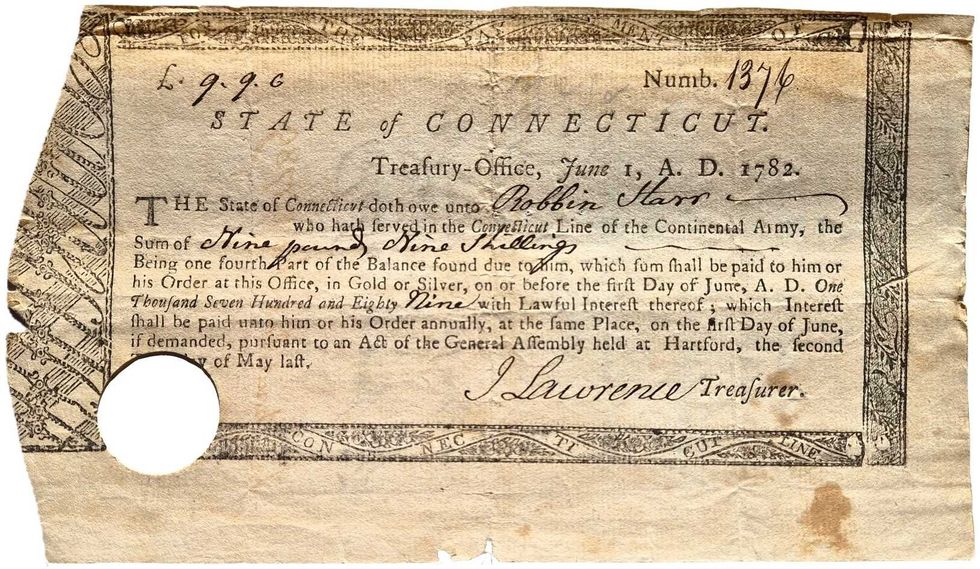 Pay Bill for Robin Starr’s service in the Continental Army.Courtesy the Alex Breanne Corporation
 John Mills speaking at Quinnipiac University.Courtesy the Alex Breanne Corporation
 Stephanie Saetta,with her rescue dog George and Blue (left), a shepherd mix awaiting his forever home.Madi Long
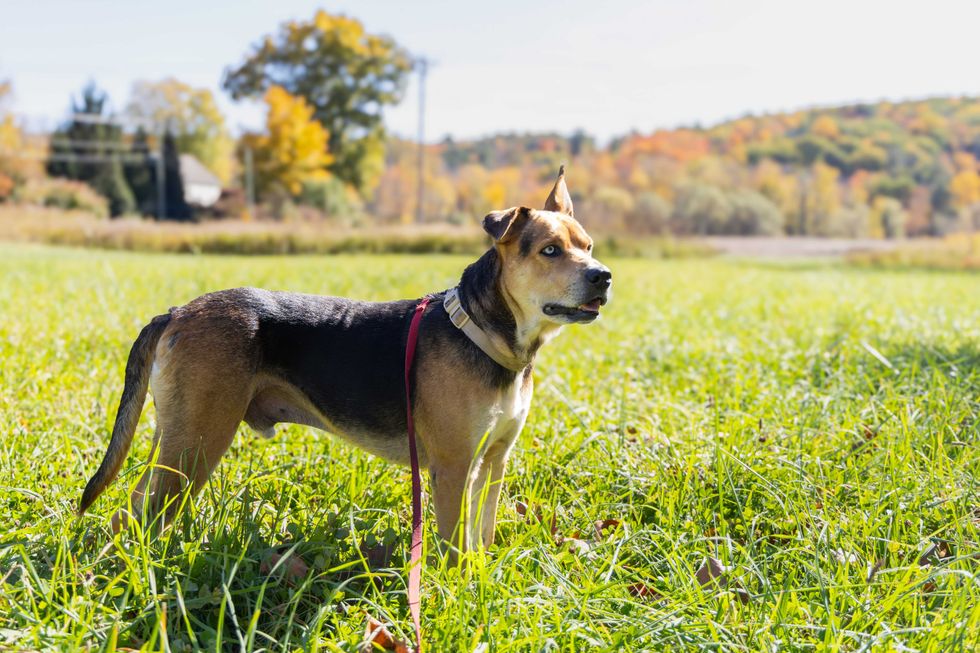 Blue, a 7 year-old Shepard mix, is waiting for his forever home. Madi Long