Latest News
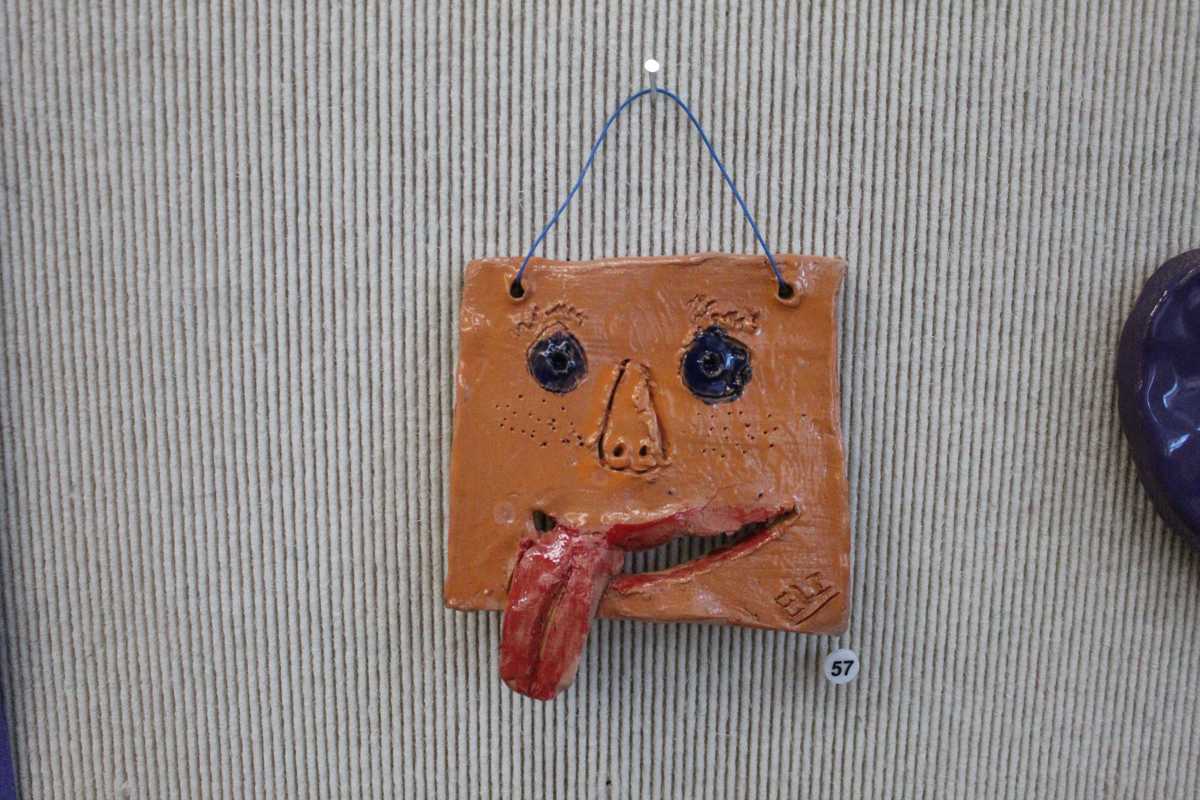
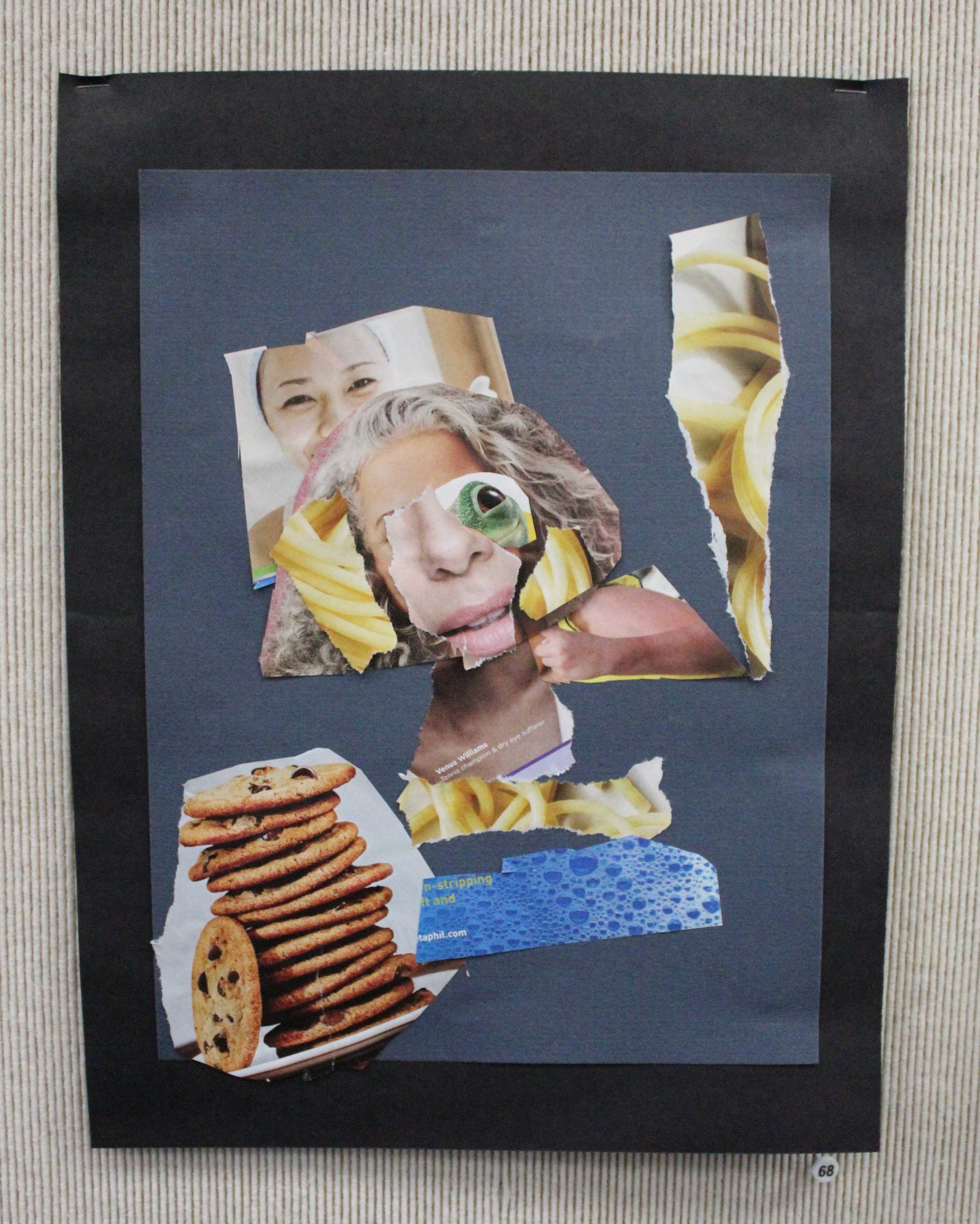
Figure by Eli Sher, grade 6.
Patrick L. Sullivan
After a November 2025 meeting with Falls Village artist Vincent Incognilios, whose show “Face Time” was on exhibition at the David M. Hunt library, students at Lee H. Kellogg, under the eye of art teacher Madeleine Stern, got busy with their responses.
The results are now on display at the library.
“Lee H. Kellogg Emerging Artists Exhibition 2026” will be on display through Friday, Feb.6, with 71 art works from Kellogg students in grades K through 8.
Keep ReadingShow less
Poet Sharon Charde will be discussing her new collection of poetry, ‘What’s After Making Love’ at The White Hart on Feb. 1.
Hedi Charde
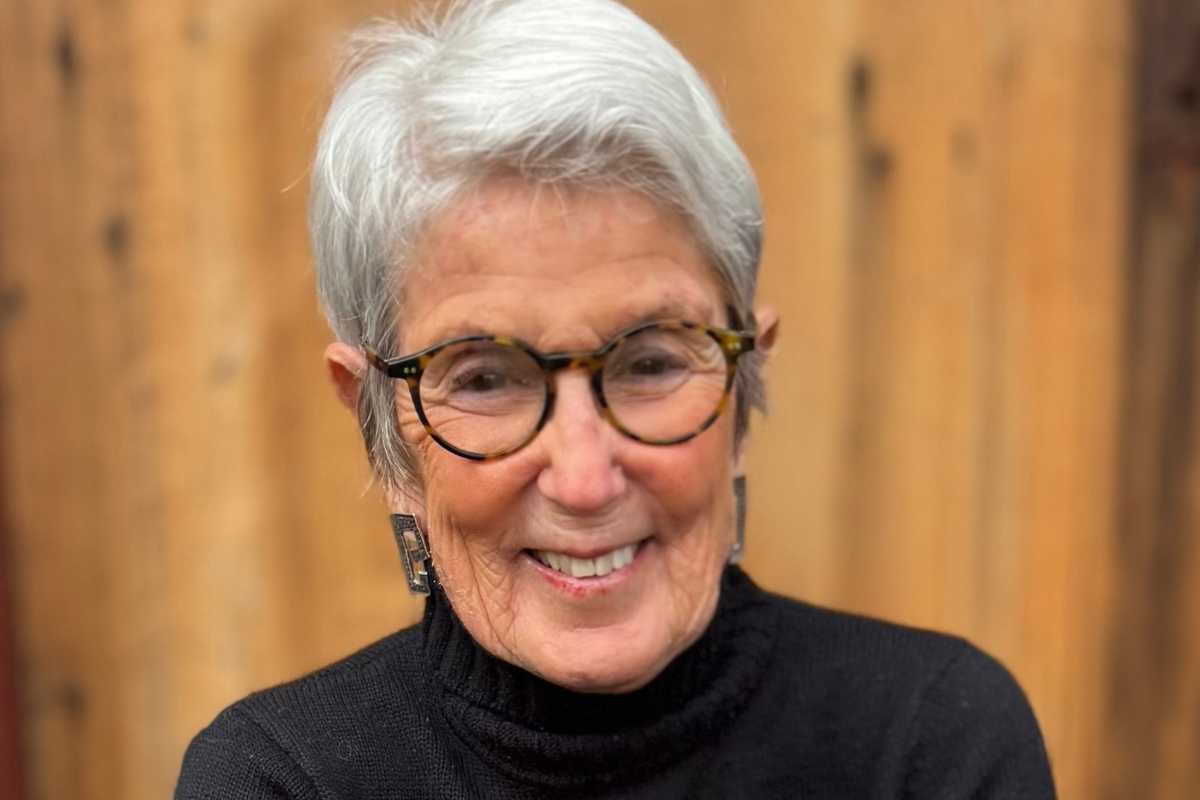
Poet Sharon Charde will appear at The White Hart Inn in Salisbury on Sunday, Feb. 1, as part of the White Hart Speaker Series, in conversation with poet Sally van Doren, to discuss Charde’s new collection, “What’s After Making Love.” The event is free, with registration requested.
The book traces a woman’s life from childhood through marriage, motherhood, and maturity, but its emotional core emerges from the death of Charde’s son, Geoff.
“Life is no longer ordinary once one has experienced grief,” said Charde. After his death, she said, grief felt “like a heavy marble coat I’d been sentenced to wear — forever,” raw and invasive, altering every experience. When a friend’s child asked if she and her husband would ever be happy again, her answer was simple: “Not for a long time.”
The poems do not suggest grief fades. Instead, they reflect how it changes shape. “After some years — and this takes much work — I learned to carry grief differently,” said Charde, describing how support from family and friends, therapy, prayer and writing allowed her to keep going. Loss, she shared, made life more fragile but also more vivid, sharpening her appreciation for love, deepening her marriage, and making ordinary moments more poignant. Poetry became a way to “take the inchoate and shape it into something outside myself — my poems, prayers for healing.”
The collection’s title grew from a poem written many years ago, reflecting on love as both joy and risk. “Everything comes after making love,” Charde said. The phrase became, for her, “an umbrella under which all could fall,” a way to hold the whole of a life without simplifying it.
Memory, too, plays a central role in the book. Charde distinguishes between factual memory and what she calls the memory of the spirit, shaped by emotion and time. “Memory is unreliable,” she said, but poetry allows it to be burnished into meaning. Writing, for her, remains a mysterious process: “I never know what will come when I sit down with paper and pen.”
Charde will be joined by Sally van Doren, a longtime friend and colleague she first met at a poetry workshop in Squaw Valley in 1999. Their conversation will reflect years of shared literary community, teaching, creative practice and will include readings from the book and questions from the audience.
The event is at 2 p.m. at The White Hart Inn, 15 Undermountain Road, Salisbury.
Free; registration requested at oblongbooks.com
Keep ReadingShow less
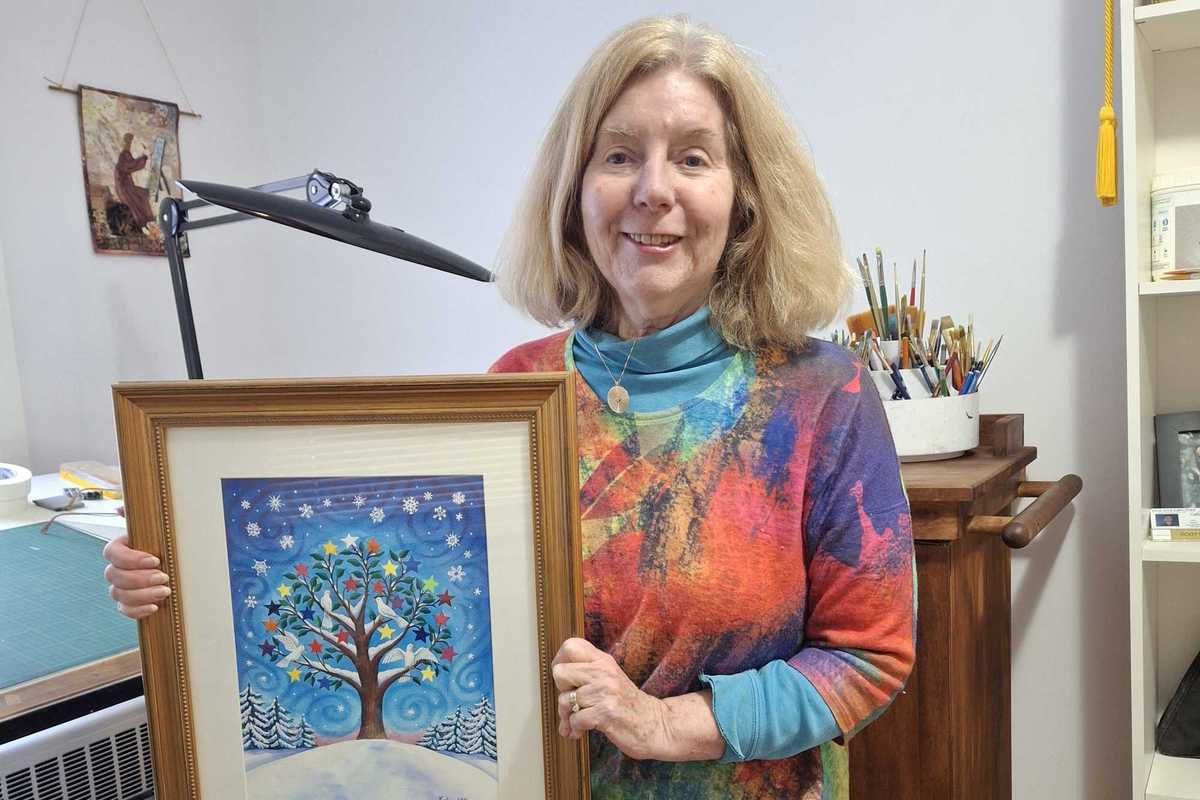
Norfolk artist Katie Atkinson in her studio with her painting ‘Tree of Hope.’Her show, “Seasons of Painting,” opens at the Norfolk Library Jan. 31.
Paul Atkinson
A new exhibition at the Norfolk Library traces the artistic evolution of longtime resident and illustrator Katie Atkinson, showcasing decades of work that grew from children’s book–inspired imagery into internationally licensed art.
“I put together the Norfolk Library show, ‘Seasons of Painting,’ to show my evolution as an artist through the years,” she explained.
The show will be on display at the Norfolk Library from Jan. 31 to Feb. 25, with an opening reception on Feb. 1 from 4 to 6 p.m. On Feb. 15 at 3 p.m., Atkinson will give a presentation and answer questions about her work.
“I remember loving painting and drawing as a child. I knew that I wanted to be an artist in elementary school,” Atkinson recalled.
After graduating from college, she lived in New York City, taking jobs in graphic design and advertising, but not feeling she had found her own style and direction yet.
She married and moved to Norfolk. “Once we had our sons and I was reading children’s books to them, it helped me to see the kind of expressive art I wanted to create.” She realized, “It was really about capturing and conveying a feeling more than about any technique.”
“It took 10 years before I was able to really have a consistent look and create my own art that felt natural to me, not trying to fit any particular market, and then the right markets came to me.”
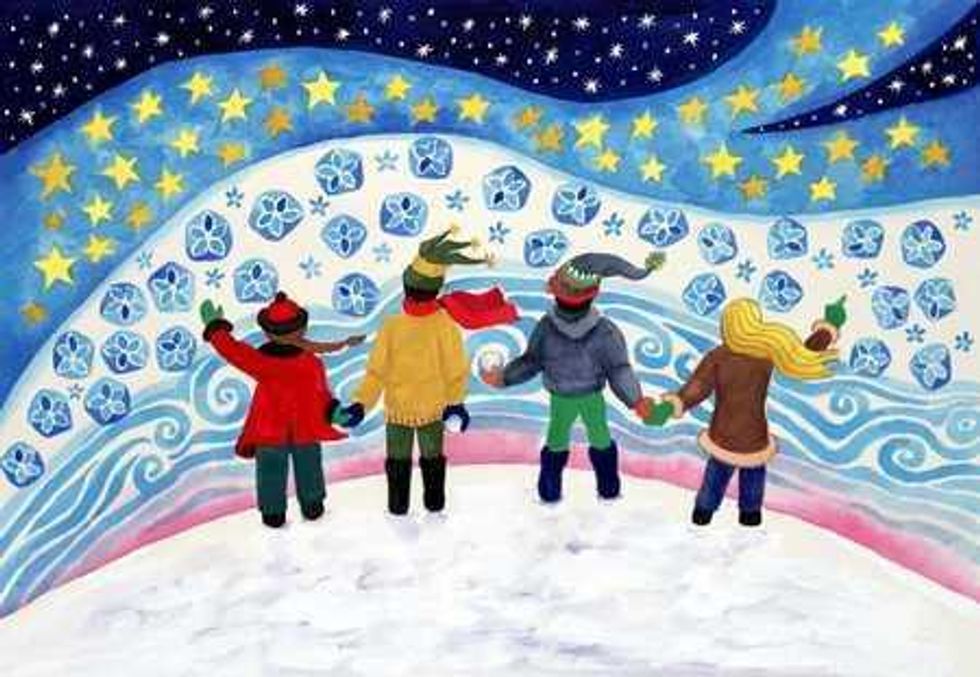
Her children loved winter, and that became a theme for her. “I felt the magic of winter as I saw it through my children’s eyes,” Atkinson remembered. She said one of her first paintings, “Winter Wonderland,” was quickly licensed by an English greeting card company “as soon as I placed it in Illustration Source,” the agency that represents her.
Around the same time, she went to the New York Stationery Show, where she showed her work to Good Source Greetings, which “bought five cards from the start.”
“These paintings were more universal, idealized and symbolic in theme, yet still with the expressive feel of children’s book illustration.” Her work was marketed worldwide by Illustration Source. “Finally, I had found two areas where I could create what I wanted, and my work was selling — often multiple times for uses and publications I wouldn’t have found on my own.”
“One of my most exciting licensing deals was in 2004, when my art was published by the American Lung Association for Christmas Seals,” Atkinson said.
That is when she felt she had finally found her way. “My ‘Tree of Peace’ and ‘Dove with Trail of Stars’ sold all over the world. I finally felt like I had my direction.”
“Then in 2007, Lands End called me to design their gift card and gift box for 2007. It was like a dream come true for me.”
While looking in a Barnes & Noble one day, Atkinson came across Bookmarks magazine. “I felt my art was in keeping with their look, and I actually painted a cover and sent it in an email to the art director.” Since then, Atkinson has since has painted more than 50 covers for the magazine, and “this has become my longest, steady, ongoing source of assignments over the past 15 years.”
“I hope this exhibit inspires other artists who have not yet found their niche to just keep on creating art, pursuing and refining what you love. It is worth the time it takes,” Atkinson said.
Keep ReadingShow less
Finding home after the fire
Jan 28, 2026
Artist Aaron Meshon
Elena Spellman
When artist Aaron Meshon arrived in the Berkshires with his family, the move followed a series of upheavals — a devastating fire, mounting financial stress and the COVID-19 pandemic — that ultimately led him to a quieter, more grounded life.
Meshon grew up in a small town outside Philadelphia, an only child raised around horses by parents he describes as “strict liberals.”
School was a struggle, but early on Meshon was impelled to translate words into pictures. “I would hear a story and automatically get an image in my head,” he said. He was accepted to every art school he applied to and chose the Rhode Island School of Design.
Meshon went on to become an award-winning children’s book author and illustrator. His first children’s book, “Take Me Out to the Yakyu,” was inspired by a deeply personal longing. After seven years of trying to have a child with his wife, who is Japanese, he imagined the story he would tell his future child about the differences between baseball in the United States and Japan. The book went on to receive multiple awards and wide recognition.
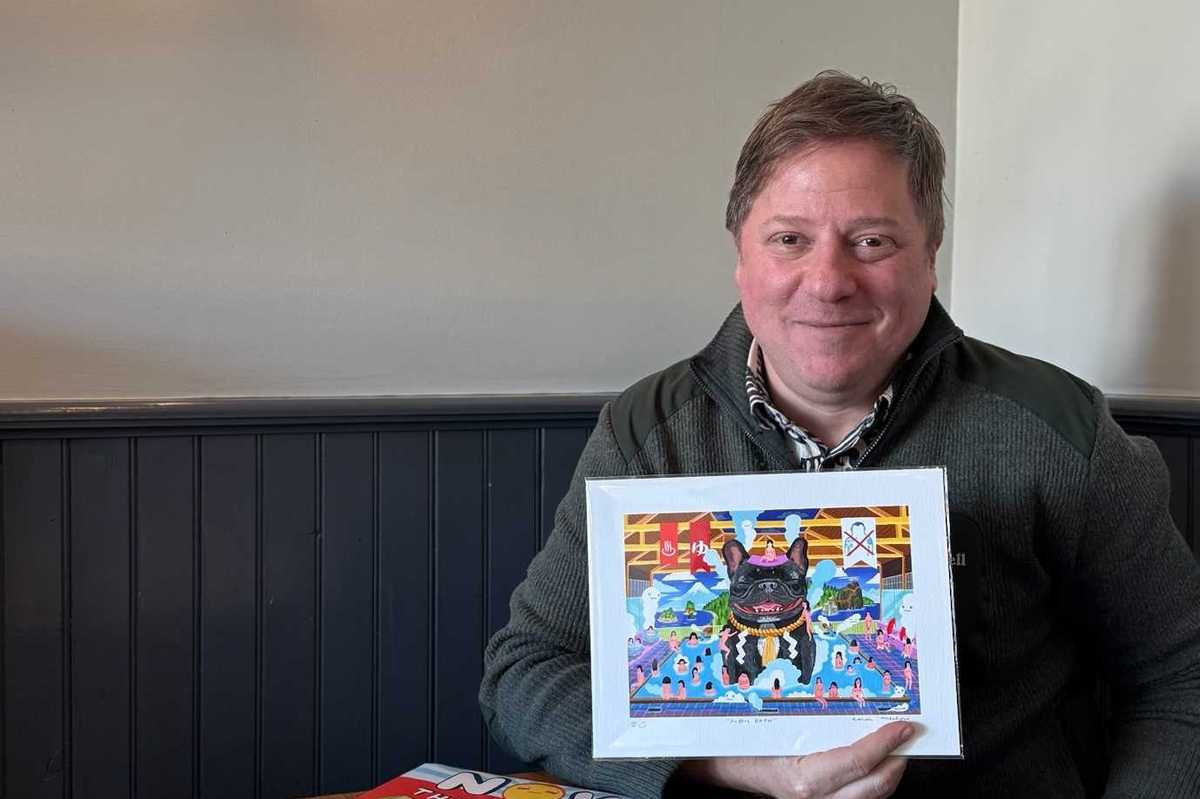
Japan itself became central to his life and work. His first visit left a lasting impression. “I felt an intense sense of safety and tranquility,” he said. Another award-winning illustration, “The Public Bath,” was inspired by meeting his wife’s father for the first time — an introduction that ended up at a Japanese public bath. “Can you imagine?” Meshon laughed. “I just met my wife’s father, and the next thing I know, I’m naked with him.”
In 2012, Meshon received a gold medal from the Society of Illustrators for “The Public Bath.” He also earned an Ezra Jack Keats New Illustrator Honor for “Take Me Out to the Yakyu.” In addition, that book received multiple starred reviews, including from The New York Times Book Review, School Library Journal and Publishers Weekly.
Even before some of those accolades, Meshon said his illustration work had begun to slow.
By 2009, city life grew increasingly expensive, particularly after the birth of his son. “For the first time, I had to work just for money,” he said.
Over the following years, the stress mounted and his health suffered. Then one morning he woke up with a clear realization: “We can’t continue living like this. Something has to change.” Then, within a few days, everything did change.
While Meshon was at work, a friend called with shocking news: His Brooklyn apartment building was on fire — so big it could be seen from Manhattan. His first thought was not about his belongings but his dog, Chubu. Firefighters could only access two apartments, and luckily, one of them was his.
They lost nearly everything. “I had to grow up at 45 and realize I have truly only myself to rely on,” Meshon said. Shortly after that, the pandemic arrived. As New York City shut down, they packed their dog, son, piano and fish tank into the car and drove north. “It felt like the world was shutting down,” he said. “My wife and I looked at each other and knew that this was it, and we were never going back.”
Today, Meshon sells his artwork at the Railroad Street Collective in Great Barrington and at the local farmers market. He also teaches art at the School of Visual Arts in New York City. His Berkshire-inspired illustrations resonated immediately with the community. “It’s like being back in art school,” he said, describing the camaraderie of local artists supporting one another.
He credits nature and community with helping him heal. “Things happen, and sometimes you have no control,” he said. “You learn to accept that life is short and to be thankful for what you have.”
Elena Spellman is a recent Northwest Corner transplant. She is a Russian native and grew up in the Midwest. In addition to writing, she teaches ESL and Russian.
Keep ReadingShow less
loading