Latest News
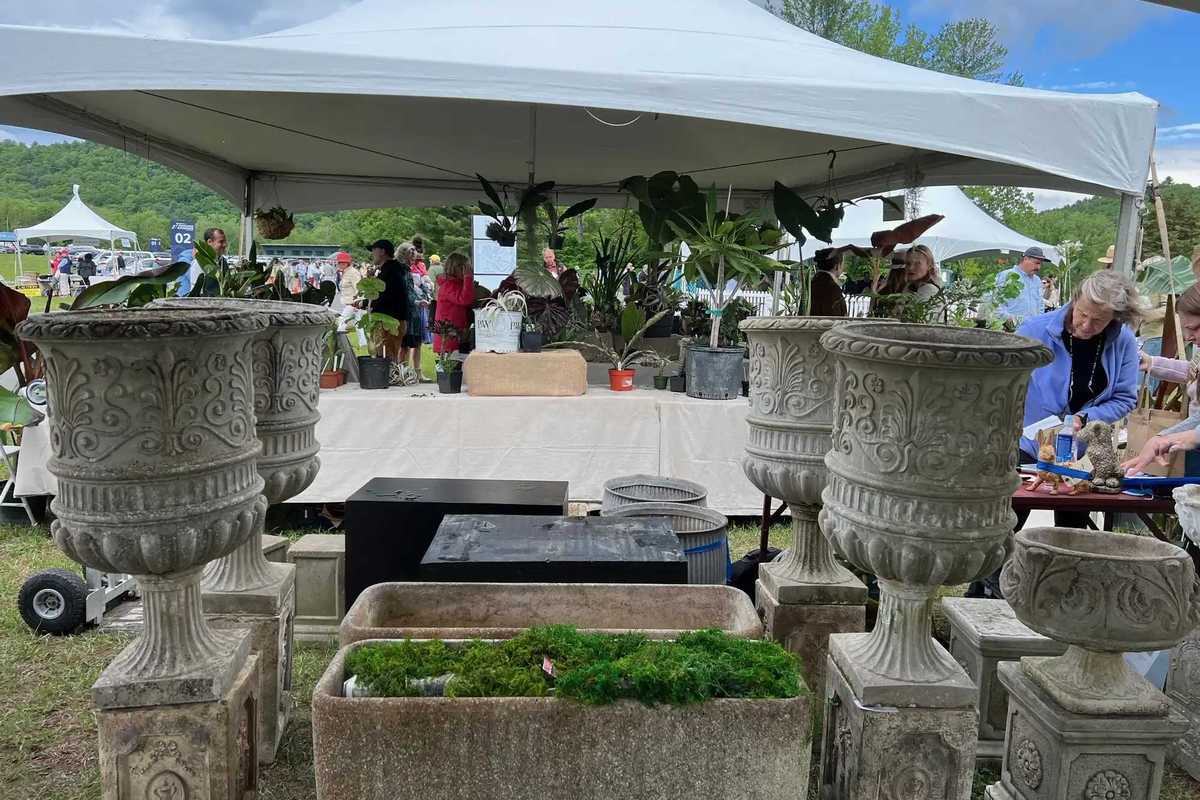
Heavy stone garden ornaments, a specialty of Judy Milne Antiques from Kingston, at Trade Secrets 2025.
Christine Bates
Van Ginhoven points to towers of boxes containing event programs, various ribbons, elegant decor and stacks of magazines, all in preparation for the event.
Project SAGE will celebrate its 26th year hosting Trade Secrets, but it’s so much more than a garden event.
“It’s a fundraiser for domestic violence prevention and intervention,” van Ginhoven said. “Anybody who attends knows they’re supporting a really meaningful and important cause.”
The fundraiser accounts for at least 30 percent of the organization’s overall budget, she said, and attracts around 3,000 people from across the region each year, creating an unmatched opportunity for Project SAGE to share its mission and generate support.
The event, though expensive to produce, generates enough income to significantly support Project SAGE’s direct services and prevention services.
Officials said a wave of new underwriters have emerged this year.
“We’re very grateful, because we live in a time when funding is uncertain,” van Ginhoven said.
Hundreds of copies of the annual Trade Secrets guide sat at Project SAGE headquarters, ready for distribution at the event. The book doubles as a domestic violence resource, complete with warning signs, myth-busting information and scripts for difficult conversations.
Volunteers will be present throughout the event to connect with community members. Each volunteer must be certified as a domestic violence counselor in order to work with Project SAGE.
“It means they can help us drive clients, move clients, take them to appointments or the grocery store,” van Ginhoven said.
Project SAGE officials said education about domestic violence should start early. The organization has developed a comprehensive curriculum spanning early childhood through grade 12 and visits schools throughout the region. The class of 2026 will be the first graduating class at Housatonic Valley Regional High School to have received all four years of training from Project SAGE.
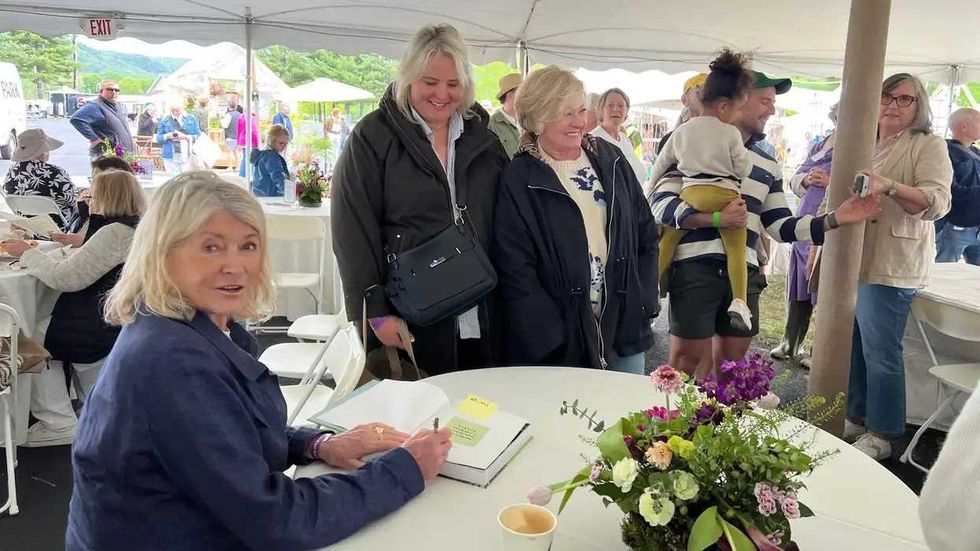 Martha Stewart signing her new book at Trade Secrets 2025.Christine Bates
The organization’s partnerships extend throughout the region and include on-site training in schools and nonprofit organizations, including the Sharon Playhouse. Community support also goes directly to Project SAGE, including a recently donated array of colorful gift bags bearing positing affirmations and filled with toiletries and basic necessities from students at the Frederick Gunn School in Washington, Connecticut.
The people who visit Project SAGE have often left uncomfortable or dangerous situations and leave without any belongings.
“Some of them have nothing,” van Ginhoven said. “They just show up because they had the courage to leave.”
Project SAGE staff say many referrals come through local hospitals, police and sister agencies.
The organization serves people in Connecticut, Massachusetts and New York.
With the stress of event planning mounting, van Ginhoven spent a “previous life” preparing for this exact moment. She spent 30 working at the intersection of arts and activism, having co-founded WAM Theatre, a Lenox-based organization focused on stories and issues affecting those who self-identify as women and girls. During her tenure, WAM donated $100,000 to 25 local and global organizations working toward gender equity in areas such as girls’ education, teen pregnancy prevention, gender-based violence, sexual trafficking awareness and midwife training.
“I love the adrenaline of putting on a show,” van Ginhoven said with a laugh. With the help of volunteers and organizers, she said she isn’t bothered by the stress.
“The show will go on,” she said.

Want more of our stories on Google? Click here to make us a Preferred Source.

Caroline Kinsolving and Gary Capozzielo at home in Salisbury with their dogs, Petruchio and Beatrice
Provided
“We met during the pandemic, a bleak time,” Kinsolving said. “On our first date, we met at The Hickory Stick Bookshop and walked outside six feet apart. We fell in love.”
They lived in a tiny studio near Averill Farm in Washington, Connecticut.
“He played his violin, I worked on my lines, we walked the dog, and suddenly we were circling each other perfectly,” Capozziello said with a laugh. “When I told her I was a violinist, she mentioned ‘Appalachian Spring’ by Aaron Copland. I sent her a recording of me playing it, and it became our song.”
“For our wedding, we wanted all our friends and family out in the field listening to that music,” Kinsolving said. Capozziello’s friends from Orchestra New England performed the piece at their wedding.
“Circus Fire,” written by Connecticut’s own Jacques Lamarre and directed by Jared Mezzocchi, is a multimedia world-premiere tribute to the Hartford Circus Fire. On July 6, 1944, the big top of the Ringling Bros. and Barnum & Bailey Circus caught fire, killing 167 and injuring 700 in Connecticut’s worst fire disaster.
Capozziello, who grew up in Fairfield, began: “I came from very limited means, though my parents gave me the kind of support that mattered most. I had a hard time in school. My music teachers, noticing my knack for music, kept me in school.” As he became a teenager, he realized how demanding classical violin truly is. “I had the honor of playing in a master class for Isaac Stern when I was 18,” he said. “That was the wake-up call. He was relentless with my intonation, telling me I must ‘feel the fire in my belly.’”
At SUNY Purchase, he “met a wonderful violin teacher who taught me to play, study and practice five hours a day.” After studying at the New England Conservatory, Capozziello earned his doctorate from The Hartt School in 2018. He now teaches at The Hotchkiss School and performs with the Hartford Symphony.
He explained that his role as assistant concertmaster is the direct line between conductor and musicians, and that the orchestra is “a family dynamic, a democratic unit, truly a living, breathing organism.”
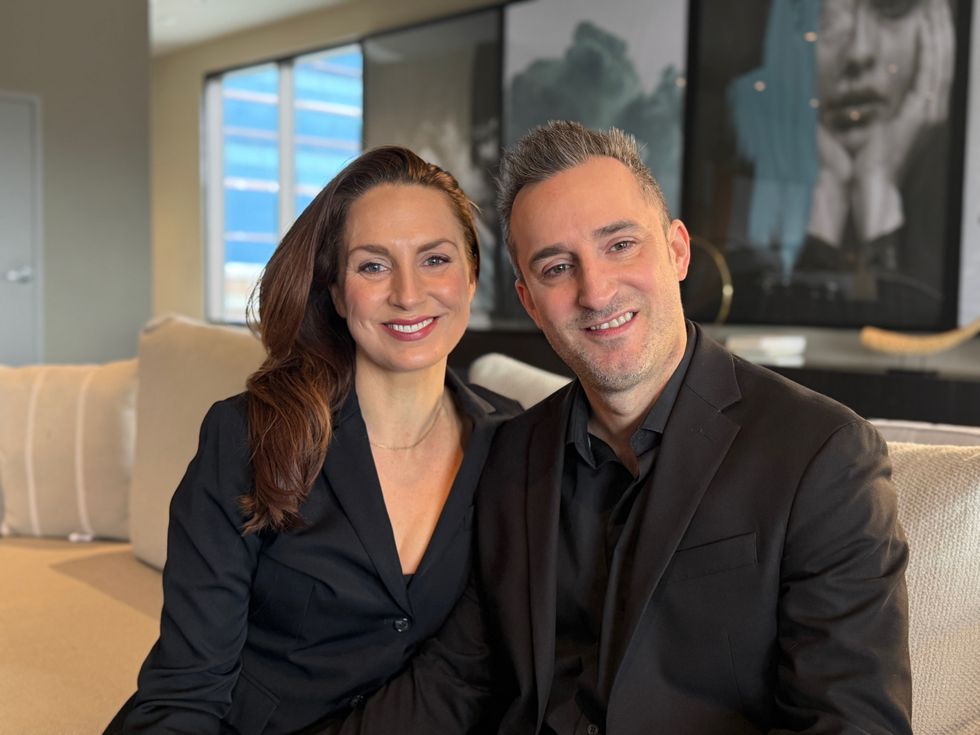 Caroline Kinsolving and Gary Capozzielo Jennifer Almquist
On May 2, Capozziello was soloist with Orchestra New England, performing the world premiere of Neely Bruce’s “Concerto for Violin,” along with “The River” by Jan Swafford and Aaron Copland’s “Appalachian Spring” at Battell Chapel at Yale.
“I care about bringing classical music into communities and spaces where people may not expect it,” said Capozziello.“Music is most powerful to me when it feels alive, humanand accessible, not distant or formal.”
For 20 years, Kinsolving has acted in film, television and theater in London, New York and Los Angeles. “I was first onstage at Washington Montessori School playing Peter Pan,” she said. “I improvised a line, got a laugh and liked the feeling.”
She enjoys performing Shakespeare. “I love Titania’s monologue because it speaks to our current climate crisis. Lady Macbeth surprised me. I fell in love with her while I was doing it. I could play those scenes forever; so much range and depth to explore,” she said.
Kinsolving added, “I love Shakespeare’s comedies for the fun and rhythm. I have loved Rosalind, Viola, Olivia, Helena and Kate, yet the top of my bucket list is Beatrice. Each character reflects a shade of my soul. Shakespeare had the brilliance to illuminate them. If I ever get a tattoo, it will be a list of their names.”
Kinsolving, whose parents, poet Susan Kinsolving and author William Kinsolving, live in Lakeville, studied at Milton Academy, universities in China, and Vassar College. Her theater training includes Stella Adler Studio of Acting, Royal Academy of Dramatic Art in London, Yale Drama Intensive and she is currently studying online through Juilliard.. She founded Theatre for Good, which donates its proceeds to charity.
Both artists are looking forward to June, when they will have more time to spend with their dogs.


Want more of our stories on Google? Click here to make us a Preferred Source.