Thank you!
Your support is sustaining the future of local news in our communities.

Wine fit for royalty: Northwest Connecticut wine served to King Charles III and Queen Camilla at White House

Wine fit for royalty: Northwest Connecticut wine served to King Charles III and Queen Camilla at White House

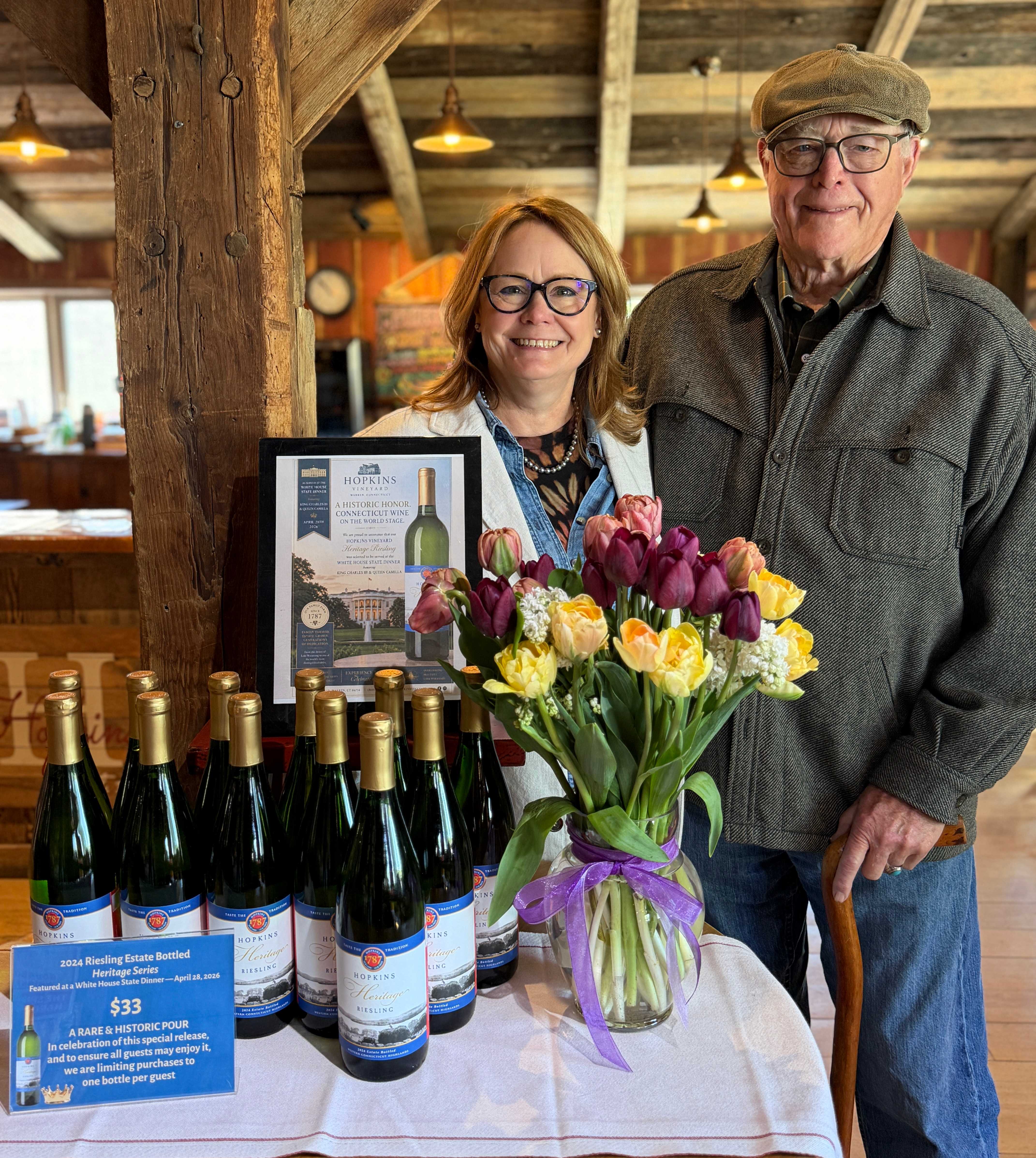
Hilary Hopkins Criollo, co-owner of Hopkins Vineyard (left) and her father Billy Hopkins, its founder, with their 2024 “Heritage” Riesling wine that was served at the White House April 28.

Jennifer Almquist

WARREN — More than 400 years after their ancestors arrived in America aboard the Mayflower, the Hopkins family is still making history – this time in a glass of wine.

Wine produced by Hopkins Vineyard in Warren, Conn., was served at a White House state dinner for King Charles III and Queen Camilla on April 28, 2026.

Hilary Hopkins Criollo, president and co-owner of the vineyard with her husband Jorge Criollo, said the recognition came unexpectedly.

She received a call just two weeks earlier from a White House chef requesting several wines for a tasting. Soon after, an order followed for 48 bottles of the vineyard’s 2024 “Heritage” Riesling.

Hilary said the chef requested expedited shipping for the $33 bottles, still not knowing what they were to be used for.

“We saw on social media that our wine was served at the state dinner,” Hilary said of the visit from King Charles III and Queen Camilla. “I was so surprised that I asked people to pinch me.”

The moment marks a milestone generations in the making.

Stephen and Elizabeth Hopkins left England on the Mayflower seeking religious freedom. During the voyage, Elizabeth gave birth to their son Oceanus Hopkins. More than a century later, after serving in the American Revolution, Elijah Hopkins purchased farmland in Warren, Conn. – land that would eventually become the vineyard.

In 1956, Bill Hopkins took over his family dairy farm. In 1979, anticipating the decline of small dairy operations, he and his wife, Judy, sold their herd, applied for Connecticut’s first winery permits, and began producing wine. By 1988, the farm was recognized as a Bicentennial Farm, having remained in the same family since the signing of the U.S. Constitution. In 2017, Hilary and Jorge purchased the 30-acre vineyard from her parents.
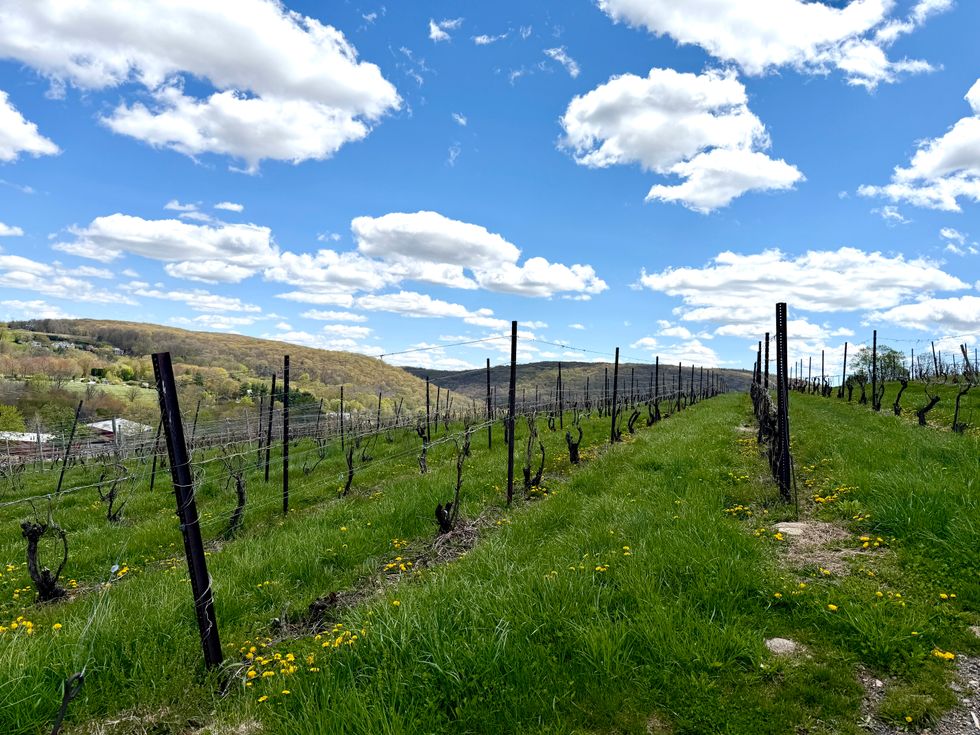
Grape vines at Hopkins Vineyard overlooking Lake Waramaug in Warren, ConnecticutJennifer Almquist

The “Heritage” Riesling label reflects that legacy, featuring an image of Hilary’s grandfather forking hay into a horse-drawn wagon overlooking the lake.

Bill Hopkins recalled the moment with pride.

“My wife and I are the founders of Hopkins Vineyard,” he said. “I had a midlife crisis and decided to start a vineyard. I am proud of everyone involved. It’s quite an honor to have the king drink our wine.”

Jorge Criollo said the news was difficult to believe.

“When I woke up at 4 a.m., we were on the news,” he said. “I spent the whole day not believing it. It’s like a miracle. They could pick wine from anywhere in the world.”

In a statement, the White House said the wine list, which included Hopkins Vineyard’s 2024 Riesling “Heritage,” was curated to “complement the menu while honoring the shared heritage and enduring friendship between the United States and the United Kingdom, and to celebrate the strength of American winemaking today.”

Winemaker and vineyard manager Jim Baker said producing wine in the Northeast requires patience.

He said Riesling is hardy and withstands the winter. “It takes three to four years for a plant to produce fruit and get a good crop,” he said. “It’s a learning curve with any new variety. Because of the rain and cold in the east, the trick is growing it.”

Baker, who has worked at the vineyard for 34 years, said the landscape keeps him rooted as he walks along the row of vines where the King’s Riesling grapes grow.

Bill Hopkins’ granddaughter, Paloma Criollo,a filmmaker, reflected on that connection in a video featured on the vineyard’s website.

“I’ve realized that without this land, without our farm, we lose our identity and connection to this land. This is our home, and this is my family’s legacy.”
Latest News

Voices from our Salisbury community about the housing we need for a healthy, economically vibrant future

Renee Wilcox

If you’ve ever wandered through Paley’s Farm Market, you probably know Renee Wilcox. For thirty years, she has been greeting you with unmistakable warmth—always ready with a smile. Renee grew up in Millerton, but it was in Salisbury that her family found something they’d never had before: a true sense of home. In 2003, she and her husband Bill were living in Millerton, but Bill—a volunteer with the Lakeville Hose Company—was already part of Salisbury life. When the Salisbury Housing Trust finished eight new homes on East Main Street (Dunham Drive), Renee and Bill were the first to sign on.

The story of those houses is really a story about the best parts of our community. Richard Dunham and his wife, Inge, along with the Housing Trust board, poured years of energy and hope into the project. Renee can’t help but light up when she talks about the people who helped her family settle in. Digby Brown came by to install appliances and bathroom cabinets; Barbara Niles spent hours painting; Carl Williams assembled bunk beds for the kids. Rick Cantele, at Salisbury Bank, helped them with their finances so they could qualify for a mortgage, while neighbors arrived at their door with fruit baskets and welcoming words.

Keep ReadingShow less
Trade Secrets: a glamorous garden event with a deeper mission

Heavy stone garden ornaments, a specialty of Judy Milne Antiques from Kingston, at Trade Secrets 2025.

Christine Bates

Tucked away on Porter Street in downtown Lakeville, Project SAGE is an unassuming building from a street view. But cross the threshold a week before Trade Secrets — one of the region’s biggest gardening events, long associated with Martha Stewart and glamorous plants of all varieties — and you’ll find a bustling world of employees and volunteers getting ready for the organization’s most important event of the year.

“It’s not usually like this,’ laughed Project SAGE director Kristen van Ginhoven. “But with Trade Secrets just around the corner, it’s definitely like this.”

Keep ReadingShow less
Two artists, two Hartford stages, one shared life

Caroline Kinsolving and Gary Capozzielo at home in Salisbury with their dogs, Petruchio and Beatrice

Provided
"He played his violin, I worked on my lines, we walked the dog, and suddenly we were circling each other perfectly."
Caroline Kinsolving

Actor Caroline Kinsolving and violinist Gary Capozziello enjoy their quiet life with their two dogs in Salisbury, yet are often pulled apart to perform on distant stages in far-flung cities. Currently, the planets have aligned, and both are working in Hartford, across Bushnell Park from one another. Bridgewater native Kinsolving is starring in “Circus Fire,” the current production of TheaterWorks Hartford, while Capozziello is a violinist and assistant concertmaster of the Hartford Symphony Orchestra. While Kinsolving hates being away from home, she feels the distance nourishes their relationship.

“We are guardians of each other’s confidence and self-esteem,” she said.

Keep ReadingShow less
google preferred source

Want more of our stories on Google? Click here to make us a Preferred Source.

Local filmmaker turns spotlight back on Hollywood’s Mermaid

Esther Williams in “Million Dollar Mermaid” (1952).

Provided

For decades, Esther Williams was one of Hollywood’s brightest stars, but the swimming sensation of the silver screen has largely faded from public memory — a disappearance that intrigued Millerton filmmaker Brian Gersten and inspired him to revisit her legacy.

As a millennial, Gersten grew up largely unaware of Williams’ influential career. His teen years in Chicago were spent with friends who obsessed over movies, spending hours at their local independent video store,and watching anything that caught their eye. Somehow, though, they never ventured into the glossy world of synchronized-swimming musicals of the 1940s and ‘50s.

Keep ReadingShow less
Summer exhibition opens at Wassaic Project

Nate King, “When I Was Younger And Now That I’m Older,” 2026, Digital projection, digital animation, photography.

photo courtesy Nate King

The Wassaic Project, the 8,000-square-foot, seven-story former grain elevator transformed into a vibrant arts space, opens its 2026 Summer Exhibition, “Because, now is the time of monsters,” on Saturday, May 16, from 3-6 p.m. at Maxon Mills, launching a season-long presentation featuring 39 artists working across installation, performance, video and sculpture.

The opening celebration will include an afternoon of exhibitions and live programming throughout the historic mill building and its surrounding spaces. Gallery and Art Nest hours run from 12-6 p.m., with special presentations scheduled throughout the day.

Keep ReadingShow less
Hotchkiss to host inaugural International Piano Competition
Murong Yang ’08, a founding supporter of the Hotchkiss International Music Competition, helped establish the program through the Yang and Hamabata families to support young musicians and artistic excellence.
Provided

The Hotchkiss School will launch a major new addition to its arts programming with the inaugural Hotchkiss International Piano Competition, a three-day event taking place May 15–17 in Katherine M. Elfers Hall.

The competition will bring together young pianists ages 10 to 18 from around the world, with participants representing the United States, Thailand, Korea, China, Canada, and Azerbaijan. Performers will compete across multiple age divisions, culminating in final rounds that will be open to the public, offering audiences the opportunity to hear a wide range of emerging international talent in performance.

Keep ReadingShow less
google preferred source

Want more of our stories on Google? Click here to make us a Preferred Source.

google preferred source

Want more of our stories on Google? Click here to make us a Preferred Source.