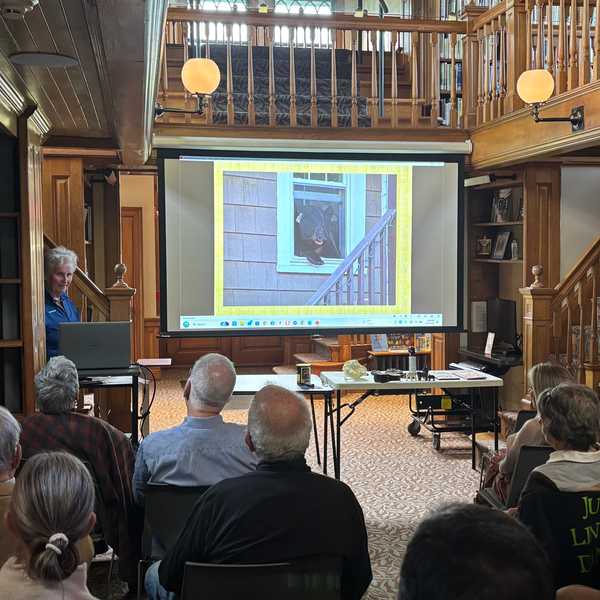
Suzan Scott on wonder and seeing

Suzan Scott discusses color, words, wonder and seeing at the Hunt Library on March 12.
L. Tomaino

Suzan Scott discusses color, words, wonder and seeing at the Hunt Library on March 12.
FALLS VILLAGE — Painter Suzan Scott’s comparison of words to colors explained the visual language she has developed over many years. “I love the thesaurus.” When she chooses a color, it is like finding a word in the thesaurus. And to her “words have color, and tone, and weight. Finding the right word, is like finding the right color.”
Attendees at her talk looked with interest through a notebook she passed around, a kind of catalog of color, two or three rectangles on each page which she painted in solid, subtle tones using gouache. This was one of her books of visual syntax, demonstrating how sets of colors come together into an image the way words do in a sentence. “My language is line and color and shape. They are my voice made visible.”
How has she built her visual language? She remembers her delight when, as a child she finally was given“ a pad, a book of blank paper!” “All of this is very personal to me.” “I paint wonder. It’s really a landscape, but I paint wonder.”
“There is so much more here than what we can see, if I can step back, maybe not try to name things but just experience them.”
She will often start a canvas in orange, her color for the earth under the grass. Her process becomes a meditation “about layers under the hill, layers of time, life lived there”, by “digging holes into hills with color.” And about clouds, trees, the seasons, weather, and the night sky. She has created a series of paintings on each. When she arranged in sequence 365 paintings she had done one year, she saw the sweep of color of the sky and earth over time.
She spoke of the artist Sol Lewitt with whom she had contact while organizing slides as Assistant to the Curator of the LeWitt Collection in Chester, Connecticut. She described him as a gentle, approachable man whose work with sequences, minimalism, and conceptual art deepened her realization of what can be represented in her work, “simplifying to get the essence of a thing.”
“Wonders are there — we just have to look. Each one of us has a specific view. Individual vision is a gift.”
Her show at Hunt Library, in Falls Village, This Beautiful Place, ended on March 13. Her website is www.suzanscott.com. Hunt Library: www.huntlibrary.org

Riley Klein
The winners of the 3-on-3 championship game were, from left, Georgie Clayton, Anthony Foley and Peyton Bushnell.
FALLS VILLAGE — A miniature version of March Madness was held at Housatonic Valley Regional High School Tuesday, March 10.
Seven teams entered the double-elimination basketball tournament to benefit the Class of 2027. The teams of three were co-ed and had to include at least one non-varsity player.
Each squad was given a name of a prominent college basketball program. The team names were UConn, Florida, UNLV, ‘Bama, UCLA, Duke and Syracuse.
Teacher Deron Bayer got things started. “Ready, set, basketball!”
The teams were afforded two losses before being eliminated. The half-court games required rebounds to be taken behind the arc before beginning a new offensive possession.
UNLV, including Anthony Labbadia, Olivia Brooks and Jaxon Visockis, entered the championship game undefeated. The trio knocked out UCLA, including Anthony Foley, Peyton Bushnell and Madeline Mechare, in the semifinal.
UCLA battled back through the losers bracket for a rematch against UNLV in the final.
Mechare had to leave early, so UCLA subbed in Georgie Clayton. The team proceeded to beat UNLV twice in a row and claim the title.
The event raised more than $100 for the junior class.
Riley Klein
LAKEVILLE — The Hotchkiss School’s boys varsity basketball team claimed the 2026 New England Prep School Athletic Conference Class A title last week.
The Bearcats defeated Phillips Academy Andover 66-54 in the championship game Sunday, March 8. The tournament final was played in Worcester, Massachusetts.
Hotchkiss entered the playoffs as the 5th seed in Class A. The boys defeated Milton Academy 57-54 in the first round Wednesday, March 4, and went on to defeat Phillips Exeter Academy 69-52 in the semifinals Saturday, March 7.
The last time Hotchkiss won the boys Class A tournament was in 2022.
Alec Linden
KENT — Municipal operating costs were anticipated to increase by nearly 6% after the Board of Selectmen’s first presentation of its budget to the Board of Finance.
The BOS presented its budget draft, which is subject to change as budget season progresses towards the town hearing and vote in May, to the BOF at its regular meeting on March 11. The bottom line total for the next fiscal year was $5,309,163, marking a 5.7% increase from the amount budgeted for this year.
The two town boards discussed the expenditure draft, noting where the most marked increases lay.
As in other towns in the Northwest Corner, insurance costs for hiked, increasing for Town Hall employees under a state plan by close to 13% per person. Treasurer Barbara Herbst noted that the state had announced that premiums would not be hiked as much as anticipated, so that number could end up lower.
The Selectmen’s own budget line is marked at a 22% increase from 2025-2026. First Selectman Eric Epstein explained that the difference is largely due to a proposed new social media specialist position for Town Hall. The new part-time role, if filled, would add $23,400 to the BOS’s expenditures.
Much of the meeting was dedicated to discussing Lake Waramaug, primarily due to a plan to combat the invasive waterweed hydrilla that was recently formulated between the lake’s three governing towns of Washington, Warren and Kent.
Kent is currently set to contribute 20% of the total staffing costs of $100,000 for a new decontamination station at the New Preston firehouse.
BOF member Jason Wright voiced his support for acting quickly against the aggressive plant, but advised that the various commissions and municipal groups in charge of the lake should figure out how to diffuse the costs away from Kent taxpayers, most of whom aren’t putting boats into Lake Waramaug.
During public comment at the meeting’s end, resident Donna Hayes felt that Kent residents were being treated unfairly by being forced to contribute such a sum to a lake many aren’t even able to use due to access restrictions and costs. She voiced her desire to “get something for our money” in future deliberations surrounding expenses for the lake.
The next stage in Kent’s budget proceedings will occur on March 25, when the Board of Education presents its drafted contribution to the yearly municipal budget

Want more of our stories on Google? Click here to make us a Preferred Source.
Riley Klein
NORTH CANAAN — Mountainside Treatment Center has applied to the Planning and Zoning Commission for approval to add a yoga room to its activities center.
Dean Smith of Mountainside presented the proposal at the commission’s regular meeting in Town Hall on Monday, March 9.
The planned addition would measure 24 by 40 feet and would be set back 231 feet from the road, Smith said. He added that the structure would not be located in wetlands. Mountainside is located on Route 7.
Zoning Enforcement Officer George Martin said the proposal has already been reviewed by Torrington Area Health and the fire marshal.
Since Mountainside operates under a special permit, an amendment to that permit is required before construction can proceed. The commission scheduled a public hearing on the application for Monday, April 13, at 7 p.m. in Town Hall.
Patrick L. Sullivan
SALISBURY — The Board of Finance received preliminary budget proposals for 2026-27 from the Board of Selectmen, Salisbury Central School and Region One during an online meeting Thursday, March 12.
The current draft budget for town spending totals $9,618,325, an increase of $413,223, or 4.4%. First Selectman Curtis Rand said there will be a third draft and possibly a fourth before the finance board’s next meeting Thursday, March 26.
Rand said salaries for unionized employees at Town Hall and the town garage are up 4%. Some employees are getting additional pay for extra work, such as reviewing the town’s ordinances, many of which are outdated, and providing additional tech support.
Rand added that the lines for the registrar’s office are up in anticipation of primary elections this year, as well as the cost of early voting.
The legal line is up “because we never know where that ends up,” Rand said.
Health insurance for town employees is down $195,200 (18%) because the town switched to a state insurance plan.
Salisbury Central School (SCS) Principal Stephanie Magyar presented the town’s education budget proposal.
The spending plan calls for a total of $7,236,676, an increase of $339,528, or 4.92%.
Magyar said 81% of the increase is from existing contracts with teachers and staff. She said there are “no new things” in the spending plan.
Region One Business Manager Sam Herrick also presented the current Region One budget proposal. He said the plan is very much a work in progress, with the regional school board’s budget committee scheduled to meet two more times before the public hearing Thursday, April 9.
The current Region One budget draft is up 6.2%, or $1,146,478, for a total of $19,631,686. Herrick said this is the biggest increase he has seen in his 26 years at Region One.
The Region One budget has three components: Housatonic Valley Regional High School (HVRHS), Pupil Services (which includes special education), and the Regional Schools Services Center (aka the Central Office).
The six Region One towns pay a percentage of the total based on how many students they send to HVRHS, except for the superintendent’s salary, which is shared equally by the towns.
Herrick said the biggest increase is in Pupil Services. Specifically, out of district placements for qualifying students and the transportation costs associated with them are up significantly. The Pupil Services line is currently at $8,205,920, an increase of $683,364, or 9.08%.
Herrick’s numbers show Salisbury’s share of Region One at $4,825,659, an increase of $44,566, or 1.07%. The SCS budget draft has that figure slightly lower, at $4,813,638 (plus $32,545, or 0.68%).
The Board of Finance will meet again Thursday, March 26 to receive final budget proposals and vote on sending them to a public hearing.
Alec Linden
KENT — The Kent Planning and Zoning Commission resolved two long-pending applications at its regular meeting Thursday, March 12 — approving a scaled-back request from High Watch Recovery Center to amend its special permit and granting approval for a housing conversion on Lane Street.
After months of deliberations and heated public hearings, the commission approved just two changes to High Watch Recovery Center’s 2019 special permit, far fewer than the seven modifications the treatment facility initially requested.
P&Z Chair Karen Casey said Thursday evening that High Watch emailed the town in late February withdrawing two proposed changes — the controversial installation of a new lecture hall and a condition that would have allowed the facility to accept patients after hours.
Other previously withdrawn elements of the original application included an expansion of two beds in the detox center, a proposal to allow the facility to admit patients who are in custody or court-mandated to treatment, and a request to remove a condition limiting use of the facility’s PA system.
Two changes were ultimately approved unanimously by the commission.
First, the commission added a note acknowledging that while the facility is expected to notify authorities if a patient leaves unexpectedly, federal privacy laws may prevent it from doing so in some cases.
Second, the commission removed a requirement that the center sign a contract with a private emergency response company for situations that do not require a 911 call.
The Kent Volunteer Fire Department has said it does not expect the facility to place an undue burden on its ambulance service. The commission also reserved the right to reimpose the private emergency response requirement in the future if needed.
“Those are the two things,” Casey said after outlining what remained of the application. “Very simple, very straightforward — no big deal, in my opinion.”
High Watch, a substance use disorder treatment facility on Carter Road, approached the commission last fall seeking to modify several conditions attached to its special permit. CEO Andrew Roberts argued the requirements were unnecessary, cumbersome or in some cases conflicted with the law.
The proposal drew pushback from neighbors. A small group of residents spoke out at public hearings, on the town’s Facebook page and in circulated fliers, arguing the changes would represent an expansion of an already disruptive institution.
Throughout the hearing process, Roberts said he believed the organization had been misrepresented by members of the public. In a February letter, he claimed that High Watch had been treated unfairly by the commission.
Lane Street housing conversion approved
A decades-old zoning issue that had prevented John and Diane Degnan from converting an old industrial building on their property into their primary residence was also resolved at the March 12 Planning and Zoning Commission meeting.
An application initially presented to the commission late last year was simplified through the joint efforts of Jay Klein, attorney for the Degnans, and Michael Ziska, the commission’s attorney. The two identified a zoning regulation that allows one nonconforming use of a property to be changed to another nonconforming use, as long as the change is not detrimental to the neighborhood.
“The regulation is tailor made for this situation,” Klein said Thursday evening. “We think this is a move in the right direction — it’s something that is endorsed by the community.”
During several rounds of public hearings on the proposal, neighbors voiced strong support for the Degnans’ plan, saying they preferred to see the building used as a residence rather than return to commercial use.
Over the years, the structure has housed an auto body shop, an aquarium store and a sign production facility, among other businesses.
The commission voted unanimously to approve the Degnans’ proposal.

Want more of our stories on Google? Click here to make us a Preferred Source.

Want more of our stories on Google? Click here to make us a Preferred Source.