Income tax in America was first tried during the Revolutionary period and then again after the Civil War broke out — well, they had to pay the troops somehow. That taxation did not last long and was quickly repealed.
Congress was mostly an exclusive club for wealthy landowners, and you don’t have to wonder why Congress gentlemen of the time repealed income tax so quickly.
It was not until 1894 that Congress created the first peacetime income tax. The rate was 2 percent on incomes over $4,000 per year, which meant fewer than 10 percent of households would pay any. In short, the tax only applied to the very wealthy as $4,000. Back then that was the equivalent to over a million-dollar salary now.
If Congress enacted a similar tax now to pay for the war — an additional flat (no deduction) 2 percent for the wealthiest Americans — the national debt would go down by half within 10 years.
Think that is too little? Consider this: The deal Washington is brokering with the most divided and contentious committee ever formed will cut the deficit by less than a quarter of that. I’ll bet if you asked the wealthiest Americans if they were willing to right this ship for a measly 2 percent of their annual income, they would agree. In fact, several already have like Warren Buffett and Bill Gates Sr.
One of the problems we all have dealing with income tax is that we do not remember some of the arguments made to permanently introduce it in the first place. So let’s cast our minds back to the pre-1894 days when revenue and spendable government funds were raised in two ways: import tariffs and loans from the wealthy.
Import tariffs were charged (levied) on every item being imported into the United States. That meant that the importer had to pay the government excise officer a tax on the value of the goods when imported. And it could be months and months before he got any return on his investment buying the goods and paying for shipping and excise tax. Import duty easily doubles the real cost of imported goods.
And it was not just a tax for goods imported into the United States because state-by-state import taxes, tariffs, were also levied. So a $1 item made in New York could cost someone in Kentucky $3 by the time you added in taxes, transportation and bank financing.
So Congress, in an effort to change the revenue stream, to help reduce the cost of goods for the average citizen, started to reduce import tariffs, drop inter-state excise duty and, instead, argued that a small income tax would be more democratic.
The wealthiest Americans opposed the notion of income tax (after all they were the sellers of these imported goods at a larger profit) and proclaimed income taxes were immoral and unconstitutional (which it technically is). The Supreme Court got around that by declaring income tax as a different sort of excise tax (which it is still called today).
But the real reason the wealthiest Americans opposed income tax was that it took away their leverage over the government. If you think lobbyists are pernicious today, imagine what George Washington all the way to Grover Cleveland had to deal with when 95 percent of all revenue for the government was by patronage or import duties controlled by the wealthy.
Originally, the Continental Congress learned a financing trick from the British lords who started the Bank of England. No, not a public institution, but the wealthiest citizens who created a bank to loan the government money at high interest rates and, in so doing, also controlled the currency. In short, they ruled the country.
It took Britain 250 years to wrest control away from these patrons and run the Bank of England themselves as a democratic government should.
In America, when discussions started over income tax in the late 1800s, some in Congress were really trying to re-democratize the country, by giving the financial power over to everyone, not just the wealthy who financed wars, roads and the civil service employees. By taxing everyone fairly, there could be no bully voice in Congress.
Well, it worked for a while, until the corporations exercised their might at election time. This last election, 78 percent of all funds raised and spent by Obama to get elected were smaller, private donations. When Bush was elected, 85 percent of funds were from corporate or wealthy donors.
And those divisions are in place for another round of bombast from both sides next year. But be careful: Even if you feel apathetic, this next election will be about avoiding the person you do not want in the White House.
Meantime, the public has forgotten the importance of income tax — there is no government boss, you are the boss, you write the check, you pay the salaries.
Our country started off the wrong way, allowing government to be controlled and run under the influence of a minority. To be fair, those early benefactors were, on the whole, interested in the benefit for all Americans. But over the years, such power corrupted until their financial power base had to be removed (income tax). For now the power is with you, if you will exercise it.
Peter Riva, formerly of Amenia Union, lives in New Mexico.

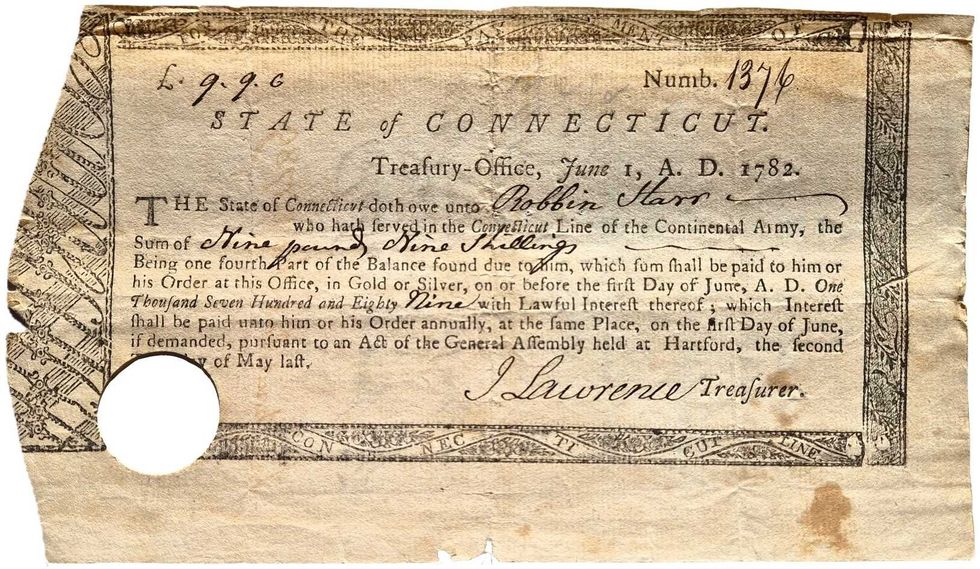 Pay Bill for Robin Starr’s service in the Continental Army.Courtesy the Alex Breanne Corporation
 John Mills speaking at Quinnipiac University.Courtesy the Alex Breanne Corporation
 Stephanie Saetta,with her rescue dog George and Blue (left), a shepherd mix awaiting his forever home.Madi Long
 Blue, a 7 year-old Shepard mix, is waiting for his forever home. Madi Long