Amesville cyclist reflects on 2,700-mile ride from Canada to Mexico

Amesville cyclist reflects on 2,700-mile ride from Canada to Mexico

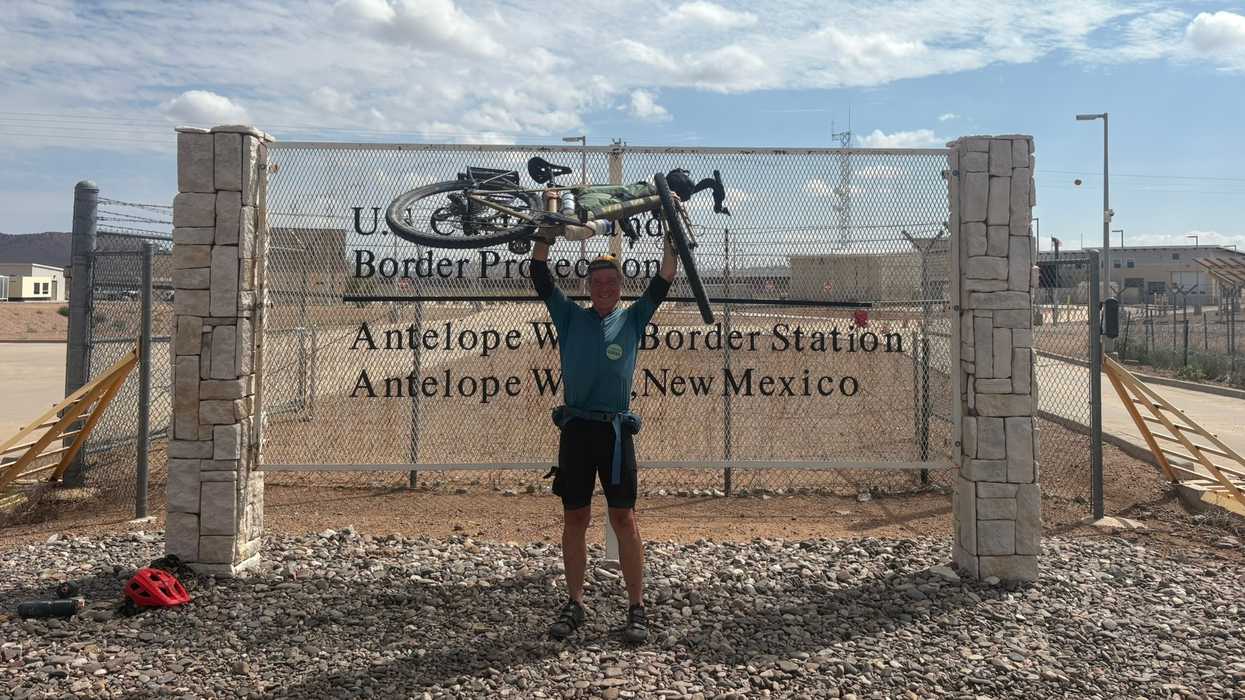
Alan Lovejoy, former teacher and current track and field coach at Housatonic Valley Regional High School, at the end of his international cycling journey.

Provided

SALISBURY — Last summer, local cyclist Alan Lovejoy pushed far beyond familiar Northwest Corner roads, embarking on a 2,700-mile international bike trek that took him from the Canadian Rockies to the U.S.–Mexico border.

Lovejoy set out to complete the Great Divide Mountain Bike Route, the longest off-pavement cycling route in the world. The trail begins in Alberta, Canada, and ends in Antelope Wells, N.M., tracing the Continental Divide through two Canadian provinces — Alberta and British Columbia — and five U.S. states: Montana, Idaho, Wyoming, Colorado and New Mexico.

On July 31, 2025, Lovejoy, a resident of Amesville and a retired teacher at the Housatonic Valley Regional High School, rode out from the northern terminus. Seventy days later, on Oct. 9, he crossed the finish point in Antelope Wells, completing the journey, which draws cyclists from across the globe.
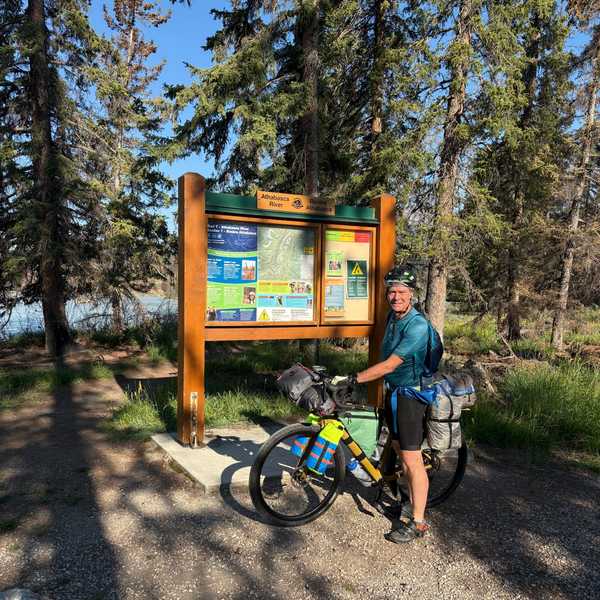
Alan Lovejoy at the start of his international cycling journey. Provided

The combination of long-distance cycling and camping is known as “bikepacking,” which requires riders to strap gear directly to their bikes and improvise overnight accommodations. Campsites ranged from forest service campgrounds to right beside an interstate highway.

Lovejoy had sampled the route in 2016, when he completed a section of it with a friend, and said that experience made planning for the full ride relatively straightforward.

Packing, he said, required strict discipline: only multi-functional items that could compress to a small size were brought along. In addition to his gear, Lovejoy carried a journal, making a point to write at least a few sentences each day to document the journey.

For the first seven days, Lovejoy rode alone. After the first week, he met cyclists from England, the Netherlands, Germany and New Zealand. A community formed among these strangers, who then went on to spend days and sometimes weeks together.

Each morning over breakfast, plans were made about where they would camp the following night and subsequently how many miles that day would entail. While weather conditions were a factor, most days entailed an average of 50 miles.

Time on the route was split, riding for seven to 10 days at a time, followed by one rest day in a nearby town to grocery shop, do laundry and enjoy a meal other than packaged tuna and rice.

The majority of the route, around 2,100 miles, is comprised of unpaved roads, meaning the weather played a large role in the condition of cycling. Using paper maps and GPS apps, Lovejoy was able to navigate around trails that were unsafe or poorly maintained if rain had fallen the night before.

In New Mexico, the main challenge was what cyclists refer to as “peanut butter mud,” in which the traction on the road is sticky and can interfere with the mechanics of the bike.

For Lovejoy, New Mexico also brought the most exciting wildlife.

One morning, a fellow cyclist was met with a road full of tarantulas, a sight Lovejoy was on the hunt to see for himself. He experienced the first snowfall on Sept. 23, two weeks before reaching the U.S.-Mexico border.

Riding each day from sunrise to sunset with no music, Lovejoy relied on the scenic views around him to pass the time.

Now that the journey has been crossed off Lovejoy’s bucket list, plans for new routes have begun to emerge. In retirement he remains the track and field coach for HVRHS, and he stated his main consideration when planning future rides is that the timeline does not interfere with the high school track season.

Lovejoy challenges himself to ride 3,000 miles each year. In the Northwest Corner, his typical route takes him from Amesville to the Massachusetts state line and back.
Latest News

In remembrance:
Tim Prentice and the art of making the wind visible
In remembrance: Tim Prentice and the art of making the wind visible

There are artists who make objects, and then there are artists who alter the way we move through the world. Tim Prentice belonged to the latter. The kinetic sculptor, architect and longtime Cornwall resident died in November 2025 at age 95, leaving a legacy of what he called “toys for the wind,” work that did not simply occupy space but activated it, inviting viewers to slow down, look longer and feel more deeply the invisible forces that shape daily life.

Prentice received a master’s degree from the Yale School of Art and Architecture in 1960, where he studied with German-born American artist and educator Josef Albers, taking his course once as an undergraduate and again in graduate school.In “The Air Made Visible,” a 2024 short film by the Vision & Art Project produced by the American Macular Degeneration Fund, a nonprofit organization that documents artists working with vision loss, Prentice spoke of his admiration for Albers’ discipline and his ability to strip away everything but color. He recalled thinking, “If I could do that same thing with motion, I’d have a chance of finding a new form.”

Keep ReadingShow less
Laurie Fendrich and Peter Plagens:
A shared 
life in art 
and love

Laurie Fendrich and Peter Plagens at home in front of one of Plagens’s paintings.

Natalia Zukerman
He taught me jazz, I taught him Mozart.
Laurie Fendrich

For more than four decades, artists Laurie Fendrich and Peter Plagens have built a life together sustained by a shared devotion to painting, writing, teaching, looking, and endless talking about art, about culture, about the world. Their story began in a critique room.

“I came to the Art Institute of Chicago as a visiting instructor doing critiques when Laurie was an MFA candidate,” Plagens recalled.

Keep ReadingShow less
google preferred source

Want more of our stories on Google? Click here to make us a Preferred Source.

Strategic partnership unites design, architecture and construction

Hyalite Builders is leading the structural rehabilitation of The Stissing Center in Pine Plains.

Provided

For homeowners overwhelmed by juggling designers, architects and contractors, a new Salisbury-based collaboration is offering a one-team approach from concept to construction. Casa Marcelo Interior Design Studio, based in Salisbury, has joined forces with Charles Matz Architect, led by Charles Matz, AIA RIBA, and Hyalite Builders, led by Matt Soleau. The alliance introduces an integrated design-build model that aims to streamline the sometimes-fragmented process of home renovation and new construction.

“The whole thing is based on integrated services,” said Marcelo, founder of Casa Marcelo. “Normally when clients come to us, they are coming to us for design. But there’s also some architecture and construction that needs to happen eventually. So, I thought, why don’t we just partner with people that we know we can work well with together?”

Keep ReadingShow less
‘The Dark’ turns midwinter into a weeklong arts celebration

Autumn Knight will perform as part of PS21’s “The Dark.”

Provided

This February, PS21: Center for Contemporary Performance in Chatham, New York, will transform the depths of midwinter into a radiant week of cutting-edge art, music, dance, theater and performance with its inaugural winter festival, The Dark. Running Feb. 16–22, the ambitious festival features more than 60 international artists and over 80 performances, making it one of the most expansive cultural events in the region.

Curated to explore winter as a season of extremes — community and solitude, fire and ice, darkness and light — The Dark will take place not only at PS21’s sprawling campus in Chatham, but in theaters, restaurants, libraries, saunas and outdoor spaces across Columbia County. Attendees can warm up between performances with complimentary sauna sessions, glide across a seasonal ice-skating rink or gather around nightly bonfires, making the festival as much a social winter experience as an artistic one.

Keep ReadingShow less
Tanglewood Learning Institute expands year-round programming

Exterior of the Linde Center for Music and Learning.

Mike Meija, courtesy of the BSO

The Tanglewood Learning Institute (TLI), based at Tanglewood, the legendary summer home of the Boston Symphony Orchestra, is celebrating an expanded season of adventurous music and arts education programming, featuring star performers across genres, BSO musicians, and local collaborators.

Launched in the summer of 2019 in conjunction with the opening of the Linde Center for Music and Learning on the Tanglewood campus, TLI now fulfills its founding mission to welcome audiences year-round. The season includes a new jazz series, solo and chamber recitals, a film series, family programs, open rehearsals and master classes led by world-renowned musicians.

Keep ReadingShow less
google preferred source

Want more of our stories on Google? Click here to make us a Preferred Source.

google preferred source

Want more of our stories on Google? Click here to make us a Preferred Source.