Photographs That Are Lovely, Dark and Deep
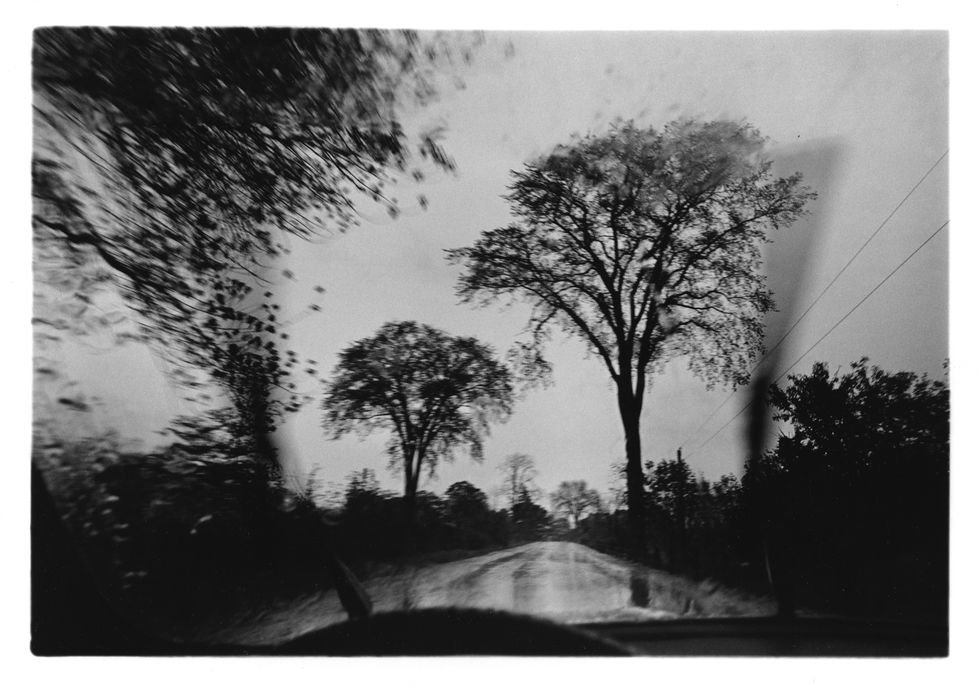
“Elm Street, 1978, Oblong Valley,CT”
Photo by Tom Zetterstrom


It’s easy to take Tom Zetterstrom of North Canaan, Conn., for granted. He’s always there, working hard to protect the trees of our landscape (especially the elms). He doesn’t really ask for our help, he just …gets to it.
What he does ask for, however, is that we notice. That we notice the beauty around us, especially the beauty of the trees. And that we notice threats to those trees, notably the non-native invasive plants that choke them and make our roadsides and forests a) unsightly and b) unhealthy and c) a haven for disease-bearing ticks.
To help us see what we might otherwise miss, Zetterstrom tirelessly visits all our area towns and offers workshops on how to stop the spread of Japanese knotweed, or whatever is the most aggressive interloper in any given year.
But he helps us notice in another way: Zetterstrom is an award-winning photographer whose work is not only in many museum and private collections, it’s also in the Library of Congress. His photos are of (yes) trees.
That his work has earned so many accolades will clue you in to their beauty. The images are black-and-white silver gelatin prints, shot on a film camera, soft focus and ghostly. They make you understand what the druids meant when they said that spirits live in trees.
The photos are usually in black and white, usually soft and glowy, always haunting. Someone described them recently as being shot “in portrait mode,” with the background softened to the point where it seems to disappear.
For those of us who know Zetterstrom but perhaps have never seen his photographs, for those who already admire the beauty of the trees around us (in forests, in parking lots, on historic town greens) and want to see them get the loving artistic treatment they deserve, there is a show of his work opening Friday, Sept. 17, at the Berkshire Botanical Garden’s Leonhardt Galleries. There will be an opening reception from 5 to 7 p.m. There are 36 of his images in Portraits of American Trees.
In addition to the gallery show, Zetterstrom will also offer three talks on the art of tree photography, on Sundays Sept. 19 at 1 p.m. and Oct. 10 and 24 at 11 a.m.
And of course, because he is as passionate about protecting trees as he is about creating beautiful images of them, he will offer four talks in a series called Whose Woods These Are: Defeating Japanese Knotweed on the Wild and Scenic Housatonic River on Sept. 25 from 10 to 11 a.m.; History and Preservation of the American Elm in New England on Oct. 2 from 3:30 to 5 p.m.; Defeating Oriental Bittersweet and Protecting Standing Forests on Oct 9 from 11 a.m. to 1 p.m. (there will be a cut-and-treat workshop along with the talk); and Pruning Young Elms, designed for arborists, tree wardens, horticulturalists, and the public on Oct. 30 from 10 a.m. to noon (again, the talk is followed by a hands-on workshop).
To find out more and to get directions, go to www.berkshirebotanical.org.
Crews work on a broken water main on the town Green in Sharon on Sunday, Feb. 1.
SHARON — A geyser erupted on the town Green Friday afternoon, Jan. 30, alerting officials to a water main break in the adjacent roadway. Repair crews remained on site through the weekend to fix the damaged line.
About 15 nearby homes lost water service Friday while crews made repairs. Water was restored by Sunday afternoon. The water system is overseen by the town’s Sewer and Water Commission.
With temperatures dipping to the single digits Sunday afternoon, Williston Case of W.B. Case Plumbing & Heating of Sharon oversaw the repairs. He explained that two pipes run side by side — one dating back to 1941 and the other significantly older. After searching for the source of the leak, crews determined the newer pipe had cracked, causing water to bubble out of the ground.
Case said crews were on site Friday night, but it wasn’t until Saturday that the leak was located. The road had to be excavated to a depth of about four to five feet. His crew worked throughout Saturday, and on Sunday, Gallagher Construction of Brewster, New York, joined the effort.
Company owner Chuck Gallagher said his firm specializes in water mains and often assists other contractors with difficult breaks.
“This pipe is an odd size,” Gallagher said, adding that the repair was complicated further by a large rock above the pipe that had to be blasted.
The initial plan was to wrap a sleeve around the damaged pipe, but the unusual pipe size made that approach unworkable.
First Selectman Casey Flanagan said that of the 15 affected dwellings, one was an apartment building with multiple units. On Upper Main Street, the outage extended from the road by the Green to Sharon Methodist Church. On Main Street, it stretched from near West Main Street to the cemetery.
Flanagan said water was delivered to affected households by members of the Sharon Volunteer Fire Department. Residents were also able to refill containers at the firehouse and were offered access to showers at the firehouse, Sharon Hospital and a building owned by the Sharon Playhouse.
Steve Szalewicz, chairman of the Sewer and Water Commission and an affected homeowner, said about 30 of the commission’s 380 customers were impacted. Water testing confirmed there was no contamination.
“The town came together,” Szalewicz said, noting gestures of assistance from various organizations. “It’s a 150-year-old system, so some things break. But we haven’t had a major break in 15 years.”
When water service was restored Sunday afternoon, Flanagan thanked the plumbing companies, the fire department, the Sewer and Water Commission, and Mark Sweeny of V.R.I. Environmental Services for working through harsh conditions, as well as residents “for their patience.”
John Harney, president of the Salisbury Housing Trust, presents Jocelyn Ayer, executive director of the Litchfield County Centers for Housing Opportunity, center, and U.S. Rep. Jahana Hayes, 5th District, with local maple syrup. Hayes was in Salisbury Thursday to tour one of the trust’s latest houses on Perry Street.
SALISBURY — Congresswoman Jahana Hayes (D-5) admired the kitchen cabinets, the sunlight streaming through the large windows and an airy room well suited for flexible living space.
She toured the new affordable home at 17 Perry St. on Thursday, Jan. 29. The house, recently completed by the Salisbury Housing Trust, is awaiting a family to call it home. The modular home is one of four erected in Salisbury through the Litchfield County Center for Housing Opportunity’s Affordable Homeownership Program for scattered sites. Houses were also built in Norfolk, Cornwall and Washington.
Jocelyn Ayer, director of the center, joined members of the housing trust and First Selectman Curtis Rand in welcoming Hayes and explaining how the project came together. Rand said the property was the site of a dry-cleaning establishment located in the center of a residential area. “It was owned by two people who walked away from it. It took 15 years before we took the initiative to do something. We didn’t want to foreclose until we were sure we had someone to share in the cleanup.”
That partner was the state Department of Economic and Community Development, which provided a grant. Once the contamination was abated, a process that took five years, the town gave the property to the trust.
Hayes commended the town, saying, “I’m surprised you took the risk.”
Ayer said the critical pieces in making the project happen were the town donating the land and the Planning and Zoning Commission approving two homes on the Perry Street lot. She also thanked Hayes for her support in securing some federal funding toward the project.
“Other towns are jealous of the support we have here,” Ayer told Hayes, which includes help from the town, state and federal government.

Each of the houses costs $250,000. The trust retains the land on which they sit. The cost to build each house was $500,000, said Ayer. So far, two of the four Salisbury homes are occupied. Those eligible must be first-time homeowners.
Heat is provided by mini-split units in each room. The houses run on electricity and Ayer said the trust is exploring solar options. “We have $40,000 for each house, but we’re having a hard time getting bids near that.”
Jennifer Kronholm Clark, vice president of the trust, described the families who are already occupying the two houses. Just next door at 19 Perry St. is a young family with two children, one born recently. The mother grew up in Salisbury and “this is a wonderful opportunity for her to raise her children where she was raised. It’s a beautiful story.”
The family in one of the Undermountain Road houses has three boys who are thrilled to have a playground practically in their front yard, said John Harney, president of the trust. When the town conveyed that parcel, it stipulated that the existing playground remain.
Even with the $250,000 price tag, which is considered affordable in today’s housing market, Ayer said there has been a lot of interest expressed, but many just cannot afford to buy because they are unable to secure a mortgage. Hayes noted the guidelines have to be adjusted, adding that while affordable housing has always been an issue, “it’s getting to the top of the priority list.”
She lauded Ayer for all the work she does to promote affordable housing, telling her “You have a great vision. I’ll keep going to bat for you. I’ll keep trying to get federal money.”
As she was about to leave, Hayes was presented by Harney with what he called “liquid gold” — maple syrup made by Dolores and Champ Perotti of East Canaan. He also had a bottle for Ayer.
Those who may be interested in applying for the homeownership program should contact Ayer at 203-579-3180.
A judge recently dismissed one lawsuit tied to the proposed redevelopment, but a separate court appeal of the project’s approval is still pending.
LAKEVILLE — A Connecticut Superior Court judge has dismissed a lawsuit filed against Salisbury’s Planning and Zoning Commission challenging a zoning amendment tied to the controversial expansion of the Wake Robin Inn.
The case focused on a 2024 zoning regulation adopted by the P&Z that allows hotel development in the Rural Residential 1 zone, where the historic Wake Robin Inn is located. That amendment provided the legal basis for the commission’s approval of the project in October 2025; had the lawsuit succeeded, the redevelopment would have been halted.
The decision, issued Jan. 29 by the Superior Court in Torrington, rejected a claim brought by Wells Hill Road residents Angela and William Cruger seeking to nullify the amendment. The Crugers filed the lawsuit in March 2025, arguing the regulation was improperly adopted and amounted to illegal spot zoning intended to benefit the project’s developer, Aradev LLC.
The zoning amendment drew scrutiny when it was adopted, with opponents asserting it was crafted specifically to enable the Wake Robin Inn project. Town officials and land use staff, however, repeatedly said the change was years in the making and intended to address zoning nonconformities affecting historic inns throughout Salisbury.
In a memorandum of decision, the court found the plaintiffs failed to meet their burden of proof that proper notification was lacking. The judge wrote that “a close examination of the record” showed the Crugers did not demonstrate that public notice of the zoning change was procedurally deficient, unduly vague or untimely filed.
The dismissed case is the first of two legal challenges filed by the Crugers related to the Wake Robin Inn redevelopment. A second lawsuit — an appeal of the P&Z’s approval of Aradev’s application to redevelop and expand the inn — remains pending before the court.
Former Planning and Zoning Commission Chair Michael Klemens said that Thursday's ruling brought vindication. In a Jan. 30 email to the P&Z and commission attorney Charles Andres, Klemens said the lawsuit was largely based on claims that he and Land Use Director Conroy had misled the public and the commission during the regulatory process.
“So not only are the regulations recognized by the Superior Court as legally adopted,” Klemens wrote, “but the aspersions cast upon the integrity of staff and your immediate past chair are hopefully finally put to rest.”
Andres informed the Land Use Office and current P&Z Chair Cathy Shyer that the Crugers have 20 days to challenge the court’s ruling.
Under the approved plan, Aradev would redevelop the Wake Robin Inn to include a new detached 2,000-square-foot cabin, event space, a sit-down restaurant and fast-casual counter, as well as a spa, library, lounge, gym and seasonal pool. If built, the project would increase the number of guest rooms from 38 to 54.
Olana State Historic Site, the hilltop home created by 19th-century Hudson River School painter Frederic Edwin Church, rises above the Hudson River on a clear winter afternoon.
On a recent mid-January afternoon, with the clouds parted and the snow momentarily cleared, I pointed my car northwest toward Hudson with a simple goal: to get out of the house and see something beautiful.
My destination was the Olana State Historic Site, the hilltop home of 19th-century landscape painter Frederic Edwin Church. What I found there was not just a welcome winter outing, but a reminder that beauty — expansive, restorative beauty — does not hibernate.
2026 marks the 200th anniversary of Church’s birth, making this a particularly timely moment to take in what he created during his lifetime. Church — one of the most notable artists of the Hudson River School movement — was an accomplished landscape painter who gained a reputation as an artist-traveler.
From South America and Western Europe to the Middle East and the Caribbean, Church sought out dramatic, epic scenes that he could capture on canvas and bring back to the U.S. to sell. The profits from those works, in turn, allowed him to create a breathtaking masterwork of his own: Olana.
Olana rises above the Hudson River like a mirage, its Persian-inspired facade an unexpected sight amid the barren winter landscape. With miles of trails, visitors can take in the natural splendor of rolling hills and the river from every angle. From the house itself, the view stretches across the Catskills, a layered panorama of soft blues and silvers that appears all the more dazzling in winter.

Inside the home, the sense of awe deepens. Olana’s interior is rich with color, pattern and texture — warm reds, stenciled walls, intricate woodwork — a striking counterpoint to the monochrome world outside. Light pours through tall windows, framing the Hudson Valley like living paintings.
Every corner of the house pays tribute to the far-flung places Church visited throughout his career. From architectural details to the objects he collected and displayed, visitors are transported to another world. Walking from room to room feels less like touring a house museum and more like stepping into the mind of an artist transfixed by the staggering beauty of the world around him.
As I made my way back down the hill, the winter light fading fast, I felt refreshed in a way that only comes from seeing something anew. Olana is not just a monument to one artist, but a testament to a way of viewing the world — one that values observation, patience and reverence for the natural environment. For those looking to venture out during the colder months and to be reminded why this region has inspired generations of artists and dreamers, there may be no better place to start than Olana.
Olana State Historic Site is located at 5720 State Route 9G, Hudson, New York. For more information and to purchase tours, visit: olana.org