Weeding Out the Walk-In

Weeding Out the Walk-In
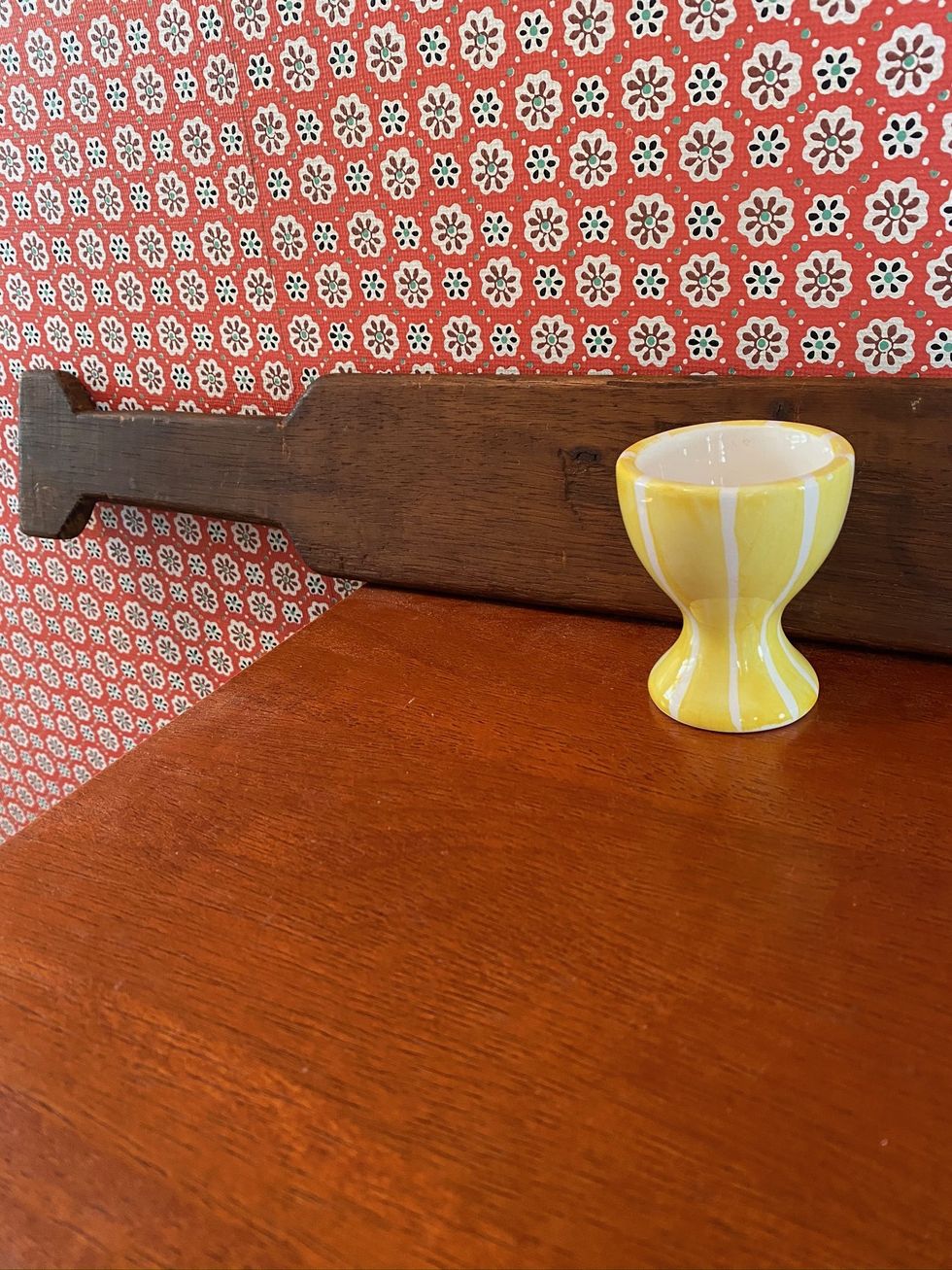
Who knows what treasures lurk in the back of your closet? Perhaps a pledge paddle and a giant egg cup … 
Photo by Leila Hawken

The fall season inspires many of us to tackle tasks in home spaces holding essential and non-essential stuff that has built up over the summer, or longer. Take, for example, a walk-in closet that has become a stretch-to-reach-in closet with various objects blocking the way.

It is time for a fall clean-out of that closet. So, I invite you and others to undertake the task along with me. I have selected the dining room closet. 

It was intended to be the guest coat closet, but reality dictates that it needs to harbor lots of other stuff.

First, open the door and have a look. OK. Five old golf clubs with wooden shafts; four still have their original leather hand grips; one is a brass putter. Six umbrellas; good condition. Two are short and collapsible, and there’s one collapsible pink one that I’ve never seen before. It’s not mine.

Moving ahead, I find my father’s 1920-ish pledge paddle for Theta Xi fraternity at Carnegie Tech in Pittsburgh, signed by fellow pledges and some members. Should keep that.

As I feared would be the case, half of the coat racks are taken up with outer clothing left behind by a wily New York City apartment-dweller who has gradually encroached on my household closet space, using it as free storage. Came heavy laden and departed with lighter luggage.

Continuing on, I discover a small-ish box labeled “Miscellaneous Non-Essentials.” This is an interesting box that has not been opened for eight years.

What’s in the box? Well, let’s see. A linen kitchen apron from the Dominican Republic: not essential, but useful. 

An unused 1963 business diary from the Acme Wire Company in New Haven, Conn.  In addition to useful calendar and appointment pages, it offers advice on chemical properties and even stain removal and First Aid. It advises on what to do if someone nearby has been struck by lightning: Simply throw water on the victim. To me, that seems like a bad idea.

Three packages of colorful clothespins will definitely be useful, even essential. A yellow egg cup. A packet of linen mailing envelopes. My initials in huge wooden letters. An extension cord. An extension outlet. Two packets of whimsical kitchen magnets. A partial packet of Christmas cards.

For fall clean-up of closets, experts use words like weeding and purging. As I survey my closet during this fall season, and now that I look over the dining room table cluttered with this assortment of non-essentials, I understand the concept of weeding.

And, then, even better is the prospect of actually walking into my walk-in closets. The experts are correct.

Latest News

Classifieds - February 26, 2026

Classifieds - February 26, 2026

Help Wanted

PART-TIME CARE-GIVER NEEDED: possibly LIVE-IN. Bright private STUDIO on 10 acres. Queen Bed, En-Suite Bathroom, Kitchenette & Garage. SHARON 407-620-7777.

The Salisbury Association’s Land Trust seeks part-time Land Steward: Responsibilities include monitoring easements and preserves, filing monitoring reports, documenting and reporting violations or encroachments, and recruiting and supervising volunteer monitors. The Steward will also execute preserve and trail stewardship according to Management Plans and manage contractor activity. Up to 10 hours per week, compensation commensurate with experience. Further details and requirements are available on request. To apply: Send cover letter, resume, and references to info@salisburyassociation.org. The Salisbury Association is an equal opportunity employer.

Keep ReadingShow less
google preferred source

Want more of our stories on Google? Click here to make us a Preferred Source.

To save birds, plant for caterpillars

Fireweed attracts the fabulous hummingbird sphinx moth.

Photo provided by Wild Seed Project

You must figure that, as rough as the cold weather has been for us, it’s worse for wildlife. Here, by the banks of the Housatonic, flocks of dark-eyed juncos, song sparrows, tufted titmice and black-capped chickadees have taken up residence in the boxwood — presumably because of its proximity to the breakfast bar. I no longer have a bird feeder after bears destroyed two versions and simply throw chili-flavored birdseed onto the snow twice a day. The tiny creatures from the boxwood are joined by blue jays, cardinals and a solitary flicker.

These birds will soon enough be nesting, and their babies will require a nonstop diet of caterpillars. This source of soft-bodied protein makes up more than 90 percent of native bird chicks’ diets, with each clutch consuming between 6,000 and 9,000 caterpillars before they fledge. That means we need a lot of caterpillars if we want our bird population to survive.

Keep ReadingShow less
Stephanie Haboush Plunkett and the home for American illustration

Stephanie Haboush Plunkett

L. Tomaino
"The field of illustration is very close to my heart"
— Stephanie Plunkett

For more than three decades, Stephanie Haboush Plunkett has worked to elevate illustration as a serious art form. As chief curator and Rockwell Center director at the Norman Rockwell Museum in Stockbridge, Massachusetts, she has helped bring national and international attention to an art form long dismissed as merely commercial.

Her commitment to illustration is deeply personal. Plunkett grew up watching her father, Joseph Haboush, an illustrator and graphic designer, work late into the night in his home studio creating art and hand-lettered logos for package designs, toys and licensed-character products for the Walt Disney Co. and other clients.

Keep ReadingShow less
Free film screening and talk on end-of-life care
‘Come See Me in the Good Light’ is nominated for best documentary at this year’s Academy Awards.
Provided

Craig Davis, co-founder and board chair of East Mountain House, an end-of-life care facility in Lakeville, will sponsor a March 5 screening of the documentary “Come See Me in the Good Light” at The Moviehouse in Millerton, followed by a discussion with attendees.

The film, which is nominated for best documentary at this year’s Academy Awards, follows the poet Andrea Gibson and their partner Megan Falley as they are suddenly and unimaginably forced to navigate a terminal illness. The free screening invites audiences to gather not just for a film but for reflection on mortality, healing, connection and the ways communities support one another through difficult life transitions.

Keep ReadingShow less
google preferred source

Want more of our stories on Google? Click here to make us a Preferred Source.

google preferred source

Want more of our stories on Google? Click here to make us a Preferred Source.