Connecticut wildlife expert debunks myths about fishers

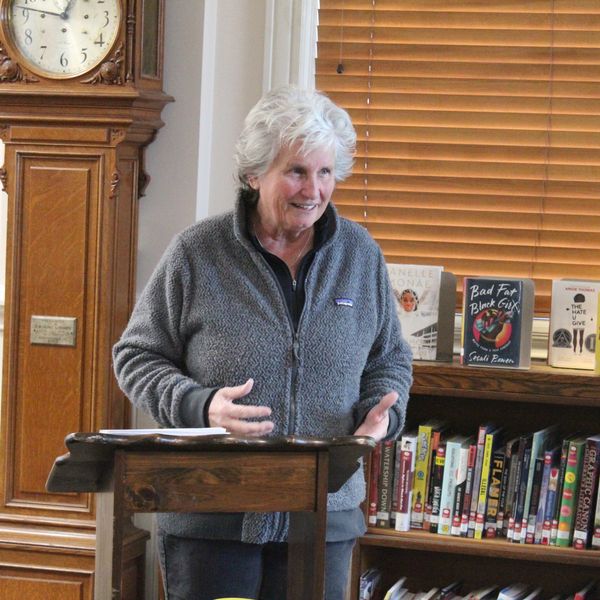
Wildlife expert Ginny Apple delivers talk about the commonly misunderstood fisher in Norfolk, May 2.
Patrick L. Sullivan

Wildlife expert Ginny Apple delivers talk about the commonly misunderstood fisher in Norfolk, May 2.
NORFOLK — A “fisher cat” is neither a cat nor the source of nighttime screeching sometimes heard in rural Connecticut.
Those were two takeaways from wildlife expert Ginny Apple’s talk at the Norfolk Hub Saturday, May 2, titled, “Fishers: Connecticut’s Stealth Hunter.”
Apple, a Master Wildlife Conservationist with the Connecticut Department of Energy and Environmental Protection, frequently delivers presentations in Northwest Connecticut towns.
The fisher’s range runs from the Canadian Rockies to the Atlantic, in parts of Northern California, and in New England, Apple said. She estimates 100,000 exist today, a little under 100 in the state, and only half a dozen or so in northwest Connecticut.
Apple corrected common misconceptions, noting that a fisher is a member of the weasel family —not a cat.
The hair-raising screams people hear at night — often attributed to the non-existent “fisher cat” — are almost always from red foxes, Apple said.
The fisher is the rare Connecticut predator that will take on a porcupine, however.
Fishers are skilled and silent hunters and only let their guard down at night when they are relaxing in a tree.
“Then they make a little chortling sound, which you won’t hear unless you’re under the tree,” Apple said.
Pekania pennanti, the official name of the fisher cat, is the second largest weasel species in the state, next to the river otter.
Fishers can rotate their hind feet, which allows exceptional mobility in trees. Apple said they are just as nimble in trees as squirrels.
They are carnivorous omnivores, meaning they prefer meat and will go to considerable effort to find it.
Males can weigh up to 18 pounds and get to be between 35-47 inches long – including their tail. Females are roughly half the size.
Fishers live up to 12 years in ideal circumstances. This does not include Connecticut, Apple said.
“We’ve got a lot of roadkill and rodenticide poisoning,” she said.
On the latter, Apple said the use of rodenticide for rat and mouse control is troublesome because the poisoned rodents get eaten by predators – including fishers – who in turn get sick.
She urged attendees to use traditional snap mousetraps or “Hav-A-Hart” no-kill traps, which come in mouse dimensions.
DEEP is currently conducting a study of fishers using electronic collars to determine why they prefer the northeastern part of the state. Apple asked the audience to call DEEP at 860-424-3211 or email deepFisherSightings@ct.gov with any sightings or roadkill reports.
Matthew Kreta
New Sharon Playhouse logo designed by Christina D’Angelo.
The Sharon Playhouse has unveiled a new brand identity for its 2026 season, reimagining its logo around the silhouette of the historic barn that has long defined the theater.
Sharon Playhouse leadership — Carl Andress, Megan Flanagan and Michael Baldwin — revealed the new logo and website ahead of the 2026 season. The change reflects leadership’s desire to embrace both the Playhouse’s history and future, capturing its nostalgia while reinventing its image.
After attending the closing performance of the Playhouse’s production of The Mousetrap last September, Christina D’Angelo told Playhouse leadership she was “completely changing her design direction” for the new logo after experiencing the work and atmosphere of the Sharon Playhouse firsthand. She incorporated the barn silhouette to capture the theater campus’s history and evoke the warmth and magic of the Playhouse.
“The barn gives a fixed image of how we all feel about the Playhouse,” said Megan Flanagan, managing director. “The new branding presents the story of the great history of Sharon Playhouse — who we were, who we are today, who we are becoming — and the barn is that unifying element.”
The design was one of several options presented and was selected unanimously by Playhouse leadership. D’Angelo also designed this season’s branding, creating a visual throughline for the 2026 season.
The Playhouse remains committed to its taglines and mission statements, “Create. Community. Together.” and “Your destination for the arts.” While those phrases are no longer reflected in the logo itself, Carl Andress, artistic director, said the organization is not moving away from them and that they will continue to appear in publications and on the updated website.
“The refreshed brand aims to shift the narrative in the community, reinforcing the Playhouse’s role not only as a theater but as a vibrant gathering place and artistic home,” Playhouse leadership said in a press release.
For more information, including a video about the updated logo and details on the upcoming 2026 season, visit sharonplayhouse.org
Patrick L. Sullivan
Gary Dodson demonstrated the two-handed switch rod cast on the Schoharie Creek on April 18. The author failed to learn said cast.
The last time I tried fishing in the Catskills, in the fall of 2025, I had to stop pretty abruptly when it became apparent my hip was not going to cooperate.
So it was with considerable trepidation that I waded across a stretch of the “Little Esopus” that turned out to be a little bit deeper and a tad more robust than I thought.
This was on Thursday, April 16.
The Esopus is a tailwater, meaning cold water comes out of a dam and supplies the river with regular infusions of cold water that is good for trout.
But it is an unusual tailwater, in that the added flow comes out of the Schoharie Reservoir in Greene County and travels 18 miles through a pipe running under a considerable chunk of mountains and empties into the Esopus in the hamlet of Allaben.
This is officially known as “Diversion from Schoharie Reservoir” or the “Shandaken Tunnel.” In practice it is called “the Portal.”
Between the Portal and the Ashokan Reservoir about 13 miles downstream the Esopus is a big brawling trout river, roughly the same size as the Housatonic. Upstream of the Portal the Esopus is a medium-sized to small freestone stream. Hence “Little Esopus.”
My compatriot Gary Dodson and I were messing around on the “Little” section a couple weeks ago.
The weather was summery. The water temperature was 58 degrees F, about ideal.
The forsythia was blooming everywhere, and that usually means the first significant mayfly hatch of the year, the one imitated by the Hendrickson fly, is going on.
And I did see some Hendricksons floating around here and there.
But mostly I saw zip, except for when I spooked a couple of suckers.
Old joke: Suckers are often mistaken for brown trout. They tend to dive and tug like browns when hooked, adding to the illusion.
It’s only when one comes to the net that the angler feels like a sucker for being taken in. Again.
The day before, with high winds complementing the summer feel, we tried the Batavia Kill impoundment in Windham, where I attempted to crack the code on the two-handed rod cast.
I failed there and blamed it on the wind. So we went to the Schoharie, where legions of recently-stocked trout should have been eager to eat anything, and the wind wasn’t quite as bad.
I failed there too. This is going to take a while.
Meanwhile the usual Harry Homeowner opening up experience included a highly satisfactory lack of mice and their droppings, and a leaky hot water heater.
We’ve had the thing for about 50 years, so it’s hard to complain too much. Phil the Plumber installed a new one and we’re good for another 50 years.
The wading adventure described above felt a little hairy but I managed, and I found an easier place to cross on the return trip.
The new hip didn’t bother me at all. My thigh muscles were pretty sore the next day, though. Too much couch time over the bleak winter.
And while our rabbit population seems to have moved on, the resident deer were messing around on the lawn in the evenings. I like to sit outside reading and occasionally chirrup to them. They like to ignore me until they take fright for a mysterious deer reason and go bounding off into the woods.
Brian Gersten
The Mahaiwe Performing Arts Center in Great Barrington.
The Mahaiwe Performing Arts Center will light up the silver screen this summer with the return of “100 Years of Movies,” a beloved film series celebrating the enduring legacy of American cinema.
Now in its third consecutive year, the program blends entertainment with insight, as director and film scholar Deborah Reinisch introduces each screening with historical context, behind-the-scenes anecdotes and a deep appreciation for the craft of filmmaking.
This year’s series carries added resonance, aligning with the 250th anniversary of the signing of the Declaration of Independence. It also pays tribute to iconic performers whose careers shaped generations of moviegoers, including the late Robert Redford, Diane Keaton, Gene Hackman, Rob Reiner and Robert Duvall.
The series opens May 15 with “Bringing Up Baby” (1938), the quintessential screwball comedy starring Cary Grant and Katharine Hepburn. A week later, audiences can dive into the shadowy intrigue of “The Big Sleep” (1946), featuring Humphrey Bogart and Lauren Bacall.
Additional highlights include “All About Eve” (1950), starring Bette Davis; “North by Northwest” (1959), directed by Alfred Hitchcock; and the Oscar-winning thriller “The French Connection” (1971). Later in the summer, the series continues its journey through decades of filmmaking with canonical works such as “The Godfather” (1972) and “All the President’s Men” (1976).
With a thoughtfully curated lineup, “100 Years of Movies” offers both longtime cinephiles and casual viewers a chance to experience the films that have helped define American culture. As Reinisch notes, the series provides “a splendid way to explore our American experience,” one frame at a time.
Tickets are available at mahaiwe.org or through the Mahaiwe box office at 413-528-0100.

Want more of our stories on Google? Click here to make us a Preferred Source.
Bobby Graham & Matthew Marden
Savory onion pie
Each month, Dugazon owners Bobby Graham and Matthew Marden share a recipe inspired by the traditions, stories and sense of welcome at the heart of their shop in Sharon, Connecticut. Visit Dugazon at 19 W. Main St. Wednesday-Sunday, 11 a.m. to 5 p.m. and online at dugazonshop.com.
This savory pie is a delicious alternative to quiche or tomato pie (which we’ll share in the future). Bobby’s mother made a similar recipe, and it was a huge hit.
Ideal for breakfast, brunch or lunch entertaining. Serve hot with a crisp white wine and a crispy green salad. Great for groups. Yum!
Inspired by a recipe from Barbara Dugazon Graham
Yield: 6 to 8 servings
Ingredients
For the crust:
•1 cup crushed saltine crackers
•1/4 cup salted butter, melted
For the filling:
•2 cups thinly sliced onions
•1 clove garlic, finely chopped (optional)
•2 tablespoons salted butter
•1 cup milk
•2 large eggs
•1/2 teaspoon black pepper
•1 1/2 cups grated cheddar and Parmesan cheese
•5 dashes Tabasco sauce
•1/2 teaspoon Tony Chachere’s Cajun seasoning
•Leaves from 1 fresh thyme sprig, or 1/2 teaspoon Italian seasoning
•1 to 2 green onions, finely chopped, for garnish
Preparation
•Heat oven to 350 degrees. Place rack in center of oven.
•Make the crust: Combine cracker crumbs and melted butter. Press firmly into a 9-inch metal pie pan to form an even crust.
•In a skillet over low heat, melt 2 tablespoons butter. Add onions and cook, stirring occasionally, until softened and lightly caramelized, about 5 to 7 minutes. Add garlic, if using. Let cool slightly, then spread evenly over crust.
•In a large bowl, whisk together milk, eggs, black pepper, Tabasco, Cajun seasoning and thyme. Stir in cheese until well combined. Pour mixture over onions.
•Bake uncovered until golden and set, 45 to 60 minutes. Watch closely during final baking.
•Let cool 5 minutes. Sprinkle with green onions, slice and serve hot or at room temperature.
Notes: Pie can be frozen after assembly and baked later. A metal pie pan is recommended for best results.
Lakeville Journal
Support local food access during Tri Corner FEED’s second annual Nourish Neighbors, May 11–17, by dining and shopping at 18 participating businesses across the Northwest Corner and eastern Dutchess County, with donations benefiting the organization’s Food Sovereignty Fund. For a list of participating restaurants and businesses, visit tricornerfeed.org/nourishneighbors
Riley Klein
WINSTED – Northwestern Regional High School’s girls tennis team hosted Housatonic Valley Regional High School on Monday, April 27.
The series of singles and doubles matches unfolded beneath ideal tennis conditions: clear skies and a comfortable 62 degrees.
HVRHS came out on top with a team score of 4-3.
In the first singles match, Northwestern’s Keria Mann defeated Housatonic’s Victoria Brooks 6-1, 6-3.
Housatonic’s Eliana Lang won the second singles match 6-4, 6-3 against Northwestern’s Lauren Kacmarcik.

Housatonic’s Mia DiRocco won the third singles match 6-4, 1-6, 10-4 against Northwestern’s Willow Byrne.
Housatonic’s Mia Belter won the fourth singles match 6-4, 6-3 against Northwestern’s Mia Zuccaro.
In the first doubles match, Northwestern’s Ava Burrell and Jailyn Rosado defeated Housatonic’s Abby
Perotti and Kate Money 6-3,6-0.
Northwestern’s Hannah Burgo and Allison Cravanzola won the second doubles match 6-1, 6-1 against Housatonic’s Noell Laurry and Lydia Fleming.
Housatonic’s Tess Churchill and Lily McCabe won the third doubles match 6-2, 6-0 over Northwestern’sHarmini Thomas and Kylee Quach.

Want more of our stories on Google? Click here to make us a Preferred Source.

Want more of our stories on Google? Click here to make us a Preferred Source.